A customer sends you an OE number and asks for a brake lining. At first, the decision looks simple: quote the OEM product or find an aftermarket alternative. But for a commercial vehicle distributor, that is rarely where the real decision ends. The OEM product may be familiar and easy for the customer to accept, while an aftermarket brake lining can offer more flexibility in product coverage, pricing and branding. The problem is that a cheaper replacement is no bargain if it comes back with a fitment complaint, abnormal wear or a fleet customer asking why its maintenance interval suddenly changed.
For distributors handling dozens or hundreds of truck, trailer and bus references, OEM vs aftermarket brake linings is therefore less about deciding which category is universally better and more about balancing application, customer expectations, product coverage, inventory, margin and after-sales risk. The more useful question is: what vehicle is the lining going onto, how will that vehicle be used, and what happens to the distributor if the replacement turns out to be wrong?
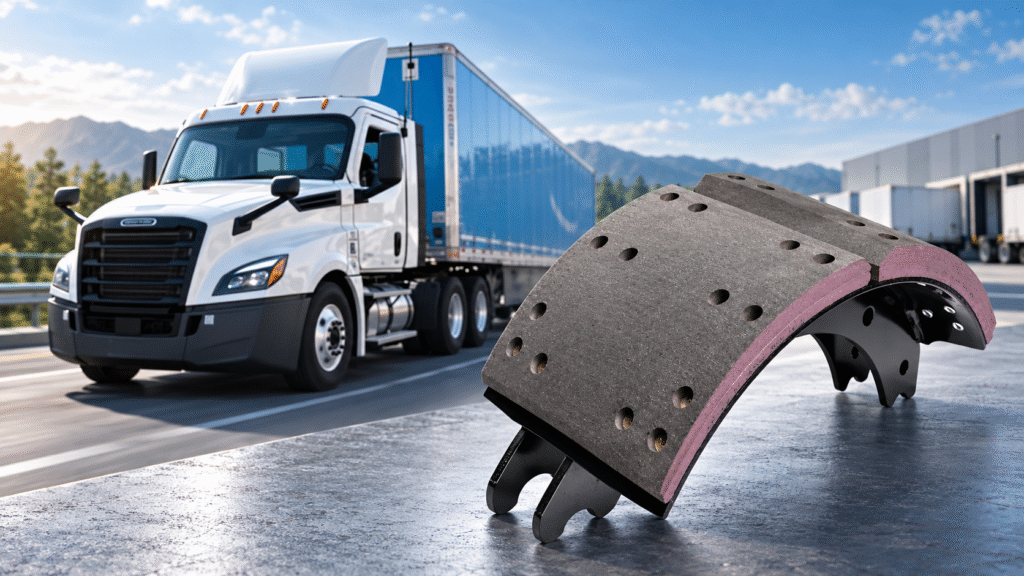
An OE Number Gets You to the Application—Not Automatically to OEM
An OE number is usually a very good place to start because it gives both the distributor and manufacturer a common reference. What it does not do is automatically turn every matching product into an OEM brake lining. An aftermarket brake lining can be developed for the same vehicle or brake application while remaining an aftermarket replacement, so “Fits OE XXXXX” and “OEM product” are two different claims.
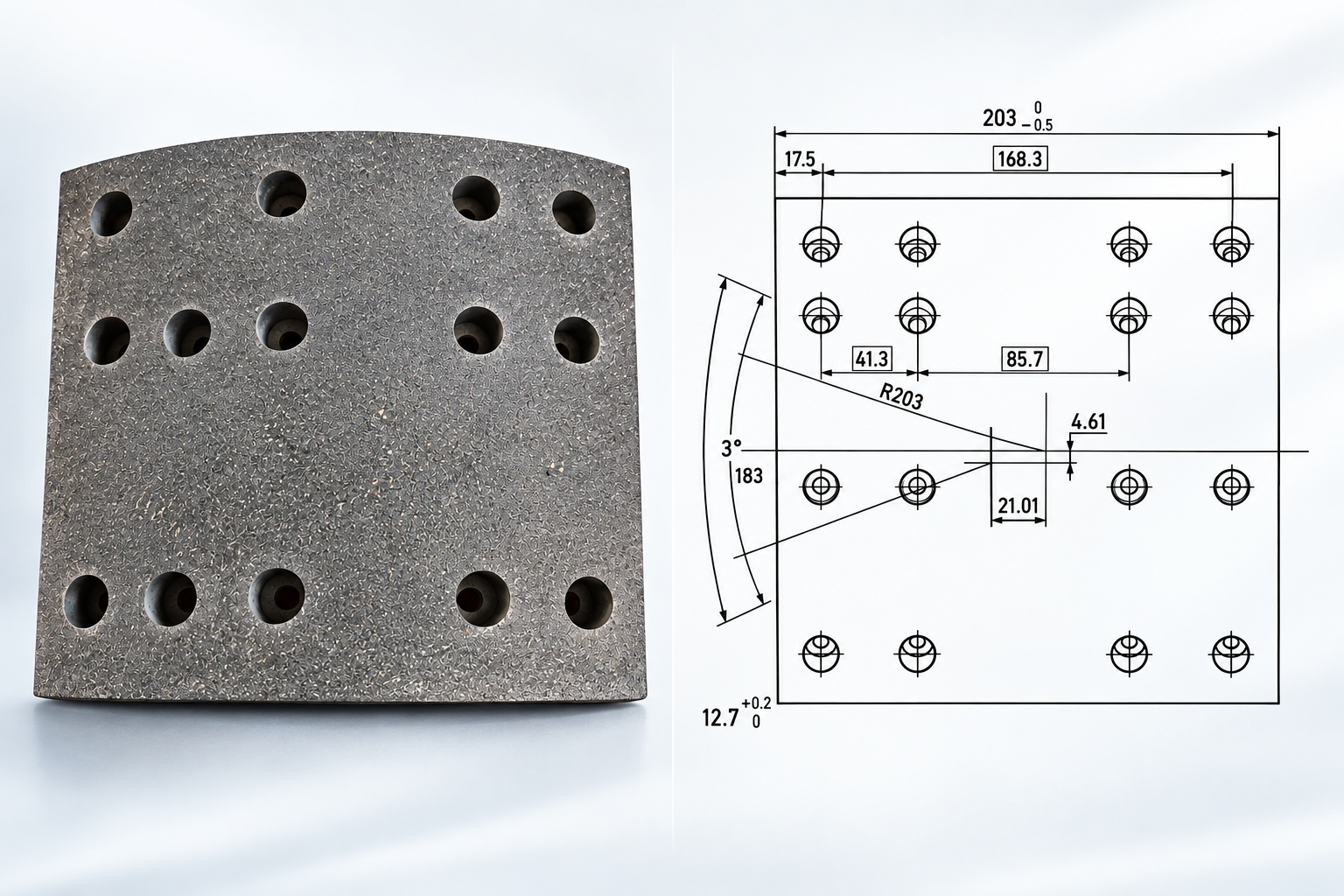
This distinction becomes more important as the order gets larger. When we receive a distributor list containing dozens or hundreds of references, we may use the OE number together with WVA or FMSI references, dimensions, lining profile, drilling pattern, brake-system information, drawings or samples. A cross-reference database helps narrow the product down, but it should not automatically be treated as proof that two products are completely interchangeable. The same distinction applies more broadly across OEM vs aftermarket brake products, particularly when buyers are comparing replacement products across several commercial vehicle applications.
UN Regulation No. 90 also distinguishes original replacement parts from replacement brake lining assemblies and drum brake linings within its regulatory framework. For distributors selling into markets where R90 applies, this reinforces the same practical point: identify the application first, then confirm exactly what product is being supplied. For a closer look at how the regulation applies to replacement friction products, our ECE R90 requirements guide covers its scope, commercial vehicle categories and testing considerations in more detail.
OEM Makes Sense When the Customer Is Really Buying the Brand
There are many situations where supplying the OEM brake lining is still the straightforward answer. If the fleet has an approved product list, the maintenance contract specifies an OE part, or the customer explicitly asks for the original brand, there may be little reason to move the conversation toward aftermarket. In those cases, the buyer is not only purchasing friction material; they are also buying an established product identity, a known specification and the confidence that comes from staying with something already accepted in their maintenance system.
That has commercial value for the distributor as well. There is less need to explain a new product, arrange additional evaluation or persuade an existing fleet customer to change something that is already working. OEM products can therefore deserve a permanent place in the range where the market clearly asks for them. The mistake is not carrying OEM; the mistake is assuming that because OEM makes sense for those customers, it must also be the best sourcing route for every replacement application.
The situation changes quickly when a distributor supports several vehicle platforms. A single business may be supplying European and Asian heavy trucks alongside buses and trailer brake systems, while also supporting both newer vehicles and older fleets. Once the customer base becomes that broad, application coverage starts to matter almost as much as brand recognition.
Aftermarket Starts to Matter When Your Product Range Gets Bigger
Aftermarket becomes much more useful when a distributor is no longer supporting one vehicle brand or one service channel. Some customers operate new trucks, while others may still be maintaining vehicles that have been on the road for ten or fifteen years. Some insist on OE brands, while others simply need the correct heavy duty truck brake lining at a workable price with reliable availability.
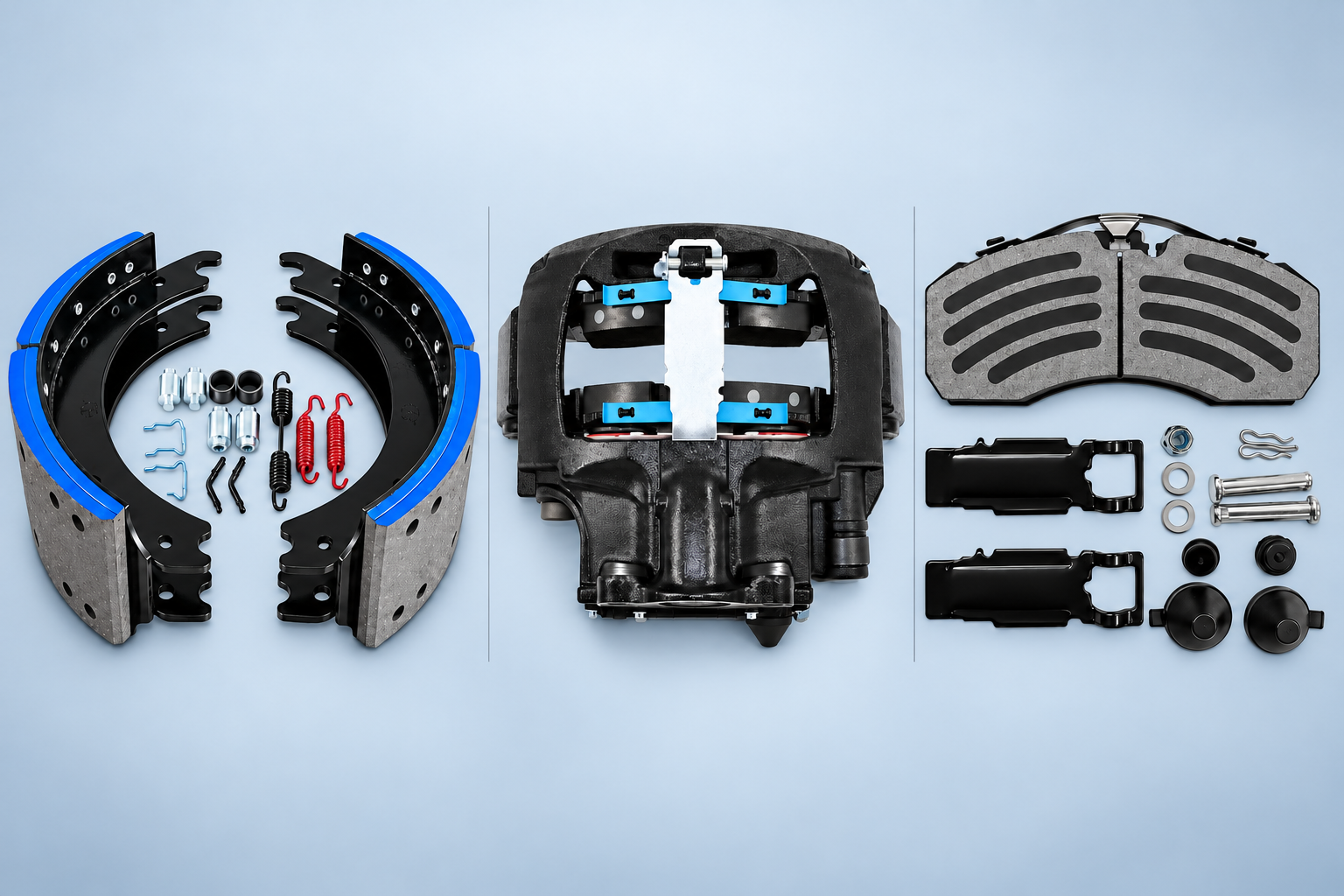
In that environment, a well-developed aftermarket range gives the distributor more flexibility to build around the vehicles actually operating in the market. OEM products can remain where customers specifically request them, while aftermarket products can cover older applications, broader multi-brand demand, different price segments and private-label programs. A distributor can also use an established commercial vehicle brake lining range as the starting point for consolidating multiple applications rather than sourcing every reference independently.
The value of aftermarket is therefore not simply that the product may cost less. It is the ability to build a replacement range around actual customer demand. For many distributors, the strongest portfolio will eventually contain both OEM and aftermarket products, each serving a different part of the market.
The Same OE Number Can Hide Very Different Brake Linings
This is where quotation comparison becomes risky. A distributor sends the same truck brake lining list to three suppliers and receives three prices against the same OE reference. On the spreadsheet, the products appear interchangeable. In reality, one supplier may have confirmed the vehicle and brake application, another may only have matched dimensions, while a third may be using a similar lining profile with a different friction formulation.
That difference matters because commercial vehicle brake linings work under very different operating conditions. A refuse truck that repeatedly brakes under load, an urban bus running constant stop-start routes and a long-haul tractor-trailer do not place the same thermal and wear demands on the friction material. CCJ’s guide to selecting replacement brake linings makes a similar point: severe-duty applications may require a different material grade from line-haul vehicles, and friction selection needs to be considered as part of the wider braking system rather than as an isolated number.
Before comparing prices, the more useful question is whether all suppliers are actually quoting against the same application, friction requirement and duty cycle. A shared OE number makes the quotations look comparable; it does not always make the products equivalent.
High Friction or Low Wear Doesn’t Always Mean a Better Brake Lining
Commercial vehicle duty cycle is where a simple OEM-versus-aftermarket comparison starts to become an engineering decision. A long-haul tractor-trailer may spend most of its working life at highway speed, which means buyers evaluating semi-trailer brake pads need to pay attention to stable friction performance, heat control and wear consistency over long operating distances. A refuse truck brake pad application is very different, because the vehicle may brake repeatedly between collection points, creating frequent thermal cycles and higher demands on fade resistance and durability. An urban bus brake pad faces its own stop-start operating pattern, often with repeated braking throughout the day and a strong need for predictable performance, noise control and service life.
Even when the brake hardware looks similar, the friction material is being asked to work in very different environments. The same principle can be seen when comparing bus vs truck brake applications, where operating conditions influence what buyers should prioritize in a friction product.
This matters when buyers ask for a heat resistant brake lining, high friction brake lining or low wear brake lining. Those properties sound attractive, but none should be treated as a stand-alone definition of quality. A lining with more aggressive friction behavior is not automatically better for every brake system, while chasing maximum lining life without considering drum wear and operating conditions may simply move maintenance cost from one component to another.
The better target is predictable braking behavior across the actual duty cycle. Instead of asking for the “strongest” or “longest-lasting” lining, distributors should first understand whether the product is going onto a long-haul truck, city bus, trailer, refuse vehicle or another severe-duty application. That information gives the friction specification a useful context.
Brake Lining Testing Matters More Than “OEM Equivalent” on a Quote
“OEM equivalent” is easy to put on a quotation. The harder question is what evidence sits behind it. Is the comparison based on an OE cross-reference, dimensional matching, material data, dynamometer testing, field history or some combination of these? For a commercial vehicle distributor, knowing that difference is important because a lining can look correct and still behave differently once repeated heat, load and braking cycles are introduced.
Testing is where those differences become easier to evaluate. Fade behavior, wear, friction stability and recovery after high-temperature braking all tell the buyer more than a catalog number alone. Our broader guide to brake testing for heavy commercial vehicles looks at why these tests matter when friction products are developed for demanding applications.
For the North American heavy-duty aftermarket, PRI’s Brake Lining Qualification Program provides another useful reference. PRI explains that TMC RP 628 uses FMVSS 121 dynamometer procedures and supplier qualification information to help fleets judge aftermarket brake lining performance on air-actuated foundation brakes. The point is not that every commercial vehicle brake lining worldwide follows the same qualification route, but that serious replacement selection uses performance evidence rather than relying only on a matching number or a supplier claim.
The Cheapest Brake Lining Can Become the Most Expensive One in the Order
An aftermarket brake lining may save several dollars per set, and across a large order that difference can look attractive. But the calculation changes immediately if part of the order is incorrectly matched. The distributor may then be dealing with return freight, replacement shipments, warehouse handling, application rechecking and customers waiting for the correct product. If several references are affected, the original unit-price saving can disappear very quickly.
Wear consistency creates the same kind of hidden cost. Commercial fleets want maintenance they can plan, so unpredictable lining life affects more than the cost of the friction material. It affects workshop scheduling and vehicle availability, and eventually that becomes a service problem for the distributor as well. For fleet customers, the same logic applies across the wider braking program: commercial vehicle brake wear control is not simply about making one component last as long as possible, but about keeping wear predictable enough to support planned maintenance.
For that reason, we would compare purchase price, freight, inventory, slow-moving stock, application errors, warranty handling and emergency replacement costs together. A premium aftermarket product makes commercial sense when the whole sourcing model works—the application is correct, performance is predictable, supply is manageable and the distributor still has enough margin. If the only advantage is the number at the top of the quotation, that advantage may not last very long.
The First Order Isn’t the Real Test of Brake Lining Consistency
The first successful order tells a distributor that a supplier can make a product correctly once. The second, third and tenth orders tell you whether the supplier can keep making it consistently. This is particularly important when fleet brake linings are supplied into maintenance programs where expected service life, braking behavior and replacement intervals need to remain reasonably predictable.
Traceability becomes useful here because it gives both distributor and manufacturer somewhere to start if a performance issue appears later. Production date, batch identification and inspection records can help narrow an issue to a particular production run instead of treating every product already in the market as suspect. UN Regulation No. 90 also includes marking provisions for replacement drum brake linings, including approval information and manufacturing date or batch identification within its applicable framework.
For a B2B buyer, this means sample approval is only the beginning. A more meaningful question is whether the approved product can remain stable after production becomes routine and repeat orders begin moving in volume.
One Hundred Brake Lining References Don’t Deserve the Same Inventory
Once you move from one brake lining to an entire distributor catalog, product range becomes an inventory problem. Suppose customers request 100 references. Perhaps 20 move constantly, another 30 sell steadily but less frequently, and the remaining 50 appear only occasionally. Buying identical quantities across all 100 simply because a supplier can produce them would tie up capital unnecessarily.
A better aftermarket strategy is built around actual demand. Fast-moving truck brake linings may deserve regular stock, medium-volume references can be replenished on a planned cycle, and slow-moving applications may be sourced only when there is confirmed demand. For multi-brand distributors, broad aftermarket coverage can still be a major advantage because it allows more purchasing to be consolidated through one supply program, but more SKUs only create value when they improve market coverage.
This is why the size of a supplier’s catalog should not be the only measure of range capability. What matters more is whether the available references match the vehicles in the distributor’s market and whether the supply structure allows those products to be replenished without turning low-volume references into dead stock.
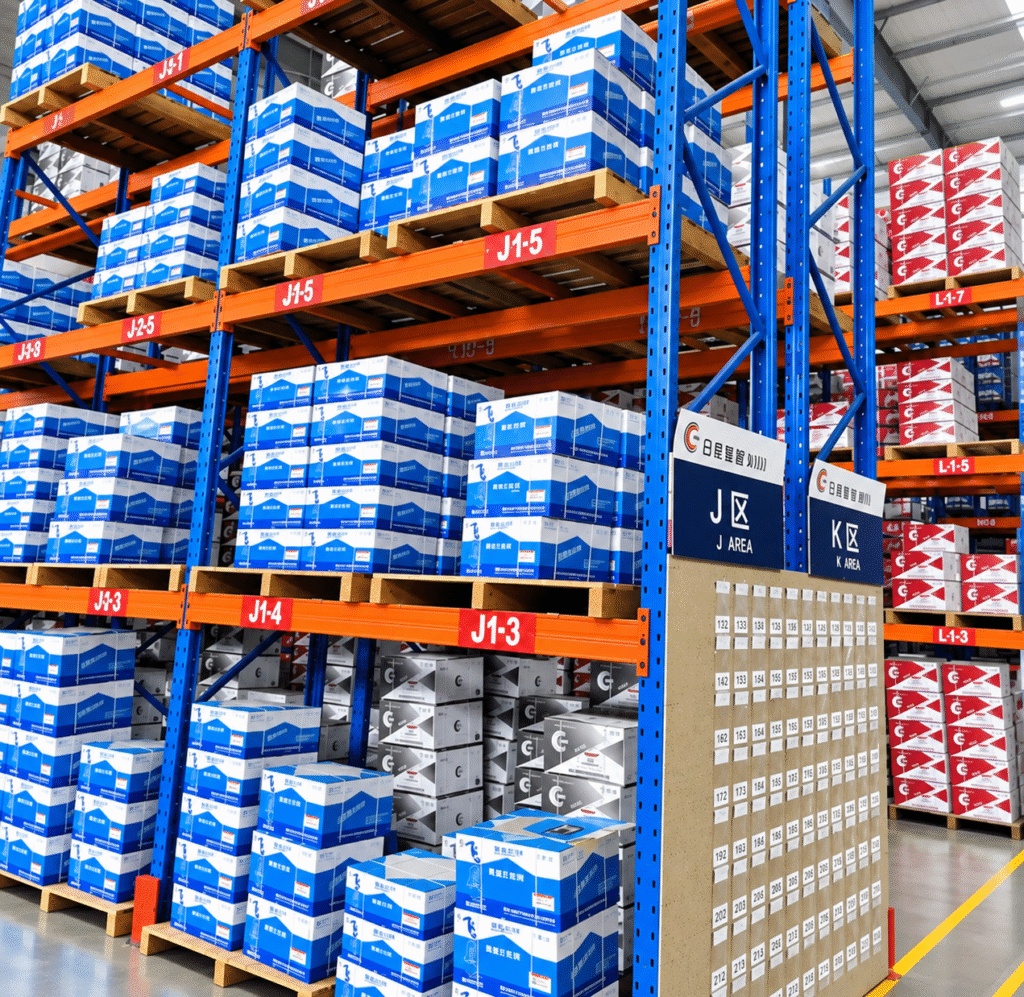
WVA, FMSI and OE Numbers Matter More as the Range Grows
When a distributor is sourcing one or two brake linings, product identification can often be handled manually. When an RFQ contains hundreds of references, cross-reference quality becomes a much bigger part of the sourcing process. WVA brake lining numbers, FMSI brake lining references and OE numbers allow both sides to work from existing identifiers instead of rebuilding every application from scratch.
Those numbers are useful starting points, but they should still lead back to the actual product. Dimensions, drawings, vehicle information or samples may be needed when two databases disagree or when an older application has several possible replacements. The larger the product list becomes, the more valuable it is to separate straightforward matches from references that need additional confirmation rather than pretending every catalog cross-reference carries the same level of certainty.
For distributors with an established catalog, there is therefore no reason to rebuild every part number before requesting a quotation. The practical approach is to send the OE, WVA, FMSI or existing internal references already in use, then work through the exceptions where more information is required.
Private Label Changes the Economics of Aftermarket Brake Linings
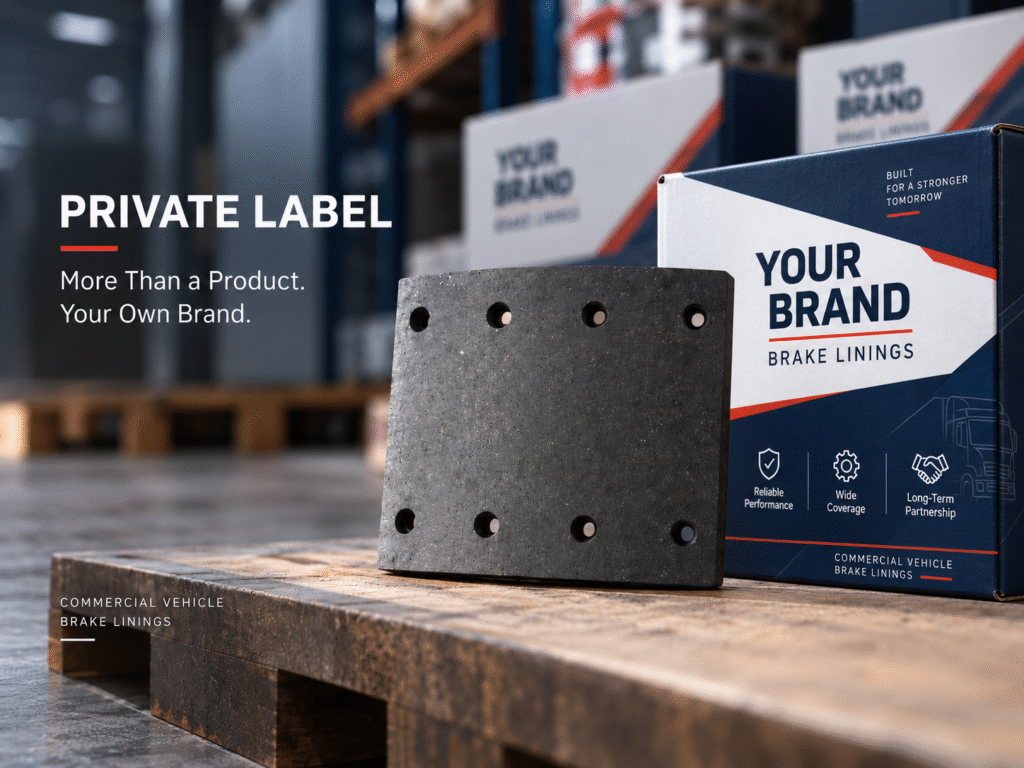
Private label changes the discussion because the distributor is no longer only choosing between an OEM product and an aftermarket replacement. The business is also deciding whether it wants customers to keep asking for somebody else’s brand or gradually start ordering under its own product identity. With an OEM product, the branding, packaging and part-number system already belong to the original manufacturer. With a private label brake lining program, the distributor can build its own cartons, catalog numbers and cross-reference structure around a confirmed product.
That control can become commercially valuable over time, but the sequence matters. We would not recommend starting with packaging artwork and then working backwards to the brake lining. A stronger private-label program follows a clearer path: reference → application → friction specification → product confirmation → sample or validation → packaging → repeat supply. The same principle applies more broadly when comparing OEM and private-label brake products: private label creates more control, but it also puts more responsibility on the distributor to keep product identity and specification consistent.
For an established distributor, this is often one of the strongest reasons to develop an aftermarket program. The value is not only the margin on a single order; it is the ability to build a product range that belongs to the distributor’s own business.
So Should a Distributor Carry OEM, Aftermarket—or Both?
For many distributors, the practical answer is both. Some customers specifically want the original brand, some fleets work from approved product lists, and some maintenance programs have little reason to change a product that is already accepted. Other customers care more about availability, replacement options, multi-brand coverage, cost or a distributor’s own brand.
| Customer Situation | What Usually Makes More Sense |
| Customer specifically requests original brand | OEM |
| OE-controlled maintenance program | OEM |
| Fleet uses an approved product list | Follow the approved specification |
| Distributor needs broader multi-brand coverage | Aftermarket |
| Older commercial vehicle applications | Aftermarket may offer more options |
| Distributor is building its own brand | Private-label aftermarket |
| Market contains different price and brand segments | OEM + aftermarket |
| Application or friction requirement is unclear | Verify first—don’t choose by price |
The goal is not to decide which category wins. A stronger brake lining range gives each one a clear role: OEM where the customer is buying the original product, aftermarket where the market needs more flexibility, and private label where the distributor is building a product business of its own.
What We’d Check Before Replacing an OEM Brake Lining With Aftermarket
When a distributor sends us an OE reference and asks for an aftermarket option, we would rather establish the product first than begin with a target price. Depending on the information available, that may involve checking the OE, WVA or FMSI reference, dimensions, lining profile, drilling pattern, brake system, vehicle application, duty cycle and friction requirement. If the catalog information is incomplete, a drawing, photo or physical sample can often resolve the uncertainty more reliably than forcing a database match.
The operating environment also matters. A heavy-duty trailer brake lining, a refuse truck lining and a long-haul truck lining should not automatically be treated as the same friction problem simply because they use similar drum-brake hardware. Once we know what the product fits and what the vehicle actually does, price becomes much more useful because we are finally comparing against a defined requirement.
That is one of the biggest differences between buying commercial vehicle friction products by part number and building a reliable replacement program: the number identifies the opportunity; the application defines the product.
The Better Aftermarket Product Is the One That Creates Fewer Problems Later
For distributors, OEM versus aftermarket ultimately comes down to more than product price. OEM can make sense where the customer specifically wants the original brand and values the familiarity that comes with it. Aftermarket can make more sense where the distributor needs broader application coverage, more sourcing flexibility, different price levels or a private-label program.
The aftermarket advantage disappears quickly, however, if the product creates returns, inconsistent wear, application mistakes or unpredictable supply. A better way to judge the decision is to look forward twelve months: are customers reordering the product, can fleets plan maintenance around it, are the applications staying consistent and is the distributor making a healthy margin without spending that margin fixing problems?
Related reading
- What Is Brake Lining? Types, Materials and How to Choose
- How to Choose a Brake Lining Manufacturer for Commercial Vehicles
- ECE R90 Brake Linings: E-Mark List, COP Documents & WVA Guide
Reviewed by: Robert, Chief Executive Officer, Tuoba Auto Parts
Technical basis: UN ECE Regulation No. 90 · FMVSS No. 121 (49 CFR 571.121) · TMC RP 628
If those answers are positive, aftermarket has created real commercial value. If the only advantage was the initial quotation price, it probably hasn’t. If you already have a commercial vehicle brake lining list, there’s no need to rebuild it into another format before sending it to us. OE, WVA, FMSI or the part numbers you currently use are enough to start. We can first separate the references that can be confirmed from those that need more information, then work through the range from there.