How OEM and Private Label Brake Pads Shape Sourcing Decisions in the Automotive Aftermarket
In today’s automotive aftermarket, brake pads are no longer a simple standardized procurement item—they represent a structured decision product that simultaneously carries safety responsibility, service experience, inventory efficiency, and brand premium potential.For brake pad distributors, importers, and service centers, the core challenge is no longer whether to purchase brake pads, but how sourcing decisions impact their underlying business model.
With over 20 years of brake pad manufacturing experience at Tuoba, we have observed a clear structural divide in the industry:
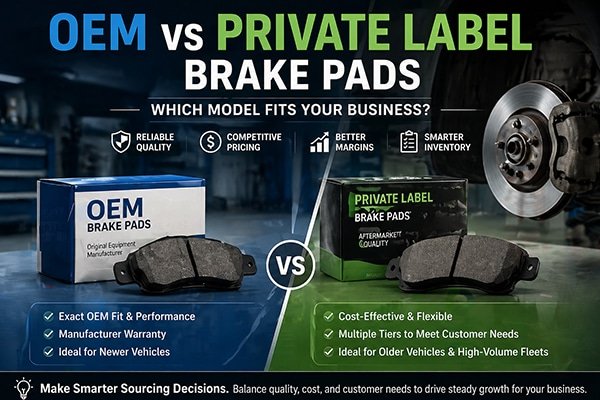
OEM sourcing focuses on stability and standardization,while private label and aftermarket sourcing focuses on flexibility and value creation.This is not a product choice—it is a business model decision.
Brake pad procurement is therefore no longer a matter of “which product is better.” Instead, it becomes a strategic decision of whether a company should prioritize operational stability and efficiency, or invest in building brand value and pricing power to secure future growth. This decision will determine whether the company remains at the operational level of the supply chain or moves upstream, ultimately achieving value creation and market control.
From a practical market perspective, this structural divergence is further reinforced in the automotive aftermarket environment.OEM systems and private label programs represent two fundamentally different sourcing paths, directly impacting profitability, inventory turnover, and brand positioning.The former prioritizes reliability, standardization, and risk mitigation, while the latter focuses on margin expansion, market differentiation, and scalable business development.
Therefore, the key question becomes:
Does your business require a stable, predictable supply system—or a scalable brand model with long-term pricing control and growth potential?
At Tuoba, we help you better understand how OEM and private label brake pad sourcing strategies work within a structured procurement framework, and how different models interact across cost structure, supply chain design, quality expectations, and market positioning—so you can clearly evaluate each stage of the sourcing decision process in the sections that follow.
Why OEM Brake Pads Are Critical for Stable Fleet and Service Operations
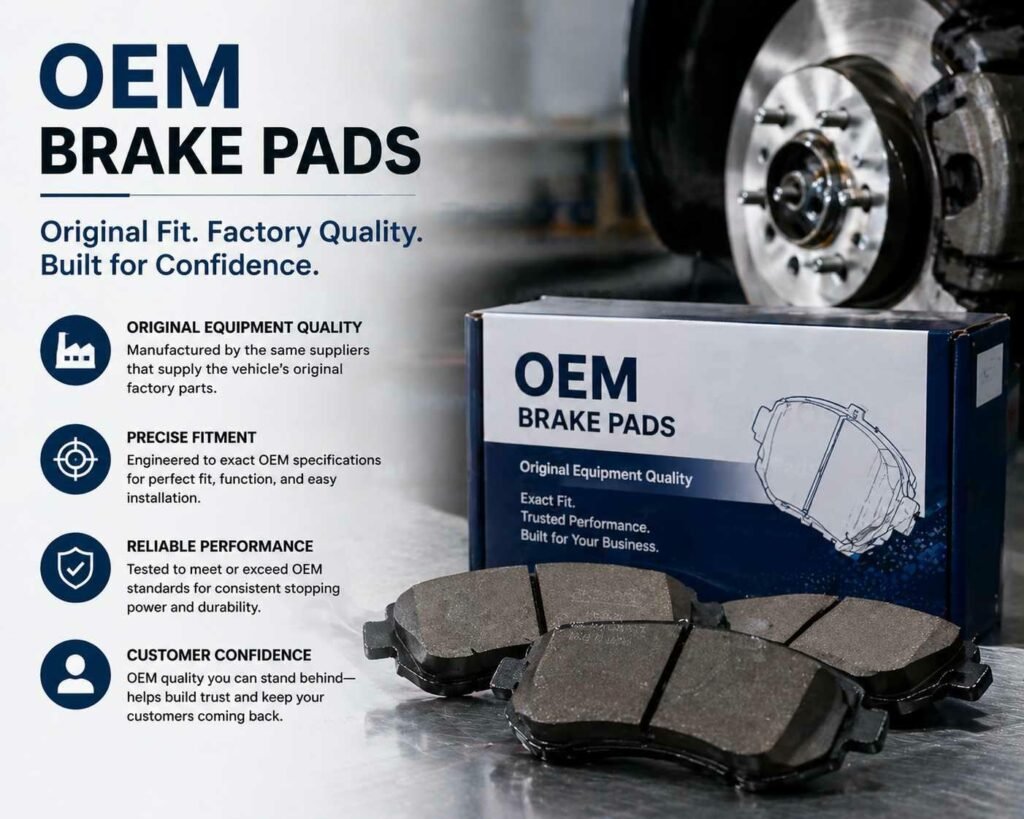
For distributors and service centers, choosing OEM brake pads is often a strategic decision to ensure operational stability, consistent product performance, and reduced service risk—especially in warranty-sensitive and fleet-oriented applications where reliability directly impacts customer retention and long-term service contracts.
In many cases, OEM sourcing is not simply about product preference, but about aligning with a controlled and standardized supply system that supports predictable operational outcomes across high-frequency maintenance environments. This is particularly important for businesses managing large vehicle fleets, commercial transport systems, or repair networks where even small variations in product performance can lead to significant downstream service costs.
Unlike generic sourcing decisions, OEM brake pads provide a tightly regulated supply standard that helps minimize installation variability, reduce quality-related claims, and maintain consistent braking performance across different vehicle platforms and operating conditions. This level of standardization also simplifies technician training, inventory planning, and after-sales service management, which further improves overall operational efficiency.
In addition, OEM sourcing plays an important role in risk management. By relying on manufacturer-approved specifications and validated production processes, distributors can significantly reduce exposure to product-related disputes, warranty conflicts, and inconsistent field performance.
This makes OEM sourcing particularly important for businesses that prioritize reliability, compliance, and long-term service consistency over short-term cost optimization, especially in markets where service reputation and operational continuity are critical to customer retention and business growth.
Limitations of OEM Brake Pad Sourcing in Competitive Markets
While OEM brake pads provide strong reliability and consistency, OEM sourcing also comes with several structural limitations that distributors and service centers should consider.
First, OEM supply chains are typically controlled by authorized channels, which limits sourcing flexibility and reduces the ability to negotiate pricing or lead times. This can restrict responsiveness in fast-moving or price-sensitive markets.
Second, OEM products often come with higher procurement costs compared to aftermarket or private label alternatives, which can compress gross margins for distributors operating in competitive environments.
Third, OEM sourcing offers limited branding opportunities. Since products are tied to vehicle manufacturer specifications, businesses have less control over packaging, positioning, and market differentiation.
As a result, while OEM ensures operational stability, it may constrain pricing strategy, branding development, and overall business scalability.
How Businesses Combine OEM and Aftermarket Brake Pads
In practice, most distributors and service centers do not rely solely on OEM sourcing. Instead, they adopt a balanced procurement strategy to reduce the limitations of OEM supply chains while maintaining operational stability.
One common approach is a dual sourcing model, where OEM brake pads are used for warranty-sensitive vehicles or premium service channels, while aftermarket or private label products are introduced for price-sensitive segments and high-volume maintenance work. This allows businesses to maintain OEM-level trust where it matters most, while improving margin flexibility in other areas.
Another strategy is multi-supplier diversification within OEM channels, working with multiple authorized distributors to reduce dependency on a single supply source. This helps improve lead time stability and reduces the risk of stock shortages caused by channel constraints.
In addition, many companies optimize their inventory segmentation strategy, separating OEM stock for critical applications and using private label products to support scalable growth and branding initiatives.
In this way, OEM sourcing is no longer treated as a standalone model, but as one layer within a broader hybrid supply chain strategy designed to balance stability, profitability, and market competitiveness.
To help you better understand how OEM sourcing limitations are managed in real-world procurement decisions, Tuoba summarizes the most common challenges and the corresponding risk mitigation strategies used by distributors and service centers.
📊 OEM Sourcing Limitations and Risk Mitigation Framework
| OEM Limitation | Business Impact | Risk Mitigation Strategy | Practical Execution in Industry |
| Pricing rigidity | Limited margin flexibility and reduced negotiation power | Dual sourcing strategy | Combine OEM products with private label or aftermarket lines to balance pricing structure |
| Limited branding control | Weak brand differentiation and limited market positioning | Private label integration | Develop own-brand brake pad programs with customized packaging and labeling |
| Channel dependency | High reliance on authorized OEM distribution networks | Multi-supplier diversification | Work with multiple authorized OEM distributors to reduce single-source risk |
| Lead time inflexibility | Slower response in urgent or fast-moving demand scenarios | Hybrid inventory system | Maintain mixed inventory of OEM and aftermarket products for flexible fulfillment |
This framework reflects a common industry shift: OEM sourcing is no longer used as a standalone strategy, but as one component within a hybrid procurement model that improves flexibility, profitability, and market responsiveness.
However, once this hybrid model becomes established in daily operations, a new question starts to emerge:
👉 how to move from cost optimization to stronger market positioning and higher-margin growth?
This is where the strategy begins to shift again.
Private label brake pads then become a natural next step, allowing businesses to move beyond procurement efficiency and into brand-driven value creation, with greater control over pricing, positioning, and long-term profitability.
Role of Aftermarket Brake Pads in Market Coverage and Pricing Flexibility
Market Coverage: From OEM Stability to Portfolio Strategy
Once distributors move beyond a pure OEM sourcing model, the focus naturally shifts from product standardization to market coverage and portfolio flexibility.
At this stage, aftermarket brake pads play an important role in expanding business reach across different customer segments. Compared to OEM-only sourcing, aftermarket solutions provide a wider range of options in terms of pricing, performance levels, and application scenarios, allowing distributors and service centers to better align inventory with real market demand.
👉 In other words, this is not just a product category shift—it is a portfolio strategy shift.
Tuoba to better understand how this flexibility translates into business value, the comparison below shows how aftermarket options support different operational decisions in real-world distribution and service environments.
Feature vs Business Value
| Feature | Operational Impact | Strategic Opportunity | Procurement Decision Insight |
| Budget to premium product tiers | Enables multi-level product positioning | Expands customer segmentation (economy / mid / premium) | Build tiered pricing system instead of single-margin model |
| Multiple brand and product lines | Reduces dependency on single supply source | Improves supply chain resilience and stock availability | Diversify suppliers to avoid stockout risk in peak demand cycles |
| Ceramic / semi-metallic / organic materials | Allows performance customization by vehicle type | Supports differentiated product positioning for different markets | Match material type with customer segment (fleet / retail / performance) |
| Flexible supplier networks | Improves pricing negotiation and lead time control | Strengthens bargaining power in procurement | Actively maintain 2–3 parallel suppliers per category |
This structured comparison shows that aftermarket sourcing is no longer only about flexibility—it is about designing a scalable portfolio syste
Market Growth Driving Demand for Private Label Brake Pads
Industry data further supports this structural shift toward flexible sourcing models.According to the Auto Care Association U.S. Aftermarket Forecast (2025–2028), the U.S. automotive aftermarket reached approximately $435 billion in 2025, and is projected to continue expanding steadily in the coming years, driven by the increasing average vehicle age, stable driving demand, and higher maintenance frequency across both passenger and commercial vehicles.
In addition, the broader industry forecast published by the Auto Care Association Industry Growth Report indicates that the total U.S. auto care industry is expected to reach $664 billion by 2028, reflecting long-term structural growth in vehicle maintenance, repair, and replacement demand.
From a procurement perspective, this sustained growth does not only indicate market expansion—it also signals a deeper shift in sourcing strategies across the aftermarket supply chain.
Within this expanding ecosystem, brake pads remain one of the most frequently replaced safety-critical components, making them a core product category for distributors, service centers, and aftermarket brands.This means that sourcing decisions in this category have a direct impact on both operational stability and long-term business competitiveness.
As a result, properly certified private label brake pads are increasingly being adopted as a strategic option, as they allow distributors to participate in market growth while maintaining control over cost structure and brand positioning.
For distributors and brands, this model enables:
- Higher and more controllable profit margins
- Flexible product tiering strategies (economy / mid / premium)
- Faster response to regional demand variations
- Strong scalability for fleet and high-mileage vehicle markets
As vehicle fleets continue to age globally, particularly in North America and Europe, demand for cost-effective yet certified braking solutions is expected to remain structurally strong, reinforcing the strategic value of private label programs in the automotive aftermarket supply chain. This trend is particularly evident in North America, where the automotive aftermarket is supported by a large and mature ecosystem valued at approximately USD 516 billion in 2025, reflecting the scale, stability, and long-term resilience of regional demand.
Why Private Label Brake Pads Are Increasingly Used by Distributors
As distributors gradually expand their market coverage and move beyond single-channel OEM sourcing, procurement logic begins to evolve in a more structural direction.
At this stage, purchasing decisions are no longer driven purely by cost comparison or product availability. Instead, experienced buyers increasingly evaluate how sourcing models influence long-term business positioning, margin structure, and customer trust formation in the aftermarket.
From a strategic procurement perspective, OEM sourcing provides the foundation of operational stability, while aftermarket sourcing introduces flexibility in product selection and supply chain management. However, as both models become standardized within daily operations, another critical factor begins to influence decision-making: brand reputation and customer trust at the point of purchase.
In practical terms, this means that sourcing decisions in the automotive aftermarket are not only operational—they are also reputational, as the brands a distributor carries directly shape how end customers perceive quality, reliability, and safety.
At this point, brand trust becomes a key influencing factor in brake pad purchasing decisions across the aftermarket.
How Brand Trust Influences Brake Pad Purchasing Decisions
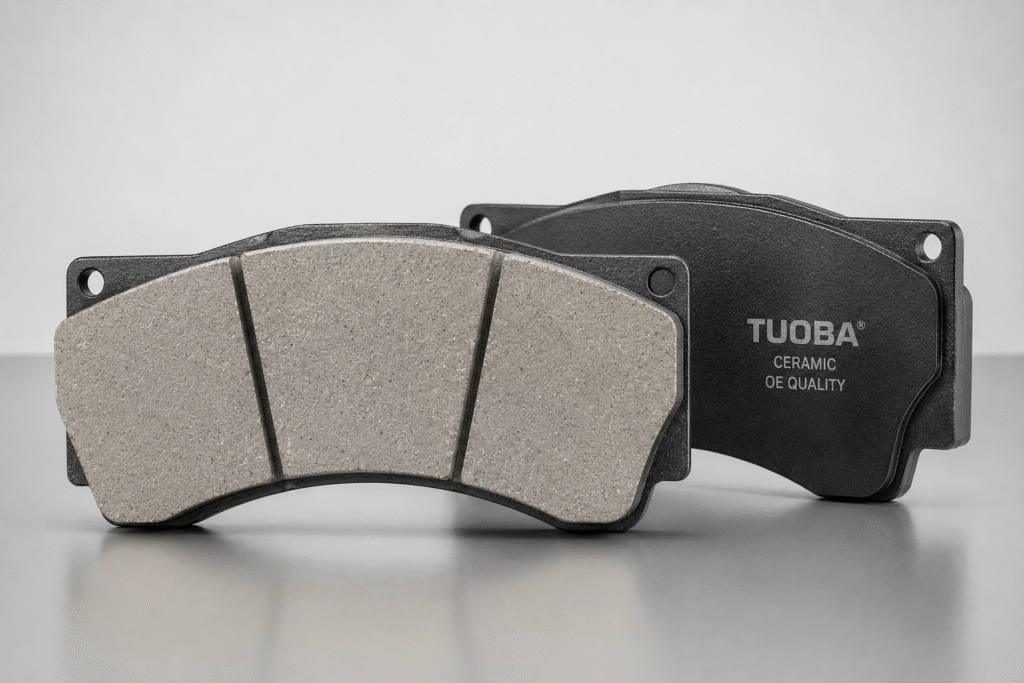
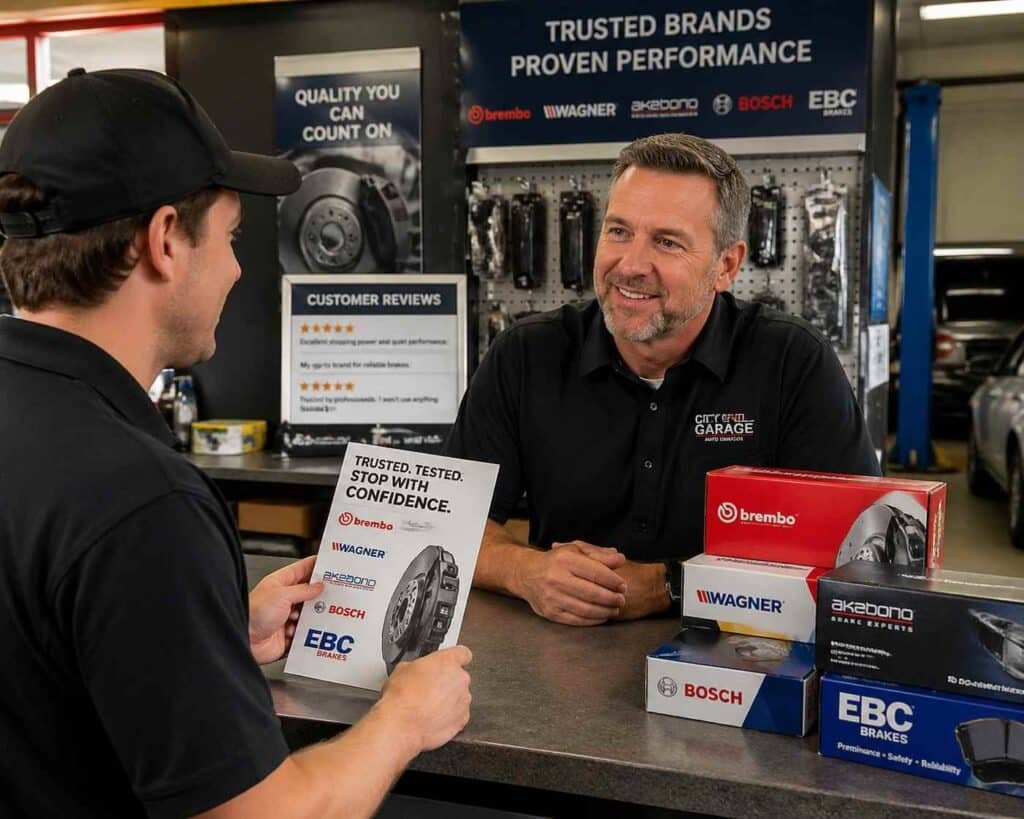
Well-established OEM and aftermarket brands such as Brembo, Wagner, Akebono, Bosch, and EBC Brakes have built long-term credibility through consistent performance and validated testing standards. By carrying these brands, distributors indirectly benefit from this accumulated trust.
This is further confirmed by industry data. According to the LexisNexis Automotive Brand Loyalty Study (2026), U.S. vehicle brand loyalty reached 51.4% in 2025, reflecting how strongly end-users still rely on recognized brands when making automotive purchasing decisions.
At the same time, the AAPEX State of the Automotive Aftermarket Survey (2026) confirms that while price sensitivity is increasing, quality remains the number one driver of customer preference, ahead of price, availability, and brand alone.
This means that in real purchasing behavior, the decision is not purely cost-driven—it is trust-driven, with quality perception acting as the hidden conversion factor.
It is precisely at this intersection of flexibility (aftermarket) and trust (brand perception) that private label brake pads begin to play a more strategic role.
Rather than simply functioning as a cost alternative, private label programs allow distributors to rebuild trust under their own brand system, rather than relying entirely on external brand equity.
This enables a structural shift from dependency to ownership:
- External brand trust → Internal brand building
- Supplier-driven positioning → Distributor-controlled positioning
- Passive margin structure → Active margin engineering
Private label programs therefore allow distributors and brands to actively shape their market position through:
- Higher and more controllable profit margins
- Tiered product positioning (economy / mid / premium)
- Faster response to regional demand differences
- Strong scalability in fleet and high-mileage segments
At this point, private label is no longer just a sourcing strategy—it becomes a mechanism for converting market trust into brand ownership and long-term pricing control. In this context, this shift is reflected in how brand selection and product comparison are presented across the aftermarket, where multiple established brands continue to define customer perception of quality and reliability.
Mechanic consulting a customer with Brembo, Wagner, Akebono, Bosch
How OEM, Aftermarket, and Private Label Fit Into Real Procurement Decisions
In practice, successful distributors do not treat OEM, aftermarket, and private label as competing choices. Instead, they build a layered sourcing framework where each model serves a different strategic function.
OEM sourcing is positioned as the stability layer, ensuring consistent performance and compliance in warranty-sensitive and fleet-oriented applications.Aftermarket sourcing functions as the flexibility layer, enabling broader product coverage and diversified customer targeting.Private label sourcing represents the growth layer, where value creation shifts from supply chain participation to brand ownership and margin expansion.
The strategic advantage does not come from choosing one model over another, but from how effectively these three layers are integrated into a unified procurement system that also accounts for brand trust dynamics in the end market.
Conclusion
Bringing these perspectives together, it becomes clear that brake pad sourcing decisions are no longer defined by a single factor such as price or product specification, but by how effectively different sourcing models balance operational stability, market flexibility, and long-term value creation within an increasingly competitive aftermarket environment.
OEM sourcing continues to provide the foundation for reliability and risk control, while aftermarket sourcing expands product coverage and pricing flexibility. At the same time, private label programs are increasingly being adopted as a way to translate market opportunities into controllable margins, brand positioning, and scalable business growth.
Ultimately, the most successful distributors and service centers are not those that rely on a single sourcing approach, but those that can structure OEM, aftermarket, and private label strategies into a coordinated system that adapts to different customer segments and market conditions.
Start Your OEM and Private Label Brake Pad Strategy with Tuoba
At Tuoba, we help distributors and service centers turn this strategy into action by enabling a structured transition from OEM and private label sourcing decisions into real-world operational execution, where businesses can start with small test orders across both product lines to evaluate performance consistency, customer response, and market acceptance before scaling their procurement strategy, and from there gradually optimize sourcing allocation based on real operational data to achieve a balanced outcome between stability, profitability, and brand positioning, ultimately building a more resilient and scalable sourcing system rather than relying on a single purchasing model.
Partnering with Tuoba is therefore not just about product supply but about establishing a long-term sourcing framework that improves customer trust, enhances operational efficiency, and supports sustainable business growth, with the first step beginning simply by placing a test order to experience a more structured and strategic approach to brake pad sourcing.