
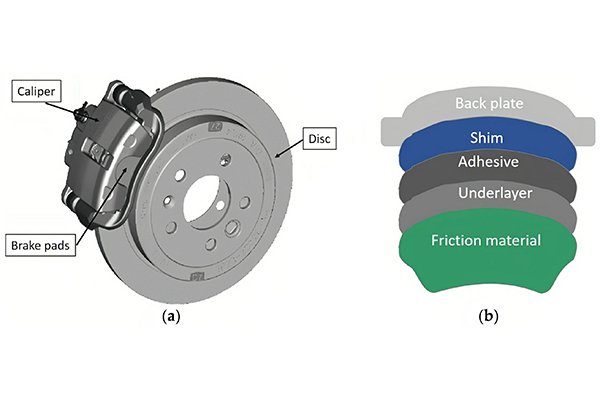
In modern vehicle braking systems, brake pads endure intense heat, pressure, and repeated mechanical loading. If friction material bonding between the pad compound and the steel backing plate is weak, the pad can crack, separate, or detach entirely. That kind of failure puts drivers, passengers, and everyone on the road at serious risk.
For engineers and manufacturers, shear strength testing is critical to ensure that the friction material remains securely bonded to the backing plate under extreme braking conditions. This property directly affects whether a brake pad can maintain structural integrity under high temperature, pressure, and repeated braking cycles.

In the United States, braking performance is regulated under the Federal Motor Vehicle Safety Standards (FMVSS), a comprehensive set of safety regulations developed by the National Highway Traffic Safety Administration (NHTSA). FMVSS defines minimum safety requirements for vehicles and key components, including braking systems, covering aspects such as stopping distance, braking effectiveness, thermal stability, and durability.
While FMVSS does not focus on a single material parameter, it requires that braking components perform reliably under real-world and extreme conditions. This is where shear strength becomes essential. Adequate shear strength ensures that the friction material does not separate from the backing plate during high-load braking events, which could otherwise lead to sudden brake failure.
Meeting FMVSS requirements therefore depends not only on overall brake system design but also on the integrity of material bonding. Shear strength testing serves as a key validation method to support compliance, helping manufacturers reduce the risk of product failure, costly recalls, and liability exposure through the brake pad shear test.
Understanding and optimizing shear strength is therefore a fundamental step in developing safe, durable, and regulation-compliant braking components, and for brake pad manufacturers and suppliers, it is also a key factor in building trust with OEMs, distributors, and fleet customers in regulated markets like the United States.
Understanding Shear Strength in Automotive Braking Systems
Every time you press the brake pedal, a complex chain of forces acts on your brake pads. These components must convert kinetic energy into heat through friction — all while enduring extreme temperatures, high pressures, and constant mechanical stress. Understanding brake pad mechanics starts with knowing how shear strength keeps the entire system intact and safe.
The Physics Behind Shear Forces During Braking
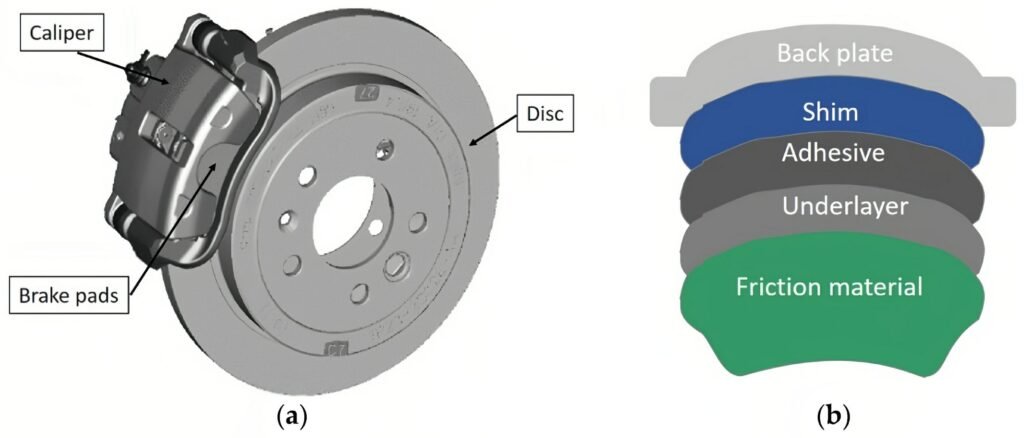
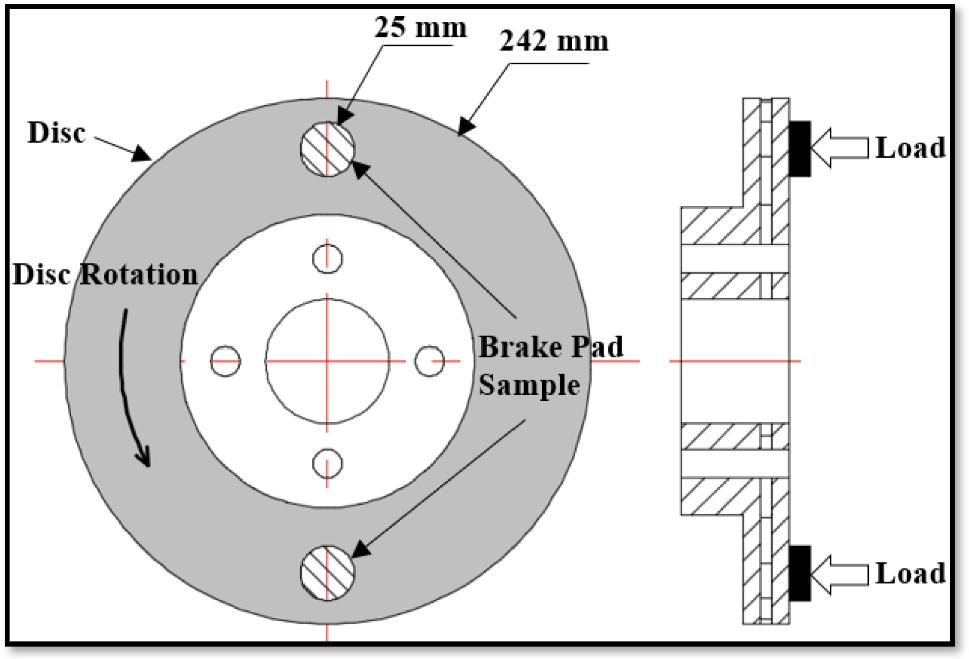
When you apply brakes, the pad presses against the spinning disc rotor. This contact generates a sliding force that runs parallel to the pad’s surface. The study of shear forces physics tells us these forces try to tear the friction material away from the backing plate. If the pad can’t resist this stress, it fails — sometimes without warning.
Temperatures during heavy braking can exceed 300°C. At these levels, friction surface integrity becomes a real concern. The material must hold together under repeated thermal cycling and intense mechanical load.
How Brake Pads Resist Parallel Forces
Parallel forces resistance depends on the structural design of the pad itself. Key factors include:
- Interfacial bonding between the friction material and the steel back plate
- Quality of adhesive application during manufacturing
- Binder resin properties — such as Novolac-type phenolic resins (like PF-234) with softening points near 98–105°C
- Proper curing temperatures, typically 170–180°C, to achieve full structural cohesion
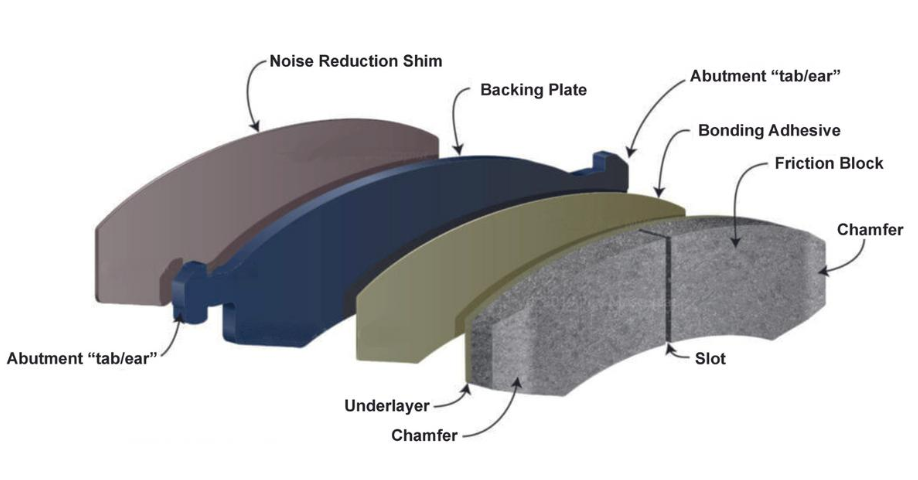
Poor adhesive quality or improper curing leads to weak joints. Under stress, these weak points become failure zones.
Critical Role of Material Bonding in Brake Performance
Material bonding strength is the backbone of reliable braking. Without it, the friction layer can separate from the back plate during normal driving conditions. This separation — called delamination — is one of the most dangerous brake failures you can experience.
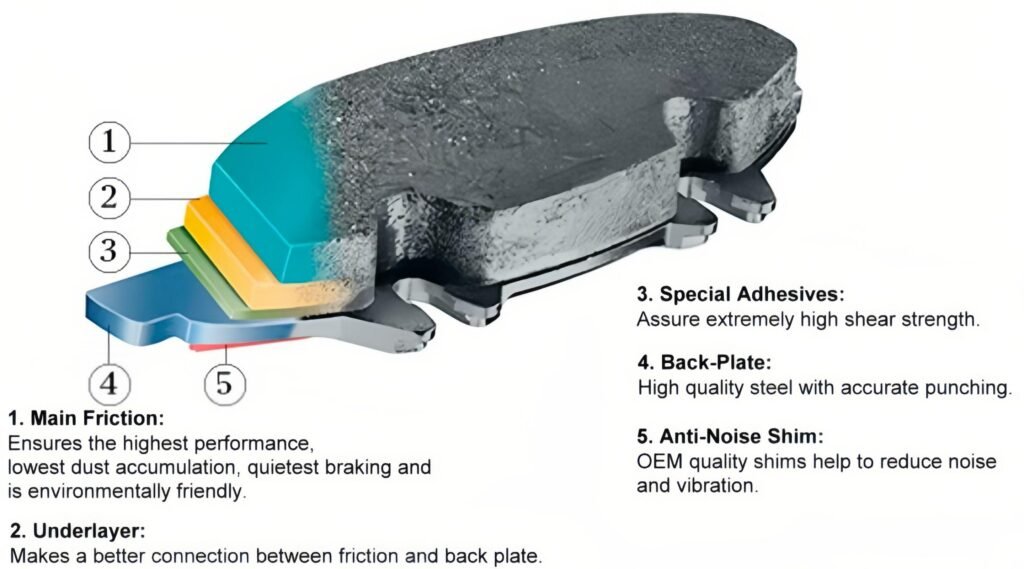
Proper bonding prevents stress concentration at the interface. It ensures the pad works as a single, unified structure capable of absorbing and distributing forces evenly across its surface. In real-world braking scenarios, pads are exposed to continuous shear forces, vibration, and thermal cycling. A well-engineered bonding system maintains structural integrity under these combined conditions, even during high-load or emergency braking.
Additionally, consistent bonding quality contributes to stable braking performance, reducing the risk of uneven wear, noise, and sudden performance loss. For manufacturers, achieving reliable bonding is not only a matter of material selection, but also precise control of adhesive application and curing processes.
Why Shear Strength Matters in Brake Pad Safety
Shear strength is one of the most critical factors in brake pad reliability. When a brake pad lacks sufficient shear resistance, the friction material can separate, crack, or detach from the backing plate during high-demand stops. Understanding why this matters helps you make better decisions about materials and design.
Preventing Catastrophic Brake Pad Failures
Catastrophic brake failure prevention starts at the material level. Inadequate bonding between the friction layer and the backing plate is a leading cause of pad detachment. Testing data shows that traditional asbestos-based pads can experience 8–10% weight loss under stress — far more than modern non-asbestos organic formulations. This material degradation weakens the pad’s structure and raises the risk of sudden failure when you need stopping power most.
Maintaining Reliable Stopping Power Under Stress
Consistent braking performance depends on a pad’s ability to hold together under varying loads and speeds. Research shows that at operational loads between 10–30N and rotational speeds of 200–1000 rpm, well-engineered pads maintain performance under stress through a process called tribo-film formation. This protective layer forms on the friction surface and stabilizes the coefficient of friction between 0.63 and 0.72 at lower speeds (200–400 rpm) and moderate loads (10–20N). Wear rates stay below 0.85 mg/N — a strong indicator of structural integrity.
The Connection to Regulatory Compliance
Many countries enforce strict vehicle safety standards that require manufacturers to prove specific shear strength thresholds before a brake pad reaches the market. Regulatory bodies — including those governed by FMVSS 135 in the United States and ECE R90 in Europe — mandate rigorous testing. Meeting these benchmarks ensures brake pad reliability across real-world driving conditions and protects end users from preventable accidents.
Key Factors Affecting Brake Pad Shear Strength
Shear strength doesn’t depend on a single variable. A wide range of factors affecting shear strength work together — from raw material quality to how the pad is mounted on the vehicle. Understanding each one helps you prevent failures before they happen.
Material composition sits at the top of the list. Unqualified friction materials or poorly balanced formulations reduce a pad’s ability to resist parallel forces. The back plate matters just as much — insufficient strength or improper surface treatment weakens the bond between layers.
Manufacturing defects are another major concern. If pressing temperature, pressure, or hold time falls outside spec, the material layers won’t fuse correctly. Incomplete curing leads to weak adhesive bonds that can fail under heavy braking loads. These brake pad durability factors are tightly controlled by reputable manufacturers for good reason.
Design choices play a role too. Consider these common issues:
- Back plate geometry that creates uneven stress distribution across the friction surface
- Improper pad thickness ratios that compromise structural integrity
- Poor adhesive coverage between the friction material and backing plate
The environmental impact on brakes is significant. Extreme heat breaks down binder resins and causes material separation. Corrosive conditions — road salt, moisture, and chemical exposure — gradually weaken bonding forces at the interface.
You should never overlook installation effects. Non-standard mounting procedures introduce stress concentrations that compromise the pad’s designed load path. Even a small misalignment can create a weak point.
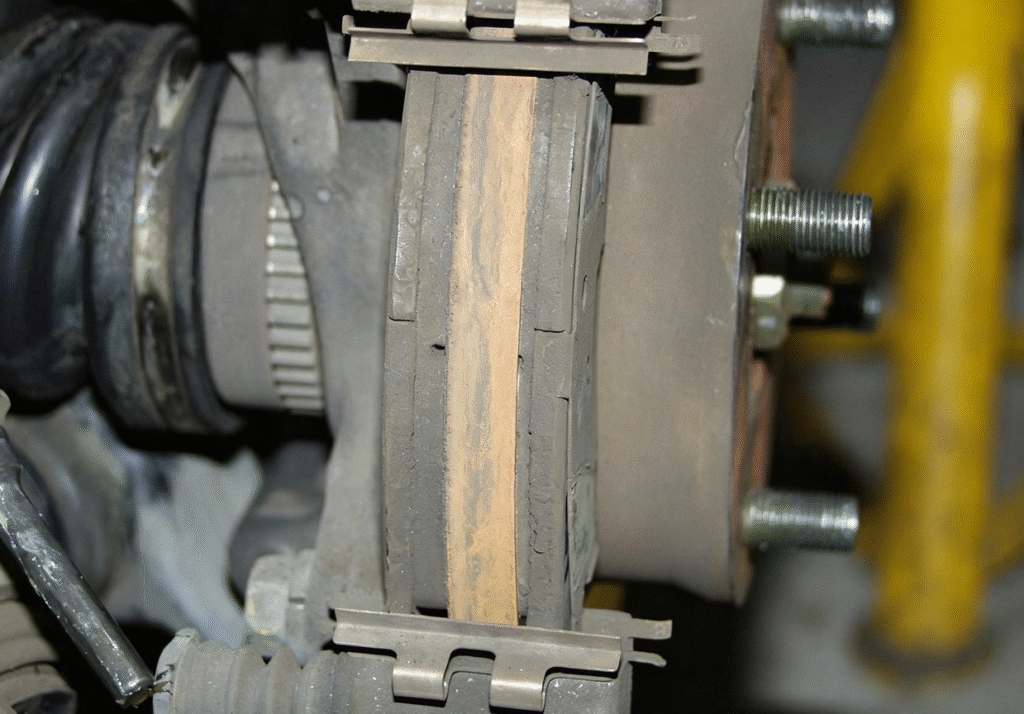
Over time, aging degradation takes its toll. Repeated thermal cycling and mechanical stress cause the adhesive bond to weaken progressively. This natural decline is why routine inspection intervals exist — and why replacing brake pads before they reach end-of-life thresholds is critical for safety. The next section explores how specific material choices influence these outcomes.
Material Composition and Its Impact on Shear Resistance
The way a brake pad is built at the molecular level determines how well it handles shear forces. Every ingredient in the friction material composition plays a specific role — from binding the pad together to controlling heat and wear. Getting this recipe right is essential for safe, reliable braking.
Role of Friction Materials and Adhesive Quality
Brake pads contain four primary component types: binders, fillers, reinforcements, and friction modifiers. Fillers like barium sulfate and synthetic graphite manage cost and volume. Friction modifiers — such as silicon carbide and zinc — fine-tune the coefficient of friction. The adhesive quality impact cannot be overstated. Weak bonding between the friction layer and the backing plate is a direct path to pad delamination under stress.
Comparing Asbestos-Free vs Traditional Formulations
Modern asbestos-free formulations have proven they can outperform their traditional counterparts. Non-asbestos organic composites deliver superior wear resistance and more stable friction output across a wide temperature range. Typical ingredients in these formulations include:
- Aramid fibers — roughly 7% by weight at 3mm length
- Steel wool and rock wool — each around 5%
- Magnesium oxide — approximately 7%
- Zirconium oxide — about 4% for enhanced wear stability
Eco-friendly alternatives like date palm fibers — with 62% cellulose content and a density of 1.35 g/cm³ — are gaining attention as sustainable reinforcement options.
Importance of Reinforcement Fibers and Binders
Reinforcement fibers give the pad its structural backbone. Copper and iron powders boost both integrity and heat conductivity. Phenolic resin binders hold everything together, offering excellent thermal stability. You need to get the binder ratio just right. Too much resin softens the matrix; too little causes cracking and poor adhesion — both of which weaken shear resistance and compromise safety.
Manufacturing Processes That Determine Shear Performance
The way a brake pad is made has a direct impact on its shear strength. In brake pad manufacturing, each step — from mixing raw materials to the final finish — plays a role in how well the friction material bonds to the backing plate.
The process starts with blending. Raw powders and fibers rotate in an industrial mixer at roughly 90 rpm for about 3 hours. This long mixing cycle ensures every particle distributes evenly. Uneven blends create weak spots that reduce shear resistance under heavy braking loads.
Once blended, the material goes through a compression molding technique to form a dense preform. This initial compaction sets the stage for the critical next step — the hot pressing process. A hydraulic press applies roughly 20 MPa of pressure while heating the upper mold to 168°C and the lower mold to 177°C for about 6 minutes. This combination of heat and force drives interparticle bonding, fusing the friction material into a solid composite.
Backing plate preparation is just as important. Dust or surface contamination on the plate weakens adhesion. Clean, properly treated substrates give the composite a stable foundation to grip.
After pressing, a post-cure treatment at 170°C for 2 hours stabilizes the thermoset resin matrix. Precise curing parameters at this stage improve toughness and thermal resistance — two traits that directly boost shear performance. Key process controls include:
- Mold temperature and pressure consistency during compaction
- Post-cure time and temperature accuracy
- Surface cleanliness of the backing plate before bonding
- Dimensional finishing to meet tolerance standards

Strict quality control manufacturing practices tie all these steps together. Without tight oversight at every phase, even the best raw materials can produce a pad with poor shear strength — something you’ll see reflected in the testing standards we cover next.
Testing and Quality Standards for Brake Pad Shear Strength
You can’t guarantee brake pad safety without rigorous testing. Every batch of friction material must pass strict evaluations before it reaches the road. Shear strength testing standards guide manufacturers through this process — from raw material checks to finished product inspections.
Industry Regulations and Compliance Requirements
Brake pad manufacturers in the United States must meet specific benchmarks set by organizations like ASTM International. ASTM D785 compliance ensures that composite materials — especially those with ceramic fillers like MgO, ZrO₂, and barite — meet minimum hardness thresholds. Regulatory bodies require documented proof that each product batch satisfies these criteria before distribution.
Laboratory Testing Methods and Performance Criteria
Modern labs rely on several key techniques to evaluate brake pad durability:
- Rockwell hardness testing — Using equipment like the HR-430 on the HRC scale, technicians take four readings per 150×100mm specimen to confirm material stiffness.
- Pin-on-disc tribometer testing — This method simulates real braking contact at loads between 10–30N and speeds of 200–1,000 rpm, measuring coefficient of friction values in the 0.2–0.4 range based on the Greenwood-Williamson contact mechanics model.
- Microstructure analysis — Field emission scanning electron microscopy (Carl Zeiss Sigma AG) and laser scanning confocal microscopy (Keyence VK-200) reveal bonding integrity at the microscopic level.
How Manufacturers Ensure Consistent Quality Control
Reliable braking performance depends on repeatable results. Quality assurance protocols require testing at every stage of production — not just at the end. Manufacturers track batch-to-batch consistency, flag deviations early, and schedule regular inspections of aging brake pad inventory. This disciplined approach keeps every product aligned with safety expectations you and your end users depend on.
Conclusion
This brake pad safety summary highlights one clear truth — shear strength is at the heart of reliable braking. From material selection and adhesive quality to pressing and curing parameters, every step in the brake pad manufacturing process plays a role. Shear strength optimization demands attention to friction compounds, reinforcement fibers, and structural design to meet strict regulatory standards.
Each automotive safety advancement depends on continued testing, smarter material choices, and improved production methods. As research moves forward, these efforts will keep making our roads safer and protecting lives behind the wheel.