Finding a truck brake lining supplier usually starts with a product list and an RFQ. The harder part comes when the quotations arrive. One supplier may cover 80 of your 100 references, another may quote all 100 but require a high MOQ for every model, while the cheapest offer may leave packaging, production status and delivery terms unclear.
For distributors and commercial vehicle parts buyers, these differences matter more than they first appear. A supplier isn’t useful simply because it has a large catalog or an attractive FOB price. It needs to turn a mixed list of truck, trailer and bus brake linings into an order that can actually be matched, produced, packed and delivered without creating unnecessary inventory or repeated problems. That’s what we would look at before moving from quotation to a trial order.
Start With the Truck Brake Lining Product List
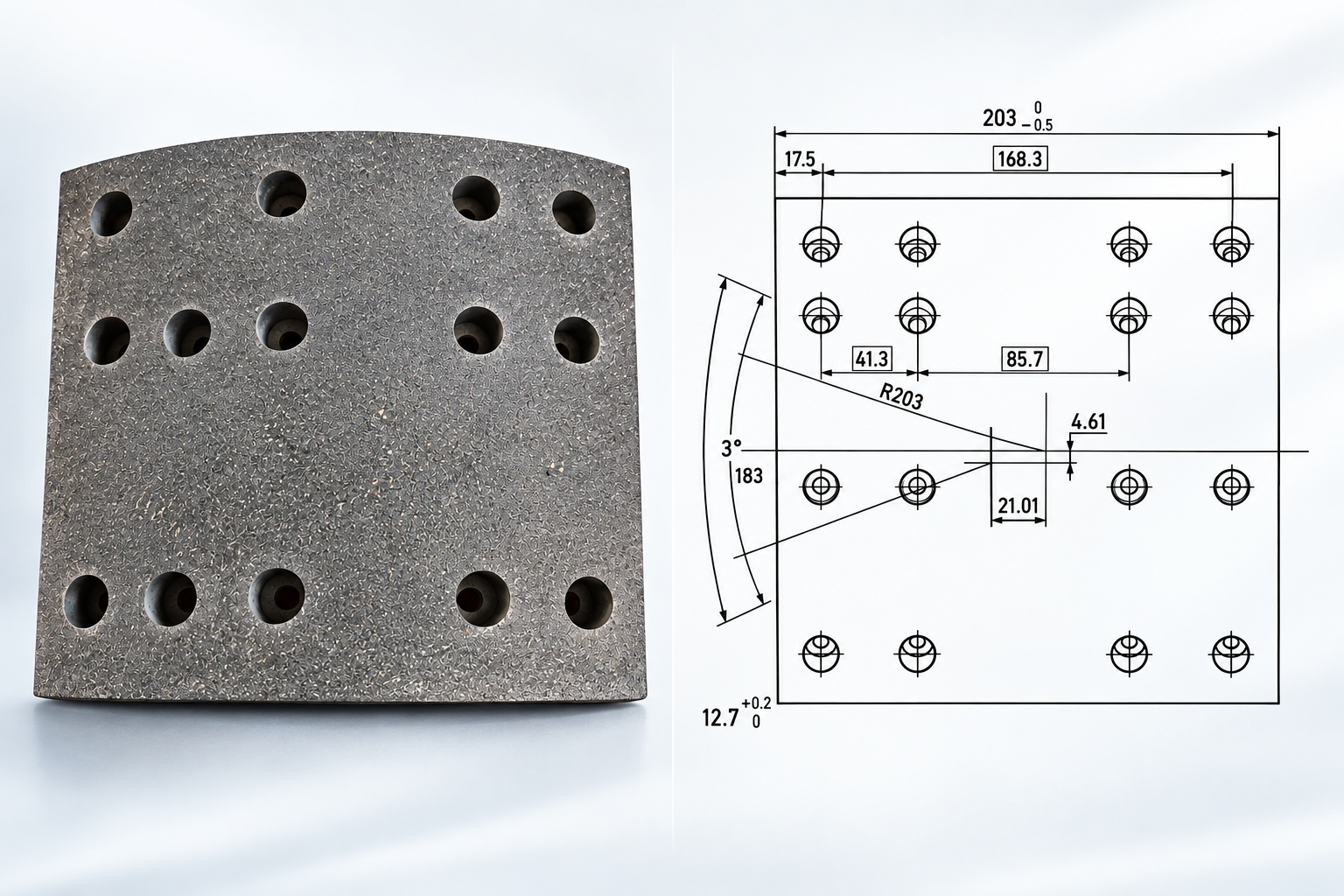
A real commercial vehicle RFQ is rarely as clean as a catalog. We regularly receive lists containing WVA numbers, OE references, FMSI numbers, competitor numbers and customer-specific part numbers in the same file. Some can be confirmed immediately; others need dimensions, vehicle or axle information, drawings or a physical sample.
This is one of the first things we think a buyer should watch when comparing truck brake lining suppliers. If 70 references are confirmed and another 10 still need checking, the quotation should make that distinction clear. We’d rather tell a customer that a reference needs more information than force a match just to complete the quotation. That becomes especially important when one RFQ contains European trucks, Japanese commercial vehicles, Chinese heavy-duty trucks and trailer applications together.
If you want to check product coverage first, you can also browse our commercial vehicle brake lining range.
Check the Truck Brake Lining Supplier’s Real Product Coverage
A supplier may say it covers 1,000 or 2,000 brake lining references. That’s useful information, but it doesn’t tell you how many of those products can actually be supplied under the conditions of your order.
We normally separate product coverage into practical situations: references already in regular production, products with existing tooling that need a new production run, and less common references that still need application confirmation or development. They may all appear in a catalog, but their MOQ and production schedule won’t necessarily be the same. For a distributor, knowing that difference before placing the order is far more useful than receiving a quotation where every SKU looks equally available.
This is particularly relevant for heavy-duty truck brake lining programs. A buyer may have a few fast-moving references and a long tail of slower models needed to complete the range. A supplier that technically covers 95% of the list can still be difficult to work with if the commercial conditions make half of those references impractical to stock.
Compare Brake Lining MOQ Across the Whole Order
MOQ becomes a very different question when the RFQ contains 50 or 100 models instead of one.
A common situation is that the fast-moving truck brake linings can support a normal production quantity, while several slower references are only needed in relatively small volumes. Applying exactly the same quantity to every SKU can leave the distributor carrying inventory that may sit in the warehouse for a long time. On the other hand, pushing every reference into an extremely small production run isn’t always realistic for the factory either.
That’s why we prefer looking at the complete list before discussing how an order can be structured. Which references are already in regular production? Which need a separate run? Which models are likely to repeat? Can different references be scheduled and shipped together? For a B2B buyer, the goal isn’t simply to find the lowest brake lining MOQ. It’s to build an order that makes sense for both production and inventory.
Make Truck Brake Lining Quotations Comparable
Two quotations aren’t really comparable just because both have a unit price next to the same part number.
Check what sits behind that number: product specification, packaging, accessories if applicable, trade terms, payment conditions, tooling status and private-label requirements. One supplier may quote FOB with neutral packaging included, another may quote EXW, while a third may show a lower product price but add packaging or tooling costs later. The difference can look quite different once the order is actually ready to ship.
A simple comparison can help:
| Quotation Item | Supplier A | Supplier B |
| Reference matching | Confirmed | Partially confirmed |
| Tooling | Existing | New tooling on some SKUs |
| Packaging | Included | Quoted separately |
| MOQ | By reference/order mix | Fixed per SKU |
| Trade term | FOB | EXW |
| Private label | Included/confirmed | To be confirmed |
| Lead time basis | Production schedule confirmed | Estimated |
The numbers in your own comparison will obviously be different, but the principle is the same. Compare what you’re actually buying, not just the price column. If the quotation doesn’t clearly explain what is included and what could change later, a very precise unit price isn’t as useful as it looks.
Use Truck Brake Lining Samples to Lock the Specification
Samples are useful, but the purpose of the sample should be clear before testing starts. Are you checking dimensions and fitment? Comparing the friction material with your current product? Confirming drilling and profile? Testing packaging? Or validating all of them before a trial order?
For a new truck brake lining supplier, the important step comes after the sample is accepted. The approved drawing, formulation and relevant product specification should carry forward into the trial and bulk order instead of becoming a new discussion each time. That’s what creates a clear line from sample → approval → trial order → mass production.
Samples are useful, but they only tell part of the story. If you also want to see how brake performance is tested before moving into a larger order, our guide to brake testing for heavy commercial vehicles takes a closer look at the testing side.
Check Brake Lining Packaging Before Production
Packaging sounds like a small part of supplier selection until an order contains dozens of similar-looking references.
A brake lining can be manufactured correctly and still create a customer complaint if the wrong reference is printed on the box. For distributors, packaging accuracy is part of supply quality. Product number, quantity, labels, barcodes, carton markings and internal identification all need to follow the approved order, particularly when several similar commercial vehicle brake linings are being packed at the same time.
Export protection matters too because brake linings are heavy friction products that may pass through several warehouses, ports and handling stages before reaching the buyer. If private-label packaging is required, we prefer confirming artwork, labels and reference information before mass printing. Correcting a PDF artwork file takes minutes; correcting cartons across 50 finished SKUs is a very different job.
Confirm Truck Brake Lining Lead Time by SKU
“30 days” or “45 days” doesn’t mean much unless you know what’s included in that schedule.
An existing truck brake lining with standard packaging is very different from an 80-SKU private-label order containing several new references. Some products may move directly into the production schedule, while others may still need drawings, samples, tooling or packaging approval. That’s why we’d rather separate those situations than give one aggressive delivery number for the entire RFQ.
Ask when the quoted lead time actually starts. Is it after deposit? After sample approval? After artwork confirmation? Also ask which references are likely to control the shipment date. A realistic production schedule that you can plan around is more useful than the shortest promise on the quotation.
Check How the Brake Lining Supplier Handles Mixed-SKU Orders
Mixed-model orders are where supplier capability becomes much easier to see.
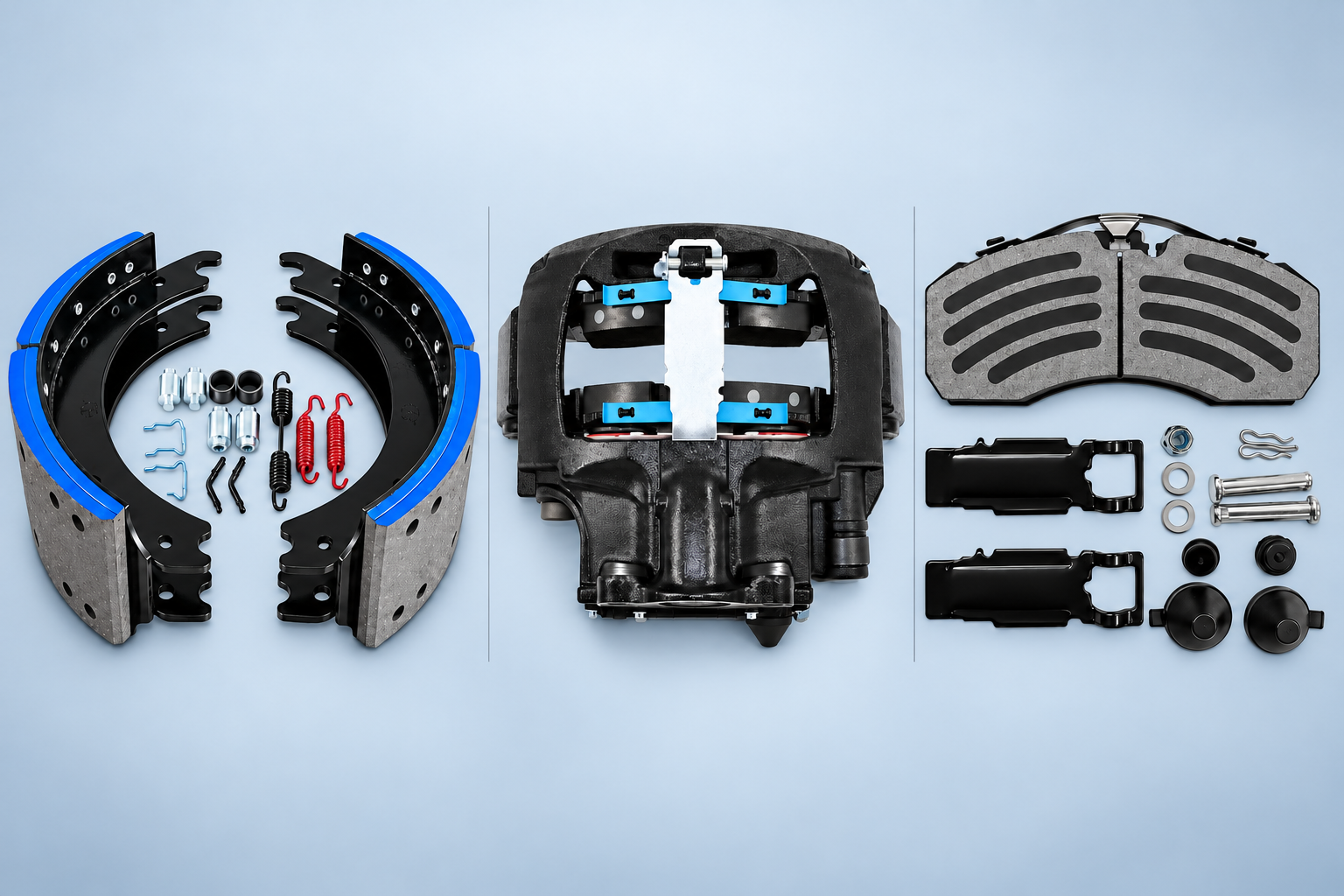
A 100-reference order has to move from an Excel sheet through production, inspection, warehousing, picking and final shipment. Similar-looking brake linings can have different profiles, dimensions or drilling patterns, and each carton still has to match the correct reference on the packing list. When brake linings are consolidated with brake pads, brake shoes or other friction products, the order becomes more complicated again.
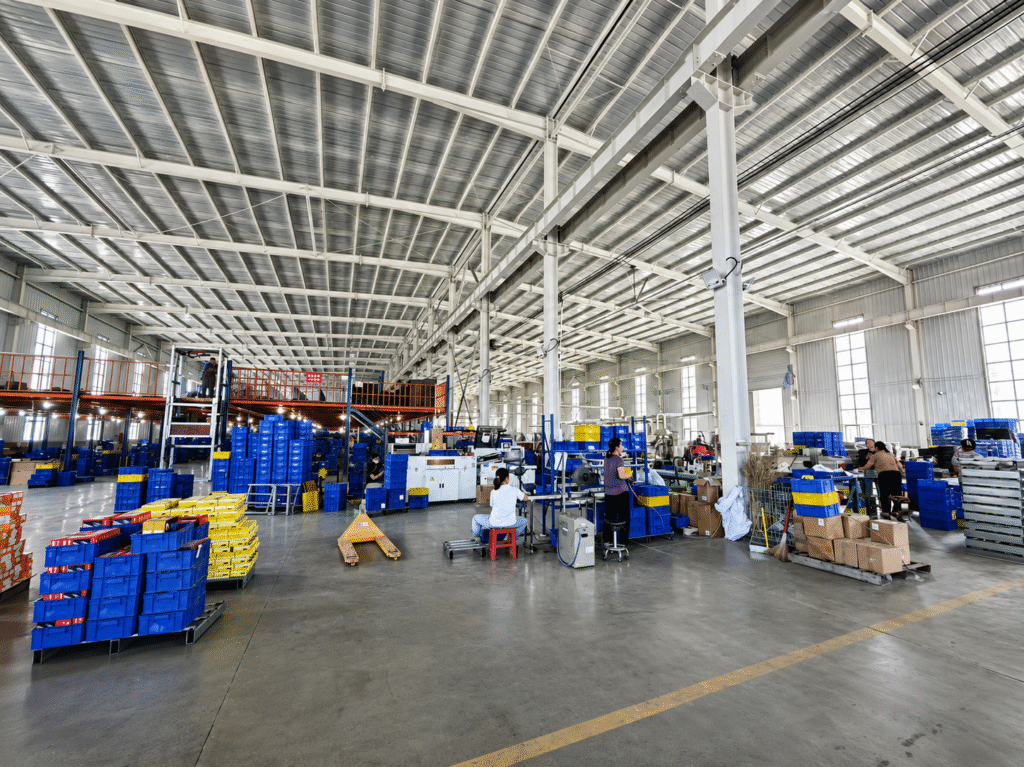
Finished commercial vehicle brake products stored by reference before order consolidation and shipment.
In our warehouse, finished commercial vehicle brake products are organized by reference so different models can be picked and consolidated according to the customer’s order. For us, this is an important part of supplying mixed-SKU orders because manufacturing the correct product is only half the job—the correct product also needs to end up in the correct box, on the correct packing list and in the correct shipment.
This becomes especially important for distributors managing a broad commercial vehicle brake lining range. The more references there are in one order, the more important accurate identification, picking and consolidation become.
Check Private Label Brake Lining Support Early
If you’re building your own brand, private-label requirements should be discussed while the quotation is being prepared, not when production is nearly finished.
A private-label brake lining program can involve cartons, labels, barcodes, internal part numbers, WVA or OE references, language requirements and market-specific product information. Once those details are approved, they should also be kept consistent for repeat orders.
The way you source matters too. If you’re choosing between building your own product line and buying existing aftermarket products, our guide to OEM vs aftermarket brake products may help. And if you’re still checking whether a factory is the right fit for long-term cooperation, take a look at our guide on how to choose a brake lining manufacturer.
Review Truck Brake Lining Supplier After-Sales Support
The real test of a supplier relationship usually isn’t the first quotation. It’s what happens when something doesn’t go exactly as planned.
A customer may report incorrect fitment, unusual wear, damaged packaging or a difference from the previous shipment. When that happens, the first job is to identify the product and collect enough information to understand the issue. Depending on the case, that may include batch information, vehicle application, installation position, mileage, brake drum condition, photos or a returned sample.
We believe after-sales support should work as an investigation rather than an argument about responsibility. Can the shipment be traced? Can the technical team review the application? Can the supplier explain what information is needed next? A reliable truck brake lining supplier isn’t one that promises there will never be a problem. It’s one that has a workable process when a problem needs to be understood.
For severe-duty applications, this becomes even more important because operating conditions can have a major influence on wear and braking behavior. Our existing article on brake linings and brake pads for refuse trucks is a good example of why application conditions need to be part of the discussion.
Compare the Total Cost of a Truck Brake Lining Supplier
Once product matching, MOQ, samples, packaging, lead time and after-sales support have been discussed, the quotation becomes much easier to judge.
A cheaper brake lining may stop being cheaper if every slow-moving reference requires too much inventory. A slightly higher unit price may make commercial sense if more models can be consolidated, reference matching is more accurate and delivery is easier to plan. Wrong-part claims, repacking, delayed shipments and excess stock all cost money even though none of them appears in the FOB price.
For a distributor, a more realistic comparison is:
Product Price + Inventory + Packaging + Freight + Order Errors + Quality Risk + After-Sales Cost
It doesn’t need to become a complicated financial model. The point is simply to make sure a few cents of unit-price difference don’t hide a much bigger difference in the way the supplier actually supports your business.
Truck Brake Lining Supplier Checklist
Before making the final choice, put the commercial details next to the product details.
| What to Compare | What to Ask | What to Watch |
| Product matching | Which references are confirmed and which need more information? | Every number is quoted immediately |
| Product coverage | Which brake lining SKUs are already in regular production? | Catalog size is the only answer |
| MOQ | Can MOQ work across the complete mixed order? | Same high MOQ for every SKU |
| Quotation | What exactly is included in the price? | Costs appear after order confirmation |
| Samples | Does the approved sample become the production reference? | Sample and bulk specifications are unclear |
| Packaging | Can carton and label details be approved before production? | Packaging is checked only before shipment |
| Lead time | Which SKUs determine the delivery schedule? | One short lead time is promised for everything |
| Mixed orders | How are multiple references checked before shipment? | No clear SKU verification process |
| Private label | Are artwork and label versions controlled for repeat orders? | Packaging starts from zero every order |
| After-sales | How are field complaints traced and investigated? | No clear technical review process |
Sometimes a supplier asking for more information, requesting a sample or giving a slightly longer lead time is the more professional answer. What matters is whether the answer makes sense and whether the same logic still applies after the order is placed.
FAQs About Truck Brake Lining Suppliers
What Should I Send to a Truck Brake Lining Supplier?
Send the WVA, FMSI, OE or existing part numbers you already use, together with quantities, destination market and packaging requirements. Vehicle, axle, dimensions, drawings or photos can help with uncertain references. For a large mixed order, sending the complete list usually gives the supplier a much better picture than requesting one model at a time.
Should I Choose the Truck Brake Lining Supplier With the Lowest MOQ?
Not necessarily. A low MOQ can help with slower references, but it needs to be considered across the whole product range. Look at which models are already in regular production, whether different SKUs can be combined and how the order affects inventory and unit cost.
Can Different Truck Brake Linings Be Combined in One Shipment?
They often can, but it depends on production status, quantities, packaging and the supplier’s order-management capability. For distributors with a broad range, confirm mixed-SKU conditions before the order rather than assuming every catalog reference can automatically be consolidated.
How Should I Compare Two Truck Brake Lining Quotations?
First make sure they’re quoting the same product and commercial conditions. Compare reference matching, specification, MOQ, packaging, trade terms, tooling, private-label costs, lead time and payment terms. Once those points are aligned, the unit-price comparison becomes much more meaningful.
A Good Truck Brake Lining Supplier Should Make the Next Order Easier
The first order with a new supplier will always involve more communication. Product references need to be checked, samples may need approval, packaging has to be confirmed and both sides are learning how the other works. By the second or third order, that process should become easier. Repeat references should be faster to confirm, packaging specifications should already be on file and fewer details should need to be explained again.
Related reading
- How to Choose a Brake Lining Manufacturer for Commercial Vehicles
- OEM vs Aftermarket Brake Linings for Commercial Vehicle Distributors
- FMVSS 121 Brake Lining Test Reports: What Importers Should Verify
Reviewed by: Robert, Chief Executive Officer, Tuoba Auto Parts
If every order feels like starting from zero, something isn’t working. If you already have a truck brake lining list in Excel, PDF or your existing catalog, there’s no need to reorganize it for us. Send us the WVA, FMSI, OE or part-number list you already use. We’ll first separate confirmed references from those that need more information, then look at production status and order requirements across the complete list.