On a semi truck, brake pads are used only at wheel ends with air disc brakes, usually the steer axle and, on many newer tractors, the drive axles as well. To order the right pad, identify the caliper first, then confirm the OE or FMSI reference, the wear sensor and the hardware kit.
We make commercial-vehicle brake friction, and the first thing we ask for on an air disc pad enquiry is a clear photo of the caliper tag. The truck model is a useful clue, but two tractors with the same badge and model year can carry different calipers, and the steer and drive axles on one truck do not always match. Below, we cover what to check, in the order we check it.
If you are buying for trailer axles, we cover trailer calipers and duty cycles separately in semi trailer brake pads.
Do Semi Trucks Use Brake Pads or Brake Shoes?
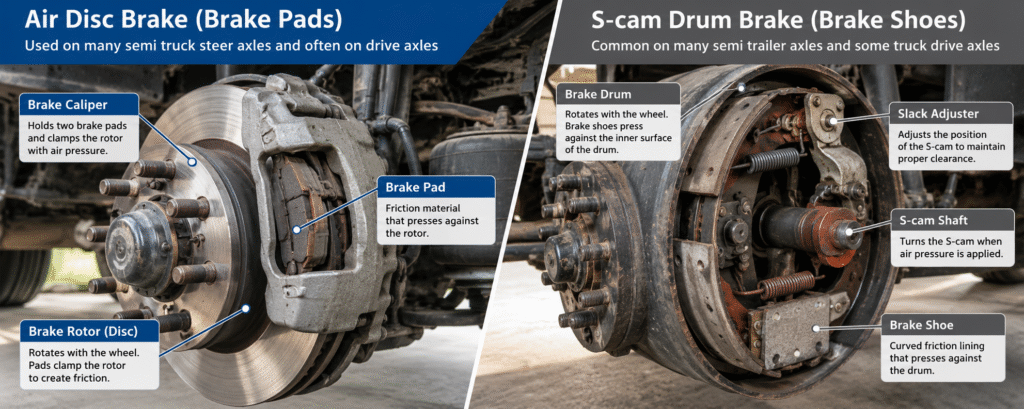
Both, depending on the axle. Air disc brakes use pads that clamp a rotor; S-cam drum brakes use shoes with linings that press against a drum. Many tractors combine the two, so check every wheel end before ordering instead of assuming one setup for the whole truck.
A disc wheel end is easy to recognise: you can see a caliper straddling a rotor. A drum wheel end shows a closed drum and no rotor. Each air disc wheel end normally holds two pads, one inboard and one outboard, so the pad count depends on how many wheel ends have discs, not on the number of axles.
| Configuration (illustrative) | Disc wheel ends | Individual pads |
| 6×4 tractor, discs on the steer axle only | 2 | 4 |
| 4×2 tractor, discs on both axles | 4 | 8 |
| 6×4 tractor, discs on all three axles | 6 | 12 |
| 5-axle tractor-trailer, discs at every wheel end | 10 | 20 |
These are individual pads, not boxes. Check whether a supplier sells kits per wheel end or per axle before you compare prices. For drum-braked axles, the shoe references are different; we compare the most common ones in 4515 vs 4707 vs 4709 brake shoes.
Types of Semi Truck Brake Pads
Semi truck brake pads differ in two ways that matter to a buyer: the brake system they fit and the friction formulation. Fit decides whether the pad goes in at all. Formulation decides how it behaves under the truck’s load, route and braking frequency, within what the brake maker approves.
By brake system
- Air disc brake pads — used on Class 7–8 tractors with air disc calipers such as the Bendix ADB22X or Meritor EX series. This is what most buyers mean by “semi truck brake pads”.
- Hydraulic disc brake pads — used on many medium-duty trucks with hydraulic calipers. They are a different product family and are not interchangeable with air disc pads.
By friction formulation
Heavy-duty pads are commonly grouped as semi-metallic, low-metallic, non-asbestos organic (NAO) and ceramic or hybrid blends. Semi-metallic is the usual choice for heavy-duty air disc brakes because of how it handles heat under load; ceramic and hybrid blends make less dust and hold friction steady but cost more and can wear rotors faster in severe service. Treat these labels as a starting point only: the full formulation and the approved application matter more than the name. We compare the two main families in semi-metallic vs ceramic brake pads.
How to Identify the Right Semi Truck Brake Pads
Identify the caliper, then confirm the pad reference against current manufacturer information. Record every identifier exactly, including suffixes. If markings are worn, use the VIN or build sheet and the vehicle or brake maker’s parts system.
- Note the axle position. Steer, front drive or rear drive. Do not assume every axle uses the same pad.
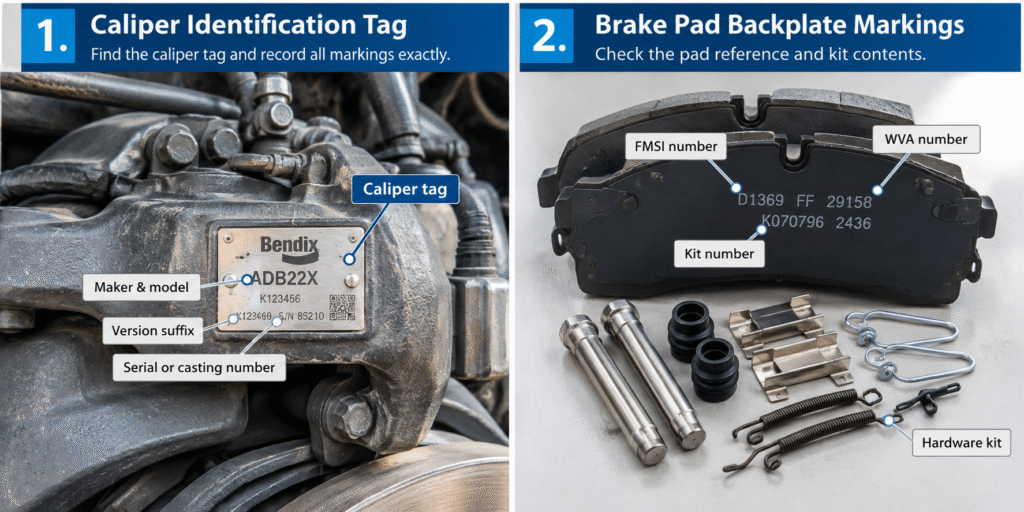
- Read the caliper tag. Record the maker, model, version suffix and any casting number. Clean the area gently and photograph it.
- Record the OE pad or service-kit number from the old pad, the kit box or the parts catalog for that exact caliper.
- Use FMSI and WVA numbers as cross-reference aids. They narrow the pad shape family, but a matching number alone does not prove full interchangeability. Confirm dimensions, friction specification and kit contents.
- Check the wear sensor and hardware. Note the sensor type and connector, and whether the kit includes retainer, springs and other mounting parts.
- Measure if in doubt. Pad length, height and total thickness, plus photos of the old pad and caliper, settle most fitment questions before a bulk order.
An example, not a fitment guarantee: aftermarket catalogs commonly list Bendix ADB22X and ADB22X-LT applications under FMSI D1369 (WVA 29158; Bendix kit K070796), and Meritor EX225 H2 under FMSI D1311 (WVA 29187). The same D1369 shape is also listed for a SAF-Holland trailer caliper, which is exactly why we match by verified reference and not by vehicle name. Variants exist, so confirm the exact application in the current manufacturer documentation.
Semi Truck Brake Pads by Truck Model and Caliper
Truck builders and brake makers have announced standard air disc fitments for several Class 8 models. The table below is historical background from those announcements, not a live fitment catalog: announcement dates are not build dates, and options, later model years and repairs all change what is on a specific truck.
| Tractor | What was announced | Before you order |
| Peterbilt 579 | Bendix ADB22X standard on the steer axle since the 2012 launch; standard on all axles announced December 2017. | Confirm model year, axle and the exact caliper on the truck. |
| Kenworth T680 | Bendix ADB22X standard on the steer axle since 2013; all axles announced July 2018. | Confirm the installed brake package. |
| International LT | Bendix ADB22X standard on all axles of 4×2, 6×2 and 6×4 LT trucks, announced June 2017. | Check the VIN or build sheet and the caliper tag. |
| Freightliner Cascadia | Meritor EX+ LS standard at all wheel positions under a supply agreement extended in November 2020 to run through 2025. | Read the caliper and current kit number; do not extend this to 2026+ builds without checking. |
| Volvo VNL / Mack Anthem | We did not find a builder-published standard caliper to cite. | Use OEM service documentation and the caliper tag. |
If the caliper has been replaced at some point, the part installed on the truck takes priority over any model-based listing.
Friction Ratings: Reading Edge Codes on Steer and Drive Axle Pads
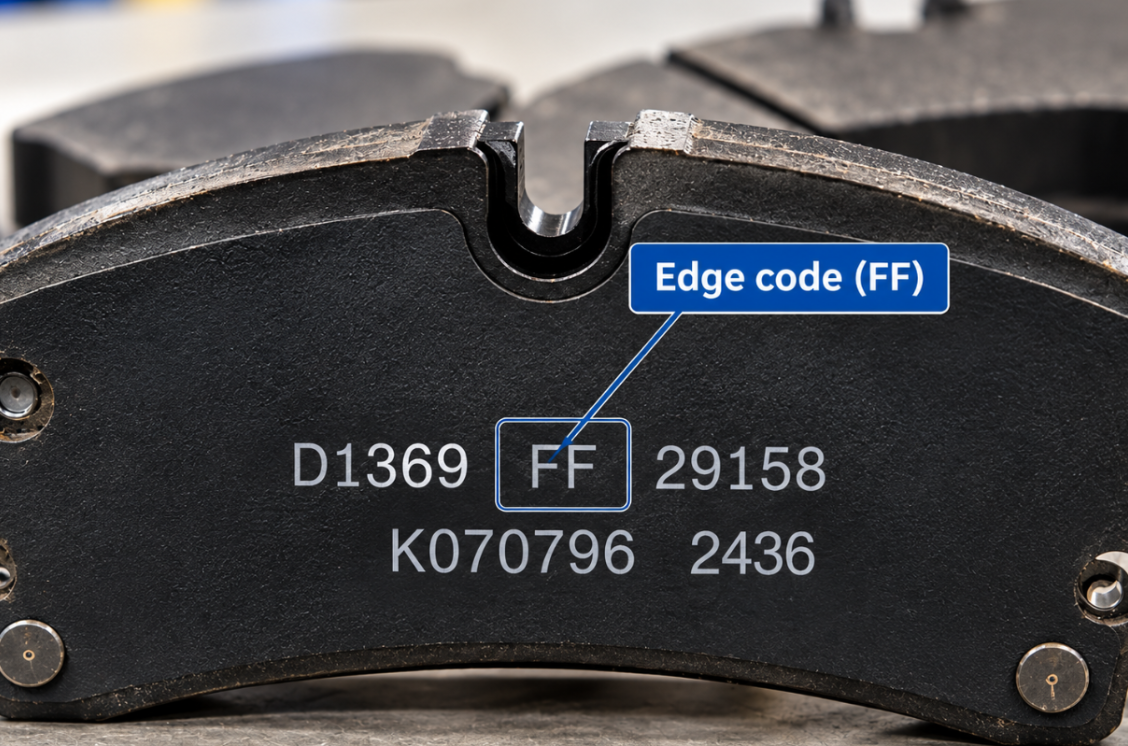
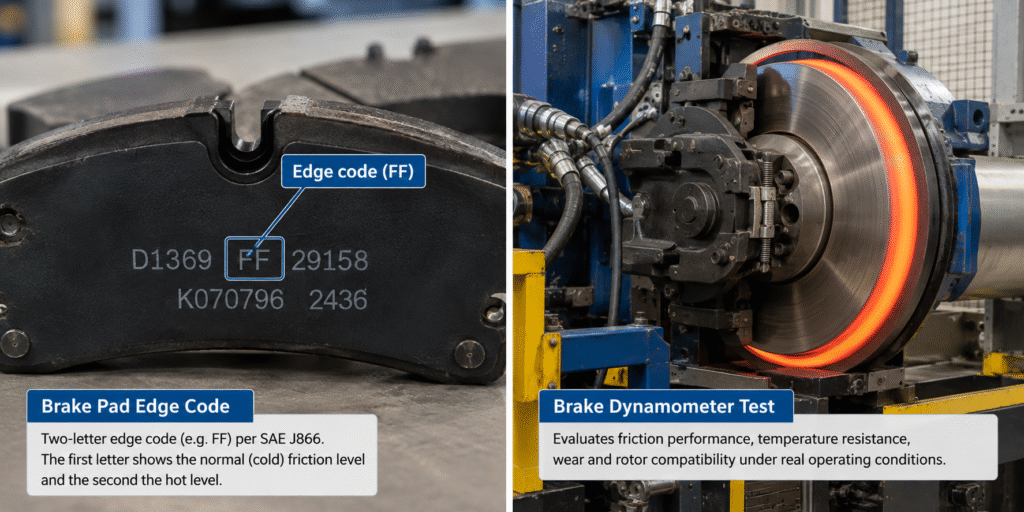
Many friction products carry a two-letter edge code such as “FF”. Under the SAE J866 marking system, the first letter describes the normal (cold) friction level and the second the hot level, each as a coefficient band: E is over 0.25 up to 0.35, F is over 0.35 up to 0.45, and G is over 0.45 up to 0.55. SAE itself states that these codes cannot reliably predict how a complete brake system will perform, and they say nothing about wear life, stopping distance or noise.
So an edge code is an identification aid, not an approval. When we match a replacement, we work from the OE or brake-system specification and treat the edge code as one check among several. On an axle, fit the same formulation on both sides as a matched set and follow the caliper maker’s service instructions; mixing unrelated compounds or replacing one side only can contribute to uneven braking and wear. Steer and drive axles may use different approved pads.
Choosing Pads for the Duty Cycle
Fit comes first; then the approved formulation should suit how the truck works. These are the questions we ask, and the evidence worth requesting from any supplier, including us.
| Application | Questions to ask | Evidence to request |
| Long-haul highway freight | How does the formulation balance wear, rotor compatibility and consistent braking over long routes? | Application approval, wear data, rotor compatibility information |
| Heavy haul or mountain routes | Are sustained temperatures and repeated high-energy stops within the application limits? | Dynamometer and thermal data for the intended configuration |
| Regional delivery, frequent stops | Is the pad suited to frequent applications and the fleet’s service interval? | Wear and service data from comparable duty |
| Cold, wet or corrosive service | Are corrosion protection, hardware condition and inspection routines covered? | Maker’s maintenance guidance and relevant corrosion test evidence |
Semi Truck Brake Pad Replacement: What to Check
U.S. rules set a floor, not a target. Under 49 CFR §393.47, air disc brake pads on both steer and non-steer axles must not be worn below 3.2 mm (1/8 inch). Roadside inspections also apply the CVSA North American Standard Out-of-Service Criteria, and many fleets replace well before either limit. For thickness by brake type, see our semi truck brake pad thickness chart.
Changing pads is also your best chance to figure out why the old ones wore the way they did. Use this as a quick checklist, not a replacement for the caliper maker’s service manual.
- Inboard pad much thinner than outboard: check guide-pin movement and the adjuster as the caliper manual describes.
- One side worn more than the other: investigate caliper operation, mounting and whether matched pads were fitted last time.
- Cracks, lifted friction material or rust under the friction layer: replace the pad regardless of remaining thickness, and inspect the caliper.
- Rotor condition: check thickness, scoring and cracking against the maker’s published limits, not appearance alone.
- Wear sensor and hardware: fit the correct sensor and connector, and follow the kit’s instructions on what may be reused.
Common Ordering Mistakes and How to Avoid Them
| Mistake | Why it matters | Better approach |
| Ordering by truck brand or year only | Different brake packages share model names. | Confirm VIN, axle position and caliper model. |
| Treating an FMSI number as proof of fit | Dimensions, friction and kit contents can still differ. | Cross-check against the approved OE service kit. |
| Ignoring the sensor or hardware | A pads-only kit may omit parts the truck needs. | Specify sensor connector and kit contents. |
| Confusing pad count with kit count | A wheel-end kit can be mistaken for an axle set. | Confirm units per package and per axle. |
| Leaving out operating conditions | Formulation choice depends on duty cycle. | Share load profile and route type. |
Sourcing Semi Truck Brake Pads for Fleets and Distributors
A useful request for quotation lets the supplier check fitment and the commercial side in one pass. These are the fields we ask for.
| RFQ field | What to provide |
| Truck | Make, model, year; VIN or build sheet if available |
| Axle position | Steer, front drive or rear drive |
| Brake identification | Caliper make, model and suffix; clear tag photo |
| Part references | OE kit number; FMSI or WVA cross-reference if known |
| Evidence | Photos of old pad and caliper; pad length, height and thickness where needed |
| Kit requirements | Wear sensor type and connector; retainer and other hardware |
| Duty cycle | Long haul, heavy haul, regional delivery or other |
| Commercial | Quantity per reference, annual demand, destination market, packaging and labeling |
At Tuoba, we manufacture brake pads and linings for commercial vehicles. Send us a confirmed caliper or OE reference and we will tell you whether a matching pad is in our current range, which test documents apply to that reference, and the sample and lead-time terms for it. We confirm these per reference on the quotation rather than promising them across every item.
Browse our heavy-duty brake pad range or send your caliper photo, OE or FMSI reference, axle position, quantities and destination to our sales team.
Frequently Asked Questions
How many brake pads does a semi truck have?
Each air disc wheel end normally has two pads. A 6×4 tractor with discs on the steer axle only has four; with discs on all three axles it has twelve. A five-axle tractor-trailer with discs at every wheel end has twenty. Package counts vary by supplier.
Do semi trucks use brake pads or brake shoes?
Both are common. Air disc brakes use pads and S-cam drum brakes use shoes with linings. A tractor may have discs on the steer axle and drums on the drives, or discs on every axle.
What are semi truck brake pads made of?
A steel backing plate and a friction layer, often with a shim or underlayer. Heavy-duty friction is usually semi-metallic or low-metallic; NAO and ceramic or hybrid blends are also used. The approved formulation for the caliper and duty cycle matters more than the label.
What brake pads does a Freightliner Cascadia use?
There is no single safe answer for every Cascadia. Many were built with Meritor EX+ LS air disc brakes under Meritor’s supply agreement, but the correct kit depends on the caliper actually installed, the build specification and any later repairs.
Are pads with the same FMSI number always interchangeable?
No. An FMSI number narrows the pad shape family, but caliper version, dimensions, friction requirements, sensors and hardware still need to match the approved application.
What do brake pad edge codes like FF mean?
They are SAE J866 friction identification codes: the first letter is the cold friction band and the second the hot band. They help identify a material but do not prove fit, stopping performance or service life.
Why do steer axle pads wear unevenly?
Uneven inboard and outboard wear often points to caliper sliding or adjustment problems; side-to-side differences can come from a caliper fault or mismatched pads. Inspect the system per the maker’s instructions rather than replacing one pad.
Reviewed by: Written by Robert
Technical basis: 49 CFR 393.47, SAE J866 edge codes