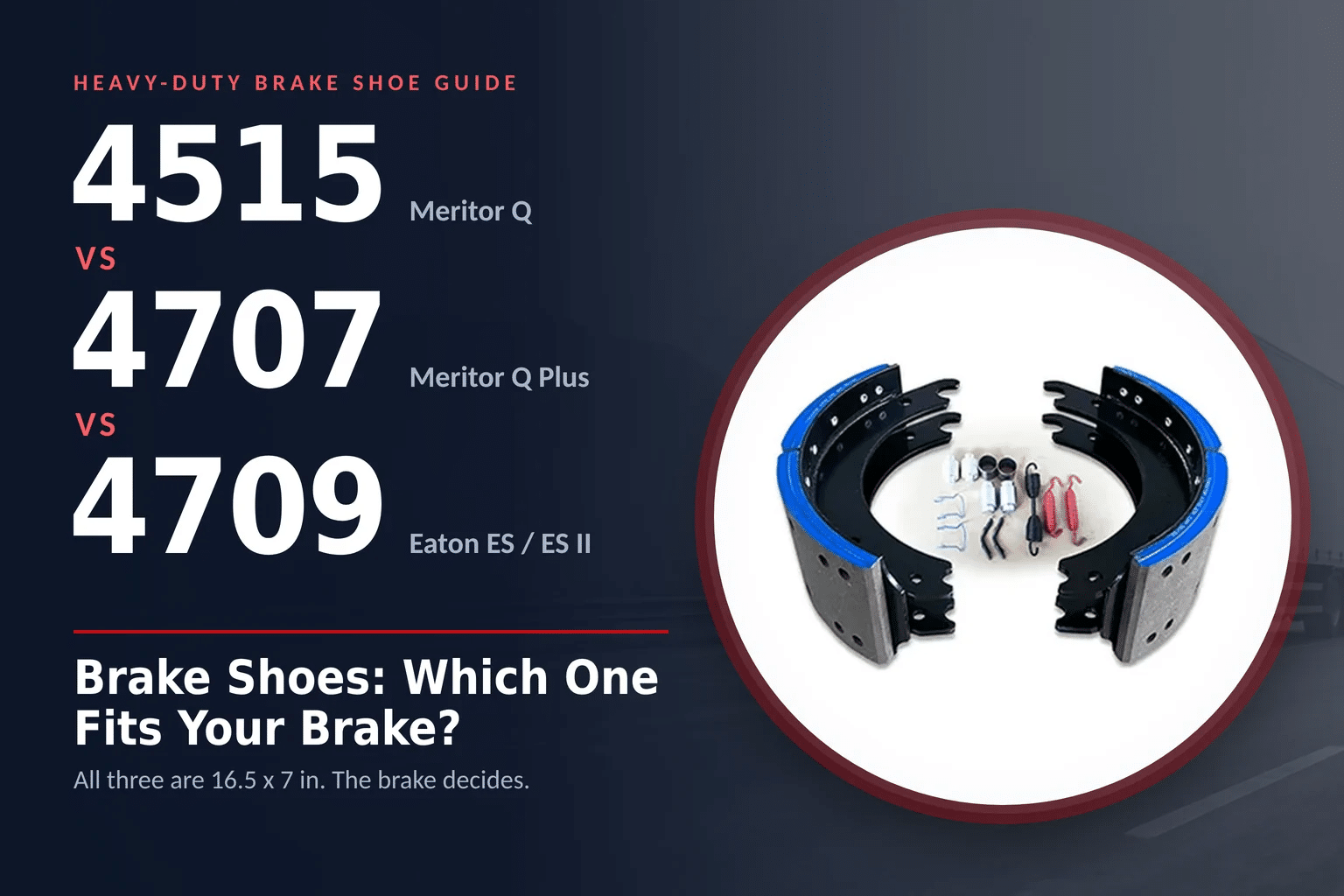
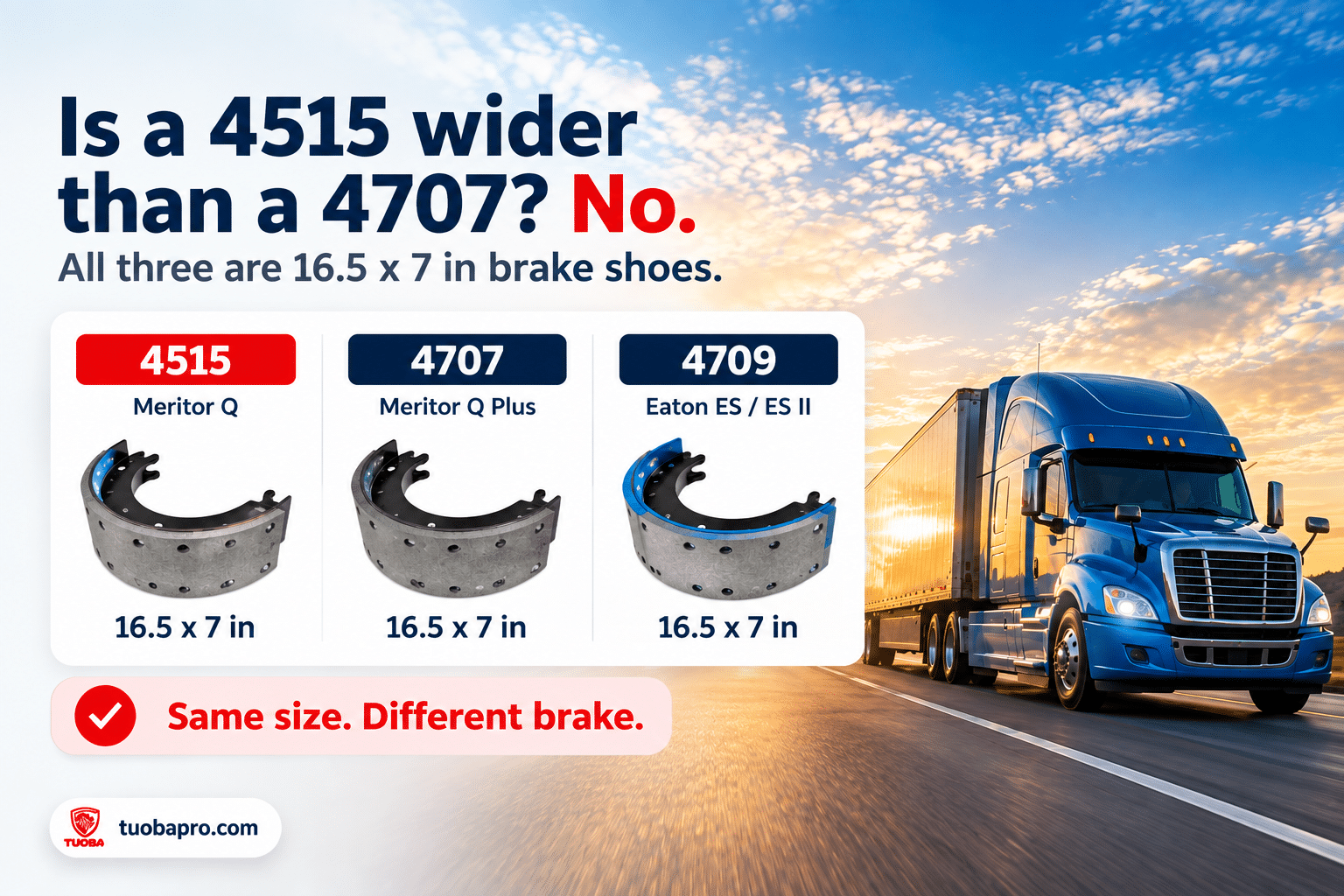
On a pallet, a 4515, 4707 and 4709 look almost identical. All three are 16.5 x 7 in S-cam drum brake shoes. The brake is what separates them: 4515 fits Meritor Q, 4707 fits Meritor Q Plus, and 4709 fits Eaton ES and ES II. Ship the wrong one and it comes back. Here’s how to tell them apart and what to put on your order.
Key Takeaways
- Identify the brake first: Meritor Q takes a 4515, Meritor Q Plus takes a 4707, Eaton ES or ES II takes a 4709 (confirm 4709E or 4709E2).
- Count the rivet holes at each end of the shoe table; the 4515 and 4707 patterns differ, and their linings are not interchangeable.
- Treat 20K and 23K as axle-load test ratings for the lining, not as shoe sizes or SAE friction codes.
- Check AI and forum size claims against a manufacturer chart; the 16.5 x 8 5/8 in shoes are the 4551 and 4711, not the 4515.
- Put FMSI number, brake type, size, axle rating and rivet pattern on every RFQ line.
What Is the Difference Between 4515, 4707 and 4709 Brake Shoes?
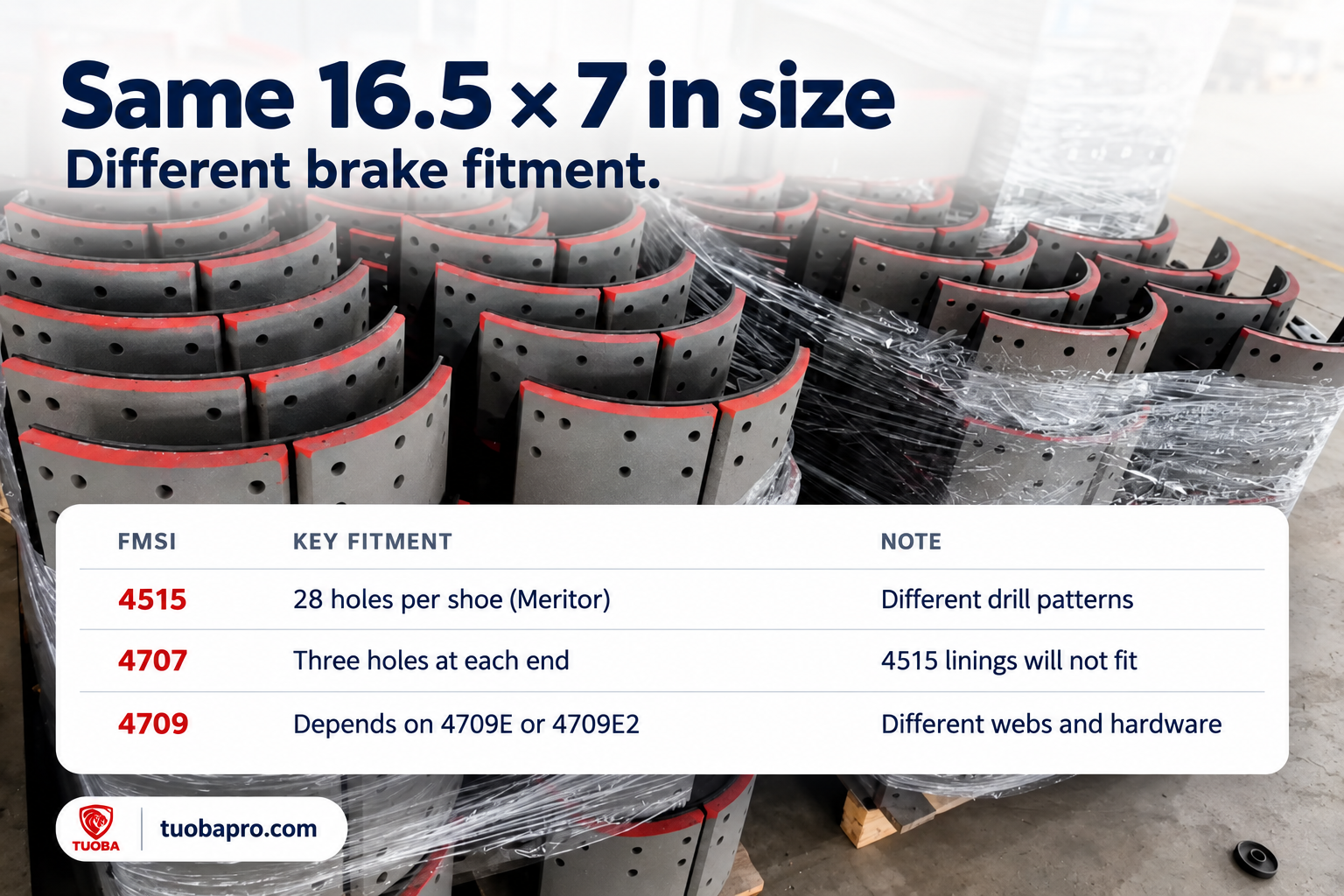
The difference is the brake each shoe is built for. All three are 16.5 x 7 in shoes, but the 4515, 4707 and 4709 have different webs, anchor ends and rivet patterns, so each one fits only its own brake family.
The Haldex air brake shoe identification chart confirms the split. It lists the 4515 as the 16 1/2 in Meritor “Q” shoe, the 4707 as the Meritor “Q” Plus shoe, and the 4709 as the Eaton “ES” or “ES II” shoe. The Meritor brake shoe identification chart gives the same size for all three. What neither chart covers is friction grade. You choose that separately.
Table 1. 4515, 4707 and 4709 brake shoes at a glance
| FMSI | Size | Brake it fits | Rivet pattern | Watch out for |
|---|---|---|---|---|
| 4515 | 16.5 x 7 in | Meritor Q (also listed for Meritor P and Fruehauf) | Meritor production drilling 4515G, 28 holes per shoe; 4515C (32) and 4515E (24) also exist | Several drill patterns; confirm with a photo or hole count |
| 4707 | 16.5 x 7 in | Meritor Q Plus | Three-hole groups at each end of the table | A 4515 lining will not fit a 4707 table |
| 4709 | 16.5 x 7 in | Eaton ES / ES II | Depends on 4709E or 4709E2 version | 4709E and 4709E2 use different webs and hardware |
- Brake make: read the brake spider or axle build sheet before looking at the shoe.
- Anchor end: Haldex lists a closed anchor pin end for the 4515 and a single anchor pin design for the 4709.
- Shoe web: a raised “hump” on the web rails used to mark a 4515, but newer 4515 shoes may not have it.
- Rivet groups: count the holes at each end of the table, not only the total.
- Axle-load rating: 20K or 23K refers to the lining’s test conditions, not the shoe.
The brake settles it. Photograph the shoe web, both ends of the table and the rivet holes, and compare them with the brake make before you order.
Is a 4515 Wider Than a 4707? Common Fitment Claims to Verify
No. Meritor lists both the 4515 and the 4707 as 16.5 x 7 in shoes. Several AI and forum answers still say the 4515 is wider or cut for a different drum. They’re wrong. Check any size claim against a manufacturer chart before you order.
Chatbots still get this wrong. In September 2026 we asked a ChatGPT model, with web search off, how the three shoes differ. It put the 4515 on a 15 in drum and the 4709 on a 17.5 in drum. Meritor’s lined brake shoe catalog lists all three at 16 1/2 x 7 in. Google’s AI Overview for “4707 vs 4515 brake shoe” did better. It cited Haldex and described the rivet test correctly. Go by the part number and the manufacturer chart, not a chatbot.
Table 2. Common claims about 4515, 4707 and 4709 shoes, checked against manufacturer charts
| Claim seen in AI or forum answers | What the manufacturer charts say |
|---|---|
| “The 4515 is an 8 5/8 in wide shoe” | The 4515 is 16.5 x 7 in; the 16.5 x 8 5/8 in shoes are the 4551 (Meritor Q) and 4711 (Meritor Q Plus) |
| “The 4515 fits a 15 in drum and the 4709 a 17.5 in drum” | Meritor lists the 4515, 4707 and 4709 all at 16 1/2 x 7 in |
| “The 4707 is 6 in wide and only comes as 20K” | The 4707 is 16.5 x 7 in, and 4707 kits are sold with 20K to 26K linings |
| “A 4515 can replace a 4707, but not the other way round” | Haldex says 4515 linings do not fit a 4707 table; Meritor says a pre-1994 16.5 in Q brake converts to Q Plus only by changing the shoes, return spring and camshaft |
Treat an AI answer as a starting point, not a spec. Check three things against a Meritor, Haldex or Bendix chart: FMSI number, brake make and width. Then send your supplier a photo of the old shoe to confirm..
How Do You Tell a 4515 From a 4707 Brake Shoe?
Start with the rivet holes at each end of the shoe table. A 4515 has groups of four holes close to the web. A 4707 has groups of three, set further out. Don’t lean on the web “hump” test anymore. Some 4515 shoes don’t have one.
Start with the rivet holes at each end of the shoe table. A 4515 has groups of four holes close to the web. A 4707 has groups of three, set further out. Don’t lean on the web “hump” test anymore. Some 4515 shoes don’t have one.
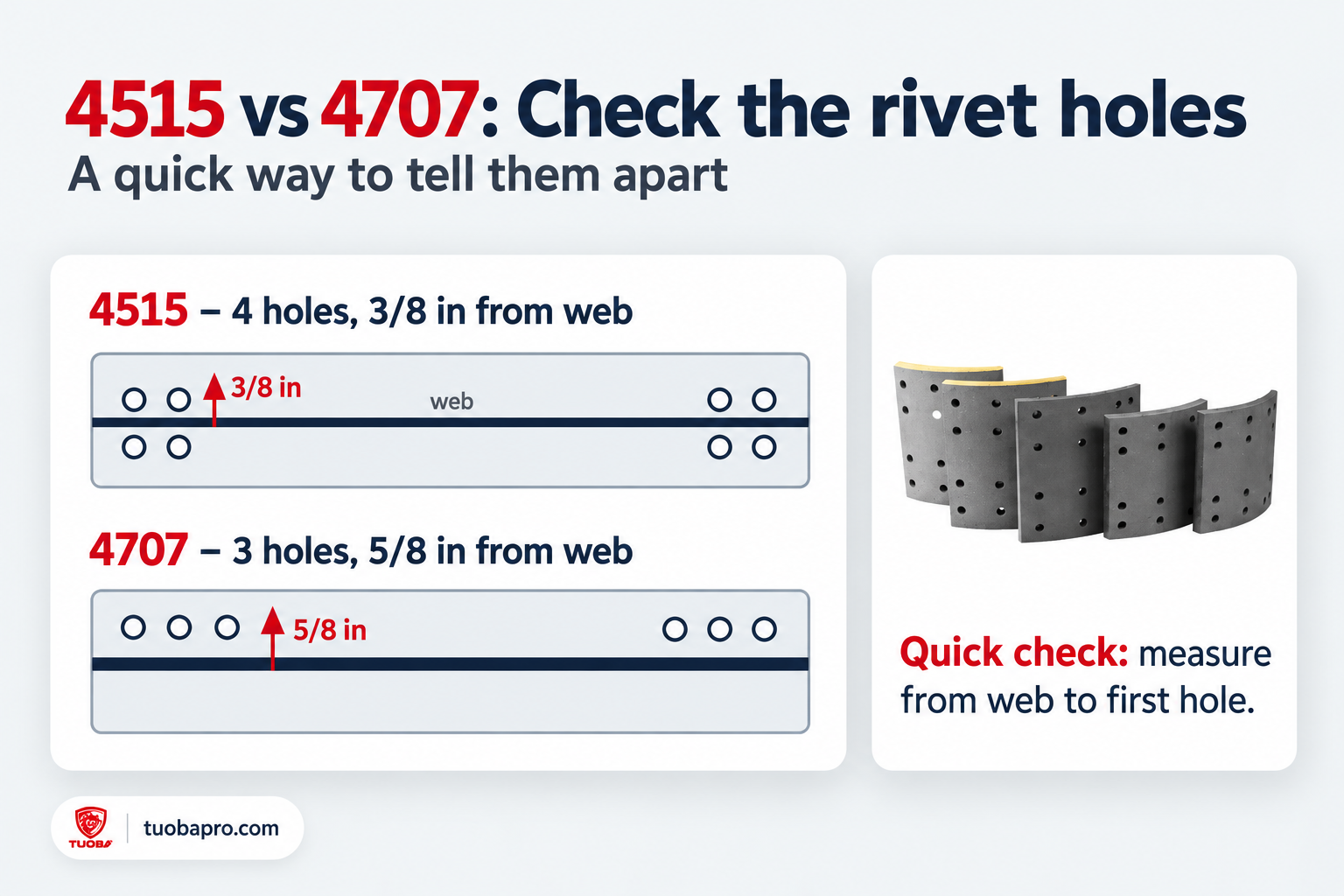
Haldex’s 4515 and 4707 identification sheet puts numbers on it: a 4515 has groups of four rivet holes 3/8 in from the web at each end of the table, and a 4707 has groups of three, 5/8 in from the web. The sheet also notes that humpless 4515 shoes have become common, and that a 4515 lining will not fit on a 4707 shoe table. Meritor’s remanufactured shoe core identification guide uses two checks to separate Q from Q Plus: the hump, and roller end thickness. That’s 1/4 in on Q and 3/8 in on Q Plus. So rivet spacing and roller end thickness are the safer checks.
- End rivet groups: four holes at 3/8 in from the web means 4515; three holes at 5/8 in means 4707.
- Web hump: present on many 4515 shoes, absent on the 4707, but not proof on its own.
- Roller end: 3/8 in on a Q Plus (4707) shoe, 1/4 in on a Q (4515) shoe, per Meritor.
- Lining fit: a lining drilled for 4515 will not fit a 4707 table.
Measure the distance from the web to the first rivet hole at one end, and count the holes in that group. Two measurements settle most 4515 versus 4707 questions.
What Changed Between the 4709E and 4709E2?
TThere are two 4709 designs. The 4709E2 is the current Eaton ES II shoe. The 4709E is the older one, now available only as a remanufactured part. The two have different web widths, and the older shoe takes a different hardware kit. Confirm which version the brake uses before you order a 4709 kit.
A Bendix technical bulletin calls the 4709E2 the widely used 16 1/2 x 7 in shoe for steer, drive and trailer applications. It has a 2 1/4 in web. The older 4709E has a 1 3/4 in web and is remanufactured only. The naming gets confusing here: Bendix also lists universal and modified 4709E shoes, with a 2 1/4 in web and a tabbed table, as direct replacements for the 4709E2. So measure the web. A 2 1/4 in web means an E2-type shoe; 1 3/4 in means the older design. The bulletin does not cover friction ratings
- 4709E2: current production shoe for Eaton ES II brakes.
- 4709E: older shoe with a narrower web, now mostly remanufactured.
- Universal or modified 4709E: shoes made to replace a 4709E2, according to Bendix.
- Hardware: the correct spring and pin kit depends on which version is installed.
Check the shoe or the brake documentation for “E2”, and ask your supplier which hardware kit ships with each version before you approve the order.
Is a 23K Brake Shoe Bigger Than a 20K Shoe?
No. A 20K or 23K label describes the axle load the lining was tested at, not a larger shoe or an SAE friction code. The same 4707 steel shoe can carry either lining, so the rating must be written separately on the order.
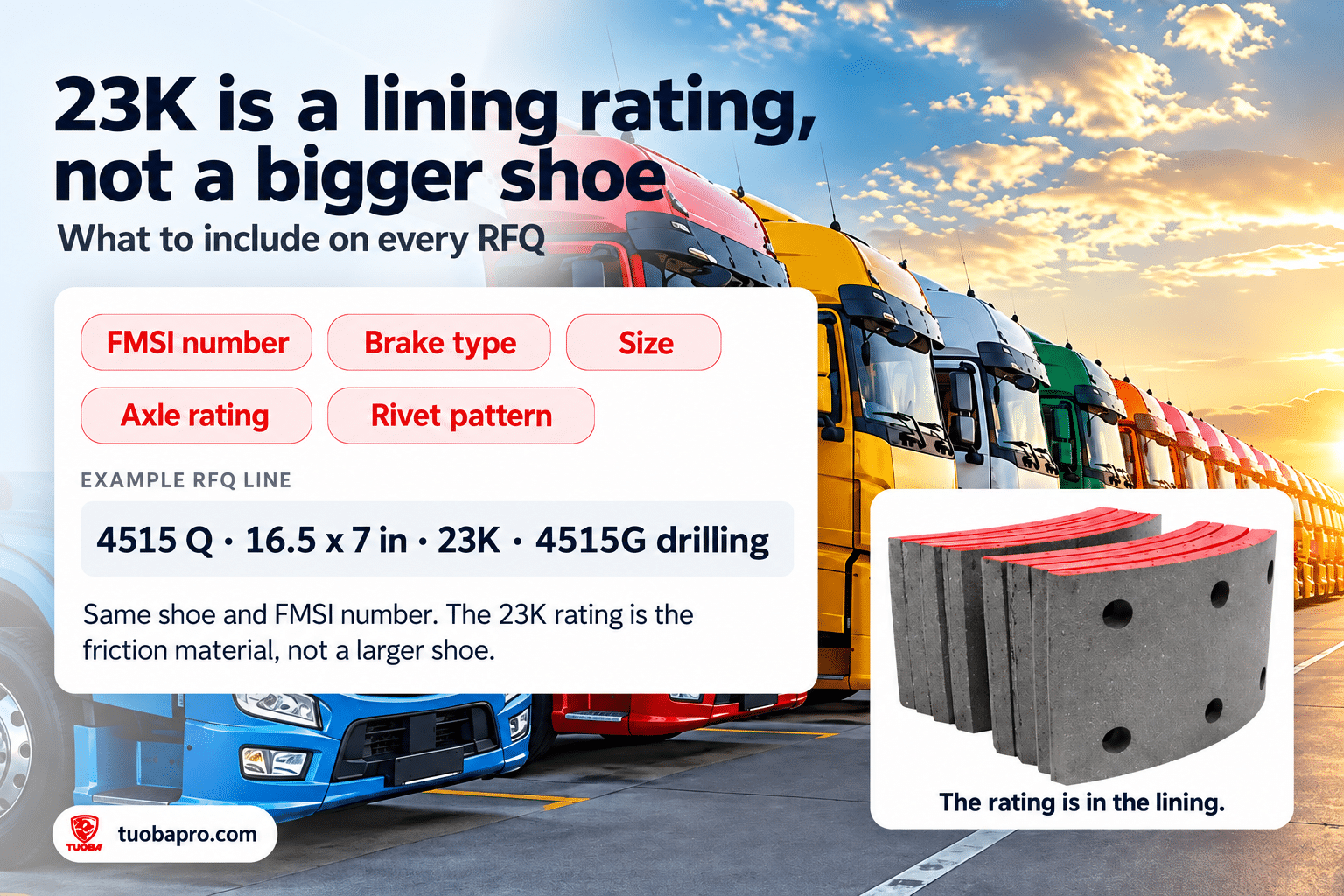
Replacement kits for the same FMSI number are sold with different lining ratings. The FMSI number alone won’t tell you which one you’re getting. Triple R Truck Parts lists 4707 Q Plus kits with 20K and 21K linings, and FortPro lists a 4707 lining set rated at 23,000 lb. Our own 4707 dynamometer reports show the same split: one Meritor 16.5 x 7 brake, one lining tested at 20,000 lb and one at 23,000 lb.
- Shoe: the steel shoe and FMSI number stay the same.
- Lining: the lining specification and its test documentation determine the axle-load rating that applies.
- Test load: the rating refers to the gross axle weight rating (GAWR) used in the dynamometer test.
- Matching: confirm the axle GAWR, brake configuration, lining specification and supporting test report for the application.
A label is not a test result. Ask the supplier for the dynamometer report behind the rating, and check that its brake size and test load match your axle. Our guide to FMVSS 121 brake lining test reports explains which report fields to check.
What Should a 4707, 4515 or 4709 RFQ Include?
List five things on every line: FMSI number, brake type, size, axle rating and rivet pattern. Leaving out the brake type or the rivet pattern can lead to a quote for the wrong version of the shoe and another round of emails.
Each FMSI number covers more than one version, as Table 1 shows. The 4515 has several drill patterns, the 4709 has E and E2 versions, and all three come with different lining ratings. A complete line removes the guesswork for the supplier.
- 4707 Q Plus, 16.5 x 7 in, 23K, 28-hole
- 4515 Q, 16.5 x 7 in, 23K, 4515G drilling (28-hole)
- 4709E2, 16.5 x 7 in, 23K, 28-hole
Add quantity, lined or unlined shoes, and whether you need hardware kits. Attach a photo of the old shoe when you are not sure of the version. For the test documents to request with friction material, see the brake lining category, and for shoe options see heavy-duty drum brake shoes.
The 4515, 4707 and 4709 are all 16.5 x 7 in air drum brake shoes, and size alone will not separate them. Start with the brake: Meritor Q uses the 4515, Meritor Q Plus uses the 4707, and Eaton ES or ES II uses the 4709. Then check the rivet groups at each end of the table, because 4515 and 4707 linings do not swap. Confirm 4709E or E2, and check size claims against a chart. Treat 20K and 23K as lining test ratings tied to axle load, not shoe sizes, and write FMSI number, brake type, size, rating and rivet pattern on every RFQ line.
FAQ
Are 4707 and 4515 brake shoes interchangeable?
Not as direct replacements. The 4515 fits the Meritor Q brake and the 4707 the Q Plus, with different rivet patterns. Meritor allows pre-1994 16.5 in Q brakes to be converted to Q Plus with Q Plus shoes, return spring and camshaft.
Can a 4707 replace a 4709 brake shoe?
No. Both are 16.5 x 7 in, but the 4707 is built for the Meritor Q Plus brake and the 4709 for the Eaton ES or ES II. Their anchor ends and hardware differ, so match the shoe to the brake make.
What do suffixes like 4515Q and 4707QP mean?
They usually mark the brake family or version. Meritor lists cores such as C4515Q for the Q brake and C4707QP for the Q Plus; 4515C and 4515E use other drill patterns. Check brake type and rivet count before ordering.
Can a 4709E replace a 4709E2?
Only with the right shoe version and hardware. Bendix lists universal and modified 4709E shoes as compatible 4709E2 replacements, while the older 4709E has a narrower web. Confirm which version and hardware kit the supplier is sending.
Does the FMSI number tell me the axle-load rating?
No. The FMSI number identifies the shoe and lining shape, not the axle-load rating or friction grade. The same 4707 shoe is sold with 20K, 23K and other linings, so state the rating separately and ask for the matching test report.
What is the difference between 4707 and 4711 brake shoes?
Width. Meritor lists the 4707 as a 16.5 x 7 in Q Plus shoe and the 4711 as a 16.5 x 8 5/8 in Q Plus shoe. Each needs a drum and brake of matching width, so they do not swap.
Not sure which one you have? Send us a photo of the shoe and we’ll confirm it.
Reviewed by: Written by Robert
Test evidence: FMVSS 121 dynamometer reports for 4707 20K and 23K linings (Link Engineering, 2023)
Technical basis: Haldex brake shoe identification charts, Meritor brake shoe catalog and Maintenance Manual 4, Bendix technical bulletin TCH-022-002