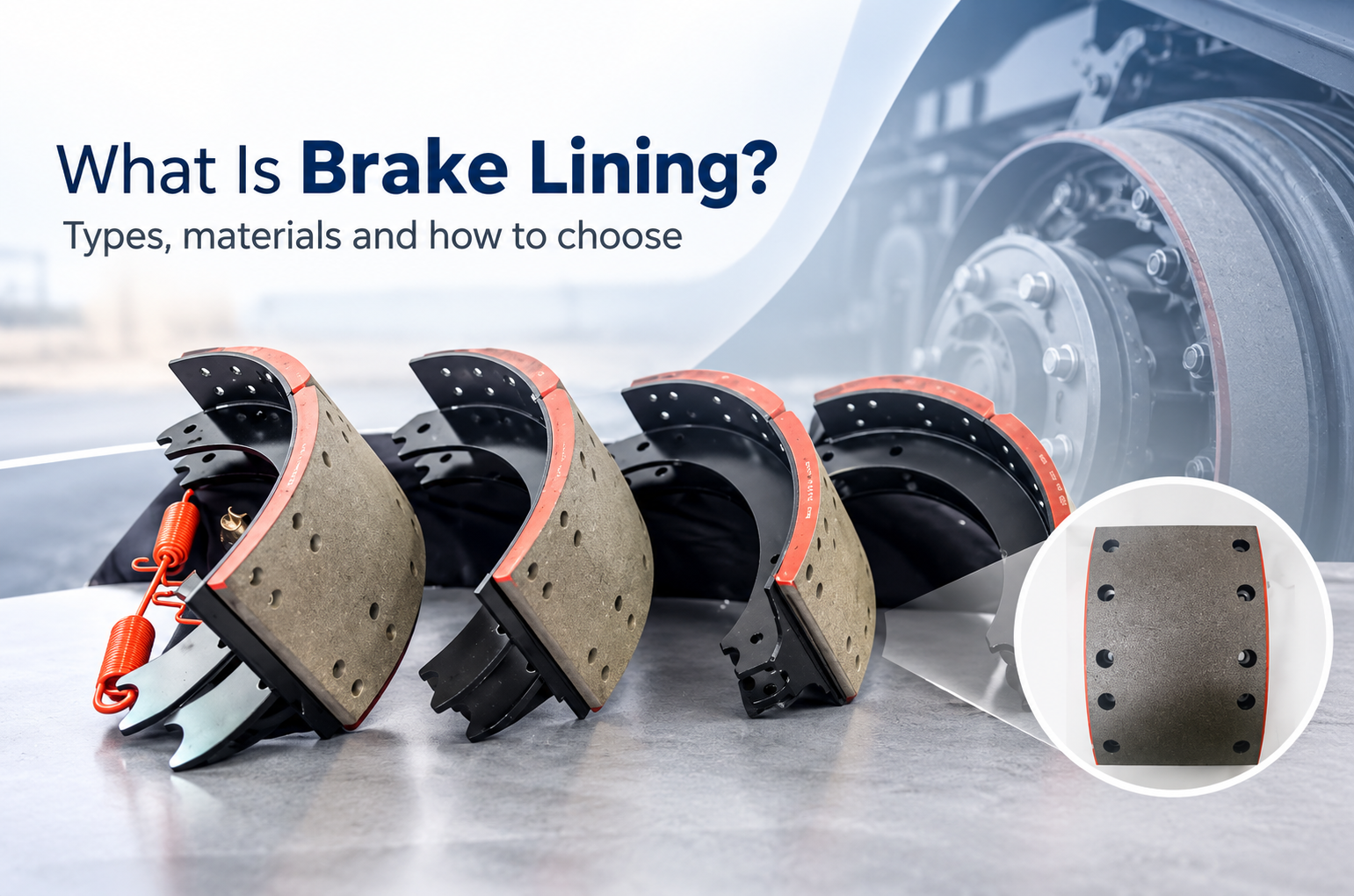
Brake lining is the friction material that presses against a drum or rotor to stop a vehicle. Some people call it a brake liner. On a heavy truck it is usually a riveted block on a steel shoe, and US rules say it must stay at least 1/4 in thick on most air drum brakes.
Key Takeaways
- Brake lining is the friction layer itself; the shoe or backing plate is the steel part that carries it.
- Heavy-duty air drum brakes mostly use riveted lining blocks, while bonded linings are more common on light vehicles and disc pads.
- Asbestos linings have been banned in the US since May 28, 2024, and LeafMark “N” marks friction material with less than 0.5% copper.
- An edge code tells you the friction level, not the stopping distance. Match codes across an axle.
- For trucks, choose by brake type and FMSI number, axle rating, test report and market rules, in that order.
What Is Brake Lining?
Brake lining is the layer of friction material that rubs against the drum or rotor when you brake. Brake liner, brake linings and friction lining all mean the same part. It wears out long before the steel shoe or backing plate does.
Wikipedia’s brake lining entry describes linings as the consumable surfaces in drum and disc brakes, fixed to a metal backing by adhesive or rivets. Put the backing and the lining together and you get what catalogs sell as a brake shoe (drum) or a brake pad (disc). The entry stops there. It has no heavy-duty data, so truck buyers need the standards covered below.
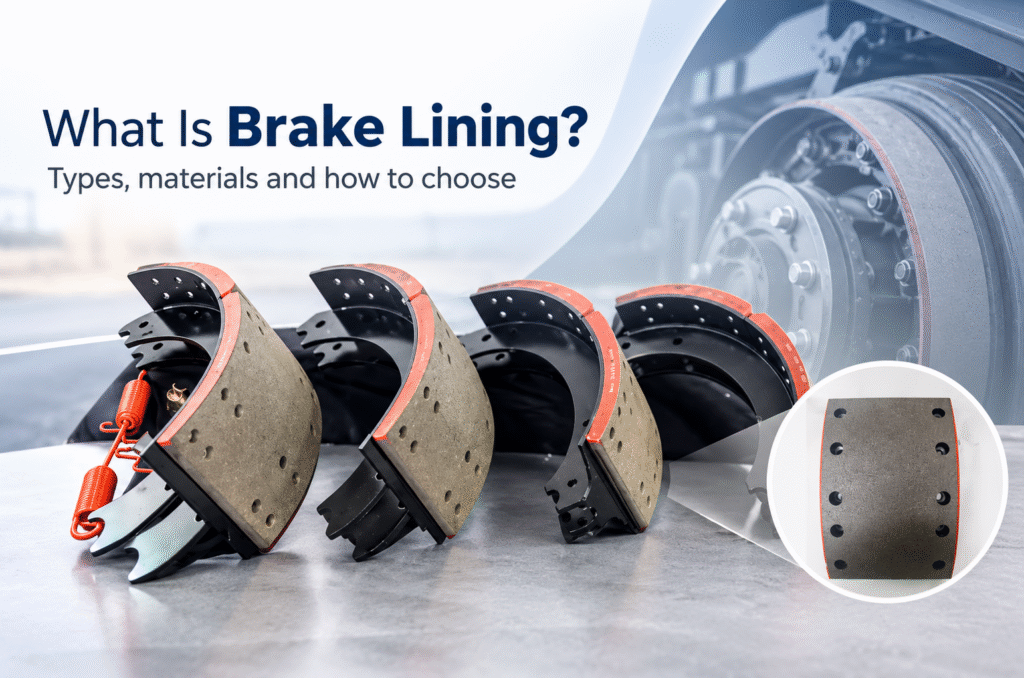
On a drum brake, the lining is curved to match the drum and sits on a shoe that the S-cam pushes outward. A disc brake carries it as a flat pad on a backing plate, which the caliper clamps against the rotor. Cranes, winches and hoists work the same way, often with woven or roll lining.
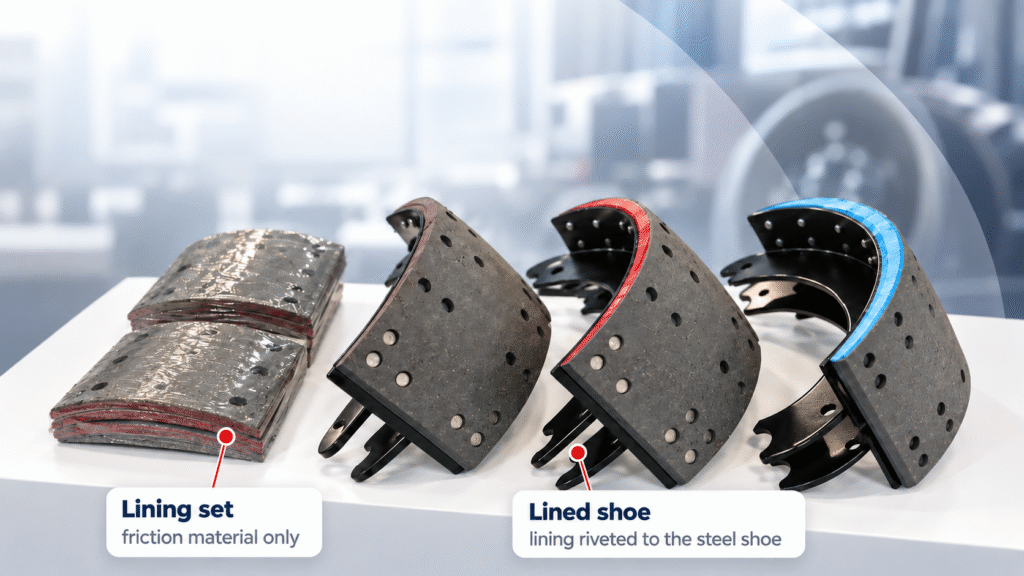
If the friction material comes off the metal once the rivets are drilled out, it is a lining set. If the friction material and steel come as one piece, you are buying a lined shoe or pad.
What Forms Does Brake Lining Come In?
Brake lining comes in four main forms: riveted drum blocks, bonded drum shoes, disc brake pads and woven or roll lining. Heavy trucks and trailers mostly run riveted blocks. The form decides how you replace the lining and how much of it you can actually wear.
Machine Design notes that linings are fixed to the shoe by riveting or bonding. Riveting is simpler, it says, but usable lining depth depends on how deep the rivet heads are countersunk. That is why rivet pattern and lining thickness both show up on heavy-duty orders.
Table 1. Brake lining forms and where they are used
| Form | Where you find it | How it is attached | What to specify |
|---|---|---|---|
| Riveted drum block | Class 7–8 trucks, trailers, buses with air drum brakes | Rivets through drilled holes in the shoe table | FMSI number, rivet pattern, thickness, axle rating |
| Bonded drum shoe | Light trucks, cars, parking brakes | Adhesive cured under heat and pressure | Shoe number, width, bonding method |
| Disc brake pad | Air disc brakes on trucks and trailers, most cars | Molded onto a steel backing plate | WVA or FMSI number, caliper model |
| Woven or roll lining | Cranes, winches, hoists, industrial band brakes | Cut to length, then riveted or bonded | Width, thickness, temperature range |
There is a trade-off here. Riveted blocks can be relined on a reused shoe core, which keeps costs down for fleets that rebuild shoes. But you stop wearing at the rivet heads. Bonded linings use more of their depth, and you replace the whole shoe when they are done.
Ask your supplier which form the quote covers. “4707 lining” and “4707 lined shoe” are different line items, and the price gap between them is the steel core.
What Is Brake Lining Made Of?
Most brake lining today is a molded mix of fibers, binders, fillers and friction modifiers, with no asbestos. The common families are non-asbestos organic (NAO), low-metallic, semi-metallic and ceramic. Each recipe trades friction level, heat tolerance, wear rate and noise against the others.
US rules now shape the recipe. The EPA’s 2024 chrysotile asbestos rule bans manufacture, import and sale of aftermarket automotive brakes and linings containing it from May 28, 2024. The Copper-Free Brake Initiative set limits of under 5% copper by 2021 and 0.5% by 2025. Hendrickson says this covers all commercial vehicle brake friction material, drum and disc, and that its trailer drum brakes already meet the 2025 level. Our drum brake linings meet the same Level N, and each carton label shows the LeafMark N, FMSI number, drill pattern and wear indicator type.
Table 2. Common brake lining material families
| Material family | Typical makeup | Usually chosen for | Trade-off to check |
|---|---|---|---|
| Non-asbestos organic (NAO) | Organic and mineral fibers, resin binder | Quiet operation, low drum wear | Can fade sooner under sustained heat |
| Low-metallic | NAO base with a small share of metal fibers | Better heat transfer than NAO | More noise and dust than NAO |
| Semi-metallic | Higher steel fiber content | Heavy loads, frequent hard stops | Harder on drums and rotors |
| Ceramic | Ceramic fibers and fillers | Clean, quiet disc pads on cars and light trucks | Less common in heavy-duty drum blocks |
Don’t buy on the family name alone. Two semi-metallic linings can test very differently, so compare the test reports. Our guide to OEM vs aftermarket brake linings shows how replacement linings are compared with the original. We produce all four families at Tuoba and match the recipe to the axle load, duty cycle and drum or rotor type.
For US sale, look for LeafMark “N” (under 0.5% copper) on the product or packaging, and ask for a written asbestos-free declaration with each shipment. It also pays to ask your supplier to tell you before they change a recipe, and to retest when they do.
How Do You Read the Markings on a Brake Lining?
Brake lining carries up to four markings: an edge code, a part number, an approval mark and a copper mark. The edge code shows friction level. The part number shows fit, and the approval mark shows its test market. None of them shows stopping distance.
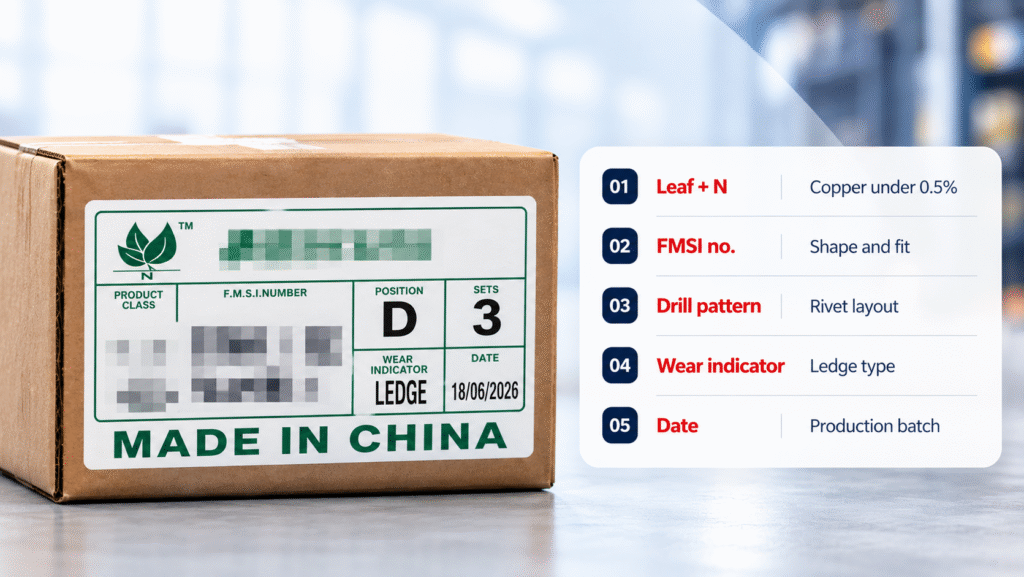
The edge code ends in two letters. Brake & Front End explains that the first letter is the normal friction coefficient (about 200–400°F) and the second is the hot coefficient (about 300–650°F). Tomorrow’s Technician adds that the letters run from C, least aggressive, to H, most aggressive. They say nothing about wear life or noise.
Table 3. What each brake lining marking tells you
| Marking | Example | What it tells you | What it does not tell you |
|---|---|---|---|
| Edge code friction letters | “FF” | Normal and hot friction level from a lab test | Stopping distance, wear life, noise |
| FMSI number (North America) | 4707 | Shape, size and rivet pattern of the block | Axle rating or friction grade |
| WVA number (Europe) | 19094 (BPW) | Pad or lining shape for European applications | Market approval |
| UN R90 approval mark | E1 + approval number | Tested against the original part for European sale | US compliance |
| LeafMark copper level | N | Copper below 0.5% by weight | Friction or durability |
Check the edge code on both wheels of an axle before you reline one side. Same FMSI number, different friction letters, and the truck will pull under braking.
For Europe, UN Regulation 90 covers replacement linings for vehicles and trailers and tests them against the original equipment part. For the US, see our guide to brake pad certifications.
What Do AI Answers Get Wrong About Brake Lining?
AI answers about brake lining are written for car owners. They talk about hydraulic pedals, copper-rich ceramic pads and a 3–4 mm replacement point. On an air-braked truck, two of those don’t apply and one is below the legal minimum.
On October 2, 2026, we pulled the Google results for “brake lining” in the US through the DataForSEO SERP API. Google’s AI Overview cited Wikipedia and GEO Brakes. It said hydraulic pressure pushes the lining against the drum, that ceramic linings use copper fibers, and that linings are worn out below 3 to 4 mm.
Table 4. AI Overview claims about brake lining, checked for heavy trucks
| What the AI Overview said | What applies to an air-braked truck |
|---|---|
| Hydraulic pressure forces the lining against the drum | Air brakes use an air chamber and S-cam, not hydraulic fluid |
| A soft or spongy pedal is a sign of worn lining | Air brakes have no hydraulic fluid to go spongy; check lining thickness and stroke instead |
| Ceramic linings are made with copper fibers | US brake friction material must now stay under 0.5% copper (LeafMark N) |
| Replace when lining is below 3 to 4 mm | FMCSA sets 1/4 in (6.4 mm) as the minimum on non-steering air drum brakes |
That last row matters most. A fleet that follows the 3–4 mm rule of thumb would keep running linings that are already below the 6.4 mm legal limit. Use the FMCSA numbers for trucks, and use AI answers only as a starting point.
How Do You Choose the Right Brake Lining?
Start with the brake, then the axle, then the evidence. Match the brake type and FMSI number first, then the axle rating, such as 20K or 23K. Then ask for the test report behind that rating and confirm the lining meets your market’s rules.
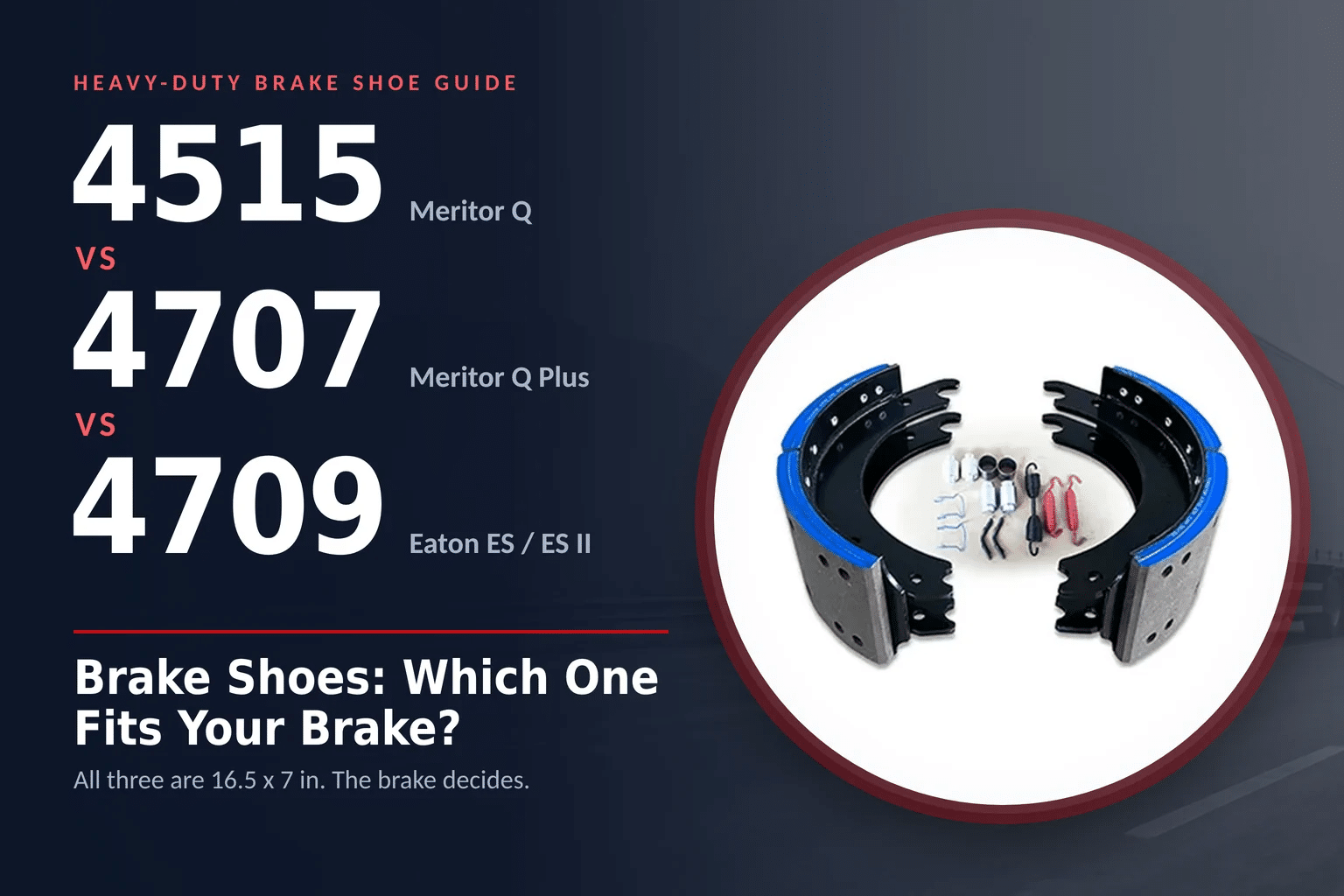
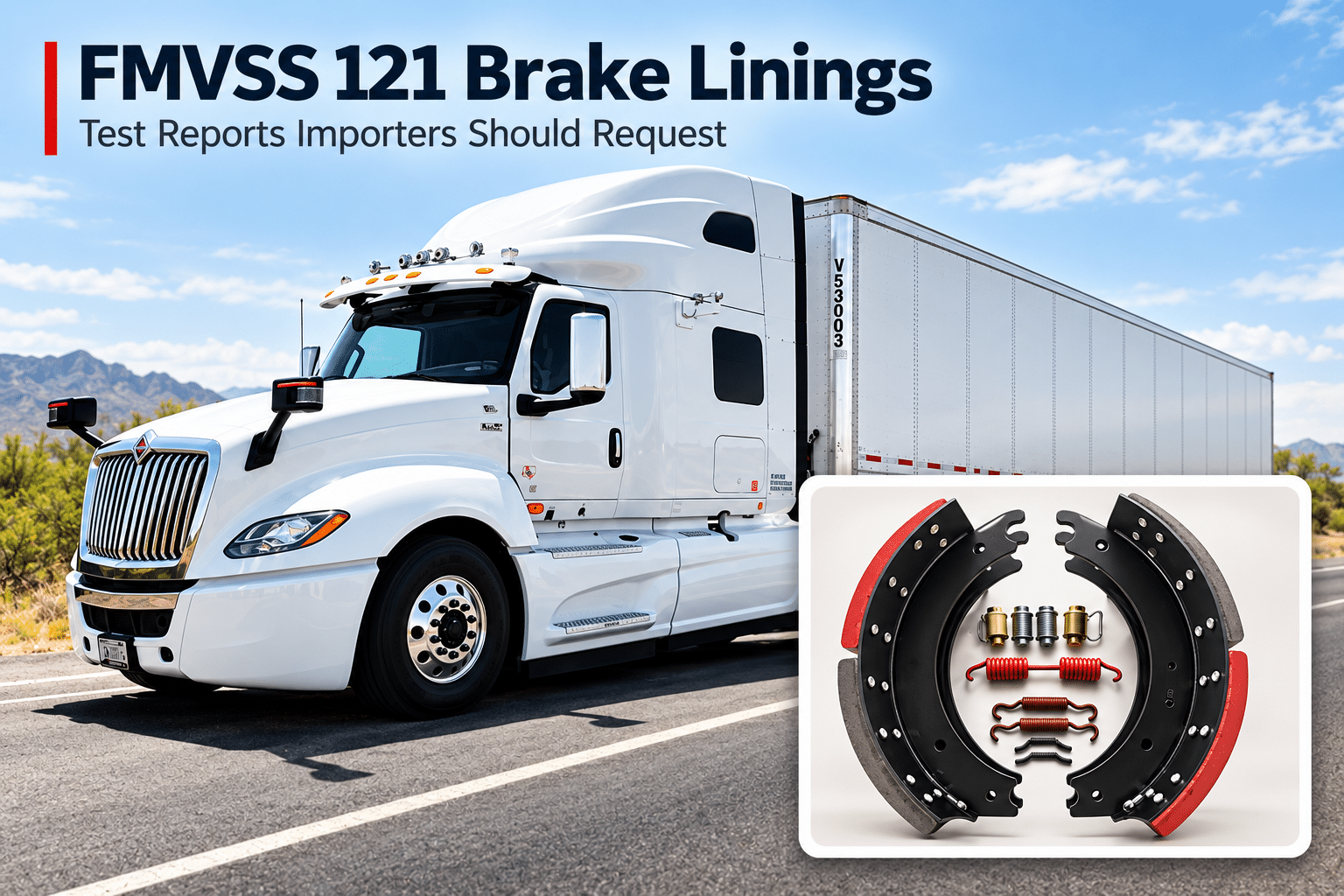
Fit comes first because one size can hide several parts. The 4515, 4707 and 4709 are all 16.5 x 7 in shoes for different brakes, as our 4515 vs 4707 vs 4709 guide shows. After fit, the rating has to be backed by a dynamometer test on the same brake size. Our guide to FMVSS 121 brake lining test reports lists the report fields to check.
When fleet buyers send us an RFQ, we ask for these six fields.
- Brake and part number: brake make and model, FMSI or WVA number, rivet pattern.
- Axle rating: the GAWR the lining was tested at, such as 20,000 or 23,000 lb.
- Test evidence: FMVSS 121 dyno report for the US, UN R90 approval for Europe.
- Friction match: the same edge code on both ends of each axle.
- Market rules: asbestos-free declaration and LeafMark copper level for US sale.
- Wear limit: plan replacement before the legal minimum (below).
The FMCSA rule at 49 CFR 393.47 sets 1/4 in (6.4 mm) as the minimum for air drum linings on non-steering axles. On steering axles it is 3/16 in (4.8 mm) at the shoe center for a continuous strip, or 1/4 in for a shoe with two pads.
Put those fields on every RFQ line and ask for the documents with the quote. A supplier who sends the report, the declaration and a sample before you order is a lot easier to approve. Our truck brake lining supplier guide and checklist for choosing a brake lining manufacturer cover the rest of the vetting. You can browse our brake lining range and heavy-duty drum brake shoes for part numbers.
Brake lining is the friction material on a drum shoe or disc pad. Heavy trucks mostly run riveted blocks, and in the US every lining must be asbestos-free and, under LeafMark “N”, below 0.5% copper. Pick by brake, axle rating and test report, and replace before the FMCSA minimum of 1/4 in on non-steering air drum brakes, not at the 3–4 mm that AI answers suggest.
FAQ
Is brake lining the same as a brake pad?
Not exactly. Brake lining is the friction material, and a brake pad is lining molded onto a steel backing plate for a disc brake. On a drum brake, the same material is riveted or bonded to a curved shoe instead.
How thick should truck brake lining be?
Under FMCSA rules, air drum brake lining on non-steering axles must be at least 1/4 in (6.4 mm). Steering axle linings need at least 3/16 in at the shoe center for a continuous strip, or 1/4 in for two-pad shoes.
How do I know if my brake linings are bad?
Measure them. On an air-braked truck, lining at or near 1/4 in on a non-steering axle is due for replacement. Also look for cracks, loose rivets, grease or oil on the lining, and a truck that pulls to one side.
Does brake lining still contain asbestos?
Not legally in the US. The EPA’s 2024 rule bans manufacture, import and sale of aftermarket automotive brakes and linings with chrysotile asbestos from May 28, 2024. Ask suppliers for a written asbestos-free declaration with every shipment.
Can you mix different brake linings on one axle?
You shouldn’t. Linings with different friction codes on the same axle brake unevenly and can pull the vehicle to one side. Reline both ends of an axle together, with the same part number, friction code and supplier.
What is the difference between riveted and bonded brake lining?
Riveted lining is fastened with rivets through the shoe table and can be replaced on a reused shoe core. Bonded lining is glued under heat and pressure, uses more of its depth, and is usually replaced as a complete shoe.
Need linings matched to your brakes and markets? Send us your FMSI or WVA numbers and axle ratings, and we’ll reply with options and test documents.
Reviewed by: Written by Robert
Data: Google AI Overview for “brake lining” (US), pulled through the DataForSEO SERP API, October 2, 2026
Technical basis: 49 CFR 393.47, EPA Copper-Free Brake Initiative, EPA 2024 chrysotile asbestos rule, UN Regulation 90, SAE J661 edge codes