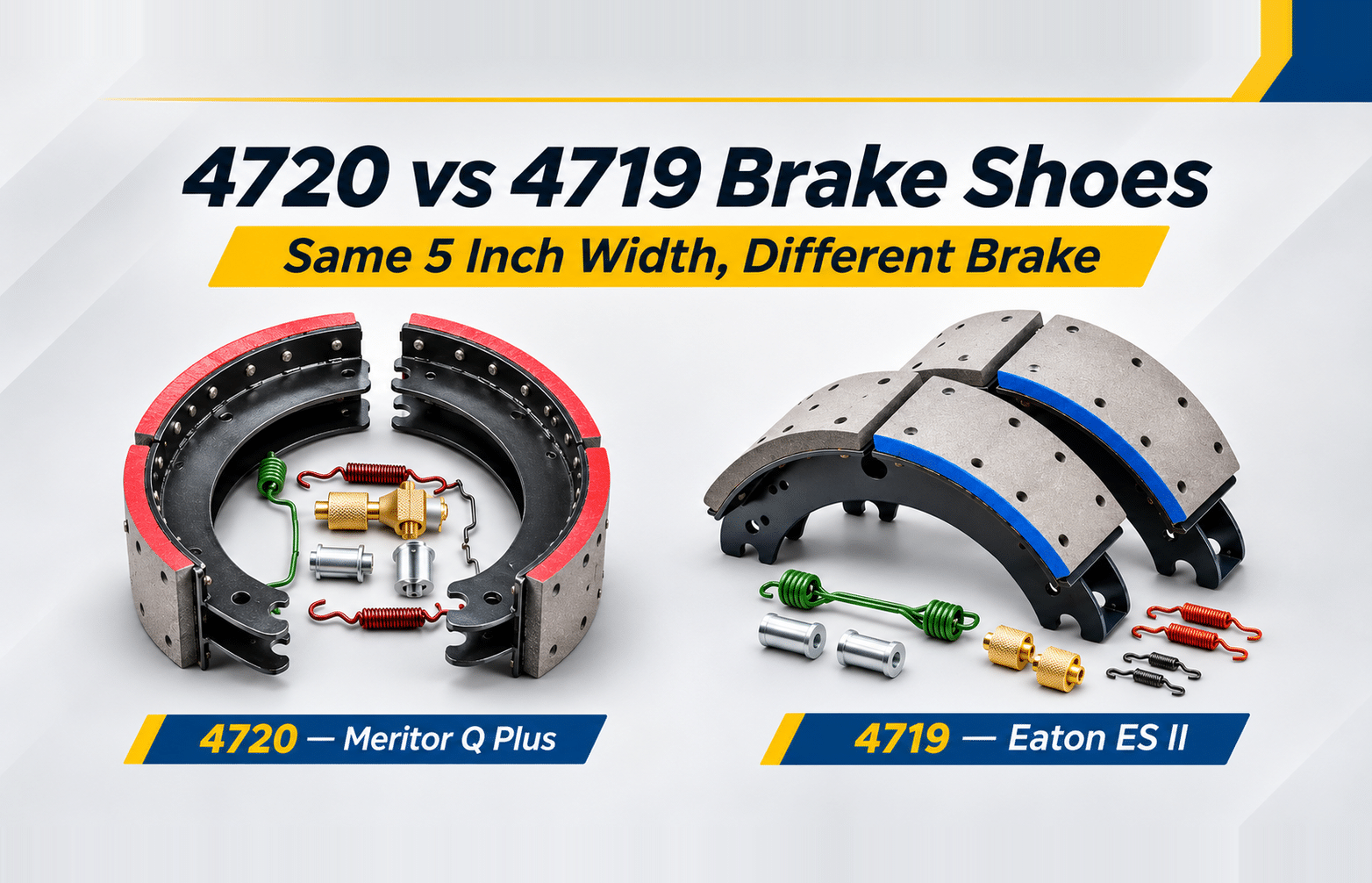
Can 4719 and 4720 brake shoes be used interchangeably?
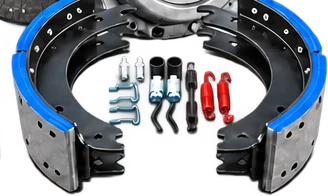
At first glance, a 4719 and a 4720 look like the same 16.5 × 5-inch brake shoe. But the 4720 is made for Meritor Q Plus brakes, while the 4719 is for Eaton ES II. Their shoe design and hardware are different, so you can’t simply swap one for the other. We’ll focus on the complete brake shoes here and bring in lining details only where they help explain the fit. If you’re comparing other widths in the same family, our Meritor Q Plus brake shoe size chart is a good place to start.
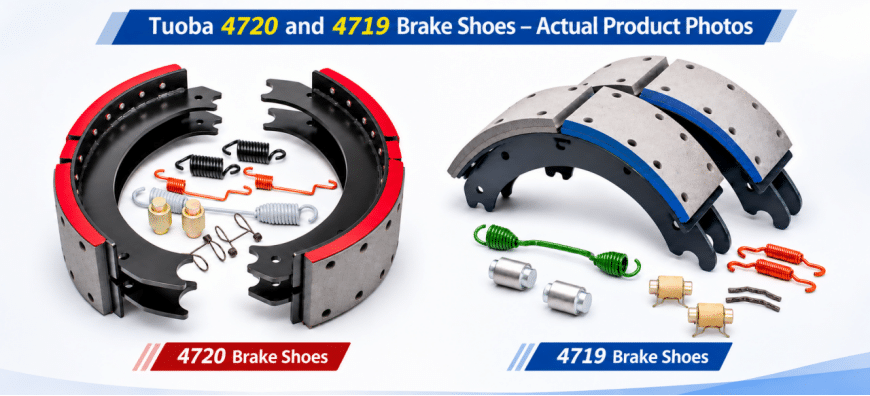
Not sure whether yours is a 4719 or a 4720? Send us the part number or a few photos and we will check it with you.
Why these two get mixed up
Both numbers often appear as ‘16.5 × 5’ on a parts list. You’ll see them in certain steer-axle applications, sometimes with several lining grades under the same shoe number. If that’s all the information a buyer has, it’s easy to think they’re the same part.
The lining size and rivet-hole layout can give us a few clues. But for a complete brake shoe, we also need to look at the anchor end, how the springs and rollers fit, and which brake assembly it’s made for.
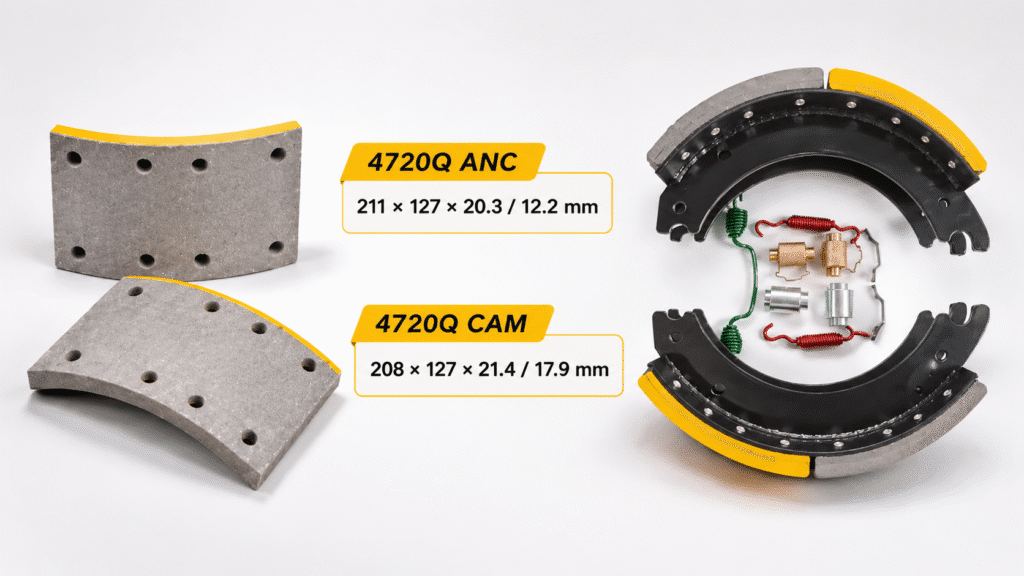
For example, our 4720Q ANC and CAM linings are both 127 mm wide, but their lengths and thickness specifications differ. The ANC measures 211 × 127 × 20.3/12.2 mm, while the CAM measures 208 × 127 × 21.4/17.9 mm. This is why checking the lining width alone isn’t enough when selecting replacement brake parts.
4720 vs 4719 Brake Shoes: Fitment and Key Dimensions
| Shoe Fitment / Lining Reference | 4720 | 4719 |
|---|---|---|
| Brake shoe size | 16.5 × 5 in | 16.5 × 5 in |
| Brake system | Meritor Q Plus | Eaton ES II (Bendix / Spicer ES II) |
| Lining block width | 127 mm | 127 mm |
| Lining dimensions (L × W × T) | ANC: 211 × 127 × 20.3 / 12.2 mm; CAM: 208 × 127 × 21.4 / 17.9 mm | Length (A/B): 199.14 / 196.09 mm; Thickness (D1/D2): 21.82 / 15.01 mm |
| Rivet holes per lining block | 8 | 10 |
| Meritor core reference | C4720QP | C4719 |
| Haldex hardware kit reference | CQ66887 | CQ65445 |
Note: The 4720 and 4719 brake shoes are both 16.5 × 5 inches, but they’re made for different brake systems. The 4720Q ANC and CAM sizes come from our actual product specs, while the 4719 details are for reference. So before ordering, it’s best to double-check the lining dimensions, shoe design and hardware to make sure you’re getting the right fit.
Why I Never Go by Size Alone
A 16.5-inch drum and a 5-inch shoe width only tell us so much. The 4720 works with Meritor Q Plus brakes; the 4719 is for Eaton ES II. Their anchor ends, rollers and related hardware aren’t the same, so a 4719 can’t simply take the place of a 4720—even if the size on the box matches.
We sometimes receive a parts list that just says ‘16.5 × 5 brake shoes.’ That’s enough to start looking, but not enough to pick the right part. We first ask which brake system is on the vehicle, then check the full shoe number and hardware. After that, we look at the lining grade.
What Meritor, Bendix and Haldex Part Numbers Tell Us
You might notice that the same brake shoe numbers show up in Meritor, Bendix and Haldex catalogues. That can make things a little confusing when comparing parts. For example, Meritor lists the 4720 under Q Plus (core C4720QP) and the 4719 under Eaton ES II (core C4719). Bendix also lists 4720Q and 4719E2. One thing worth checking is the anchor end. Bendix shows a pressed-in pin on its 4719E2 core, while the rivet-hole pattern helps distinguish the 4720Q from similar Q-style shoes. Haldex has replacement kits for both models too, with hardware references CQ66887 for certain 4720Q kits and CQ65445 for 4719ES2 kits.
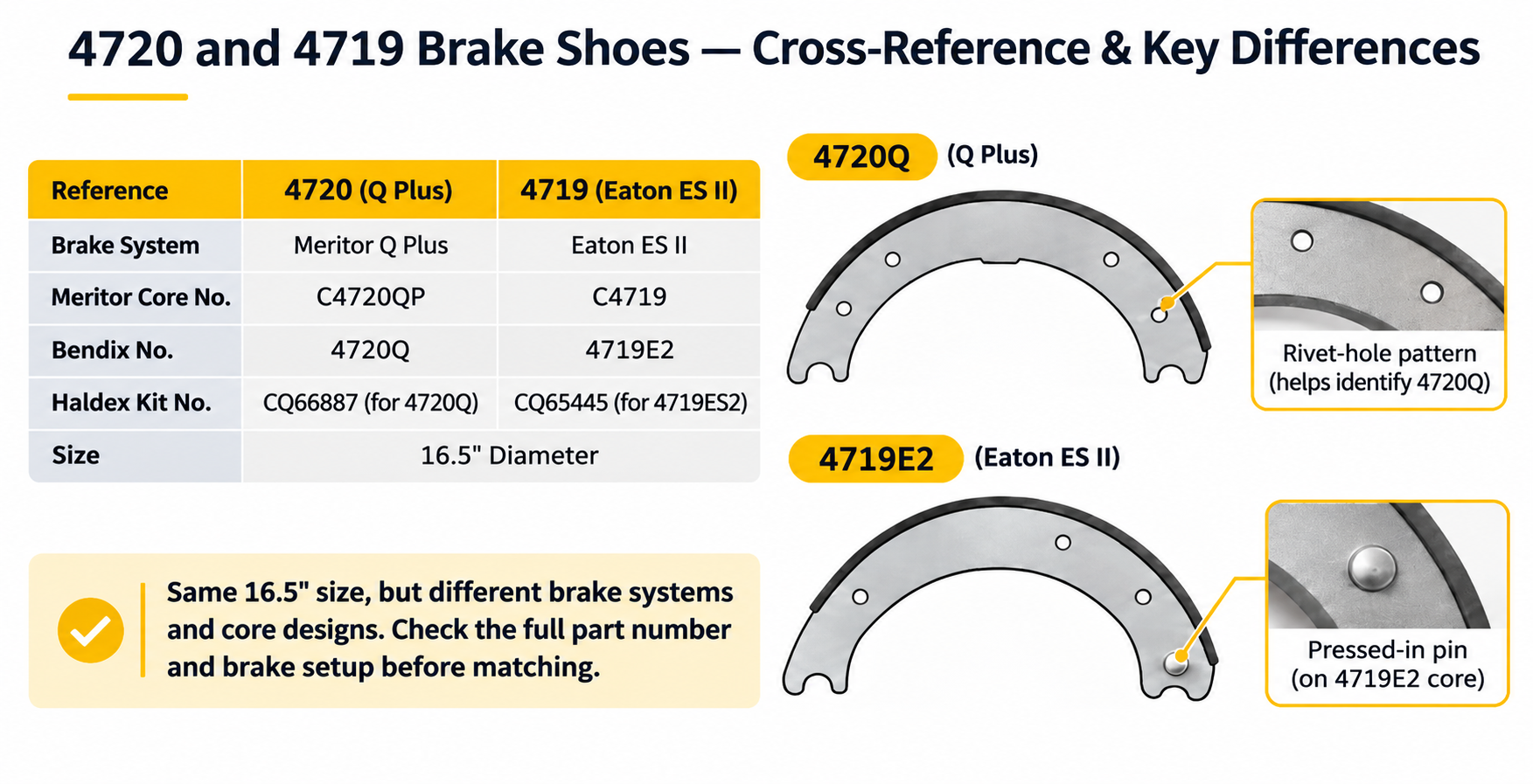
At Tuoba, we often use these brand numbers to find the matching product for our customers. But just because a 4719 appears in a Meritor catalogue doesn’t mean it fits Meritor Q Plus brakes. It’s still an Eaton ES II design. Even when the basic model number matches, the springs, rollers or lining grade may be different. So we normally check the full part number and brake system before confirming the right replacement. You’ll see a similar situation with the 4707 and 4709 models below.
4707 vs 4720: Same Brake Family, Different Width
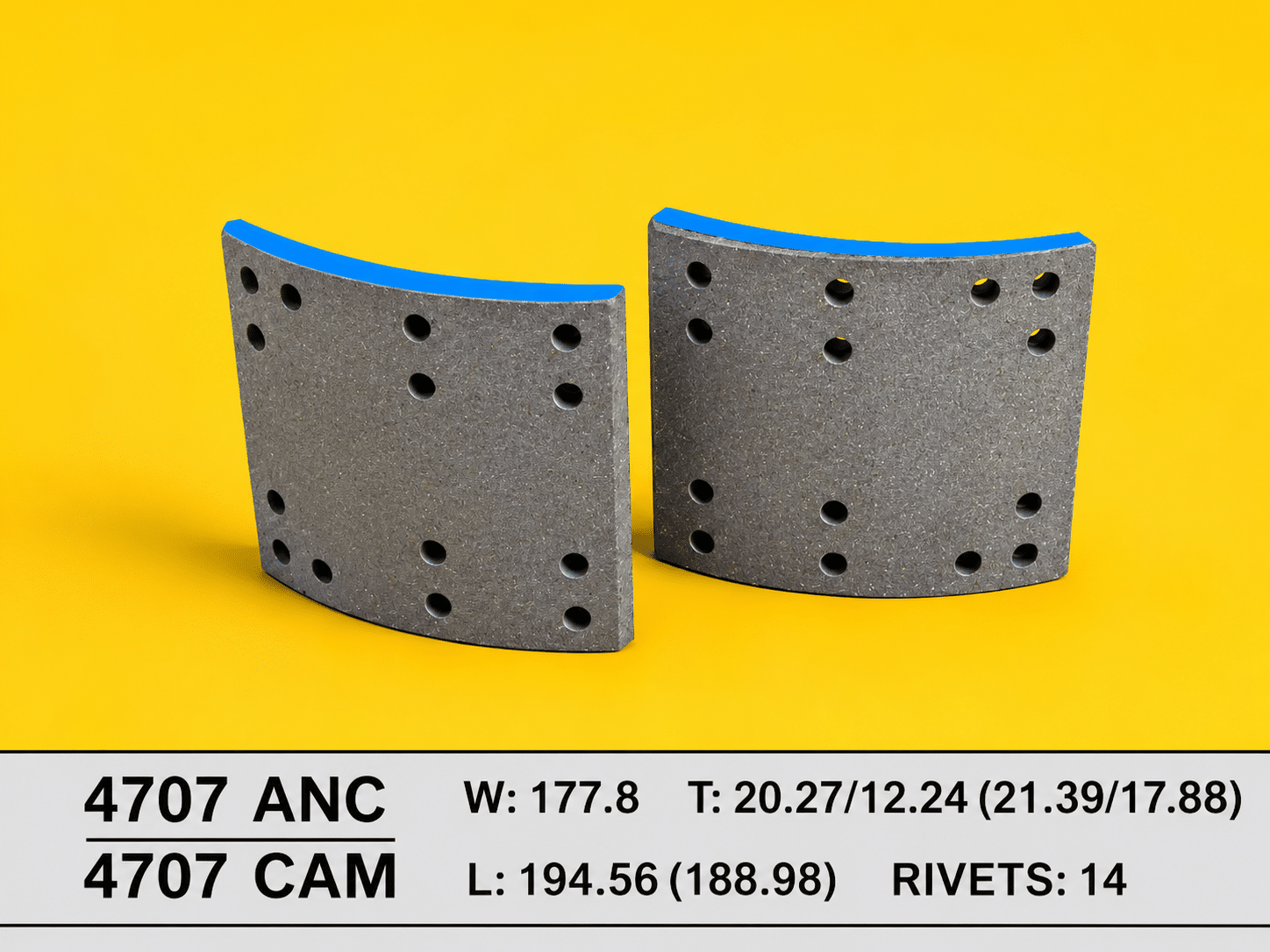
Take the 4707 and 4720. Both are used with 16.5-inch Meritor Q Plus brakes, but the 4707 is a 7-inch (177.8 mm) shoe and the 4720 is 5 inches (127 mm).
In our catalogue, the ANC and CAM lining blocks for the two models have similar lengths and thickness profiles. What stands out is the width and hole pattern: the referenced 4707 blocks have 14 rivet holes each, while the 4720 blocks have 8.
If a customer asks us for a ‘16.5-inch Q Plus shoe,’ we’d still ask for the width and full part number. A photo of the old shoe showing the ends and hardware is helpful too.
The picture below shows our lining blocks rather than complete shoes, making the width difference easy to see.
4709 vs 4719: A Similar Mix-Up in the Eaton ES Family
Eaton ES has a similar example. The 4709 is a 7-inch (177.8 mm) shoe, while the 4719 is 5 inches (127 mm). Our catalogue shows 14 rivet holes on the referenced 4709 lining block and 10 on the 4719 block. The photo is of a loose lining, so it’s useful for comparing widths and hole layouts—not for identifying the anchor end or hardware of a complete shoe. We compare the 4709 with its neighbours in our 4515 vs 4707 vs 4709 brake shoes guide.
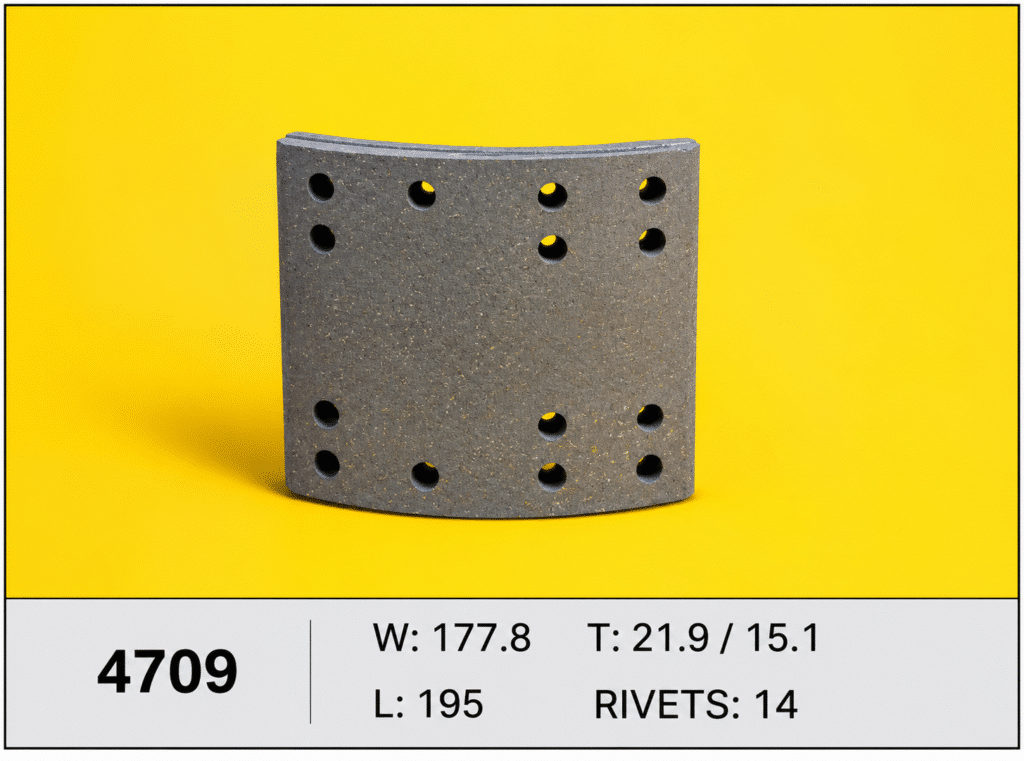
This is our Tuoba 4709 lining block, 177.8 mm wide with 14 rivet holes. It’s a reference for the wider Eaton ES model, not a photo of a 4719 brake shoe. For the finished shoe, we’d still check the ends and hardware.
Does a 23K Lining Mean a Bigger Brake Shoe?
We sometimes get asked whether a 23K version is physically bigger than a 20K one. Not necessarily. The shoe dimensions can stay the same even when the lining grade changes. What matters is which friction product suits the brake and axle application—not simply which rating is higher. For a 4719 or 4720 order, we ask about the required grade, axle application and any RSD requirements. An existing Meritor, Bendix or Haldex part number can also help us check what the customer has been using.
Does More Lining Area Mean a Better Fit?
We can compare lining area too, but it won’t tell us whether a complete shoe will fit a Q Plus or ES II brake. Using our catalogue dimensions, the two 4720 lining blocks (194.56 mm and 188.98 mm long) at 127 mm wide add up to roughly 487 cm² per shoe. The two 4719 blocks, each about 196.09 mm long at the same width, come to around 498 cm². These are simple estimates before curvature, rivet holes and chamfers. The numbers are close, but they don’t tell us which lining will stop better, last longer or handle more heat. The friction material, brake assembly and working conditions matter much more.
How We Check a 4719 or 4720 Before Quoting
When someone asks us to quote a 4719 or 4720, the full part number is the first thing we look for. ‘4719E2’ or ‘4720Q’ tells us much more than just ‘16.5 × 5.’ If the marking has worn off, we check the anchor end, cam and roller end, shoe web and spring mounts. Rivet-hole patterns help too, but they can vary by brand and version, so we don’t rely on hole count alone.
A couple of clear photos often answer the next questions. We like to see both sides of the old shoe, its ends, any remaining numbers and the hardware that came off with it. A side view with a tape measure helps confirm the width. We also ask whether the buyer needs lined brake shoes or a wheel-end kit with springs and other hardware. Loose lining blocks are a separate product, and we quote them separately.
What If a Fleet Uses Both Brake Systems?
For a mixed fleet, this isn’t just a catalogue detail—it affects what goes on the shelf. Two trucks may both use 16.5 × 5-inch shoes, but if one has Q Plus brakes and the other has ES II, the parts aren’t interchangeable. We’d keep 4720Q/QP and 4719E2/ES2 in separate bins, with the full part number, lining grade and matching hardware recorded for each. That makes repeat orders easier and gives the workshop less chance of picking up the wrong set.
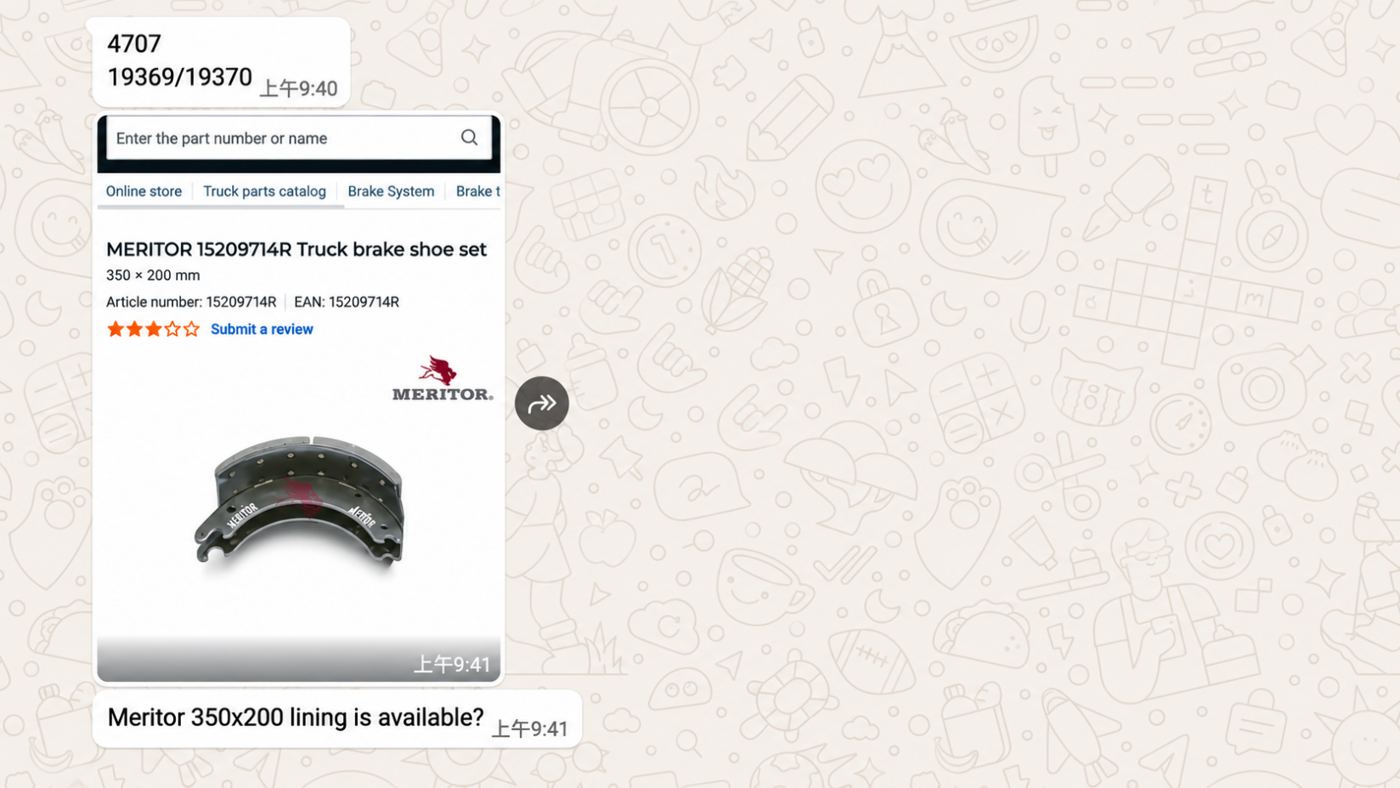
We get questions like this from customers quite often. For example, one customer sent us a photo of a Meritor brake shoe on WhatsApp and asked if we had a 350 × 200 mm brake lining. They also shared a few part numbers for us to check.
That’s a good start, but we still need to check the exact model, lining specs, and brake application to make sure we’re recommending the right part.
What We Need to Quote the Right Brake Shoe
You don’t need to send a technical drawing every time. Usually, the full part number and a few details about the brake are enough for us to start checking:
- Part number: 4719E2, 4720Q or 4720QP—or the Meritor, Bendix or Haldex number you’re buying now.
- Brake details: Brake family, axle position and vehicle or axle information, if you have it.
- Friction grade: 20K/23K requirements, any RSD needs or the grade you currently use.
- Product format: Lined brake shoes or a wheel-end kit with springs and hardware. If you only need loose lining blocks, let us know separately.
- Order details: Quantity by model, destination and any carton or branding requirements.
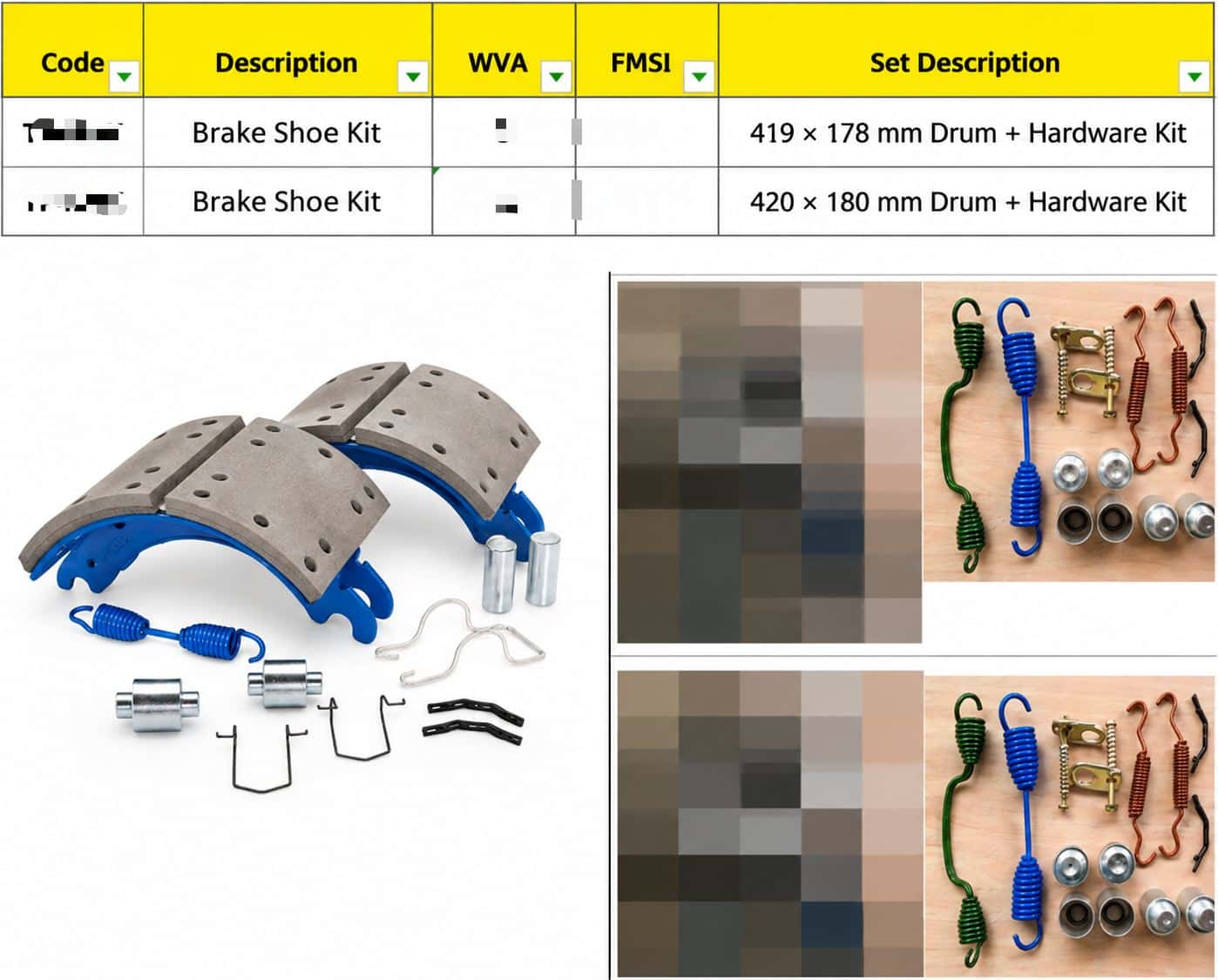
Here’s a real enquiry from one of our customers. They sent us a list of brake shoes and photos of the hardware they needed. We use these details to check the models, sizes and matching hardware before putting together a quote.
At Tuoba, we are a brake shoe manufacturer making commercial vehicle brake shoe assemblies and linings for North American truck and trailer applications. If you already buy a Meritor, Bendix or Haldex part number, send it over and we’ll look for the corresponding Tuoba model. For test documents, we’ll need the brake application and friction grade. You can read more in our FMVSS 121 brake lining test reports. If you’re not sure whether it’s a 4719 or 4720, send us the part number or a few photos, and we’ll check the details with you. You can also browse our brake linings and heavy-duty drum brake shoes to see the products we offer, or read about trailer brake shoes if you also supply trailer axles.
Tuoba Brake Lining and Drum Brake Shoe Catalog (PDF, 26.8 MB)
Browse brake lining models, WVA references, dimensions, applications and drum brake shoes before you send an RFQ.
FAQ
Are 4719 and 4720 brake shoes interchangeable?
No. Both measure 16.5 × 5 inches, but a 4719 fits Eaton ES II brakes and a 4720 fits Meritor Q Plus. The shoe ends and hardware are different, so they’re not direct substitutes.
What size is a 4719 brake shoe?
It’s a 16.5 × 5-inch shoe for Eaton ES II brakes. Check whether your application calls for the 4719E2/ES2 version.
What size is a 4720 brake shoe?
It’s also 16.5 × 5 inches, but this one is for Meritor Q Plus brakes. You’ll often see it listed as 4720Q or 4720QP.
What’s the difference between 4719E2 and 4720Q?
They’re for different brake systems. The 4719E2 is an Eaton ES II shoe; the 4720Q is for Meritor Q Plus. The anchor end and hardware differ, even though the overall size is the same.
Can I use Meritor, Bendix or Haldex part numbers to find a Tuoba replacement?
Yes. Send us the full Meritor, Bendix or Haldex number and we can look for the matching Tuoba replacement. We’ll check the suffix, lining grade and hardware before quoting.
Does a 23K friction grade mean a different brake shoe size?
No, not by itself. A 20K and 23K version may use the same shoe dimensions; the friction specification and intended application are what change.
Is a 4719 brake shoe kit enough for one axle?
Not always. Many kits cover one wheel end with two lined shoes and, in some cases, hardware. An axle normally has two wheel ends, so check what’s included before ordering.
Which Meritor Q Plus shoes are wider than the 4720?
The 4720 is 5 inches wide. In the same 16.5-inch Q Plus range, you’ll also find 4715 (6 inches), 4707 (7 inches), 4718 (8 inches) and 4711 (8⅝ inches). Our Meritor Q Plus brake shoe size chart has a fuller comparison.
What should I do if the brake shoe number is worn off?
Send clear photos of both sides, especially the anchor end, cam end and spring mounts. A brake or axle tag helps too. We can use those details to narrow it down.
Next in this series: Another common mix-up involves two 6-inch shoes. Read our 4715 vs 4725 Brake Shoes: Same 6 Inch Width, Different Brake article for that comparison.
Related Reading
- 4707 vs 4711 vs 4726 Brake Shoes: Sizes, Brake Systems and Replacement Supply
- 4515 vs 4707 vs 4709 Brake Shoes
- FMVSS 121 Brake Lining Test Reports
Sources
- Tuoba lining catalogue, reference dimensions and rivet layouts for the specific 4720/4719 lining entries
- Meritor Brake Shoe Identification Chart TP-12162
- Haldex Air Brake Shoe Identification Chart
- Bendix brake shoe core identification guide
- Cummins and Meritor heavy-duty S-cam drum brake specs
- Meritor PartsXpress: XK3124719E (20 rivet holes; product-specific example)
- Haldex kit listings: GD4720QJ, GD4719ES2G
- PTP PR4709ESII notes on ES II hold-down springs