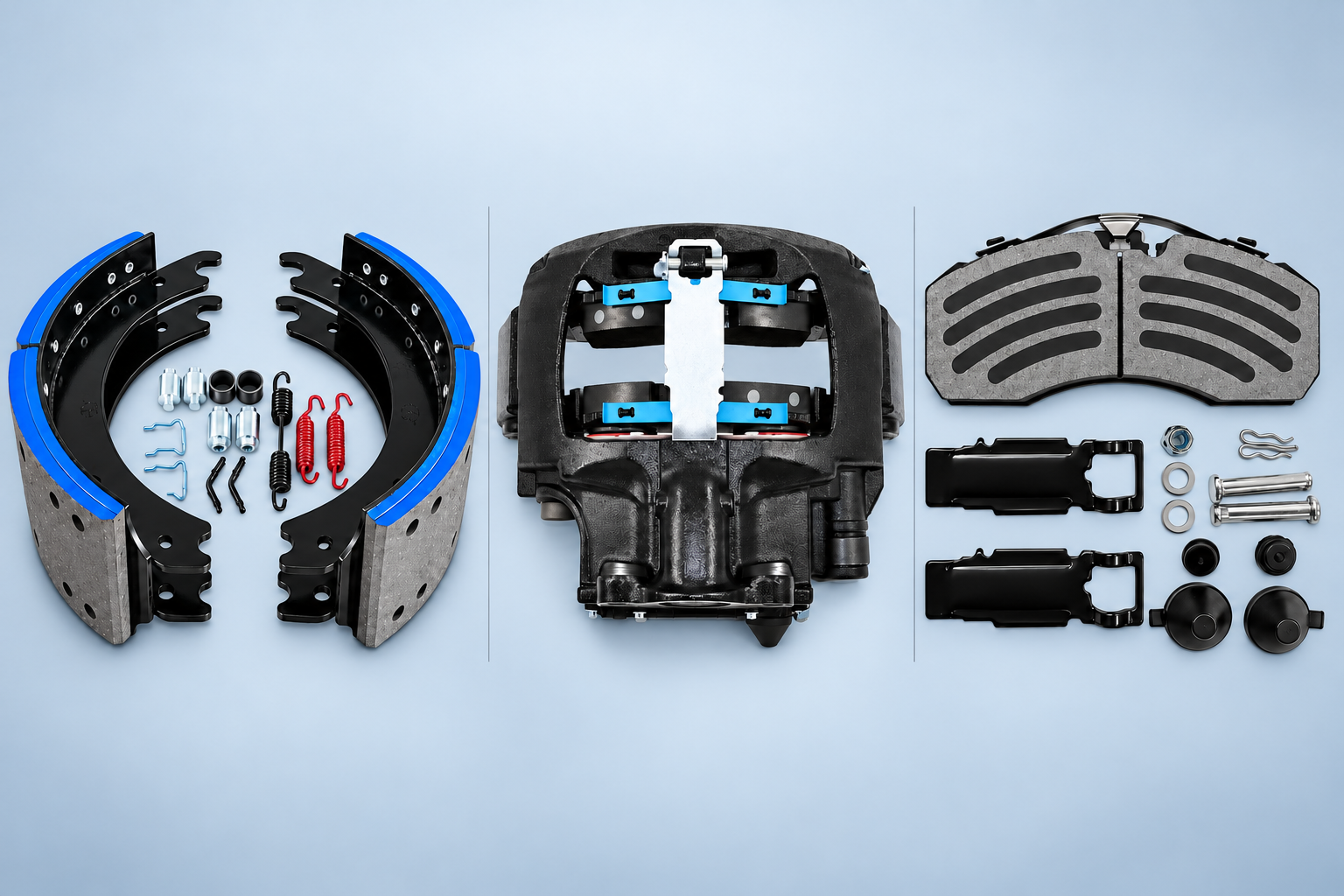
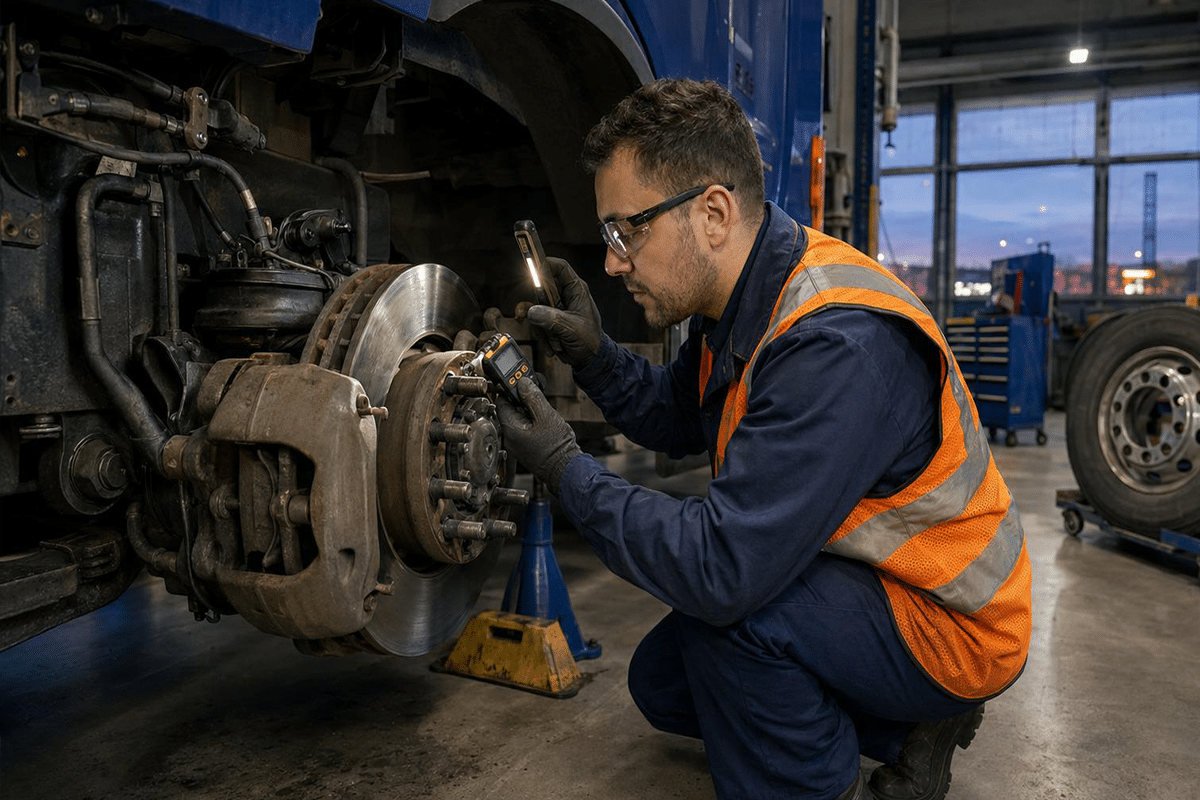
When commercial vehicle brake pads develop cracks, excessive wear, noise, glazing, fading, or rotor damage, many buyers first suspect a brake pad quality problem or friction material issue. However, professional brake pad manufacturers know that failure analysis requires a systematic investigation of product design, manufacturing process, brake system condition, and vehicle application. In practice, however, a field complaint does not automatically prove that the brake pad formulation is defective.
The same symptom may result from an unsuitable friction material, a variation in the manufacturing process, incorrect installation, worn brake hardware, an incompatible rotor, excessive axle load, or operating conditions that were never considered when the product was originally selected. Even when two vehicles use the same brake pad reference, their actual braking demands may be completely different.
Customers usually describe brake pad problems through visible or operational symptoms. They may report that the friction material has cracked or separated from the backing plate, that the pads wear out much faster than expected, or that braking becomes noisy or unstable at high temperatures. In other cases, the rotor may suffer abnormal wear, the inner and outer pads may show significantly different wear patterns, or the same product may perform well in one market but develop problems in another. These observations are valuable, but they describe the result of a problem rather than its root cause.
This is especially important for OEM customers, distributors, and fleet operators who need reliable brake pad suppliers rather than temporary replacement solutions. For this reason, an experienced brake pad manufacturer should not recommend a new formula based only on a photograph, material name, or part number. A reliable commercial vehicle brake pad solution begins with structured failure analysis. The objective is not simply to replace the returned product, but to understand why the problem occurred and determine whether the correct response involves the friction formulation, product design, manufacturing process, brake system, or vehicle operation.

What Commercial Vehicle Inspection Data Shows
The scale of commercial vehicle brake problems is reflected in official roadside inspection data. During the Commercial Vehicle Safety Alliance’s 2025 Brake Safety Week, inspectors in 52 North American jurisdictions conducted 15,175 commercial motor vehicle inspections and placed 2,296 vehicles, or 15.1%, out of service because of brake-related violations.
The most frequently cited reason for placing a vehicle out of service was the 20% defective-brakes criterion, which applies when 20% or more of a vehicle’s—or combination of vehicles’—service brakes have an out-of-service condition. Inspectors recorded 1,199 violations under this criterion. They also identified 113 brake drum and rotor violations, with 39 vehicles placed out of service because of those conditions.
These were targeted inspections rather than a random sample of the entire commercial vehicle population, so the percentage should not be interpreted as an industry-wide brake defect rate. Nevertheless, the results demonstrate how frequently serious brake conditions are identified during focused inspection and enforcement activities. Customers can review the complete figures in the CVSA 2025 Brake Safety Week report.
The detailed results from the previous year also show why brake pad complaints cannot be treated as one universal type of failure. During the 2024 campaign, in which brake linings and pads were the designated focus area, inspectors recorded 654 lining and pad violations. These included 248 contamination violations, 180 cases involving cracks or voids, 172 worn components, and 54 loose or missing linings or pads.
This distribution is important because the conditions do not point to one common root cause. Contamination may be associated with oil, grease, brake fluid, road debris, or maintenance practices. Cracks and voids may result from thermal, mechanical, material, or process-related factors. Worn pads may reflect normal service, an unsuitable duty cycle, continuous brake drag, or a mismatch between the pad and rotor. The complete breakdown is available in the CVSA 2024 Brake Safety Week results.
The latest available 2026 data comes from CVSA’s unannounced Brake Safety Day, conducted on April 14 across 47 jurisdictions in Canada, Mexico, and the United States. Inspectors examined 4,021 commercial vehicles in one day and restricted 574 vehicles, or 14.3%, from further travel because of brake-related out-of-service violations.
During the 2026 inspection initiative, 313 vehicles met the 20% defective-brakes criterion. Inspectors also identified 43 drum and rotor violations, including 24 rusted rotors, nine broken drums, eight broken rotors, and two cases of metal-to-metal contact. Twenty-one of these drum and rotor violations resulted in an out-of-service condition. The complete findings are available in the CVSA 2026 Brake Safety Day results.
Because Brake Safety Day is a one-day unannounced inspection initiative, its results are not directly comparable with the seven-day Brake Safety Week campaigns conducted in 2024 and 2025. However, the findings provide the most recent official evidence that brake-related out-of-service conditions remain a significant concern during commercial vehicle inspections.
At the time of writing, CVSA’s 2026 Brake Safety Week has not yet taken place. The campaign is scheduled for Aug. 23–29, 2026, with brake drums and rotors designated as the primary focus area. CVSA will collect and analyze the inspection data and publish the complete results later in the year. More information is available in the official 2026 Brake Safety Week announcement.
Taken together, the 2024, 2025, and latest available 2026 findings make one thing clear: what you see on a brake pad is only part of the story. Contamination, cracks, rapid wear, brake drag, rotor damage, or weak braking may look like brake pad problems, but they can come from different parts of the braking system, how the vehicle is used, or the conditions it operates in. That is why the complete brake system must be checked before the root cause can be confirmed.
Why Similar Brake Pad Failures Can Have Different Causes and Quality Issues
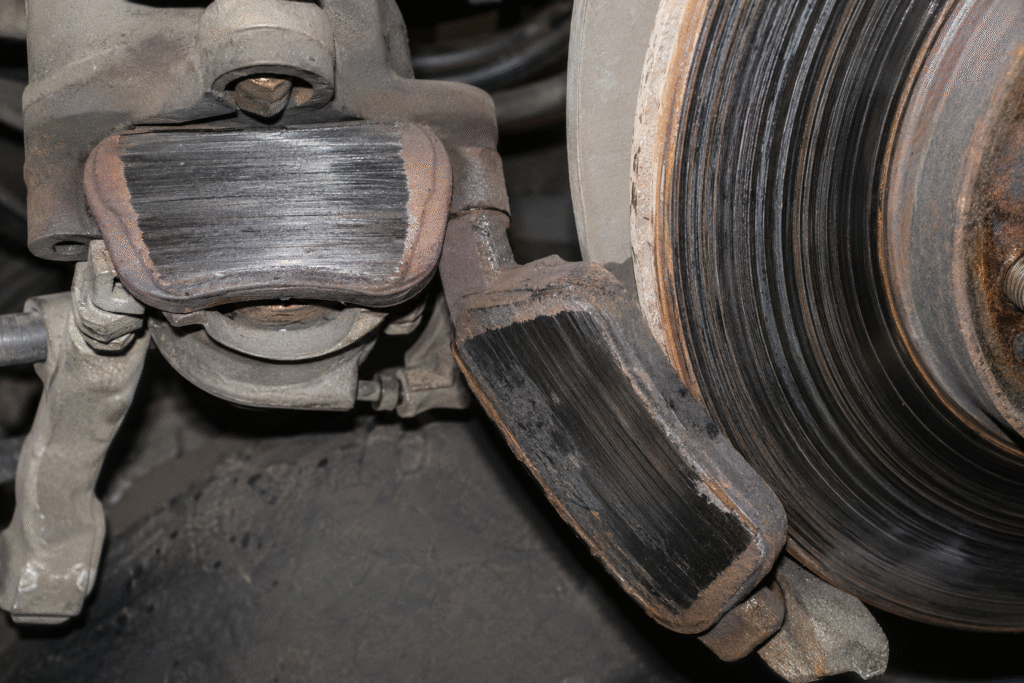
Commercial vehicle brake pad quality problems and failures generally originate from one or more of four areas: application mismatch, brake system condition, product design, or manufacturing variation. These areas are closely connected, which is why a single visible symptom can lead to several possible explanations.
For example, cracked friction material may initially appear to indicate insufficient material strength. However, similar cracking can also be produced by repeated thermal shock, uneven caliper pressure, excessive vehicle load, incorrect pad geometry, poor bonding, impact during installation, or continuous contact caused by a sticking caliper. Before changing the formula, the manufacturer must establish whether the crack began inside the friction material, along the bonding interface, around a mechanical retention feature, or in an area exposed to abnormal pressure.
Brake noise presents a similar challenge. The friction compound influences noise and vibration, but it is only one part of the complete brake system. Rotor condition, caliper stiffness, pad clearance, shims, clips, bedding procedures, and environmental conditions can all affect acoustic performance. A formulation adjustment may reduce one vibration frequency while creating an unwanted change in wear, braking response, or rotor compatibility.
The same principle applies to rapid or uneven wear. Excessive pad wear may be caused by a compound that is unsuitable for the operating temperature, but it can also result from continuous brake drag, an abrasive rotor surface, excessive braking frequency, incorrect axle loading, or a vehicle being used outside its intended duty cycle.
A guide to common heavy-truck brake pad failures and solutions can help drivers, technicians, and fleet operators recognize the initial symptoms. Manufacturer-level analysis must then go further to identify the responsible mechanism before corrective action is selected.
What Official Recall Investigations Reveal
Public safety recall investigations provide practical examples of why brake pad symptoms must be traced back to their actual causes. They also show that apparently similar problems may require completely different engineering responses.
In a 2018 brake pad equipment recall submitted to the U.S. National Highway Traffic Safety Administration, 3,026 pads were included in the affected batch, with approximately 3% estimated to contain the defect. According to the official report, human error resulted in some pads receiving an unintended second thermal treatment during manufacturing. This additional exposure to high temperature reduced adhesion between the friction material and the backing plate, creating a risk that the material could detach during use.
The investigation began after two field separation events were reported. The brake calipers were subsequently examined and found not to be responsible, which allowed the investigation to focus on the affected brake pad batch and its production history. The case demonstrates why curing records, batch identification, retained samples, and manufacturing traceability are essential when separation occurs. The complete defect description and investigation chronology are available in the NHTSA Part 573 Safety Recall Report 18E-057.
A different NHTSA case shows how abnormal pad wear can originate outside the friction material. A 2018 Nova Bus recall covered 1,058 buses equipped with affected radial air disc brake calipers. According to the official report, improper surface roughness on a caliper guide pin could create increased friction, brake noise, uneven pad wear, and tapered wear. If the condition remained undetected, it could damage the guide-pin support bolt and reduce brake function.
In this case, the visible wear pattern could easily have been interpreted as a pad formulation or wear-resistance problem. However, the investigation traced the condition to a caliper guide-pin surface that did not conform to specification. The corrective action therefore focused on the affected caliper components rather than developing a harder friction formula. The full investigation is documented in the NHTSA Part 573 Safety Recall Report 18V-299.
A further commercial vehicle example involved approximately 11,000 Thomas Built Buses equipped with affected air disc brake calipers. The recall documentation explained that an unintended reduction in the running clearance between the brake pad and rotor could create a dragging brake. Continuous contact could then generate high wheel-end temperatures, smoke, damage to the ABS sensor, and a potential fire risk.
The remedy involved inspection and, where required, replacement of the caliper with a component containing an updated clearance-adjustment mechanism. The case demonstrates that overheating and rapid pad wear do not necessarily mean that the friction compound lacks heat resistance. The pad may be responding to continuous contact created by another brake-system component. The recall details and repair procedure can be reviewed in the NHTSA Thomas Built Buses Recall 19V-444.
Together, these cases illustrate three very different mechanisms: a thermal-treatment error affecting adhesion, a guide-pin surface problem producing uneven wear, and a clearance-adjustment issue causing brake drag and overheating. The symptoms involved the pads, but the correct solutions were not the same.
The Investigation Must Begin with the Vehicle Application
A brake pad part number primarily identifies shape and fitment. It does not fully describe the operating conditions the friction material must withstand. Two vehicles using the same OE, WVA, or FMSI reference may require different performance characteristics because their loads, routes, braking frequencies, climates, and maintenance practices are different.
A long-haul truck operating mainly on flat highways may experience relatively few braking events, but each stop can involve substantial vehicle mass and thermal energy. An urban bus using the same basic pad shape may brake hundreds of times per day, creating repeated heat cycles and demanding different wear and recovery characteristics. A vehicle operating in a mountainous region faces prolonged braking and higher temperatures, while an application in a coastal or northern market may require greater attention to moisture, road salt, and corrosion.
Vehicle type alone is also insufficient. A refuse truck, city bus, trailer, construction vehicle, and long-haul tractor may all be described as commercial vehicles, yet their braking patterns are fundamentally different. Understanding the relationship between operating conditions and friction material is therefore essential when selecting or developing a product. Buyers evaluating different applications can also refer to the comparison of brake pads for buses and trucks.
A meaningful investigation should establish the vehicle model, axle position, typical payload, gross vehicle weight, brake system, caliper type, rotor specification, route, terrain, braking frequency, and environmental conditions. The manufacturer also needs to know how long the pad remained in service, whether the rotor was new or reused, how the product was installed and bedded, and whether the complaint affected one vehicle or several vehicles using the same batch.
This information allows the engineering team to determine whether the original product was appropriately matched to the application. Without it, a supplier may be able to quote a replacement product, but it cannot confidently confirm that the proposed formula will solve the problem.
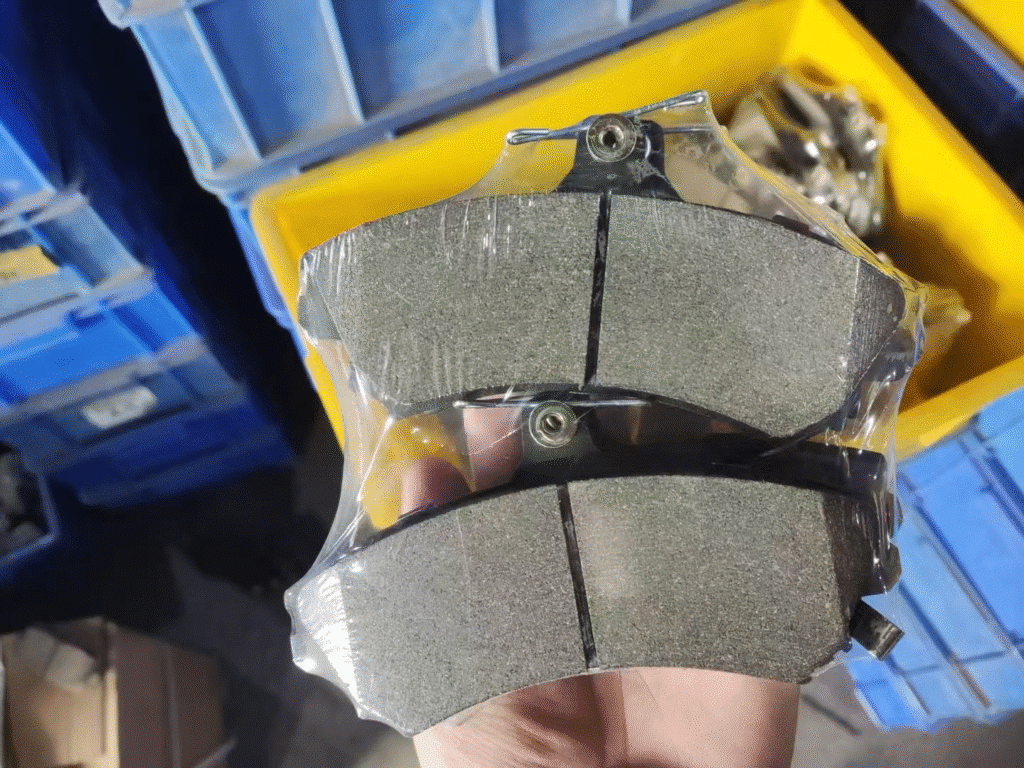
What Returned Brake Pads Reveal About Product Quality and Failure Causes
A returned brake pad can contain valuable evidence about heat exposure, contact pressure, contamination, bonding condition, and wear behavior. To preserve this evidence, the component should not be cleaned, ground, repainted, or otherwise modified before inspection.
The failed pad should be evaluated together with the other components from the same axle. Comparing the inner and outer pads, the left and right wheels, and the leading and trailing edges can reveal whether the condition is consistent across the brake system or concentrated in one position. Measurements taken from the top, center, and bottom of the friction material can identify taper wear, uneven pressure distribution, or incomplete brake release.
If one pad shows severe taper wear while the corresponding pad remains relatively normal, the investigation should focus on caliper movement, pad fitment, hardware condition, and pressure distribution. If several vehicles using the same production batch develop similar cracks or bonding problems under comparable operating conditions, the batch records and product characteristics require closer examination.
Surface appearance also provides useful clues, but it must be interpreted carefully. Blue, darkened, or glazed areas on a used pad or rotor may suggest localized heat exposure, while an uneven contact pattern may indicate that only part of the friction surface was working effectively.
However, the original color of a new brake pad is generally associated with its backing plate coating, friction material appearance, or brand positioning. As explained in the brake pad color guide, color is not a standardized indicator of friction level, temperature resistance, noise, durability, or overall quality.
Photographs are useful for preliminary analysis, but they should show more than a close-up of the damaged area. Images of the complete pad assembly, backing plate, friction surface, rotor, caliper, hardware, axle position, and batch markings provide the context needed to interpret the failure. Whenever possible, the physical component should also be returned for dimensional, mechanical, and material inspection.
Separating Brake Pad Manufacturing Defects from Formula and Brake-System Problems
Once the application and field evidence have been reviewed, the manufacturer must determine whether the problem is related to the friction formulation, production process, product fitment, or surrounding brake system.
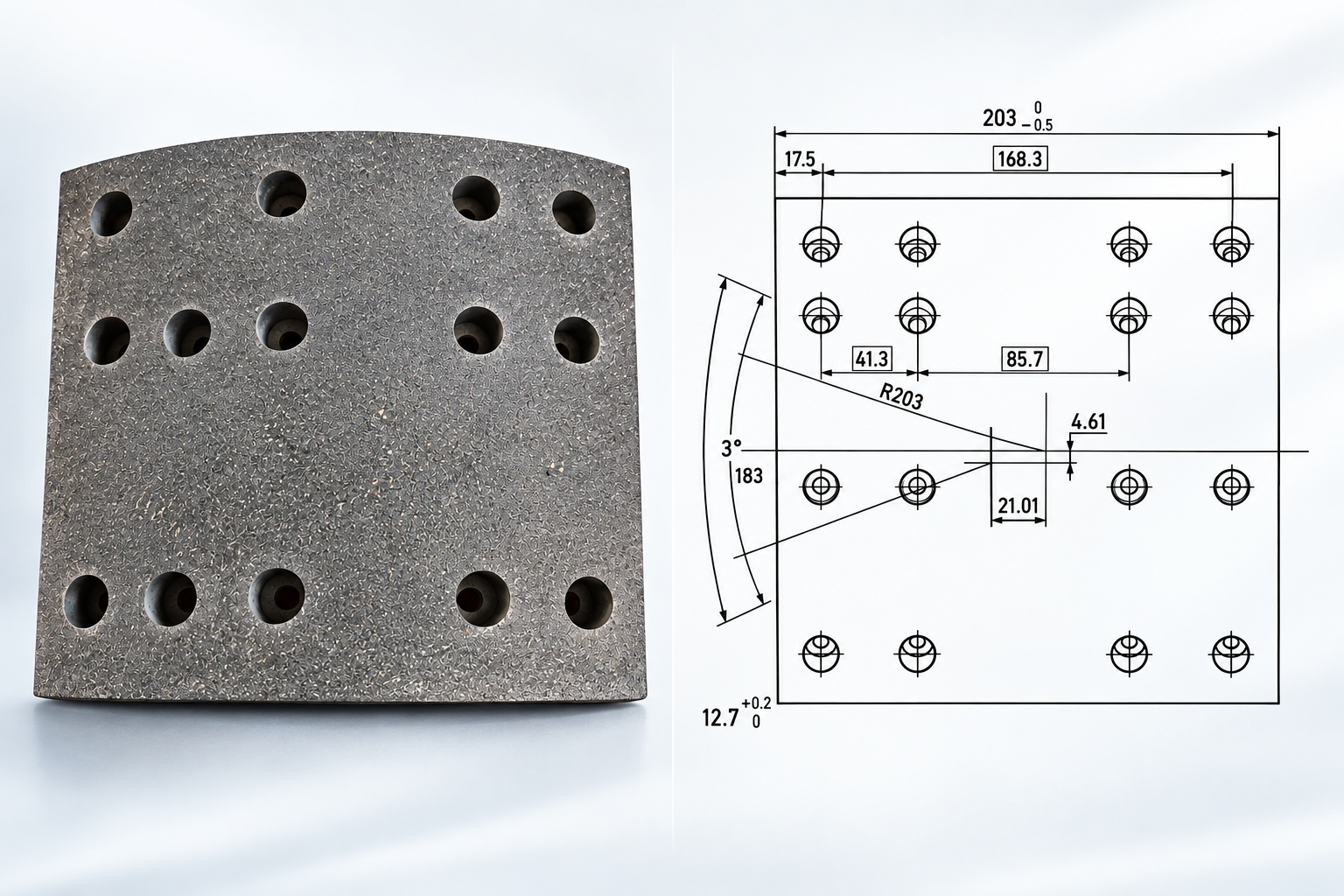
Dimensional inspection is one of the first steps because incorrect fitment can produce symptoms that resemble material failure. Excessive clearance may allow the pad to move and vibrate inside the caliper bracket, while insufficient clearance may prevent normal release and cause continuous contact with the rotor. Overall thickness, backing plate dimensions, abutment areas, chamfer and slot positions, sensor placement, shim installation, and hardware compatibility should therefore be confirmed before the formula is modified.
Material testing may then be used to compare the returned pad with an unused product, an approved reference sample, or a retained sample from the same batch. Density, hardness, compressibility, internal strength, cure condition, bonding integrity, and brake pad shear strength can help determine whether the failed component differs from its approved specification.
For separation complaints, it is particularly important to establish whether the fracture occurred inside the friction block, at the adhesive interface, between different material layers, or around a mechanical retention feature. Improving the adhesive system will not solve a fracture occurring inside the friction material, while changing the formula may not correct inadequate backing plate preparation.
The production history should also be examined. Even a stable formulation can produce inconsistent results if raw material weighing, mixing, pressing, curing, backing plate preparation, adhesive application, grinding, scorching, or hardware assembly is not properly controlled. Reviewing the relevant brake pad manufacturing process and batch records helps determine whether the complaint represents an isolated field condition, a supplier quality issue, or a repeatable production variation.
If the retained samples and batch records remain within specification while the damage is limited to one wheel position, the condition may be more closely related to the vehicle or installation. If samples from the same batch show similar deviations in density, dimensions, bonding, or curing, a manufacturing corrective action may be required. If the product remains consistent but repeatedly fails under the intended duty cycle, the formulation or product design may need to be reconsidered.
Professional brake pad technology is therefore not limited to creating new friction compounds. It also involves knowing when the formula is responsible, when production control must be corrected, and when the product itself should remain unchanged.
Turning a Customer Complaint into an Engineering Target
Once the likely failure mechanism has been identified, the complaint must be translated into a measurable development objective. Vague goals such as “improve the quality” or “make the brake pad last longer” do not provide a reliable basis for formulation development.
If the customer reports rapid pad wear, the engineering question is whether wear can be reduced without increasing rotor damage, noise, or thermal fade. When the complaint involves high-temperature performance, the target may be more stable friction during heating and stronger recovery after the brake system cools. If the friction material cracks, the team must determine whether the required improvement concerns thermal stability, internal strength, compressibility, bonding, pressure distribution, or a combination of these characteristics.
Noise-related development also requires balance. The objective is not simply to produce quiet brake pads, but to control noise without compromising braking performance, heat resistance, wear life, or rotor compatibility. A relatively quiet passenger-car formulation cannot automatically be transferred to a heavy truck, bus, or trailer simply because it performs well acoustically.
When a formulation adjustment is justified, engineers may change the balance of binders, fibers, abrasives, lubricants, fillers, and friction modifiers. They may also revise compressibility, chamfer geometry, slot design, shims, backing plate features, or mechanical retention. Each change must be evaluated as part of the complete pad assembly because improving one characteristic can produce an unwanted change elsewhere.
For example, increasing pad wear resistance may increase rotor wear or alter noise behavior. Increasing the friction level may improve initial response but reduce stability at elevated temperatures. Changing compressibility may influence pressure distribution, pedal feel, and vibration. This is why a revised formula cannot be approved based on one favorable result alone.
Selecting the Correct Validation Method
After the corrective direction has been established, testing should be selected according to the original failure mechanism. Using a large number of tests does not automatically produce a more reliable conclusion. Each procedure must answer a defined engineering question.
A bonding or separation complaint may require shear-strength evaluation based on ISO 6312, which specifies a method for measuring the strength of the connection between the friction material and its carrier. A wear complaint may require controlled dynamometer comparison under SAE J2707, while friction effectiveness, fade, and recovery may be assessed using procedures such as SAE J2522.
Where noise is involved, the scope of the selected method must be stated accurately. SAE J2521 provides an inertia-dynamometer procedure for high-frequency squeal evaluation in passenger cars and light trucks within its defined vehicle range. Heavy commercial vehicle projects may therefore require application-specific dynamometer cycles and vehicle or fleet validation rather than relying on a passenger-vehicle noise procedure alone.
Testing should compare the original approved product, the returned field sample, an unused sample from the affected batch, and the revised candidate whenever these samples are available. This structure helps separate normal product characteristics from batch variation and field-induced changes. More information about the role of these procedures can be found in the guide to brake pad testing for heavy commercial vehicles.
A test report is meaningful only when the procedure, sample configuration, brake assembly, temperature range, pressure, speed, and acceptance criteria are clearly stated. A single friction coefficient, stopping-distance claim, or noise value without test conditions provides limited evidence for an engineering decision.
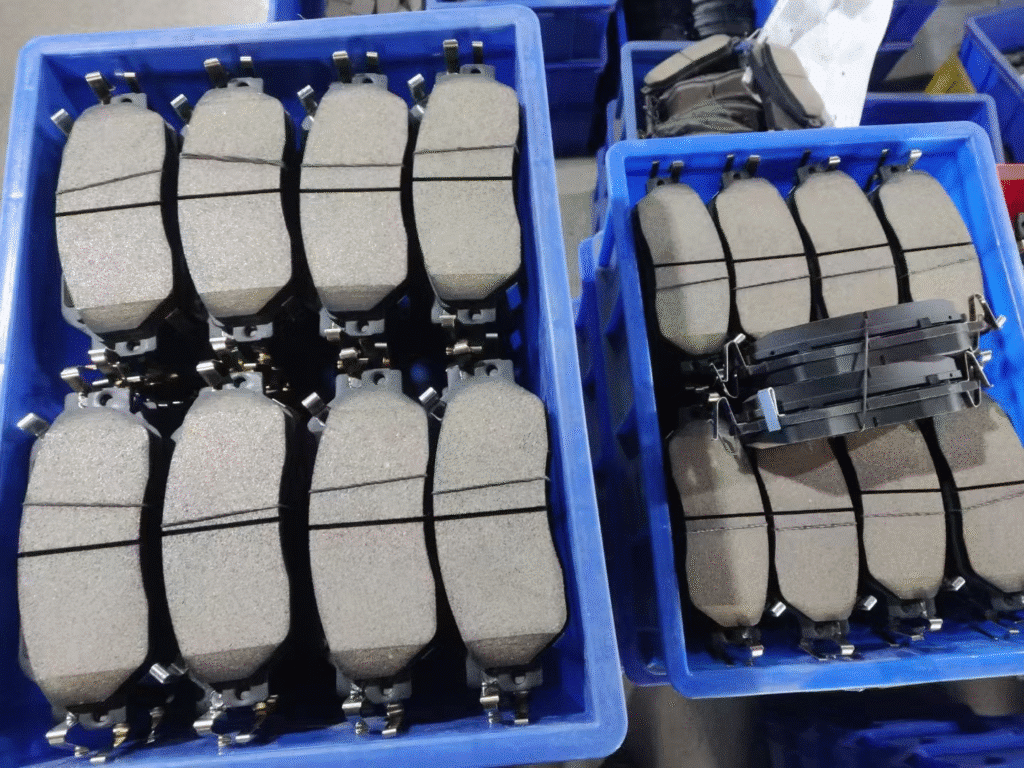
From Laboratory Formula to Field-Validated Product
Laboratory testing is only one part of the validation process. A formula that performs well under controlled conditions must still be produced through a representative pilot batch so that normal mixing, pressing, curing, finishing, and inspection conditions can be evaluated.
The pilot batch should meet the same dimensional, bonding, and material requirements that will apply to mass production. If the complaint originally involved batch inconsistency, samples should be taken from different positions and stages of the pilot run rather than only from the most favorable pieces.
Field testing is particularly important when the complaint is closely related to route, payload, climate, braking frequency, or maintenance practice. The revised product should be installed on a defined group of vehicles and monitored over an agreed period. Pad thickness, wear pattern, rotor condition, noise, braking stability, temperature behavior, and driver or technician feedback should be recorded so that the revised product can be compared with the previous version under similar conditions.
The evaluation period should be long enough to reproduce the operating condition connected with the original complaint. A short test on an unloaded vehicle may not provide meaningful evidence for a brake pad intended for a fully loaded truck operating on mountain routes.
Only after laboratory, pilot-production, and field results support the corrective action should the revised specification enter mass production. The approved formula version, raw material requirements, process parameters, inspection frequency, release criteria, and traceability method must then be documented. A successful engineering sample has limited value if the factory cannot reproduce the same performance consistently across future batches.
Turning Corrective Action into Stable Mass Production
Once the revised product has been approved, the solution must be transferred from the engineering team to normal production without losing the controls established during development.
The production specification should identify the approved formulation version and critical raw material characteristics. It should also define the acceptable ranges for weighing, mixing, molding, curing, grinding, scorching, bonding, and final dimensions. When hardware, shims, slots, or chamfers form part of the corrective action, their specifications and inspection methods must also be updated.
Traceability should connect finished products to their raw material, process, inspection, and packaging records. This makes it possible to isolate a future issue more accurately and prevents an entire production period from being treated as one undifferentiated batch.
Corrective action should also include preventive measures. If a curing deviation caused the problem, the response should not end with reprocessing or replacing the affected pads. The manufacturer should examine why the deviation was possible, how it can be detected earlier, and whether equipment controls, operator instructions, inspection frequency, or approval procedures need to be improved.
This is one of the main differences between replacing a failed product and actually solving the problem.
What Buyers Should Expect from a Professional Brake Pad Manufacturer and Supplier
Buyers often search for the “best brake pad manufacturer” or “brake pad supplier,” but a large catalog, competitive quotation, or impressive production facility does not fully demonstrate technical capability. The difference often becomes most visible after a field problem occurs.
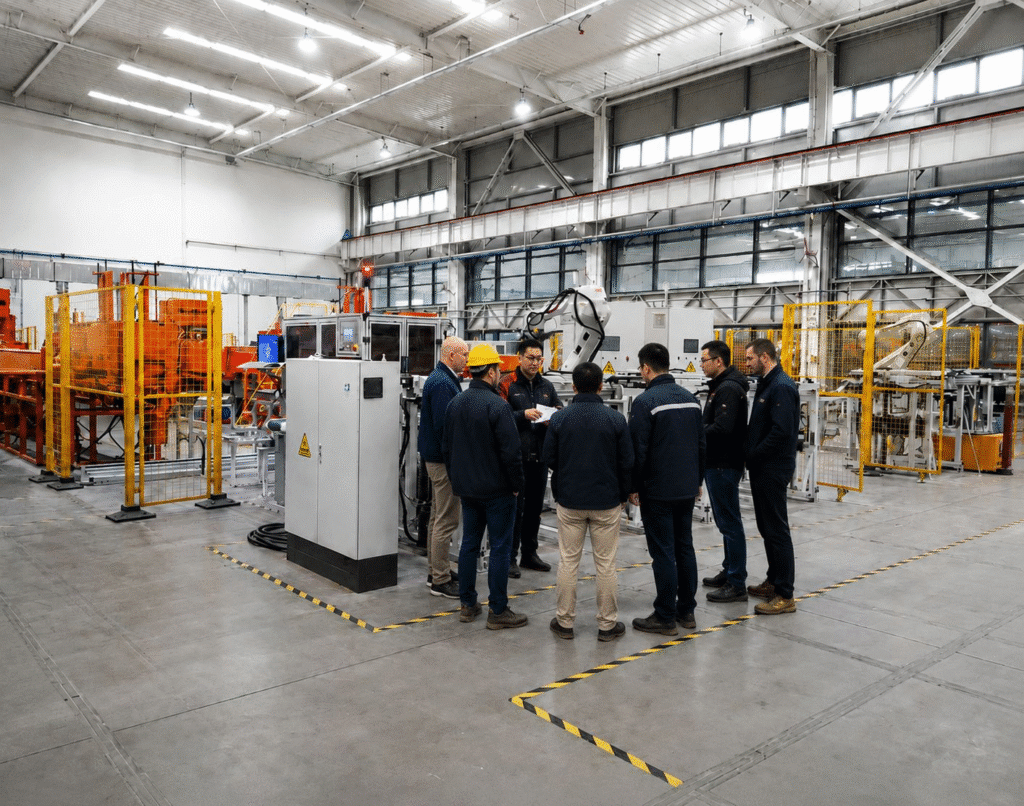
Factory visits can provide valuable evidence when they are conducted as technical evaluations rather than simple production tours. During a recent visit to Tuoba, a technical team from a German OEM customer reviewed the automated brake pad production lines, manufacturing processes, quality management controls, and inspection capabilities. The visit allowed the customer to compare documented procedures with actual production practices and discuss how the factory manages consistency, traceability, and OEM requirements.
However, even a comprehensive factory audit should be considered together with the manufacturer’s response to real-world product problems. A professional manufacturer should collect complete evidence rather than immediately rejecting a complaint or promising a new formula. It should be able to review traceability records, compare field samples with retained samples, separate confirmed facts from assumptions, and explain the probable relationship between the vehicle, brake system, friction material, and production process.
If corrective action is required, the manufacturer should define what will be changed, why the change is expected to work, and how the result will be validated. The customer should receive a clear comparison between the original and revised products, together with an appropriate sample-testing and field-monitoring plan. The corrective action should then be incorporated into production controls so that the same problem is less likely to reappear.
Equally important, an experienced manufacturer should be willing to explain when the available evidence does not support changing the formula. An unnecessary reformulation may introduce new wear, noise, or braking risks without addressing the actual cause. Honest technical judgment is therefore more valuable than agreeing with every proposed solution.
For buyers comparing factories, technical problem-solving capability should be evaluated together with certifications, product traceability, production consistency, test capability, communication, and long-term supply support. These considerations are also important when sourcing truck brake pads or evaluating a custom brake pad factory for an OEM or private-label project.
Conclusion
Commercial vehicle brake pad problems cannot be solved reliably through photographs, material names, color, or part numbers alone. Effective failure analysis must connect the vehicle application, axle load, route, environmental conditions, brake system, field history, damage pattern, material characteristics, manufacturing records, and validation results.
The purpose of this process is not to assign blame quickly. It is to identify the mechanism behind the problem and develop a corrective action that remains stable in both real operation and mass production. In some cases, the correct answer is a revised friction formulation. In others, it may involve improved bonding, tighter production control, a design adjustment, brake system maintenance, or more accurate application matching.
Official inspection and recall records demonstrate why this distinction matters. Contamination, cracking, wear, separation, brake drag, and uneven pad wear may appear as brake pad problems, but the underlying causes can originate from several different parts of the product, production process, vehicle, or operating environment.
Tuoba supports OEM customers, distributors, private-label brands, and fleet operators with application-specific brake pad development, OEM brake pad solutions, and technical problem analysis. If you are experiencing abnormal wear, cracking, noise, fade, bonding failure, or rotor damage, providing complete vehicle information, operating conditions, photographs, batch details, and service history will allow our engineering team to conduct a more accurate preliminary evaluation.
As an experienced brake pad manufacturer and supplier, Tuoba combines OEM development experience, production capability, quality control, and testing support to provide reliable commercial vehicle brake pads and private label brake pad solutions for global automotive and commercial vehicle markets.
Frequently Asked Questions
Can a brake pad failure be diagnosed from photographs?
Photographs can support preliminary analysis, but they rarely confirm the complete root cause. Vehicle information, service history, rotor and caliper condition, dimensional measurements, batch records, and physical samples may also be required. Photographs should show the complete brake assembly and corresponding components rather than only the damaged area.
Should the brake pad formula be changed after one complaint?
Not automatically. The manufacturer should first determine whether the complaint is isolated or repeatable and whether it is related to formulation, manufacturing, fitment, installation, brake hardware, or operating conditions. Changing the formula before identifying the cause may create new problems without correcting the original one.
Can brake pads with the same part number perform differently?
Yes. A part number primarily identifies shape and application. Friction formulation, backing plate design, shims, hardware, manufacturing controls, and test requirements can differ between suppliers. The same pad shape may also be used in vehicles operating under very different loads and duty cycles.
How is a revised brake pad formula validated?
Validation may combine material-property testing, bonding and shear testing, dynamometer evaluation, pilot production, and controlled field trials. The exact plan should reflect the original complaint and intended vehicle application. A revised product should be compared with the original specification and, where possible, with the returned field sample.
Does brake pad discoloration prove that the product overheated?
Discoloration may indicate heat exposure, but it should be evaluated together with wear patterns, rotor condition, caliper operation, and vehicle history. The original coating color of a new pad is not a standardized performance indicator, while color changes during service may provide only one part of the diagnostic evidence.
Why can the same brake pad perform differently in two markets?
Differences in payload, traffic, terrain, temperature, humidity, road salt, driving habits, brake maintenance, and replacement intervals can change how the product performs. A formula that works well in one operating environment may therefore require further validation before it is introduced into another market.
What information should a buyer provide when reporting a field problem?
The most useful information includes the vehicle model, pad reference, axle position, normal payload, route, mileage, installation date, production batch, rotor and caliper condition, maintenance history, photographs, and a detailed description of when the problem occurs. Complete information allows the manufacturer to move from assumptions toward evidence-based analysis.
What are common brake pad manufacturing defects?
Common brake pad manufacturing defects may include bonding failure, inconsistent density, improper curing, dimensional variation, and material distribution problems. Professional manufacturers use process control, inspection procedures, and testing methods to prevent these issues.
How do buyers evaluate a reliable brake pad manufacturer?
Buyers should evaluate a brake pad manufacturer based on production capability, quality management systems, testing equipment, traceability, certifications, and experience supporting OEM or aftermarket applications.
Related reading
- Why Truck Brake Pads Crack: Causes, Limits and Fixes
- Commercial Truck Brake Pad Thickness: Minimum Limits and Inspection Guide
- Brake Pad Shear Test: Evaluating Critical Safety Metrics
Reviewed by: Robert, Chief Executive Officer, Tuoba Auto Parts
Technical basis: CVSA Brake Safety Week results · NHTSA Part 573 recall report 18V-299 · ISO 6312 · SAE J2521 · SAE J2522 · SAE J2707
Need a quote or a part-number check? Send your OE, FMSI or WVA references, quantities and destination market to our team through the contact page, or email [email protected].