How OEM and Private Label Brake Pads Shape Sourcing Decisions in the Automotive Aftermarket
Brake pads used to be a simple line item for distributors. Not anymore. Today the same box carries safety liability, service quality, inventory cost and, if you get it right, a brand premium. So for brake pad distributors, importers and service centers, the real question isn’t whether to buy pads. It’s how the way you source them shapes your business model.
We’ve spent over 20 years making brake pads at Tuoba, and we keep seeing the same split in the industry:
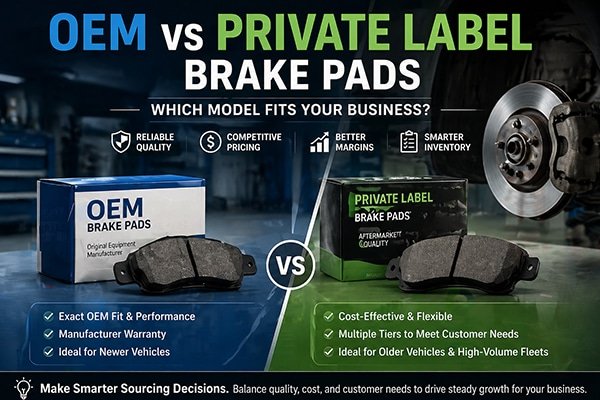
OEM sourcing is about stability and standard specs. Private label and aftermarket sourcing are about flexibility and building value. So this isn’t really a product choice. It’s a business model choice.
That’s why the question is no longer which pad is better. It’s a choice between putting stability and efficiency first and investing in your own brand and pricing power. That choice decides if you stay a pure supply-chain operator or move upstream and start owning part of the market.
In the automotive aftermarket the split is even sharper. OEM systems and private label programs are two different sourcing paths, and each one hits profitability, inventory turnover and brand positioning differently. OEM puts reliability, standard specs and low risk first. Private label goes after margin, differentiation and room to scale.
So the key question is:
Does your business need a stable, predictable supply system, or a brand you can scale with long-term control over pricing?
Below we walk through how OEM and private label brake pad sourcing work in practice: what each does to your cost structure, supply chain, quality expectations and market position. That way you can judge each step of the decision for yourself.
Why OEM Brake Pads Are Critical for Stable Fleet and Service Operations
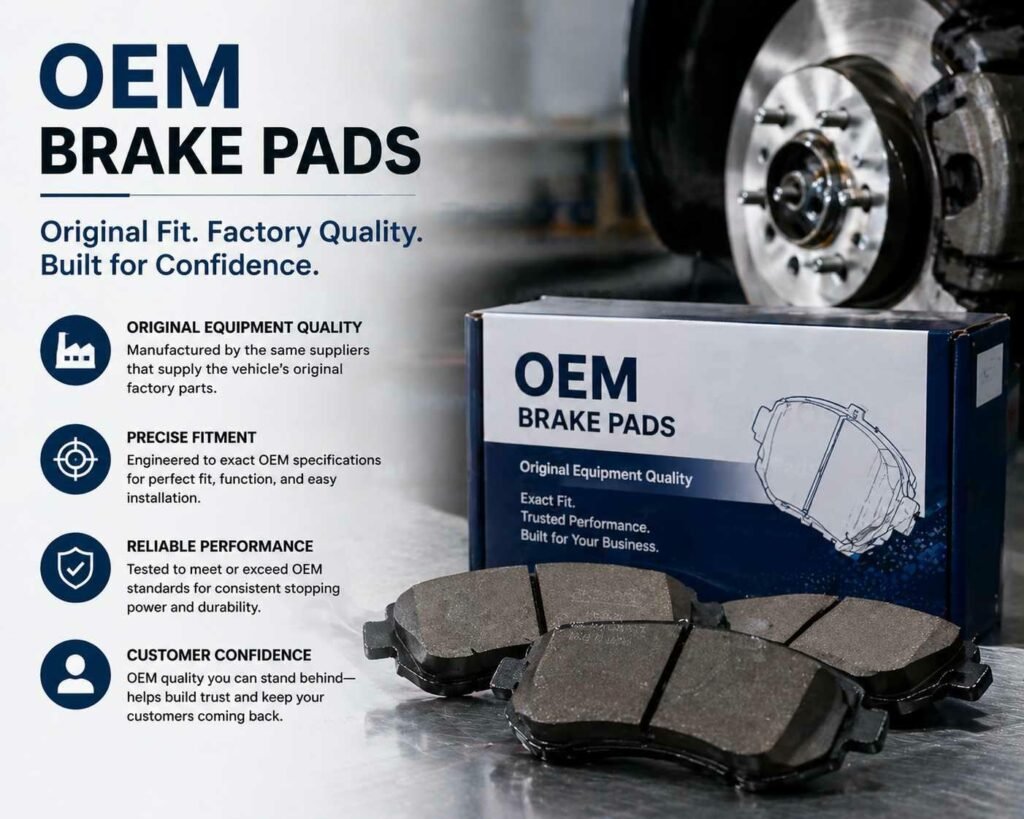
For distributors and service centers, OEM brake pads are usually a stability play. You get consistent performance and less service risk. That matters most in warranty work and fleet accounts, where one bad batch can cost you the contract.
Often OEM sourcing is less about liking the product and more about plugging into a controlled, standardized supply system. That matters if you look after large fleets, commercial transport or repair networks. There, small differences in pad performance turn into big service costs later.
OEM brake pads come with a tight supply standard. That means fewer fitment surprises, fewer quality claims, and the same braking feel across different vehicle platforms. It also makes technician training, inventory planning and after-sales service simpler.
OEM sourcing helps with risk, too. With manufacturer-approved specs and validated production processes, distributors face fewer product disputes, warranty fights and field complaints.
So OEM sourcing makes the most sense when reliability, compliance and consistent service matter more than short-term savings. That’s especially true in markets where your service reputation is what keeps customers coming back.
Limitations of OEM Brake Pad Sourcing in Competitive Markets
OEM brake pads are reliable and consistent. But OEM sourcing has some built-in limits that distributors and service centers should weigh.
First, OEM sourcing usually runs through authorized channels. You get less room to negotiate on price or lead time, which hurts in fast-moving or price-sensitive markets.
Second, OEM products usually cost more than aftermarket or private label options. In a competitive market that squeezes your gross margin.
Third, there’s little room for branding. The product is tied to the vehicle maker’s specs, so you have limited say over packaging, positioning or how you stand out.
So OEM sourcing keeps operations steady, but it can hold back your pricing, your brand and how far you can scale.
How Businesses Combine OEM and Aftermarket Brake Pads
In practice, most distributors and service centers don’t run on OEM alone. They mix sources to get around OEM’s limits without losing stability. The most common setup is dual sourcing: OEM brake pads for warranty-sensitive vehicles and premium service, and aftermarket or private label for price-sensitive and high-volume work. If you’re weighing OEM against aftermarket parts for specific vehicles, our OEM vs aftermarket brakes guide covers that side in detail.
Many also spread OEM sourcing across several authorized distributors, keep OEM stock for critical jobs, and use private label products to grow and build a brand.
Here are the most common OEM sourcing problems and how distributors usually handle them:
OEM Sourcing Limitations and Risk Mitigation Framework
| OEM Limitation | Business Impact | Risk Mitigation Strategy | Practical Execution in Industry |
| Pricing rigidity | Limited margin flexibility and reduced negotiation power | Dual sourcing strategy | Combine OEM products with private label or aftermarket lines to balance pricing structure |
| Limited branding control | Weak brand differentiation and limited market positioning | Private label integration | Develop own-brand brake pad programs with customized packaging and labeling |
| Channel dependency | High reliance on authorized OEM distribution networks | Multi-supplier diversification | Work with multiple authorized OEM distributors to reduce single-source risk |
| Lead time inflexibility | Slower response in urgent or fast-moving demand scenarios | Hybrid inventory system | Maintain mixed inventory of OEM and aftermarket products for flexible fulfillment |
In short, OEM sourcing has become one layer of a mixed sourcing model rather than the whole strategy.
Once that mix is running, the next question shows up: how do you move from saving on cost to a stronger market position and better margins?
That’s usually where private label brake pads come in. They take you past buying efficiency and into building your own brand, with more control over price, positioning and long-term profit.
Role of Aftermarket Brake Pads in Market Coverage and Pricing Flexibility
Market Coverage: From OEM Stability to Portfolio Strategy
Once you move past a pure OEM sourcing model, the focus shifts from standard products to coverage.
Aftermarket brake pads give you more price points, performance levels and applications than OEM alone, so you can match stock to what your customers actually buy. The OEM vs aftermarket guide linked above compares them from the end buyer’s side. Here we look at what they mean for a distributor’s range.
It’s a change in how you build your range, not just in what you buy.
The table below shows how those aftermarket options turn into business decisions in day-to-day distribution and service work.
Feature vs Business Value
| Feature | Operational Impact | Strategic Opportunity | Procurement Decision Insight |
| Budget to premium product tiers | Enables multi-level product positioning | Expands customer segmentation (economy / mid / premium) | Build tiered pricing system instead of single-margin model |
| Multiple brand and product lines | Reduces dependency on single supply source | Improves supply chain resilience and stock availability | Diversify suppliers to avoid stockout risk in peak demand cycles |
| Ceramic / semi-metallic / organic materials | Allows performance customization by vehicle type | Supports differentiated product positioning for different markets | Match material type with customer segment (fleet / retail / performance) |
| Flexible supplier networks | Improves pricing negotiation and lead time control | Strengthens bargaining power in procurement | Actively maintain 2–3 parallel suppliers per category |
The point: aftermarket sourcing isn’t only about flexibility. It’s how you build a product range that can grow with you.
Market Growth Driving Demand for Private Label Brake Pads
Industry numbers back this up. According to the Auto Care Association U.S. Aftermarket Forecast (2025–2028), the U.S. automotive aftermarket reached about $435 billion in 2025. It’s expected to keep growing, helped by older vehicles on the road, steady driving demand and more frequent maintenance across passenger and commercial vehicles.
Separately, the Auto Care Association Industry Growth Report expects the total U.S. auto care industry to reach $664 billion by 2028, a sign of long-term growth in maintenance, repair and replacement.
For buyers, that growth means more than a bigger market. It’s also changing how the aftermarket supply chain sources products.
Brake pads are among the most frequently replaced safety parts, so they’re a core category for distributors, service centers and brands in the automotive aftermarket. Get the sourcing wrong here and it shows up in both daily operations and long-term competitiveness.
That’s why properly certified private label brake pads are becoming a strategic option. Private label programs let distributors ride that growth while keeping control of cost and brand positioning.
For distributors and brands, private label gives you:
- Higher margins you can actually control
- Room to tier your range (economy / mid / premium)
- Faster response to regional demand
- Easy scaling in fleet and high-mileage markets
As vehicle fleets keep aging, especially in North America and Europe, demand for affordable but certified brake parts should stay strong. That supports private label programs across the aftermarket supply chain. North America stands out, with an automotive aftermarket valued at approximately USD 516 billion in 2025.
Why Private Label Brake Pads Are Increasingly Used by Distributors
As distributors widen their coverage beyond single-channel OEM sourcing, the way they make decisions changes.
Price and availability stop being the only questions. Experienced buyers start asking how each sourcing model affects their position, their margin structure and how much customers trust them.
OEM gives you a stable base. Aftermarket adds flexibility in products and supply. Once both are routine, a third factor starts to drive decisions: brand reputation and customer trust at the point of sale.
Put simply, sourcing in the automotive aftermarket is about reputation as much as operations. The brands you carry shape how end customers judge quality, reliability and safety. That’s where brand trust comes into brake pad buying decisions.
How Brand Trust Influences Brake Pad Purchasing Decisions
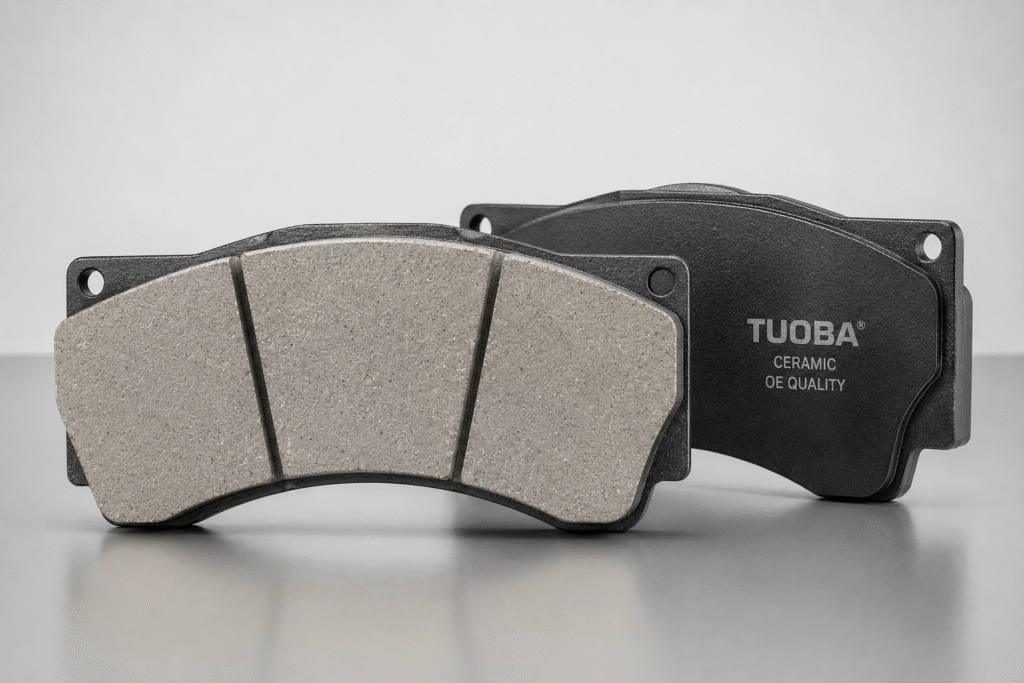
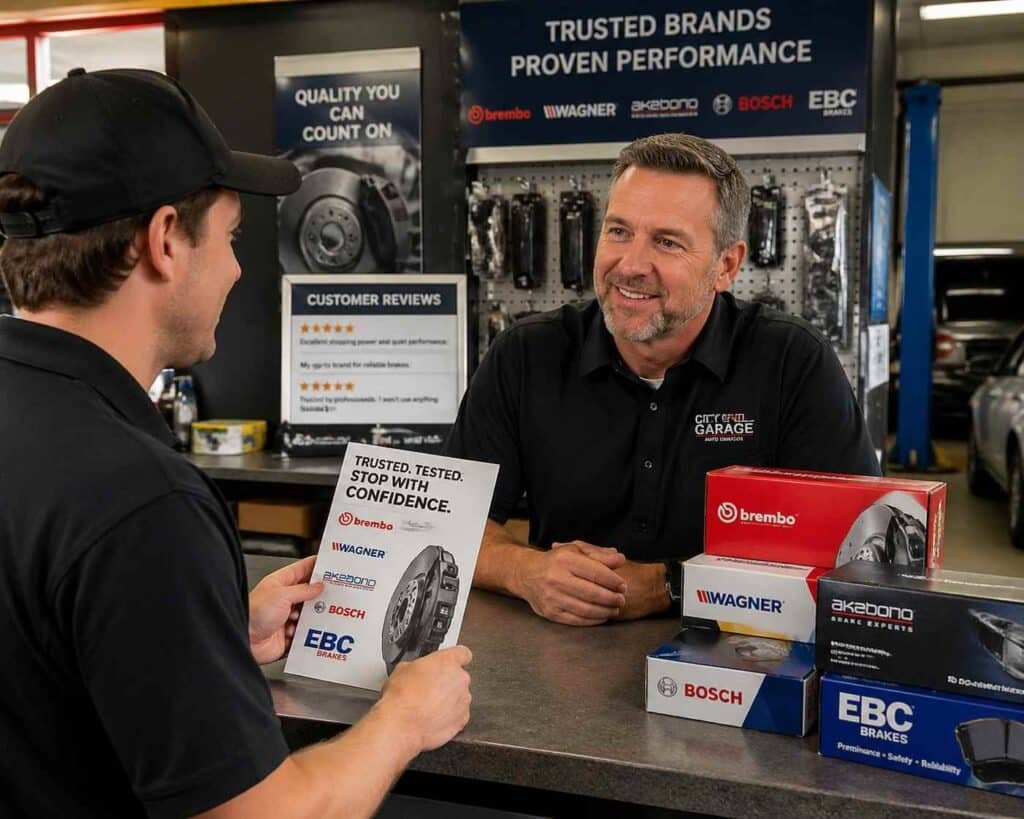
Established OEM and aftermarket brands like Brembo, Wagner, Akebono, Bosch and EBC Brakes have built credibility over years of consistent performance and testing. When you carry them, you borrow some of that trust.
The data agrees. The LexisNexis Automotive Brand Loyalty Study (2026) found U.S. vehicle brand loyalty reached 51.4% in 2025. End users still lean hard on brands they know.
At the same time, the AAPEX State of the Automotive Aftermarket Survey (2026) found that price sensitivity is rising, but quality is still the top reason customers pick a product, ahead of price, availability and brand.
So real buying decisions run on trust more than price, and perceived quality is what tips the sale.
Private label brake pads sit right where flexibility (aftermarket) and trust (brand) meet.
They’re more than a cheaper alternative. Private label programs let you build trust under your own brand instead of renting it from someone else’s.
The shift looks like this:
- External brand trust → Internal brand building
- Supplier-driven positioning → Distributor-controlled positioning
- Passive margin structure → Active margin engineering
At this point, private label isn’t just a way to buy. It’s how you turn market trust into a brand you own, with long-term control over pricing. You can see it in how the automotive aftermarket lines brands up side by side, where a handful of big names still set what customers expect on quality and reliability.
How OEM, Aftermarket, and Private Label Fit Into Real Procurement Decisions
Successful distributors don’t treat OEM, aftermarket and private label as rivals. They stack them, and each layer has its own job.
OEM sourcing is the stability layer: consistent performance and compliance for warranty and fleet work. Aftermarket is the flexibility layer: wider coverage and more customer segments. Private label is the growth layer, where you move from supplying the chain to owning a brand and its margin.
The advantage doesn’t come from picking one. It comes from how well you combine all three into one buying system that also accounts for how end customers trust brands.
Conclusion
Put together, brake pad sourcing is no longer decided by price or spec sheet alone. It comes down to how well your mix balances stability, flexibility and long-term value in a crowded aftermarket.
OEM sourcing still gives you reliability and risk control. Aftermarket widens your range and pricing options. Private label programs turn market demand into margins you control, a brand position and room to grow.
The distributors and service centers that do best rarely rely on one approach. They run OEM, aftermarket and private label as one system and adjust it by customer segment and market.
Start Your OEM and Private Label Brake Pad Strategy with Tuoba
At Tuoba, we help distributors and service centers put this into practice. Most start with small test orders on both product lines to check consistency, customer response and market fit. Then they shift volume based on real sales data until they hit the right balance of stability, profit and brand position. Want to see how a private label program runs from formula to first container? Our custom brake pad manufacturing guide walks through each step.
Working with Tuoba isn’t only about supply. It’s about a sourcing setup that earns customer trust, runs efficiently and supports steady growth. The first step is simple: place a test order and see how a more structured approach to brake pad sourcing works for you.