For a brake pad distributor, starting a private label program can look fairly simple from the outside: choose a reference, compare quotations, approve a sample, design the box, and place an order. In practice, the decisions made before mass production often determine whether that product becomes a repeat-order item or another reference that eventually disappears from the catalog.
Two brake pads can share the same dimensions, use the same backing plate, and fit the same vehicle while behaving differently in service. Noise, wear, friction stability, heat resistance, rotor compatibility, and braking feel are influenced by the friction material, vehicle application, operating conditions, and the market in which the product will be sold. Regulatory requirements add another consideration, especially when the same private label range is intended for several countries.
That is why custom brake pad manufacturing is better understood as a product-development process rather than a simple purchasing transaction. The buyer brings knowledge of the market, customers, target applications, price position, and existing product problems. The manufacturer turns that information into a product specification, validates it, reproduces it in production, and supports the range as the market changes.
The real work therefore begins before the first production order.
Why Custom Brake Pads Start With the Market, Not the Factory
For distributors and aftermarket brands, adding another brake pad reference to the catalog is usually the easy part. The harder part is making sure that product gives customers a reason to buy it again. This is where private label brake pads begin to differ from ordinary catalog sourcing. The goal is not simply to put a different brand on an existing product, but to define what that product should deliver in the market where it will be sold.
A standard catalog pad may fit the vehicle perfectly, but fitment alone does not answer the questions that matter after the sale: Will it remain quiet in urban use? Will wear stay predictable under heavier loads? Will braking performance remain stable as temperature rises? And will the next production batch behave the same way as the first one?
In most cases, buyers are not asking a factory to invent an entirely new brake pad from zero. Their needs are often much more practical: reducing noise complaints on an existing passenger-car application, improving wear consistency for commercial vehicles, strengthening high-temperature performance for demanding routes, adjusting the cost-performance balance for a price-sensitive market, or keeping a validated specification consistent across repeat orders. Custom manufacturing gives the buyer more control over these decisions and allows the product to be developed around the target market, vehicle application, and brand position rather than being limited to whatever standard specification a supplier already has available.
For a private-label distributor, that control matters more as the range grows. Once dozens or hundreds of references sell under the same brand, the real value isn’t simply having more SKUs. It’s having a range with a clear, repeatable product standard. Workshops know what to expect from the brand, procurement teams can manage repeat orders with more confidence, and price stops being the only difference between one supplier’s pad and another.
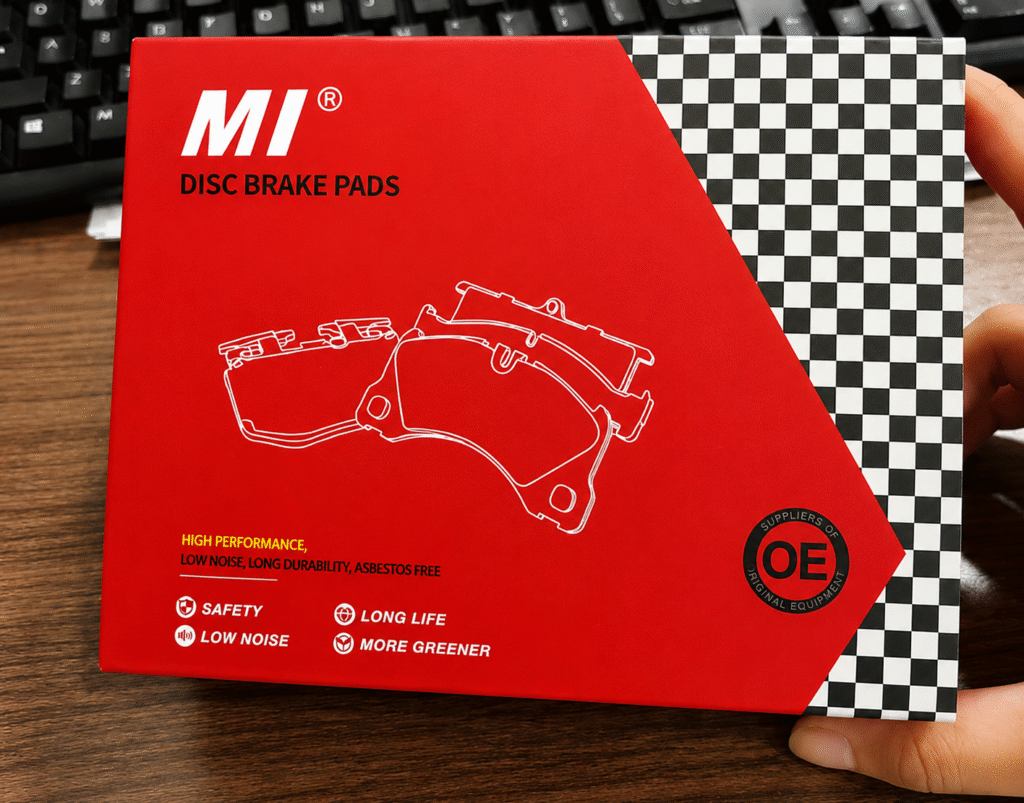
When the Same OE Number Needs a Different Product
An OE number tells a manufacturer which vehicle the pad needs to fit. It does not tell the manufacturer how the distributor wants that product to behave.
Two buyers can request the same reference and still have different priorities. A distributor serving urban passenger-car workshops may be highly sensitive to squeal and visible brake dust because those are the complaints its customers notice first. Another buyer may supply pickups or commercial vehicles operating under higher loads, where wear and temperature stability become more important. A third may be building a private label across several export markets and therefore needs packaging, labeling, certification, and product positioning to work across different regulatory environments.
This is where working with the right custom brake pad factory can make a real difference. The buyer can work backward from the market instead of simply choosing from whichever standard formulation happens to be available.
Once a specification has been validated and kept stable through repeat orders, the private label starts to represent something more than packaging. Workshops and distributors begin to associate the name with a predictable product experience, and that consistency is much harder for a competitor to copy than a box design.
What a Private Label Brand Needs to Define
Before talking seriously about formulation, both sides need to understand what is actually being developed. The useful starting information usually includes the target OE, FMSI or WVA references, vehicle category, destination countries, expected product position, current customer complaints, preferred material if one has already been identified, certification requirements, packaging expectations, and likely purchase volume.
This early discussion also helps prevent a common sourcing problem: comparing prices before comparing specifications. A supplier can quote an OE reference very quickly, but two quotations may be based on different friction materials, accessories, testing requirements, and quality standards. If those assumptions are not visible, the lower quotation may appear more attractive simply because the two products are not actually equivalent.
Defining the market first makes the next stage much more useful: turning those commercial requirements into a brake pad specification.
How Market Requirements Shape the Brake Pad Specification
The first technical question in a custom project should not be “ceramic or semi-metallic?” It should be “where and how will this product be used?”
Vehicle weight, brake design, road gradient, traffic pattern, braking frequency, ambient temperature, and operating load all affect how a friction material behaves. Commercial positioning matters as well. A premium low-noise product and a value-oriented replacement pad may fit the same vehicle, but they are unlikely to be developed around exactly the same priorities.
Regional experience helps define the starting point, but there is no useful universal “Middle East formula,” “Latin America formula,” or “European formula.” The destination market needs to be considered together with the actual vehicle and duty cycle.
Latin America: Getting the Cost-Performance Balance Right
Price matters in Latin America, but “competitive price” should not be confused with “the cheapest brake pad available.” Distributors still have to deal with what happens after the sale. If a cheaper pad wears noticeably faster, generates repeated noise complaints, or comes back through the warranty channel, the saving made at the purchasing stage can disappear quickly.
The difficulty is that there is no single specification for the region. A distributor selling mainly to older passenger vehicles may need a reliable, straightforward product at a price workshops can accept. The priorities change when the same business moves into pickups, buses, or commercial vehicles, where higher loads and more demanding braking can make wear and temperature stability much more important. Product positioning matters too. An economy line and a mid-range private label should not end up with the same specification simply because they share an OE reference.
This is where the discussion with the factory needs to become specific. Instead of asking how much can be taken out of the product to reach a lower price, it is more useful to decide what cannot be compromised first. Once the important performance requirements are clear, the formulation, accessories, testing, and packaging can be worked around the price level the market can realistically support. That usually produces a much healthier product than starting with the lowest quotation and dealing with performance problems later.
Middle East: Heat Is Only Part of the Story
Heat naturally comes up early when developing brake pads for the Middle East, but we would not judge an application from ambient temperature alone. A passenger car used mainly for highway driving and a loaded commercial vehicle running frequent stop-and-go routes may operate in the same climate, yet the demands on their brake pads are very different.
That is why descriptions such as “high-temperature formula” do not tell a buyer very much on their own. What matters is what happens when the brake is repeatedly worked: whether friction remains reasonably stable as temperature builds, how much performance drops during a demanding cycle, how well it recovers afterward, and what happens to wear. A pad can perform well during normal braking and still behave quite differently once repeated braking pushes the temperature higher.
When a distributor already has experience with the application, that information is especially useful. Vehicle type, typical load, route conditions, current pad life, and even recurring complaints from workshops can give the factory a much better development target. If the current product works well except for wear, for example, there is little reason to redesign everything. The first job is to understand why wear is happening and whether the new formulation can improve it without creating another problem elsewhere. Sample testing then has a clear purpose: not to prove that the pad is simply “good,” but to see whether it improves the issue the buyer actually wants to solve.
Europe: Performance and Compliance Move Together
Europe is a different conversation because a brake pad can perform well and still not be ready for the market. Product behavior, compliance, and customer expectations need to line up.
Noise is a good example. A pad may stop the vehicle perfectly well, but repeated squeal can still become a headache for workshops and distributors, particularly in passenger-car applications. Dust and wheel cleanliness also matter in parts of the market where customers expect a more refined product. These may sound like secondary characteristics compared with braking performance, but for a private-label distributor they often show up directly in reviews, complaints, returns, and whether a workshop orders the same brand again.
Compliance needs to be considered early for the same reason. For relevant replacement applications, ECE R90 brake pads have to be part of the product plan, not something discussed after the formulation and packaging are already finished. Brake-particle emissions are also receiving more attention in Europe, bringing wear and material composition further into the development conversation.
If Europe is one of the intended markets, it is worth making that clear before the first sample is developed. The formula, validation work, certification route, and even the launch schedule may be affected. Changing a sample is manageable. Changing a finished product after packaging has been printed and inventory has been produced is a much more expensive conversation.
These examples are not meant to suggest that every Latin American buyer needs one type of pad, every Middle Eastern buyer another, and every European buyer a third. Real projects are rarely that neat. The market gives us the starting point; the vehicle, how it is used, what customers are already saying about the current product, and where the brand wants to compete tell us what should actually be developed.
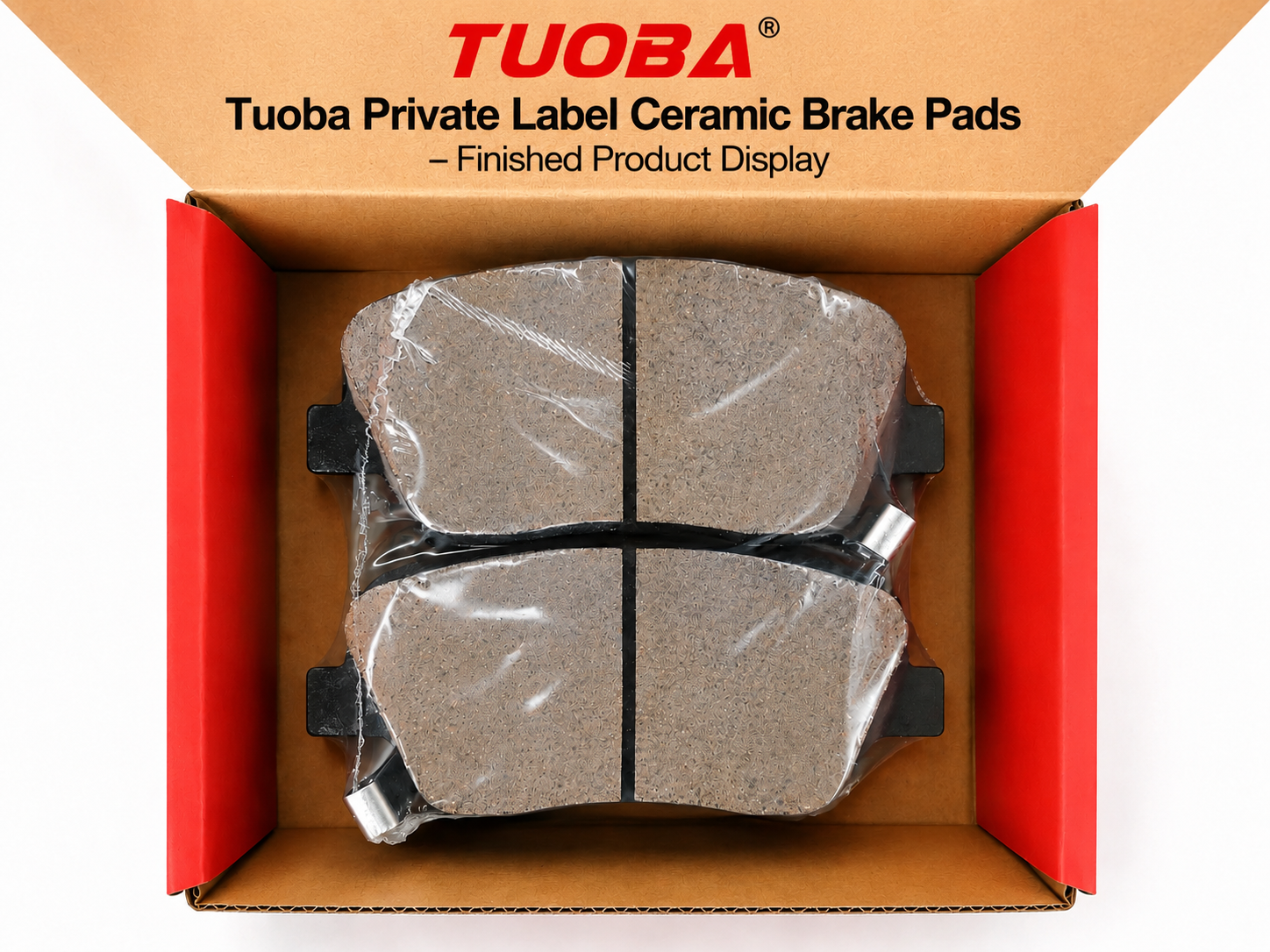
How a Manufacturer Turns Those Requirements Into a Brake Pad
Once the application, market, and performance priorities are clear, the development discussion can move into friction formulation. This is where the information collected earlier starts to become an actual product. A request such as lower noise, more predictable wear, or better stability under repeated high-temperature braking has to be translated into material choices and performance targets that can later be tested.
In practice, this is rarely as simple as choosing ceramic, semi-metallic, or low-metallic from a list. A brake pad formula is a balance. Materials selected to improve wear can also influence noise or rotor interaction; changes intended to strengthen high-temperature performance may affect cold behavior, cost, or service life. Even two pads sold under the same broad material category can behave differently because the formulations behind them are different. This is why solving one problem should not create another one somewhere else.
Tuoba’s engineering approach reflects this directly: if an existing product already performs well in most areas, there may be little reason to redesign everything. The better starting point is to understand what already works, find what actually needs to improve, and develop around that gap. Material selection comes after that, not before.
Define the Performance Before Choosing the Material
Existing customer feedback is often more useful than a material brochure. If workshops repeatedly report squeal, the development target should focus on the conditions creating that noise rather than automatically switching the product to ceramic. If a commercial vehicle pad wears too quickly during repeated heavy braking, temperature stability and duty cycle need to be examined before simply selecting a harder friction material.
The same applies when the current product performs well but costs too much for the target market. The challenge then becomes maintaining the performance characteristics customers actually value while reviewing where the specification can be optimized.
Friction coefficient is part of this discussion, but it should not be treated as a complete product description. SAE J866 classifications such as EE, FF, and GG are useful references, yet two FF pads can still differ in wear, temperature behavior, and braking feel. For a buyer, the more useful question is whether friction remains appropriate across the operating range the vehicle will actually experience.
Ceramic, Semi-Metallic or Low-Metallic: Which Fits the Target?
Once the performance window has been defined, different material systems can be evaluated as possible engineering routes.
Ceramic brake pads are often considered where braking comfort, lower visible dust, and noise performance carry greater weight. Semi-metallic brake pads may offer advantages for applications where thermal performance and demanding operating conditions are more important. Low-metallic and NAO (non-asbestos organic) formulations occupy different positions between friction performance, noise, wear, and cost.
The important point for a buyer is that the material name should come after the application analysis, not before it.
This is also why two quotations for the same OE reference may differ substantially. A lower-priced product and a higher-priced product can look nearly identical while using different friction formulations, accessories, validation methods, and process controls. Unless those assumptions are clear, the unit price does not tell the whole story.
Where Performance and Target Price Have to Meet
A technically excellent product that cannot be sold profitably is not a successful private-label product. A low-cost pad that creates returns, complaints, and warranty claims becomes expensive very quickly.
The sensible approach is to agree first on what can’t move. Vehicle compatibility, basic safety performance and the applicable compliance requirements stay fixed. Everything else can then be weighed against the intended market position: the material system, accessories, packaging, and how hard the product is tuned for dust, noise and wear.
Once both sides agree on that balance, the specification can move from discussion to a physical sample. At that point the question changes from “does this formulation sound suitable?” to “does the sample actually do what we agreed?”
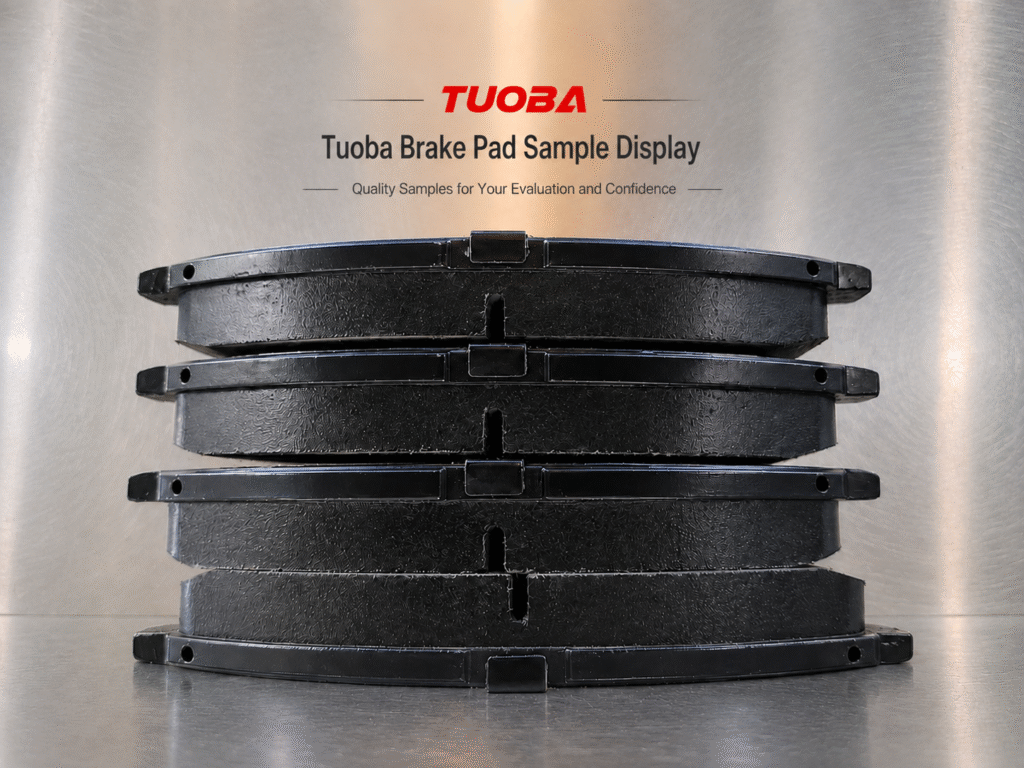
Before You Place the Order: Proving the Sample Works
A sample is not valuable simply because it gives the buyer something to photograph, hold, or compare visually. Its real value is that it gives both sides a chance to find problems before thousands of sets are produced.
Some issues can be checked right away. Dimensions, backing-plate geometry, accessories and fitment are usually confirmed quickly. Others take much longer to show up: noise, excessive wear, unstable friction under heat, or unexpected rotor interaction. By then, inventory may already be sitting in warehouses or fitted to customer vehicles.
Good validation moves as much of that risk as possible to the development stage.
What Dynamometer Testing Can Tell You
Dynamometer testing allows brake performance to be evaluated under controlled and repeatable conditions. Depending on the test method, engineers can examine effectiveness, fade, recovery, wear, and behavior across changing temperatures. The results can then be checked against the performance targets set during development.
For a buyer, the report itself is not the main value. The useful part is being able to compare the results with the original development target or with a benchmark product already known in the market. This makes it easier to judge whether the sample is ready to move forward or still needs adjustment.
If a distributor has an existing brake pad that performs well, that product makes a useful reference. Testing the two under comparable conditions shows where the new formulation behaves the same and where it differs. That’s a much stronger basis for sample approval than comparing paint finish, printing or packaging. For heavy-duty programs, we cover the role of controlled validation in brake pad testing for commercial vehicle safety.
Why Road and Fleet Feedback Still Matters
Lab testing is valuable because it controls variables. Real-world use is valuable because it doesn’t. Driver behavior, vehicle load, traffic, weather, gradient, cooling time and braking frequency all show up together in normal operation. An urban bus and a long-haul truck may both use commercial friction material, but they don’t wear it the same way.
For larger or more demanding programs, field validation can therefore add another layer of confidence. Selected workshops, fleets, or existing customers can provide feedback on noise, braking feel, wear, and operating behavior before the product is released more widely.
That feedback can help the buyer decide whether the sample is ready, needs another adjustment, or should be positioned differently. More background on these differences is available in commercial vehicle brake pad operating conditions.
Certification Should Be Confirmed Before Production
Compliance is easiest to manage when it’s in the validation plan from day one. The destination market and vehicle category decide which approvals and documents you’ll need. If those markets are known early, testing schedules and certification costs can be planned into the project. If they show up late, the same requirements can delay the launch or force work to be repeated.
A product that is acceptable in one market should not automatically be assumed to satisfy another. Buyers managing several destinations can review the broader brake pad certifications guide when defining the approval plan.
What Should Be Agreed Before Sample Approval?
Before a sample becomes the production reference, both sides should know exactly what has been approved. The formulation, product configuration, test method, relevant test results, changes between prototype versions, and final production specification should all be clear.
This sounds basic, but it becomes very important six months later when a repeat order is placed. If the buyer and factory do not share the same reference for what “approved” means, it becomes much harder to investigate whether a later shipment has changed.
Once these points are agreed, the sample is no longer just a sample. It becomes the reference for production.
From an Approved Sample to Your Own Brand
Once the product itself has been confirmed, the next step is turning it into a finished private label brake pad ready for the market, with the branding, packaging, and product information agreed before production.
This stage is often treated as a visual-design exercise, but distributors usually feel the commercial consequences of packaging through much more practical issues: part identification, warehouse picking, application accuracy, returns, and repeat ordering.
What Needs to Be Confirmed Before Packaging Starts
Before printing begins, the manufacturer and buyer should confirm the brand name, logo, internal SKU, OE/FMSI/WVA references, backplate markings, product labels, barcode, packaging language, regulatory information, inner box, and master-carton requirements.
Part-number management matters more as the range grows. Ten private-label references are easy to control. Hundreds across several vehicle brands are another matter. The link between the distributor’s internal SKU and the OE or industry reference has to stay clear to the warehouse, the sales team and the workshop receiving the product.
Packaging approval should therefore check information accuracy just as carefully as colors and artwork.
Small Packaging Errors Become Big Problems at Scale
A wrong reference on a sample box is easy to correct. The same error printed across several thousand boxes may require relabeling, warehouse sorting, shipment delays, or product returns.
That is why final artwork and label approval should be treated as a production checkpoint rather than an informal design confirmation.
Good packaging also helps repeat business. When the box, barcode, reference information, and product markings remain stable between shipments, the distributor can integrate the product into its inventory and sales system without repeatedly checking what has changed.
The Real Test Comes When Production Scales Up
A good sample proves the product can be made correctly once. Mass production has a harder job: making sure the product approved during development is still the product being delivered when the order grows from samples to hundreds or thousands of sets.
For a private-label buyer, this is where consistency starts to matter more than presentation. A well-prepared sample can make a strong first impression, but the real test of a supplier is whether the same standard holds through regular production and repeat orders.
How the Approved Formula Is Kept Consistent
Once a formulation has been tested and approved, it needs to become a controlled production specification. The formula itself matters, but so do the raw materials and production conditions behind it. Changes in material source, mixing, pressing, or curing can affect the finished pad even when the OE number and appearance remain exactly the same.
This gives buyers a very practical question to ask:
How do you make sure my next order is still the product I originally approved?
There should be a clear answer. The approved formulation, material requirements, production parameters and inspection standards need to be recorded and followed from batch to batch. Nobody can remove every variation from manufacturing. The point is to keep the variables that affect product performance under control.
Changes are sometimes necessary. A raw material may become unavailable, a customer may ask for an improvement, or a formulation may need to be adjusted for a new requirement. What matters is that the change is known, evaluated, and, where necessary, validated before it becomes part of regular production. A private-label buyer should not discover a product change only after the new batch has reached the market.
What Batch Traceability Gives the Buyer
Traceability rarely gets much attention when everything is running normally. Its value becomes obvious when a customer reports a problem.
If an unusual wear pattern, noise complaint, or other quality issue appears in the market, the first question should not be whether every product is affected. The manufacturer needs to be able to work backward: which batch did the product come from, when was it produced, what material records are associated with it, and whether other products from the same production run show the same issue.
That is where traceability turns a general complaint into something that can actually be investigated.
The same principle applies throughout the brake pad manufacturing process. Checks at critical production stages help catch dimensional, bonding, curing, or finishing problems before the pads are packed and shipped. If something does go wrong later, production records give the factory somewhere concrete to start instead of relying on assumptions.
For the distributor, this can make a big difference. A problem that can be narrowed down to a specific batch is very different from a problem where nobody can tell what changed, when it changed, or how much stock may be involved.
Why the Second Order Matters More Than the First
The first order usually gets plenty of attention. Samples have been approved, specifications have been discussed, and both sides are watching production closely. The more revealing test often comes later, when the same product is ordered again.
By then, workshops and customers know what to expect. They’re used to the fit, braking feel, wear and general behavior of the previous batch. If the second or third shipment suddenly gets noisier, wears differently or just feels inconsistent, the distributor is the one who has to explain it to the market, even though the OE number, box and brand name haven’t changed.
There is nothing wrong with improving a brake pad over time. Customer feedback may give a real reason to reduce noise, improve wear, or adjust the product for a changing market. But improvement and inconsistency are not the same thing. A planned improvement is evaluated before it reaches regular production; inconsistency leaves the distributor discovering the difference after the product is already in customers’ hands.
For a private-label brand, this matters more with every repeat order. The first shipment proves that a factory can make the product. The orders that follow show whether it can keep making the product the buyer approved.
Can the Factory Grow With Your Orders?
Capacity does not matter very much when it is only a number in a factory presentation. It starts to matter when a product sells better than expected.
A private-label program may begin with a relatively small trial order across a handful of references. If the market responds well, the next order may be several times larger. A few months later, the distributor may want to add another twenty or thirty references, replenish the fastest-moving items more frequently, or prepare additional stock before a busy sales period. At that point, the pressure on the factory is no longer just about producing more pieces. More SKUs mean more raw-material planning, production scheduling, tooling and part-number control, packaging coordination, inspection, and warehouse management.
This is where buyers sometimes discover the difference between available capacity and usable capacity. A factory may have enough equipment to produce the required volume on paper, but that does not automatically mean it can absorb a growing private-label program without longer lead times or rushed production. The better question is whether the supplier can increase volume while keeping the same controls that were used when the order was smaller.
Talk about this before the business gets there. How are repeat orders scheduled when several references need restocking at once? Can fast-moving SKUs be planned differently from slow ones? Can new references be added without disrupting products already in production? These questions say much more about practical capacity than one annual production figure.
For a distributor, growth shouldn’t create a new sourcing problem every time sales improve. The factory that handled the trial order should be able to support the next stage too: more volume, more references and more frequent repeat orders. It should do that without forcing the buyer to choose between delivery speed and the product standard that made the range work in the first place.
What Happens After the First Order?
The first production order is not the end of a custom program. It is the point where the product begins generating real market information.
Most of that information may simply confirm that the product is performing as expected. Some feedback, however, can reveal new applications, changing customer expectations, or genuine product issues worth investigating.
When Customer Feedback Should Lead to a Product Change
Workshops, fleets and distributors can reveal conditions that lab testing doesn’t always reproduce. Repeated feedback about noise, wear, dust, braking feel or a particular vehicle application may eventually show a pattern. The key word is repeated. One complaint doesn’t justify changing a formulation that’s already performing well.
When the same issue begins to appear repeatedly, the next step is to understand why it is happening rather than immediately changing the formula. The factory needs to look at the application, operating conditions, and available feedback first, then decide whether the formulation is actually the cause. If an adjustment is needed, it should be tested and confirmed before being introduced into regular production. This allows the product to improve without creating unnecessary changes to a specification that customers already know and trust.
Adding New References Without Starting From Zero
Private-label ranges rarely stay the same size for long.
New vehicle models enter the aftermarket, fleets replace older platforms, and distributors discover adjacent applications their customers are already requesting. A brand that begins with twenty high-volume references may eventually need one hundred or several hundred.
A manufacturer that can continue developing new applications makes that growth much easier. The distributor does not have to rebuild the entire quality, packaging, and communication process with a new factory every time a new OE reference is required.
The same applies when expanding a product line into another vehicle category, friction-material option, or price tier. Growth becomes easier when the development and production system already exists.
When Regulations or Materials Change
Brake friction technology does not stand still either.
Regulations, material restrictions, and environmental requirements continue to influence friction formulations. A product that fits the market today may therefore need review during a long sales lifecycle.
The distributor does not need a factory to predict every future regulatory change. What matters is receiving enough warning to plan properly. If a material or compliance requirement is changing, affected references, testing, inventory, and transition timing should be discussed before the issue becomes urgent.
That is part of long-term supply support just as much as making the next shipment on time.
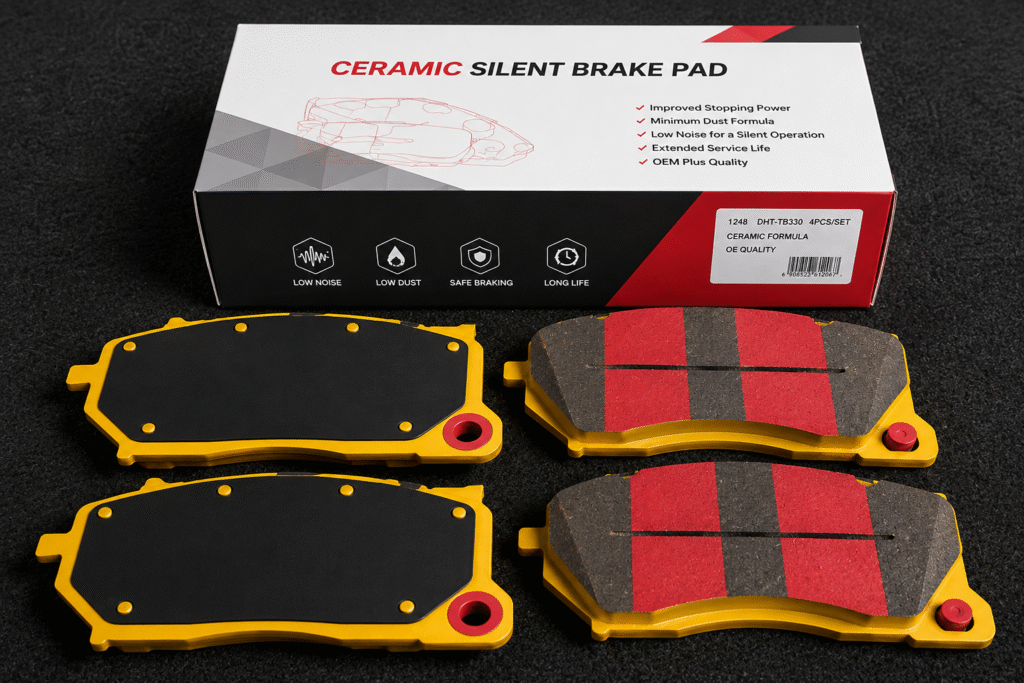
How to Choose the Right Manufacturer for Your Program
After following the process from market requirement to repeat production, judging suppliers gets much easier. We cover the full evaluation, with the seven criteria, test standards, questions to ask and red flags, in our how to choose a custom brake pad factory guide. Here’s the short version for a custom program.
Unit price still matters. It drives margin, competitiveness and inventory cost. But by now you know what sits behind that price, and which capabilities your program actually needs.
What to Look at Beyond the Quotation
Go beyond how many sets the factory can make or how fast it can quote an OE number. Ask if you can talk application and formulation with technical staff, whether performance claims are backed by testing, how the approved product is controlled in mass production, and whether a quality issue can be traced to a batch.
Buyers comparing suppliers in China can also use the China brake pad factory guide as a broader reference for evaluating manufacturing capability.
Not Every Buyer Needs the Same Type of Factory
Not every brake pad sourcing project needs the same kind of factory. If you are buying a mature OE reference with a proven specification for one established market, there may be little reason to make the process more complicated than it needs to be. A reliable factory that can reproduce the required product consistently, control quality, and deliver on time may already be the right choice. The situation changes when you are building a private-label range across several markets, developing products around specific performance requirements, or planning to add new references over time. Then formulation support, testing, compliance, production consistency, and continued product development become much more important.
It also depends on what your own team brings. Some buyers arrive with detailed specs, benchmark samples, test requirements and engineers who know exactly what they want. Others know their market inside out. They know which applications sell, what price customers will accept and what workshops complain about, but they need the manufacturer to turn that into a workable product specification. Both can be experienced buyers. They just need different things from the factory.
Tuoba supports product development, testing, manufacturing, and private-label programs, but not every customer needs every part of that capability. Some need us to reproduce an established specification reliably; others need more involvement in formulation, testing, or developing products for a new market. The right factory is not necessarily the one offering the longest list of capabilities, but the one whose capabilities match what the buyer is actually trying to build.
From the First Specification to the Next Repeat Order
A strong private-label brake pad program follows a fairly natural path. Understand the market first. Define what the product needs to do. Select or develop the formulation around that requirement. Validate the sample before committing to volume. Confirm the brand and product information carefully. Then make sure the factory can reproduce the same specification when the first order becomes the second, fifth, or tenth.
For a distributor, that leads to a more useful sourcing question than simply asking which manufacturer offers the lowest quotation:
Can this supplier understand what I am trying to sell, turn that requirement into the right product, show me why it works, reproduce it consistently, and continue supporting the range as my business grows?
When those pieces are in place, custom brake pad manufacturing becomes more than putting a different logo on a standard brake pad box. It becomes a way to build a product customers can recognize, a range the distributor can continue expanding, and a business that does not have to start from zero every time the market changes.
If you are developing a private-label brake pad range, you can contact the Tuoba team on WhatsApp to discuss applications, specifications, or sample requirements.