If you’ve sourced brake shoes for trucks or trailers before, you already know that not every company calling itself a brake shoe manufacturer brings the same experience. Some mostly make parts for cars or motorcycles. Others only make the steel shoe and have never developed a heavy-duty friction material or a complete lined assembly.
On a commercial vehicle, steel strength, weld quality, shoe geometry, friction material and heat resistance all decide how well the brake works and how long it lasts. A matching part number is only the starting point. The real difference is in manufacturing capability and application experience.
In this guide we look at 30 commercial vehicle brake shoe manufacturers and major braking companies worldwide: OE suppliers, friction specialists and factory-direct makers of commercial vehicle brake shoes. If you’re buying mainly for the US market, our list of the top 10 brake shoe manufacturers in the USA goes deeper on domestic suppliers, remanufacturing and local stock.
Commercial Vehicle Brake Shoe Manufacturers at a Glance
The companies in this market have very different strengths. Being able to produce a matching part number doesn’t make someone a real brake shoe manufacturer.
Some are tied closely to complete braking systems and vehicle platforms. Cummins-Meritor, Haldex, BPW and Akebono built their names over years of work on trucks, trailers and fleets. Many customers know them because those brands are already on the vehicles they run every day.
Others are known more for what’s inside the brake than for the steel shoe. TMD Friction, BREMSKERL, Fras-le and Marathon put a lot of their effort into friction materials, because lining performance, heat resistance and wear consistency decide how a brake behaves after thousands of stops.
Then there’s the factory-direct side of the market, makers like TUOBA, which supplies heavy-duty brake shoes for trucks, trailers and commercial vehicles. For distributors and private-label buyers the draw isn’t just cost. It’s being able to talk friction formulas, specs, packaging and market requirements directly with the people who make the product.
Different buyers want different things. A fleet may stick with Meritor or Bendix because its technicians and customers already know the brand. A distributor building its own brake program may prefer a direct brake shoe manufacturer that gives it more control over the product and the branding.
Not every company below makes brake shoes as its main product. Some are here because they matter in commercial vehicle braking systems, friction materials or the aftermarket supply chain.
The list covers OE suppliers, friction specialists, aftermarket brands and factory-direct manufacturers that matter in the global commercial vehicle brake market.
| Company | Country / Region | Best Known For |
| Cummins-Meritor | United States | Heavy-duty truck and trailer brake systems |
| Haldex | Sweden / Global | Commercial vehicle foundation brakes |
| Marathon Brake Systems | United States | Heavy-duty brake shoes and friction solutions |
| STEMCO | United States | Wheel-end systems and commercial vehicle components |
| Carlisle Brake & Friction | United States / Global | Specialty and heavy-duty braking solutions |
| BPW | Germany | Trailer axles and drum brake systems |
| BREMSKERL | Germany | Commercial vehicle brake linings and complete shoes |
| TMD Friction | Germany / Global | Commercial vehicle friction materials |
| Fras-le | Brazil / Global | Truck, trailer and bus friction products |
| Akebono Brake Industry | Japan | OE commercial vehicle brake engineering |
| MAT Friction Group | United States / Global | Automotive friction products and brake components |
| Brakes India | India | Heavy commercial vehicle braking systems |
| Allied Nippon | India / International | Commercial vehicle friction products |
| Rane Brake Lining | India | Automotive friction materials |
| TUOBA | China | Heavy-duty brake shoes, linings and private-label solutions |
| Ege Fren | Türkiye | European truck and trailer friction applications |
| Mineral-Loy Automotive | South Africa | European heavy-truck brake components |
| Knorr-Bremse | Germany / Global | Commercial vehicle braking systems |
| ZF Commercial Vehicle Solutions | Germany / Global | Integrated commercial vehicle systems |
| Bendix Commercial Vehicle | United States | North American truck braking products |
| SAF-Holland | Germany / United States | Trailer axle and braking solutions |
| Textar | Germany / Global | Commercial vehicle friction materials |
| Don | Germany / Global | Heavy-duty friction products |
| Bendix Spicer Foundation Brake | United States | Foundation brake components |
| NAPA Commercial Vehicle | United States | Commercial vehicle aftermarket distribution |
| Raybestos | United States | Aftermarket brake products |
| Centric Parts | United States | Automotive friction and replacement braking |
| ASK Automotive | India | Automotive components and braking products |
| Standard Friction Components | India | Heavy-duty friction materials |
| Eastman Auto & Power | India | Commercial vehicle replacement parts |
Commercial Vehicle Brake Shoe Market Trends
Demand for commercial vehicle brake parts keeps rising with freight volumes, fleet growth and replacement needs. According to the Commercial Vehicle Brake Systems Market Report published by Research and Markets, the global commercial vehicle brake systems market is expected to grow from approximately USD 19.64 billion in 2025 to USD 28.93 billion by 2031, a CAGR of around 6.6%.
For brake shoe manufacturers, that growth comes mostly from heavy-duty trucks, trailers and buses, where durability, load capacity and reliable braking can’t be compromised. According to the Brake Pads and Brake Shoes for Commercial Vehicle Market Analysis published by Wise Guy Reports, aftermarket replacement cycles and fleet maintenance keep demand for commercial vehicle friction parts steady.
The industry is changing too. Buyers now want more than capacity: engineering support, better friction options, testing backed by proper commercial vehicle brake testing, and flexible OEM/private-label programs. For global distributors and parts brands, a manufacturer with stable quality control and real customization ability will matter more every year.
Leading Commercial Vehicle Brake Shoe Manufacturers
1. Cummins-Meritor — United States
Website: Cummins Drivetrain & Braking Systems
If you work in the North American heavy-duty brake market, you’ll run into Meritor sooner or later.
For a lot of distributors and brake makers, references like 4515, 4707 and 4720 are more than part numbers. They’re the benchmarks people use to identify applications, compare products and build aftermarket catalogs. Meritor became one of the reference points for heavy-duty drum brakes in North America.
It isn’t only brand recognition. Meritor’s Q Plus brake systems are common on trucks, tractors and trailers, and its detailed product data lets distributors and manufacturers match brake types, lining materials, friction codes and FMSI references with confidence.
If you want factory-direct private label, Meritor usually isn’t the partner. But if you’re building heavy-duty brake shoe programs around 4515 or 4707, Meritor is often the benchmark you compare dimensions, specs and performance against.
2. Haldex — Sweden / Global

Website: Haldex
Haldex comes up naturally in any conversation about heavy-duty commercial vehicle braking.
The company has spent decades on trucks, trailers and buses instead of trying to cover the whole automotive market. You can see it in how it develops products: brake parts are treated as systems that have to match axle loads, vehicle types and operating conditions, not as isolated pieces.
That’s where Haldex helps distributors. You don’t pick a brake shoe or friction material by size alone. Axle configuration, operating environment and expected service life all change the right spec, and Haldex’s experience in foundation brakes, friction products and commercial vehicle applications makes it a useful reference.
Haldex plays a different role from a factory-direct manufacturer focused on OEM or private label. In the end, though, both serve the same people: distributors, fleets and operators who need brakes they can rely on.
3. Marathon Brake Systems — United States
Website: Marathon Brake Systems
Marathon is one of the names buyers look at once they move past the big OE brands in heavy-duty brakes.
Unlike large braking groups that cover many vehicle systems, Marathon built its name on heavy-duty friction products. What sets it apart is attention to the foundation under the friction material too: the brake shoe that carries the lining.
That matters to fleets and distributors. Two brake shoes can look the same from outside, yet differences in steel quality, weld consistency, surface treatment and dimensional control show up directly in lining life and braking performance. Marathon highlights high-grade carbon steel, full seam welding, E-coating and dimensional monitoring in its new brake shoe production.
Marathon also pairs its own friction materials with new brake shoes to sell complete lined shoes. Building both halves together helps the shoe and the lining perform consistently in tough applications.
For a private-label brake shoe program, Marathon usually isn’t the factory-direct partner. It’s still a useful benchmark for heavy-duty brake shoe quality, especially in North American 16.5 × 7-inch commercial vehicle applications.
4. STEMCO — United States
Website: STEMCO.com
Many heavy-duty fleet customers know STEMCO, especially once they start thinking about the whole wheel end rather than single brake parts.
STEMCO isn’t a brake shoe supplier focused only on friction parts. Its business sits in the wider wheel-end market, including components that directly affect maintenance and uptime.
In real fleet operation a brake shoe never works alone. Drums, seals, bearings and other wheel-end parts all affect service life and maintenance cost, and suppliers who know the whole wheel end tend to judge braking performance from a wider angle.
For distributors serving tractor and trailer markets, STEMCO is a good reference for a full-maintenance approach rather than a single replacement part.
5. Carlisle Brake & Friction — United States / Global
Website: Carlisle Brake & Friction
Carlisle is a bit different from most companies in the commercial brake market.
Most buyers wouldn’t think of it for a common aftermarket 4707 or 4515 brake shoe. Carlisle made its name where braking is harder: heavy-duty equipment, industrial vehicles and off-highway machines.
Those machines run hotter, carry heavier loads and work in rougher conditions. A friction material that’s fine in a standard application may not be the right one when durability and performance come first.
For commercial vehicle buyers, Carlisle shows a different side of the industry. It’s less about high-volume replacement parts and more about the engineering behind reliable brakes in tough applications.
6. BPW — Germany
Website: BPW
If you work with commercial trailers in Europe, BPW needs no introduction.
Its axles and drum brakes are everywhere in European trailer fleets, and “BPW brake shoe” has become a familiar reference in the aftermarket.
Matching a BPW brake shoe isn’t just a dimension check. Axle generation, drum size, shoe width, lining thickness, rivet pattern and WVA references all decide whether the part fits and performs.
What’s interesting about BPW is that it treats braking as part of a complete axle system. Its replacement brake shoes and drums are developed for specific applications, not treated as generic interchangeable parts.
7. BREMSKERL — Germany
Website: BREMSKERL
BREMSKERL is a good example of why choosing a brake shoe supplier isn’t only about the steel.
In commercial vehicle brakes, the friction material often decides how the brake performs on the road. BREMSKERL built its reputation on friction technology and supplies drum brake linings as well as complete brake shoe assemblies for commercial vehicles.
Its range covers many European commercial vehicle systems, including BPW, SAF, Gigant, DAF and Meritor/ROR applications.
For distributors and fleets that’s a real advantage. Instead of treating the steel shoe and the lining as separate products, BREMSKERL looks at how the two work together to give stable braking.
That makes it especially relevant if you serve European truck and trailer markets, where getting the application right, friction consistency and long-term reliability matter more than finding the cheapest replacement part.
8. TMD Friction — Germany / Global
Website: TMD Friction
TMD Friction is a reminder that a brake shoe is never just a steel frame.
Many buyers start by looking for whoever makes the shoe, but the friction material inside it matters just as much. TMD Friction built its name on friction technology rather than steel fabrication, supplying commercial vehicle brake pads, drum brake linings and friction products for trucks, trailers, buses and coaches.
That’s why it remains an important name in commercial vehicle brakes. Through brands such as Textar and Don, it has a strong presence in the European aftermarket and fleet business, where consistent friction and correct application matching count.
For buyers comparing complete lined brake shoes, TMD Friction is the other half of the picture. The shoe structure is the foundation. The friction material decides how the product performs on the road, especially with heavy loads, frequent braking and long service cycles.
9. Fras-le — Brazil / Global
Website: Fras-le
Fras-le is one of the friction brands buyers start to recognize once they look past the brake shoe itself.
In heavy-duty brakes, the steel shoe is only the base. The friction material usually decides real-world performance, and that’s where Fras-le built its reputation, developing brake linings and friction products for trucks, trailers and other commercial vehicles around the world.
Its strength is long experience with friction materials. Its references cover a wide range of commercial vehicle applications, and the brand often comes up in aftermarket conversations next to other well-known heavy-duty friction suppliers.
For distributors it’s more than another lining supplier. When customers ask about friction grades, wear or interchange, names like Fras-le come into the conversation, because the material can matter as much as who made the shoe.
10. Akebono Brake Industry — Japan
Website: Akebono Brake Industry
Akebono is a reminder that drum brakes are still very much part of heavy-duty vehicles.
Passenger cars have largely moved to disc brakes, but many trucks and commercial vehicles still rely on drums for their durability, load capacity and ability to cope with hard use. Akebono keeps developing commercial vehicle brake technology around those needs, including drum brakes, brake linings and drum brake shoes for trucks.
Akebono treats braking as a complete system rather than a replacement part. Its background is OE-level engineering, where consistency, reliability and long-term vehicle performance come first.
If you want factory-direct private label, Akebono usually isn’t the partner. Its work is still an important part of the global commercial vehicle brake industry and shows why drum brake technology still matters in heavy-duty use.
11. MAT Friction Group — United States / Global

Website: MAT Holdings
MAT may not be the first name you think of for commercial vehicle brakes, but it’s worth knowing in friction manufacturing.
The group makes brake pads, brake shoes, shims and back plates for passenger cars, commercial vehicles and heavy-duty applications, and its automotive business supports OEM and private-label customers in different markets.
What’s interesting about MAT is its manufacturing background. It doesn’t just sell finished brake parts. It has hands-on experience across friction products and related automotive components.
Compared with companies known mainly for one brake brand, MAT is a different kind of supplier: manufacturer-oriented, and relevant for OEM and private-label programs where production capability and flexibility matter.
12. Brakes India — India

Website: Brakes India
Look at India’s commercial vehicle brake market and Brakes India comes up quickly.
It’s on this list not because of size alone but because of its place in heavy vehicle braking. Unlike many suppliers focused on cars or two-wheelers, Brakes India has long worked on truck and bus applications, including foundation brake systems and lined shoes.
For buyers looking at Indian suppliers, it represents the traditional OE-oriented side of the market. Its experience is tied to vehicle makers and commercial fleets, where consistency and application knowledge count as much as the part itself.
For international distributors it’s a useful reference for understanding India’s commercial vehicle braking capability.
13. Allied Nippon — India / International
Website: Allied Nippon
Allied Nippon covers several automotive segments, so calling it only a heavy-duty brake shoe manufacturer wouldn’t be accurate.
It does have a dedicated friction business, including commercial vehicle brakes. Its range covers truck brake linings and friction components, which makes it more relevant to commercial vehicle buyers than suppliers focused on motorcycles or small cars.
For distributors, Allied Nippon is interesting as a broad friction manufacturer rather than a single-product factory.
Companies like this get shortlisted for their experience across vehicle applications and market requirements, not just for the products in the catalog.
14. Rane Brake Lining — India
Website: Rane Brake Lining
Rane Brake Lining shows why you can’t judge brake performance by looking at the steel shoe alone.
The company built its experience on friction materials for different automotive applications. On commercial vehicles, the friction material drives wear behavior, heat resistance and braking consistency.
For buyers comparing suppliers, Rane is more relevant for material development than as a brake shoe factory.
Its value is in knowing how friction materials behave under different operating conditions, which matters more and more on buses, trucks and other heavy-duty vehicles.
15. TUOBA — China
Website: TUOBA
TUOBA represents the factory-direct side of the commercial vehicle brake market.
Some suppliers handle only finished friction products. Others only make steel parts. TUOBA works on both the brake shoe structure and the friction material, so conversations can go past part-number matching into friction performance, wear life, material choice and application requirements.
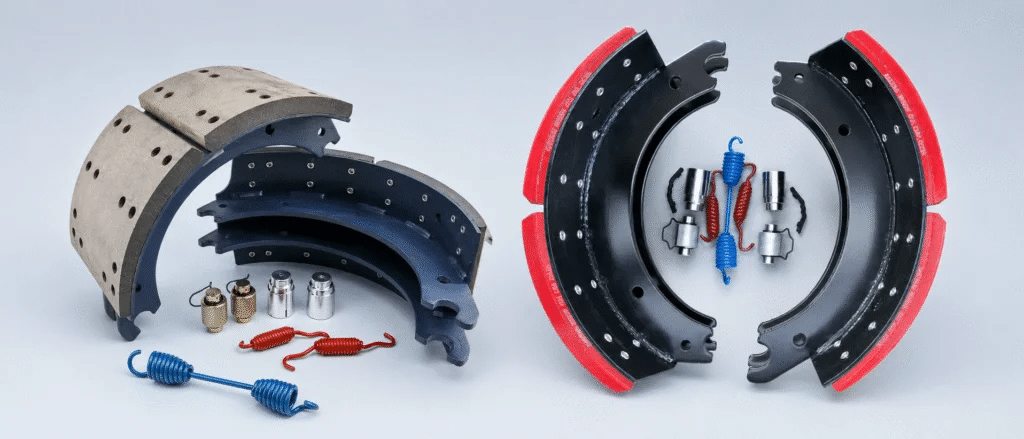
The company supplies heavy-duty truck brake shoes, brake linings and complete lined shoe assemblies for trucks, trailers and buses. Its range covers common North American references such as 4515, 4707, 4709, 4711 and 4720, plus European applications matched through WVA and OE references.
For distributors and private-label customers, working directly with the manufacturer gives more flexibility on product development, packaging and market-specific solutions.
16. Ege Fren — Türkiye
Website: Ege Fren
Ege Fren becomes more relevant once you look at commercial vehicles built on European platforms.
Türkiye sits between Europe and its neighboring markets, and many trucks and trailers in the Middle East, Central Asia and North Africa run on European braking systems. Ege Fren’s range reflects that, with applications for BPW, Mercedes-Benz, MAN, Scania and Volvo.
For distributors, its value is mostly application knowledge. Replacing commercial brakes is rarely about finding a part that looks similar. The right references, vehicle compatibility and operating conditions all matter.
That makes Ege Fren worth considering in markets where European commercial vehicles dominate.
17. Mineral-Loy Automotive — South Africa
Website: Mineral-Loy Automotive
Mineral-Loy is a different kind of player: a regional supplier that knows its local market.
Its range covers European truck applications, including references for Volvo, Scania and Mercedes/MAN, which matches the vehicle mix in Southern African fleets.
For international buyers, regional suppliers can offer more than manufacturing. Knowing the local vehicle population, replacement cycles and customers is valuable when you serve one specific market.
Mineral-Loy shows that commercial vehicle brake supply isn’t only about big global brands. Regional specialists who know their customers matter too.
18. Knorr-Bremse — Germany
Website: Knorr-Bremse
Knorr-Bremse is different from most companies here because it’s built around complete braking systems, not individual replacement brake shoes.
On a commercial vehicle many components have to work together, and companies with system-level experience approach brake development from a wider angle.
Knorr-Bremse has worked on truck and bus braking technology for a long time, which makes it an important reference when you look at how commercial vehicle brake systems have evolved.
If you’re buying brake shoes specifically, it isn’t a typical sourcing partner. It does help explain how commercial vehicle braking moved from individual parts to integrated systems.
19. ZF Commercial Vehicle Solutions — Germany / Global
Website: ZF Commercial Vehicle Solutions
ZF Commercial Vehicle Solutions shows another side of the industry: braking technology tied into wider vehicle systems.
ZF isn’t a traditional brake shoe manufacturer. It focuses on braking, safety and vehicle control technology for commercial vehicles.
For truck and bus makers, system compatibility matters more as vehicles become more connected and electronically controlled.
For distributors and aftermarket buyers, ZF is less about buying one brake part and more about understanding where commercial vehicle technology is heading.
20. Bendix Commercial Vehicle — United States
Website: Bendix Commercial Vehicle
Bendix comes up all the time in North American commercial vehicle braking.
It’s closely tied to truck and trailer braking systems, especially in heavy duty, where fleets, repair shops and distributors work with Bendix products and references every day.
Bendix is best seen as a commercial braking system supplier rather than a brake shoe factory focused on one component. Its products span heavy-duty braking, from foundation brake parts to friction products.
If you serve the North American truck market, Bendix is a useful reference, because many replacement decisions follow established fleet preferences and aftermarket habits, not just part numbers.
21. SAF-Holland — Germany / United States
Website: SAF-Holland
Anyone working with commercial trailers will run into SAF-Holland sooner or later.
Its reputation is built on trailer axles, suspension systems and related parts rather than brake shoes. Brakes are closely tied to the axle platform, though, which makes SAF-Holland relevant for trailer brake applications.
For trailer distributors, knowing the axle behind a brake part is often as important as knowing the shoe dimensions. Axle generation, drum design and application requirements all affect the replacement choice.
SAF-Holland represents the system side of trailer braking, where brakes, axles and fleet maintenance are considered together.
22. Textar — Germany / Global
Website: Textar
Many people in commercial vehicle friction know Textar, especially for European applications.
Textar is part of TMD Friction and focuses on friction materials rather than complete steel brake shoes. Its experience comes from developing brake pads, linings and friction products for many vehicle applications.
When you compare complete lined shoes, the friction supplier behind the product can matter as much as whoever made the shoe.
So Textar is on this list not as a brake shoe factory but for the material expertise that drives braking performance, wear life and consistency.
23. Don — Germany / Global
Website: Don
Don is another TMD Friction brand with strong ties to commercial vehicle braking.
Like other friction specialists, Don works mainly on the material side, not on fabricating the brake shoe structure.
For distributors and fleets that difference matters. A brake shoe assembly isn’t judged only on fit. Long service life, stable friction and predictable wear count too.
Don stands for the friction technology behind the finished brake part.
24. Bendix Spicer Foundation Brake — United States
Website: Bendix Spicer Foundation Brake
Bendix Spicer Foundation Brake focuses on the foundation brake side of commercial vehicles.
On heavy-duty trucks and trailers, the foundation brake is where mechanical parts, friction materials and vehicle loads meet. Companies working here are important references for how commercial vehicle braking systems are designed.
For aftermarket buyers it isn’t a typical place to source brake shoes, but it gives useful insight into how North American heavy-duty brake systems have developed.
Its importance is in understanding the whole braking environment, not just one replacement part.
25. NAPA Commercial Vehicle — United States
Website: NAPA Auto Parts
NAPA shows a different side of the brake market: distribution.
Unlike manufacturers such as Meritor or TMD Friction, NAPA is known as an aftermarket parts network linking suppliers, repair shops and end users.
For commercial vehicle buyers, distribution matters. A technically good product isn’t worth much if it can’t reach a customer quickly while a truck sits waiting for repair.
That’s why NAPA belongs in a global brake supplier list. It represents availability, coverage and customer access, another important part of the aftermarket.
26. Raybestos — United States
Website: Raybestos
Raybestos is a familiar name in the automotive aftermarket brake business.
Compared with companies focused on OE commercial vehicle systems, Raybestos is more closely linked to replacement brake products and aftermarket distribution.
For buyers, brands like Raybestos matter for market recognition as much as manufacturing. In many replacement markets, people buy what they know, what’s available and what the catalog covers.
Raybestos represents the aftermarket side of braking, where getting the product to the customer can matter as much as the spec sheet.
27. Centric Parts — United States
Website: Centric Parts
Centric Parts is another example of how much the aftermarket matters.
The company focuses on replacement brake products and serves distributors who want broad catalog coverage across many vehicles.
Centric isn’t known mainly for heavy-duty truck brake shoes, unlike the specialist commercial brake makers. It’s still an important part of the wider brake supply chain, especially in replacement markets where availability and application coverage drive purchasing.
For distributors, companies like Centric show that the brake market isn’t only about making parts. It’s also about getting the right products to the right customers.
28. ASK Automotive — India
Website: ASK Automotive
ASK Automotive is one of India’s well-known automotive component makers, with experience in braking systems and friction-related products.
It reflects the growing capability of India’s automotive supply chain, especially in OEM manufacturing and large-scale production. If you’re exploring Indian suppliers, it’s a useful reference for regional manufacturing strength.
If you need a dedicated brake shoe manufacturer, still confirm the specifics: heavy-duty applications, friction options and OEM/private-label support.
29. Standard Friction Components — India
Website: Standard Friction Components
Standard Friction Components represents the material-focused side of India’s commercial vehicle braking industry.
Rather than treating it as just another brake shoe supplier, look at its experience with friction materials in different operating environments.
A city bus, a highway truck and a construction vehicle may use similar brake hardware, yet need very different friction materials.
For distributors building heavy-duty brake programs, suppliers with friction knowledge are valuable once requirements go beyond basic replacement.
30. Eastman Auto & Power — India
Website: Eastman Auto & Power
Eastman is a broad automotive supplier with export experience across many replacement part categories.
Its link to commercial vehicle braking comes through aftermarket products and international supply channels.
Broad catalogs are convenient when you need several product categories from one source. For a specific brake shoe program, though, confirm the actual manufacturing source and technical capability behind each product line.
Eastman represents the wider aftermarket supply side of the commercial vehicle parts industry.
Choosing the Best Brake Shoe Manufacturer for Your Business
There’s no single best brake shoe manufacturer. The right truck brake shoe supplier isn’t always the biggest one. It depends on your market, your applications and whether you need standard replacement parts, OEM supply or OEM and private-label brake solutions.
A US fleet may care most about local inventory, a proven service record and getting replacement shoes fast when trucks are back in the yard. A European trailer distributor may focus on BPW, SAF and WVA coverage, while a private-label importer may need a factory that handles customization, packaging and steady production.
A friction manufacturer, on the other hand, may want thousands of bare steel shoes so it can apply its own friction materials on its own line.
An importer building a private-label truck parts brand has completely different needs. It may want one reliable factory that can supply 4515, 4707, 4709, 4711 and 4720, tune friction formulas, provide branded packaging and keep container-volume production steady.
That’s why price should come fairly late in the comparison. The question isn’t just “Who’s cheapest?” It’s “Which manufacturer gives my market the best long-term solution?”
Compare these first:
- application coverage;
- brake shoe geometry;
- steel and welding control;
- friction development;
- dynamometer capability;
- relevant certification;
- traceability;
- OEM/private-label capability;
- production capacity;
- and long-term consistency.
Only when those are roughly equal does arguing over the last few dollars of unit cost make sense.
For a commercial vehicle distributor, a brake shoe that costs a little less but brings short lining life, uneven wear or warranty claims is rarely cheaper in the end.
How to Evaluate a Brake Shoe Factory?
A polished website shows what a supplier wants you to see. The production floor shows what it can actually make. Visiting a brake shoe factory usually tells you more than certificates or a showroom ever will.
When you evaluate a brake shoe factory, look past the certificates and focus on how the product is actually made. Ask to see the brake shoe manufacturing processes in order: steel forming, welding, surface treatment, friction lining installation, riveting control and final inspection. A manufacturer that runs these steps in-house usually has better control over consistency than one that buys parts and assembles them.
For example, TUOBA runs several key brake shoe production steps in-house, including welding, coining, e-coating, powder coating and heat treatment, and uses computerized riveting monitoring to keep production consistent and traceable. Details like these show you how quality is built into the product, not just what the supplier claims.
For complete lined brake shoes, also check whether the manufacturer can run brake performance tests and validate the product before it ships.
OEM and Private Label Brake Shoe Solutions
Many commercial vehicle parts distributors aren’t just buying replacement parts anymore. They’re building their own brake programs and need a manufacturing partner who can help with development, customization and long-term supply.
A capable brake shoe manufacturer offers more than part-number matching. OEM and private-label projects can include custom brake shoes, bare shoe production, complete lined assemblies, friction material selection, custom packaging and branded products for different markets.
Different applications need different solutions. A distributor serving North American trucks may need FMSI-based applications such as 4515, 4707, 4709, 4711 and 4720, while European projects are matched by WVA numbers, OE references or axle specs. Being able to adjust the product to the target market is what separates a long-term manufacturing partner from a parts supplier.
At TUOBA, we work with distributors, importers and commercial vehicle parts brands on OEM and private-label brake shoe programs: product matching, friction material options, complete lined assemblies, custom packaging and technical support for each application.
If you’re building your own brake program, the goal isn’t just to buy a brake shoe. It’s a product line with consistent quality, steady supply and solutions that fit your market.
Why Choose China Brake Shoe Manufacturers?
China has become an important source of commercial vehicle brake shoes because many factories combine capacity, product coverage and flexible OEM support for global markets.
For distributors and private-label importers, working with China brake shoe manufacturers isn’t only about price. Many factories cover a wide range of applications, including North American FMSI references such as 4515, 4707, 4709, 4711 and 4720 and European WVA and OE-based applications, so you can build a broader catalog with fewer suppliers.
Flexibility matters too. Instead of only selling standard replacement parts, many Chinese manufacturers can customize friction materials, packaging, branding and specs for different markets, which is especially useful if you’re building your own commercial vehicle parts brand.
Still, don’t choose a China brake shoe manufacturer on price alone. Check production capability, quality systems, test equipment, traceability and export experience. A good supplier should give you consistent quality and long-term support, not just products.
What Is a Commercial Vehicle Brake Shoe Actually Made Of?
One of the most common questions about this product sounds simple:
What is brake shoe material?
There are really two answers.
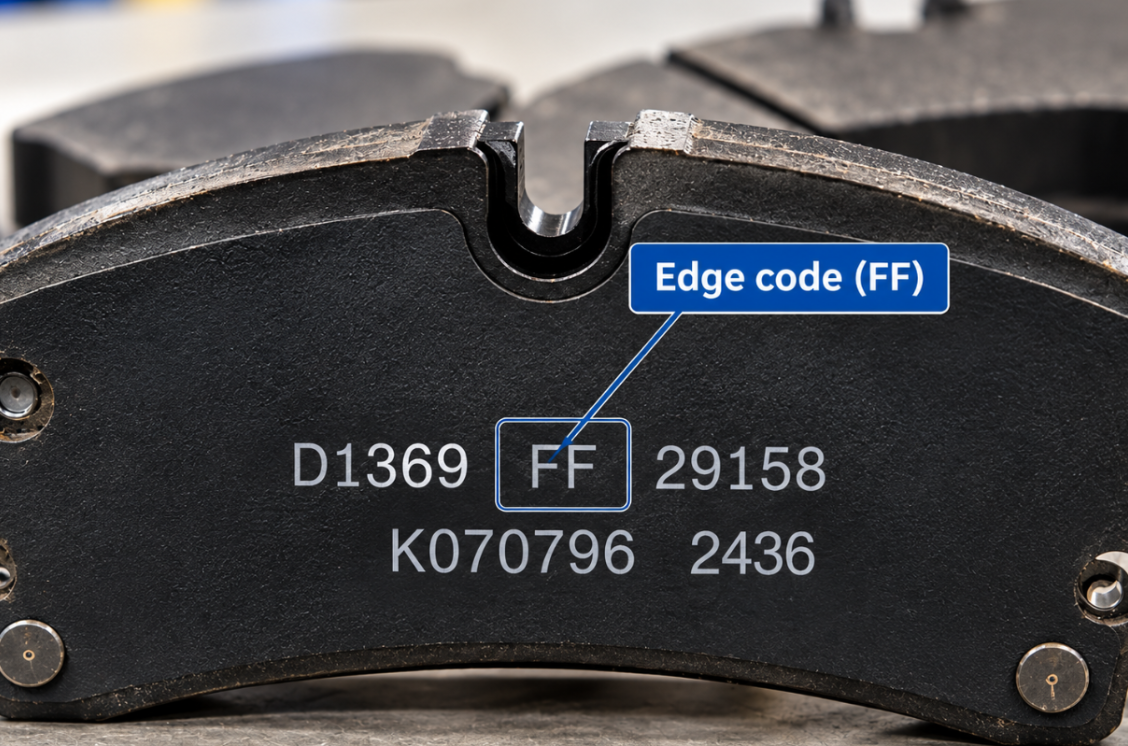
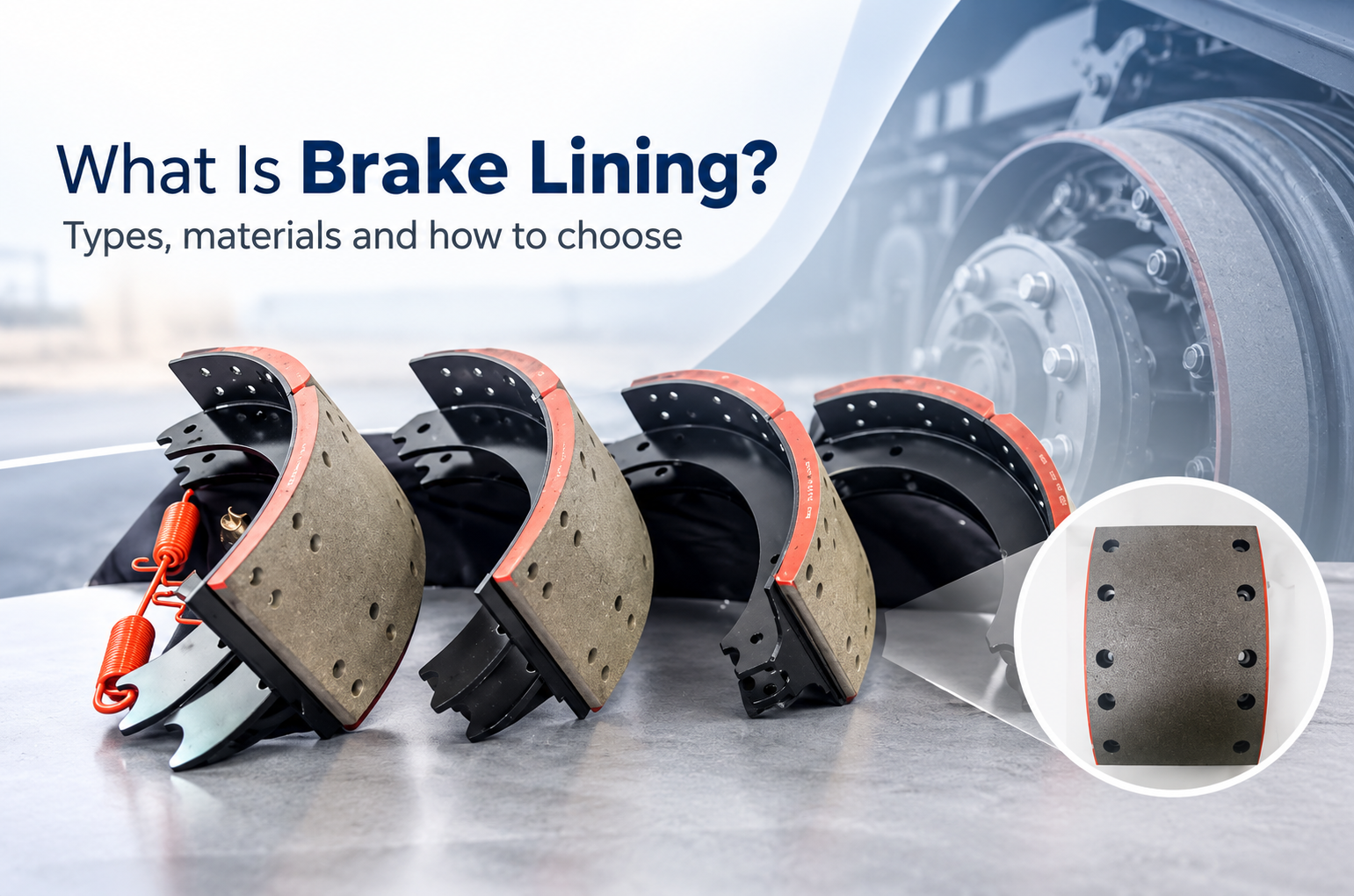
The first is the shoe itself. It’s usually a formed steel part, with the table and web that carry the lining and pass on the braking force. The steel has to hold its shape through repeated load and heat.
The second, and often the one that decides performance, is the brake shoe lining material.
That’s the friction compound riveted or otherwise attached to the steel shoe.
Modern commercial brake linings can combine metallic fibers, mineral fibers, fiberglass, ceramic fibers, aramid fibers, graphite, resin, abrasives and various friction modifiers.
In commercial vehicle drum brakes, terms like semi-metallic, low-metallic, low-copper and NAO describe broad formulation families. They don’t tell you the whole performance story.
A semi-metallic formula built for a lightly loaded commercial vehicle and one built for a heavily loaded tractor-trailer can behave very differently, even with the same general label.
That’s why experienced buyers ask for performance data instead of buying on a material name.
So the more useful question isn’t:
| Brake Shoe / Lining Material | Typical Properties | Common Use |
| Fabricated steel | High strength, weldability, fatigue resistance | Truck and trailer shoe structure |
| Semi-metallic friction | Heat resistance, strong and stable braking | Heavy trucks and trailers |
| Low-metallic friction | Balanced wear and thermal performance | Trucks and buses |
| Ceramic composite | Noise control and stable friction | Selected premium applications |
| Low-copper material | Reduced copper with controlled performance | Environmentally regulated markets |
| NAO | Lower noise and moderate heat performance | Light/medium commercial vehicles |
| Reinforced composite | High thermal and structural stability | Severe-duty applications |
“Which brake shoe material is best?”It is:“Which friction material has been validated for my brake system, axle load and operating conditions?”
The Brake Shoe Numbers Commercial Vehicle Buyers See Again and Again
If you sell into North America, a few FMSI brake shoe families come up constantly. 4515 / 4515Q is a familiar heavy-duty drum brake family, and 4707 / 4707Q / 4707QP is even better known, especially in 16.5 × 7-inch truck and trailer applications. 4709, 4711 and 4720 also show up often in heavy-duty catalogs.
For European trucks and trailers the sourcing language changes. Buyers work with WVA numbers, axle brands and OE references for BPW, SAF, Gigant, Volvo, Scania, Mercedes-Benz, MAN, DAF and Iveco. It’s worth knowing the difference before you contact a factory.
Tell a supplier “We need American truck brake shoes” and they have to guess. Send “FMSI 4707QP, 16.5 × 7 inch, FF friction, 20,000-lb axle application” and you’re in a technical conversation right away.
New Brake Shoes or Remanufactured Shoes?
It depends where you sell. In North America, remanufactured heavy-duty brake shoes are still common because there’s a mature core-return system: used cores are collected, inspected and rebuilt if the steel is still sound. If you already run that system, reman can make sense. We compare new and reman shoes for US buyers in more detail in our USA brake shoe manufacturers guide.
Most international buyers, especially those importing from China or India, find new shoes easier. No cores to collect, no guessing how the shoe was used before, no hidden fatigue in the steel. You can also set dimensions, friction material, packaging and private label from day one.
Buying wholesale brake shoes direct from the manufacturer keeps inventory planning simple, too: predictable specs, steady supply and consistent quality. That’s why most export-oriented brake shoe manufacturers in China, India and other manufacturing regions focus on new complete shoes rather than rebuilt cores.
Frequently Asked Questions
1. Who are some leading brake shoe manufacturers?
Leading commercial vehicle brake shoe manufacturers include Cummins-Meritor, Haldex, BPW, Marathon, TMD Friction, Fras-le, Brakes India and TUOBA. They serve different markets: OE supply, aftermarket replacement and OEM/private-label programs.
2. Who manufactures brake shoes for heavy-duty trucks?
Manufacturers such as Meritor, Haldex, Marathon and TUOBA supply brake shoes for heavy-duty trucks, trailers and commercial vehicles. Look for suppliers with proven heavy-duty experience rather than ones focused mainly on passenger cars.
3. Are Chinese brake shoe manufacturers suitable for OEM and private-label orders?
Yes. Many China brake shoe manufacturers run OEM and private-label programs with custom branding, packaging, FMSI/WVA coverage, friction options and stable capacity. Check the factory’s capability, quality control and production experience before you start.
4. What should I look for in a truck brake shoe supplier?
A good truck brake shoe supplier should have heavy-duty experience, accurate model coverage, stable production, a quality system, traceability and the ability to supply long-term. OEM and private-label support matter too if you’re building your own product line.
5. What should I send a manufacturer when requesting a quote?
Send FMSI or WVA numbers, OE references, truck or axle model, brake specs, annual volume, packaging requirements and destination market. A drawing or sample helps confirm the right product when references aren’t clear.
6. What is the MOQ for brake shoe orders?
MOQ depends on the model, the customization and the production schedule. Many manufacturers accept trial orders before regular volume. For ongoing OEM or private-label programs, MOQ varies with specs, packaging and annual demand.
7. What certifications should I ask a commercial brake shoe manufacturer for?
Buyers usually review certifications and test documents such as IATF 16949, ISO 9001, ECE R90, FMVSS or SAE reports. Always check them against the specific brake shoe model and friction formula you’re buying.
8. What material is commonly used for brake shoes?
Heavy-duty brake shoes usually combine a fabricated steel structure with a friction lining. Common formulations include semi-metallic, low-metallic, low-copper, ceramic and NAO, depending on the vehicle and performance needs.
9. What are the most important brake shoe material properties?
The key ones are steel strength, fatigue resistance, weld quality, friction stability, heat resistance, wear performance and fade recovery. A good brake shoe depends on the steel and the friction material working together.
10. What is the difference between a brake shoe and a brake lining?
The brake shoe is the steel part that carries the friction material. The brake lining creates braking force through friction against the drum. Together they make a complete lined brake shoe, or brake shoe assembly.
Sourcing Commercial Vehicle Brake Shoes?
TUOBA is a truck brake shoe supplier and manufacturer making brake shoes, brake linings and complete lined brake shoe assemblies for heavy-duty trucks, trailers, buses and other commercial vehicles.
For North America, our range covers common FMSI families such as 4515, 4707, 4709, 4711 and 4720. European projects can be matched by WVA number, OE reference or axle spec.
Bare shoes, complete lined shoes, custom friction materials, private-label packaging or help with product testing: we’ll build the solution around your market and application.
If you’re a distributor, importer or commercial vehicle parts brand looking for a reliable brake shoe supplier, send us your FMSI number, WVA number, OE reference, drawing, sample or annual demand, and our team will confirm the right product.
Contact TUOBA to talk through your OEM or private-label brake shoe project.