If you’ve sourced commercial vehicle brake shoes for a fleet, an aftermarket brand or a regional distribution business, you know finding brake shoe manufacturers isn’t the hard part.
The hard part is knowing whether a supplier will keep the same specs and quality order after order. A sample shows dimensions, workmanship and first performance. It can’t prove long-term consistency. You still need to know whether friction materials are controlled batch to batch, whether critical dimensions are recorded, whether key references ship on time, and whether a quality problem can be traced to a specific production lot.
That’s why experienced buyers don’t compare brake shoe manufacturers in the USA on price alone. They also look at application coverage, friction consistency, shoe geometry, corrosion protection, country of origin, lead-time reliability, traceability, and how the supplier responds when something goes wrong.
Those checks matter even more in a market this big and this fragmented. The United States is served by domestic manufacturers, remanufacturers, friction specialists, national aftermarket brands, distributors and international OEM suppliers. Seeing the whole market helps explain why they sell such different products, and why a supplier that’s right for one application can be wrong for another. If you also buy outside North America, our global list of 30 commercial vehicle brake shoe manufacturers covers suppliers in Europe, Asia and South America.
Global Brake Shoe Market: Production Scale and Replacement Demand
Two kinds of demand drive the brake shoe market. The OEM channel follows new vehicle and equipment production. The aftermarket follows vehicles already on the road. For many suppliers the aftermarket is the steadier business, because trucks, trailers, buses, industrial vehicles and older cars keep needing maintenance whatever happens to new-vehicle sales.
Asia Pacific leads on production scale. China, India and Japan have big vehicle industries and established friction-material supply chains. China matters as both a vehicle producer and a component manufacturing base, while India combines growing commercial vehicle production with heavy demand from cost-sensitive platforms.
The International Organization of Motor Vehicle Manufacturers lists China, the United States, Japan, India, Germany, Mexico, South Korea and Brazil among the world’s key vehicle-producing countries. They don’t create the same kind of brake shoe demand, though. In Asia demand tracks manufacturing volume. In the United States and much of Europe it tracks replacement cycles and the number of vehicles already in service.
| Region | Estimated 2025 market share | Main source of brake shoe demand |
|---|---|---|
| Asia Pacific | 45.9% | Vehicle production and expanding domestic fleets |
| North America | 24.2% | Large vehicle population and mature aftermarket |
| Europe | 16.4% | Replacement demand and safety requirements |
| Latin America | 9.1% | Commercial vehicles and cost-sensitive platforms |
| Middle East and Africa | 4.5% | Heavy transport and imported vehicle fleets |
North America stands out because its aftermarket is so valuable. The Auto Care Association and MEMA market forecast projected the US light-vehicle aftermarket to reach $435 billion in 2025 and exceed $500 billion by 2028.
Inside North America, the United States is one of the most attractive replacement markets: a huge vehicle population, a mature repair network and strong fleet demand. That leaves room for domestic manufacturers, remanufacturers, aftermarket suppliers and international OEM brake shoe manufacturers serving US distributors.
Why the US Brake Shoe Market Attracts Global Suppliers
The US isn’t one uniform brake shoe market. A long-haul fleet, a refuse operator, a school bus contractor, a car parts distributor and a steel mill may all buy brake shoes, and their needs have almost nothing in common.
Long-haul trucks run long highway stretches with the occasional high-energy stop. Refuse trucks and city buses build heat through constant stops. Construction vehicles deal with heavy loads, dust, moisture and rough roads. Northern fleets fight salt and corrosion, and industrial operators may need to restore a brake that went out of production decades ago.
That variety supports several kinds of American brake shoe manufacturers and suppliers. Some make new steel shoes, some restore and reline used cores, and others supply complete foundation-brake systems. A few focus on car brake shoe applications, while others work almost only with heavy-duty trucks, trailers, transit vehicles, cranes, mining equipment or industrial machinery.
The US market also supports both local and international sourcing. A domestic brake shoe manufacturer USA buyers already know may deliver faster and make technical support easier. An overseas OEM manufacturer may offer wider application coverage, custom friction materials, private-label packaging and better pricing at production volume.
Knowing those differences is more useful than hunting for one company that claims to be the best brake shoe manufacturer for everything.
What US Brake Shoe Buyers Actually Care About
Most purchasing problems don’t start with a shoe that’s obviously bad. They start with one that looks fine but doesn’t perform consistently in service.
A distributor gets a good price and good samples, then finds the supplier can’t hold the same friction formula across batches. A fleet saves a few dollars per shoe set and loses far more when trucks come back early. A private-label brand builds a big catalog, then finds its supplier can’t keep the fast movers in stock.
So experienced buyers look past unit price. They want to know whether the shoe radius is controlled, whether the roller and anchor ends are heat-treated, how the lining is bonded or riveted, how the shoe is protected from corrosion, and whether a complaint can be traced to a specific material and production batch.
Availability matters as much as manufacturing. A brake lining manufacturers directory or supplier catalog may list hundreds of references, but that means little if popular truck and trailer applications keep going out of stock. For a distributor, fill rate and steady lead times can be worth more than catalog size.
Private-label buyers need even more. A capable OEM brake shoe manufacturer should support application data, cross-references, multilingual packaging, barcode labels, pallet planning, product images, test documents and a clear claims process, not just print a logo on a box.
None of that shows up in the unit price, but it decides how much time and money you’ll spend after the product leaves the factory.
Types of Commercial Vehicle Brake Shoe Manufacturers in the USA
No single type of manufacturer represents the US commercial vehicle brake shoe market. It’s made up of several supplier categories, each serving different customers, vehicles and buying models.
Some focus on OE-level braking systems for fleets, trailer builders and service networks that need strict application matching, consistent friction and solid aftermarket support. Others specialize in replacement shoes, remanufactured products or friction development, for buyers who care most about cost, inventory flexibility or unusual operating conditions.
For fleets and distributors, picking the right brake shoe manufacturer takes more than brand recognition or unit price. Look at application coverage, friction formulation, manufacturing capability, quality control, traceability, corrosion protection, capacity and the supplier’s ability to support you for years.
That’s especially true in heavy duty, where brake shoes face high loads, frequent braking, temperature swings and rough roads. A supplier that works well for a regional aftermarket program isn’t automatically right for an OEM project, a fleet contract or a private-label brand.
Top 10 Brake Shoe Manufacturers and Suppliers in the USA
The companies below cover different parts of the US commercial vehicle brake shoe market: OE-aligned brake system suppliers, aftermarket manufacturers, remanufacturers, friction specialists and industrial brake providers. Each serves different applications, from trucks, trailers and transit vehicles to industrial equipment and fleet replacement programs.
Supplier Categories at a Glance
| Supplier Category | Company | Main market | Product model | Strongest capability | Best suited to |
| Commercial Vehicle Brake System Suppliers | Bendix | Commercial vehicles | New and remanufactured brake shoes | Controlled remanufacturing and fleet support | Large truck fleets |
| Commercial Vehicle Brake System Suppliers | Cummins-Meritor | Trucks and trailers | OE and aftermarket brake products | Integrated brake-system expertise | OE-aligned fleet programs |
| Commercial Vehicle Brake System Suppliers | Haldex | Truck, trailer and transit | New and remanufactured brake shoes | Broad friction and application coverage | Fleets and distributors |
| New Brake Shoe Manufacturers | Marathon Brake Systems | Heavy-duty trucks | New brake shoes | US-made steel shoe program | Buyers avoiding core returns |
| Engineered Friction & Brake Solution Providers | Carlisle Brake & Friction | On- and off-highway equipment | Engineered brake systems | Severe-duty engineering | Equipment OEMs |
| Friction Material Specialists | ProTec Friction Group | Commercial and industrial | Custom friction products | Application-specific materials | Rebuilders and specialized projects |
| Friction Material Specialists | BREMSKERL | Commercial and industrial | New shoes and friction products | Friction-material expertise | Multi-market distributors |
| Heavy-Duty Aftermarket Brake Suppliers | SilverbackHD | Heavy-duty trucks and trailers | New, core-free products | Complete wheel kits and severe-duty options | Fleet aftermarket |
| Industrial Brake Specialists | Winkle Industries | Cranes and industrial equipment | New and remanufactured | Obsolete and custom brake support | Industrial operators |
| Industrial Brake Specialists | Cook Bonding & Manufacturing | Industrial equipment | Custom and relined products | Low-volume friction work | Replacement and repair projects |
1. Bendix Commercial Vehicle Systems
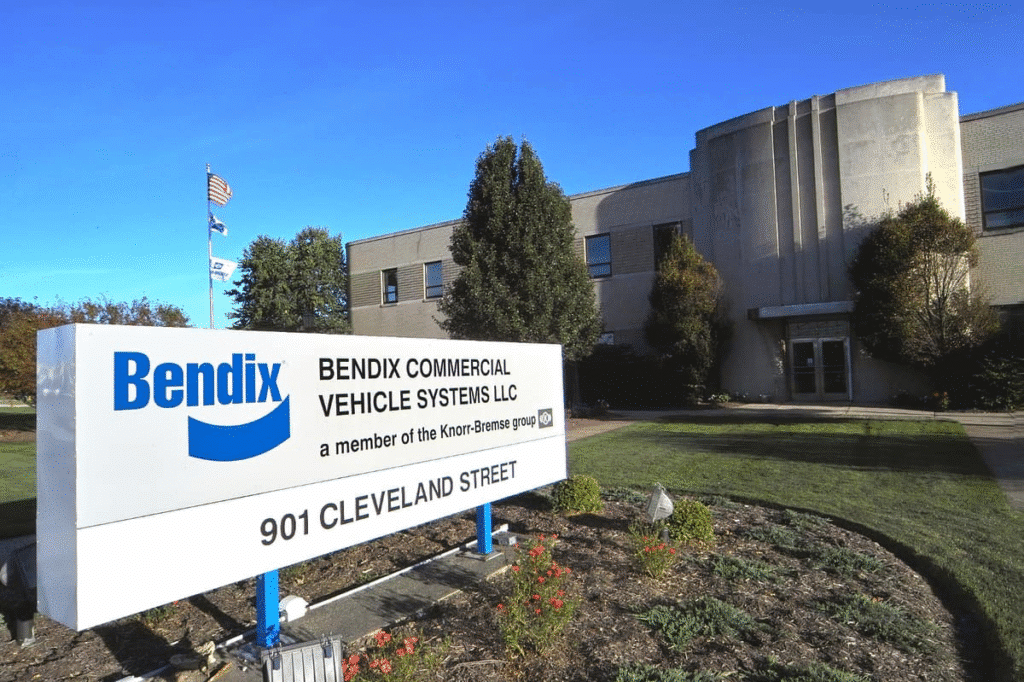
For a large truck fleet, the appeal of Bendix Commercial Vehicle Systems is simple. Technicians know the brand, distributors know the range and technical information is easy to get, which cuts the time it takes to roll a product out across many workshops.
Bendix supplies new and remanufactured lined brake shoes for medium- and heavy-duty commercial vehicles. Its documentation separates new lined shoes, remanufactured kits, individual remanufactured shoes and unlined shoes. It also sells pads, shoes, drums, hardware and hydraulic brake parts through its Formula Blue commercial-vehicle program.
Its approach to remanufacturing stands out. New friction material on an old core doesn’t automatically restore the shoe’s original shape. Repeated heat and braking force can distort a used shoe, which leads to poor drum contact and uneven lining wear. Bendix says it coins remanufactured shoes back to OE geometry, and its Huntington, Indiana, facility had produced more than ten million remanufactured brake shoes by 2021, according to the company’s brake shoe remanufacturing report.
Bendix suits fleets and service networks that want familiar part identification, broad commercial vehicle coverage and a controlled reman process. It’s less of a fit for a small private-label buyer after unique packaging or a proprietary friction formula. Before ordering, confirm whether the product is new or reman, which friction grade is installed, whether a core return is required, and whether the part matches the axle and duty cycle.
Official website: Bendix Commercial Vehicle Systems
2. Cummins Drivetrain and Braking Systems—Meritor
Cummins Drivetrain and Braking Systems includes the former Meritor business, which Cummins acquired in 2022. The Meritor name still carries real weight in commercial vehicle axles, foundation brakes, drivelines, trailer products and aftermarket parts.
Its main strength is system-level experience. A brake shoe doesn’t work alone: friction material, shoe geometry, S-cam design, hardware, drum condition and axle configuration all affect performance. Meritor’s Q Plus drum brake platform and broad North American truck and trailer coverage give it a strong position with fleets that prefer OE-aligned parts.
Its documentation identifies shoes by friction mix, FMSI number, brake type and service replacement number. That heads off one of the most common buying mistakes: a shoe that fits physically but doesn’t match the intended friction or performance spec. You can see how these identifiers work in the Meritor product identification guide.
Cummins-Meritor suits truck and trailer fleets, OE service programs and distributors that put compatibility, documentation and established aftermarket support first. Confirm the lining mix, exact brake configuration, corrosion-protection option, warranty and regional availability before standardizing a fleet on one reference.
Official website: Cummins Drivetrain and Braking Systems
3. Haldex
Haldex North America supplies braking and air-suspension products for heavy commercial vehicles. Its brake shoe programs cover trucks, trailers, transit vehicles and coaches, with both new and remanufactured products.
Haldex is useful if you need different friction grades and shoe configurations inside one commercial vehicle program. Its TransitmaX range includes new and reman lined shoes for transit and coach use. Haldex says its remanufactured products go through more than 30 inspections covering the shoe table, rivet holes, web, welds, coating, geometry, lining fit and anchor or roller-end wear. The checks are described in the company’s North American aftermarket overview.
It also offers new Midland steel shoes with heat-treated roller and anchor ends, non-asbestos organic friction material and e-coating. Details are in the Midland brake shoe program.
For fleets in northern states, ports, farm regions or on the coast, corrosion protection deserves extra attention. Rust jacking can push the lining off the shoe table and cause failure before the friction material reaches its normal wear limit. That makes Haldex a practical choice for fleets, transit operators and distributors that need both new and remanufactured shoes.
Official website: Haldex North America
4. Marathon Brake Systems
Marathon Brake Systems is especially relevant if you want a truck brake shoe manufacturer with a domestic manufacturing program. It supplies heavy-duty brake linings and new brake shoes for truck and trailer applications.
Marathon says its new shoes are made in the United States with steel from US suppliers. The design focuses on details that directly affect service life: carbon-steel quality, seam welding, heat-treated anchor and roller journals, controlled shoe radius and corrosion protection.
According to Marathon’s new brake shoe manufacturing information, critical dimensions are monitored with computerized gauges, and e-coated shoes go through 1,000 hours of salt-spray testing. Those structural details matter, because even a good brake shoe lining material can’t make up for poor geometry, weak welds or thin corrosion protection.
Marathon is a practical option for heavy-duty distributors and fleets that want new steel shoes without core charges, return freight and core paperwork. Check part-number coverage, friction options, order quantities, production lead time, and whether the quote covers shoes only, hardware or a complete wheel-end kit.
Official website: Marathon Brake Systems
5. Carlisle Brake & Friction
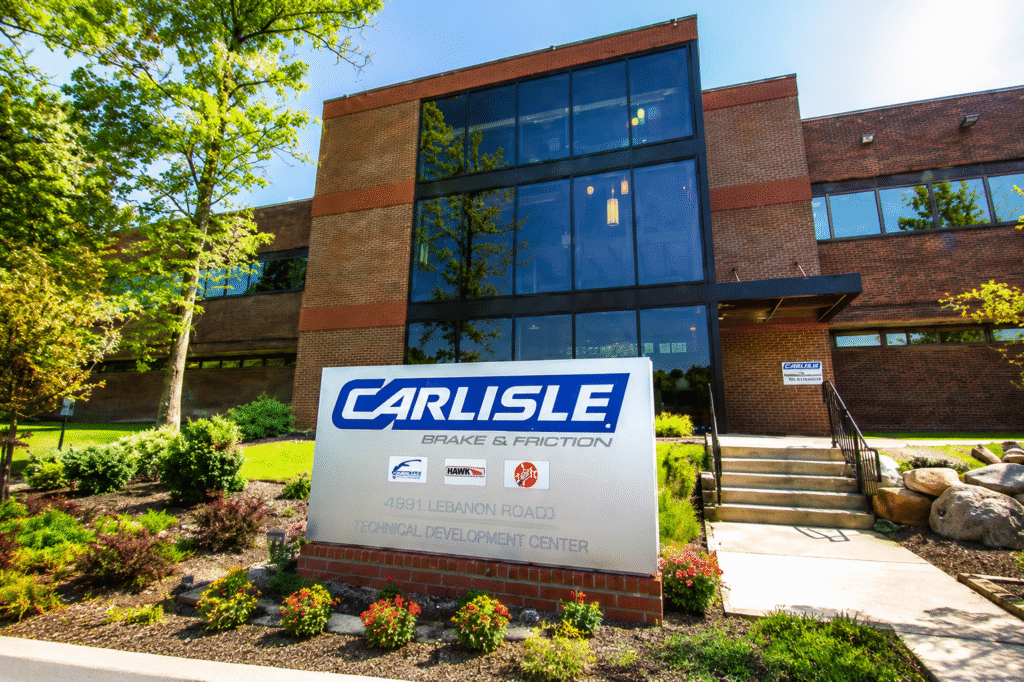
Carlisle Brake & Friction works in a more engineering-heavy market than a typical car brake shoe manufacturer. It supplies brake, friction, clutch, transmission and hydraulic products for on-highway trucks, construction equipment, mining vehicles, farm machinery, military applications and industrial equipment.
Its range includes brake shoes, shoe assemblies, wedge brakes, friction products, hydraulic controls and complete braking systems. Carlisle comes into its own when an application involves high loads, extreme temperatures, unusual actuation, or equipment where a standard aftermarket reference won’t do.
The company is headquartered in Medina, Ohio, and supports customers through a global manufacturing and engineering network. Its brake and friction product portfolio shows more focus on application engineering than on high-volume passenger car catalog coverage.
Carlisle fits equipment OEMs and severe-duty operators that need technical development and long-term system support. Talk through operating conditions, validation responsibility, tooling cost, expected volume and spare-part availability before development starts.
Official website: Carlisle Brake & Friction
6. ProTec Friction Group
ProTec Friction Group specializes in advanced friction materials for commercial and industrial use. Since 1988 it has worked with equipment makers, dealers and specialist brake and clutch rebuilders.
ProTec’s value is less about catalog size and more about matching friction behavior to a specific application. That matters when a standard lining causes excessive wear, fade, cracking, noise or drum damage. Frequent stops, poor cooling, contamination, unusual drum materials or obsolete equipment can all call for a carefully chosen formula.
Come to ProTec with more than an old part number. Useful details include vehicle or equipment weight, drum diameter, lining dimensions, braking frequency, operating temperature, previous lining material, expected service life and the current failure mode. That gives them a solid basis for recommending a brake shoe material with the right friction, wear and thermal properties.
ProTec is a strong candidate for industrial operators, specialist rebuilders and OEM customers that need custom friction materials. Agree minimum quantities, tooling, prototype steps, test methods and lead times at the start.
Official website: ProTec Friction Group
7. BREMSKERL
BREMSKERL Commercial Vehicle is part of an international friction group serving commercial vehicles, industrial equipment, rail and other demanding applications. Its drum brake range includes friction linings and complete brake shoes for commercial vehicle axles.
BREMSKERL makes sense if you want friction expertise as well as finished brake shoes. The steel shoe you can see is only part of the story. Fibers, resins, fillers, abrasives, lubricants, density and curing all affect friction stability, fade, recovery, wear, noise and drum compatibility.
Its international manufacturing background can also help distributors serving several vehicle markets. Its commercial-vehicle drum brake catalog includes complete brake shoe box kits and related friction products.
Don’t assume every product sold by a North American company is made in the United States. Check country of origin, production site, stock availability and test documents part number by part number.
Official website: BREMSKERL Commercial Vehicle
8. SilverbackHD
SilverbackHD supplies heavy-duty brake and suspension products for trucks, tractors and trailers in the United States and Canada. Its drum brake program focuses on new, core-free shoes, ceramic-enhanced friction, corrosion protection and complete wheel kits.
Its pitch is cost per mile. A relined shoe may be cheaper to buy, but the saving disappears if the used core has poor geometry, makes uneven contact, rust-jacks or sends the truck back to the shop early. New shoes remove the guesswork about past heat exposure and the hassle of core returns.
SilverbackHD also sells severe-duty products for high-load, high-heat work such as refuse trucks, fire trucks and snowplows. Its severe-duty brake kit documentation describes new cast-iron shoes, high-temperature friction and complete hardware kits.
SilverbackHD is headquartered in Canada and serves the US through its North American distribution network. Treat it as a North American aftermarket supplier, not automatically a domestic US manufacturer. Check product origin, local stock, friction grade, warranty, and whether performance claims apply to the exact part you’re buying.
Official website: SilverbackHD
9. Winkle Industries
Winkle Industries serves a different brake shoe market from the commercial vehicle companies above. The Ohio business specializes in heavy industrial brakes for cranes, hoists and rotating equipment.
Winkle remanufactures magnetic shoe brakes and supports equipment from Cutler-Hammer, Square D, General Electric, Westinghouse, P&H, Clark and other industrial brands. It offers replacement brake shoes, in-house relining, complete assemblies, controls and support for obsolete equipment.
That specialization is valuable in steel mills, ports and plants, where replacing a whole machine because one brake is obsolete makes no sense. Winkle says its remanufactured brake assemblies cover several actuation methods and torque ratings from 10 to 9,000 lb-ft. You can review these on its industrial brake assembly page.
Winkle suits industrial maintenance teams, crane operators and contractors dealing with specialized or discontinued brakes. A good inquiry includes the brake model, drum dimensions, required torque, lining spec, photos and details of the operating environment.
Official website: Winkle Industries
10. Cook Bonding & Manufacturing
Cook Bonding & Manufacturing is a Cleveland specialist in friction materials, crane brake shoes, hoist friction products and custom industrial parts. Its market is closer to industrial repair and replacement than high-volume automotive retail.
Companies like this become valuable when you have an older assembly, a discontinued reference, or a quantity too small for a big automotive supplier. A project might mean making a replacement shoe, bonding or riveting new friction material, or reproducing a part from an original sample.
Buying here is more technical than ordering a standard vehicle part. Cook may ask for shoe dimensions, drum diameter, lining thickness, attachment method, equipment speed, working load and service conditions before it recommends anything.
Cook Bonding fits industrial brake replacement, crane and hoist applications and custom friction projects. Confirm current material availability, dimensional inspection methods, test documents, order quantities and delivery time.
Official website: Cook Bonding & Manufacturing
How to Shortlist a Brake Shoe Manufacturer
A list of ten companies only helps if you can cut it to two or three realistic candidates. These factors usually matter more than company size or brand name.
Confirm What the Company Actually Does
The term brake shoe manufacturer covers several kinds of supplier. Some make the steel shoe, develop the friction formula, attach the lining and inspect the finished product in-house. Others use outside factories while managing specs, quality control, inventory and distribution. Remanufacturers work differently again: they inspect used cores, replace worn friction material and return qualified shoes to service.
The business model alone doesn’t decide quality. A supplier working with a qualified overseas factory may deliver consistent products and broad coverage, while a regional remanufacturer may suit fleets with an established core-return program. What counts is how well the supplier controls the steps that shape the finished product.
Before you order, confirm where the shoe is made, who controls the friction formula, how the lining is attached and which dimensional and performance checks are done. For reman shoes, also ask how used cores are inspected, which defects get a core rejected, and whether geometry is checked before new lining goes on.
Look at traceability and after-sales responsibility too. A reliable supplier can identify the production batch, review a quality issue with records, and hold the approved spec across repeat orders.
You don’t need a company that does every step in-house. You need one with a clear supply chain, proper quality control and clear responsibility for what it delivers.
Match the Product to the Duty Cycle
A part number confirms basic fit, dimensions and vehicle application. It doesn’t describe the conditions the brake shoe will actually work in, and two vehicles with the same brake configuration can ask very different things of the friction material.
A long-haul trailer may run high annual mileage with relatively few brake applications, while a refuse truck stops constantly and builds heat fast. A school bus brakes often and has to stay smooth and quiet. Construction vehicles carry heavy loads through dust, moisture, steep grades and rough ground. All of this changes operating temperature, wear rate, fade resistance, recovery, drum life and maintenance intervals.
Before recommending a product, a capable truck brake shoe manufacturer should understand:
- Vehicle type and axle configuration
- Normal operating load and maximum axle load
- Highway, urban, mountain, construction, or mixed-route use
- Frequency and intensity of brake applications
- Typical and peak operating temperatures
- Climate, road salt, moisture, dust, and corrosion exposure
- Current brake lining service life
- Existing problems such as rapid wear, fade, noise, cracking, or drum damage
- Target maintenance interval and expected cost per mile
With that information the supplier can balance friction, heat resistance, lining wear and drum compatibility. A high-friction formula may add braking torque but increase drum wear or heat in the wrong application. A long-life material may do well on the highway but not recover fast enough for stop-and-go work.
The goal isn’t the most aggressive or longest-lasting material on paper. It’s a formula that performs consistently in the vehicle’s real operating conditions. Suppliers who take time to understand the duty cycle are usually better at recommending a brake shoe that gives you both braking performance and predictable maintenance cost.
Do Not Choose by Brake Shoe Material Name Alone
Terms like semi-metallic, low-metallic, ceramic-enhanced and non-asbestos organic are a useful starting point when you talk about brake shoe lining material, but they describe broad families, not complete performance specs.
Two products can share the same brake shoe material name and still behave differently in service. Their real brake shoe material properties depend on the whole formula and the manufacturing process. Fibers add structure and strength, resins bind the mix, abrasives drive friction and surface conditioning, lubricants help control noise, heat and drum wear, and fillers affect density, stability and cost. Mixing accuracy, molding pressure, curing temperature and curing time can matter as much as the ingredients.
Look at friction across the full temperature range, too. One lining may brake hard when cold and lose bite after repeated high-energy stops. Another may stay stable when hot but wear drums unnecessarily on the highway. That’s why one friction coefficient or material category isn’t enough to choose a product.
A higher friction coefficient isn’t automatically better. Too aggressive a material can add braking torque but also heat, noise and drum wear. A softer formula may be quiet and easy on drums but wear out fast under heavy loads or frequent stops. The right balance depends on vehicle weight, brake size, route, stop frequency, drum material and your maintenance goals.
When you compare materials, review:
- Normal and hot friction performance
- Fade during repeated braking and recovery after cooling
- Lining wear under the intended load and temperature
- Compatibility with the brake drum
- Noise and vibration behavior
- Shear or attachment strength
- Resistance to cracking, swelling, and heat damage
- Corrosion protection between the lining and shoe table
- Consistency between production batches
Test results are most useful when they match the intended application. A lab result from a passenger car duty cycle tells you little about a refuse truck, bus or heavy trailer. Ask which test method, brake configuration, load and temperature range were used, rather than relying on phrases like “high performance” or “premium material.”
The aim isn’t to find one brake shoe material that’s best for every vehicle. It’s to choose a formula with stable friction, acceptable wear and good drum compatibility in the conditions the product will really face.
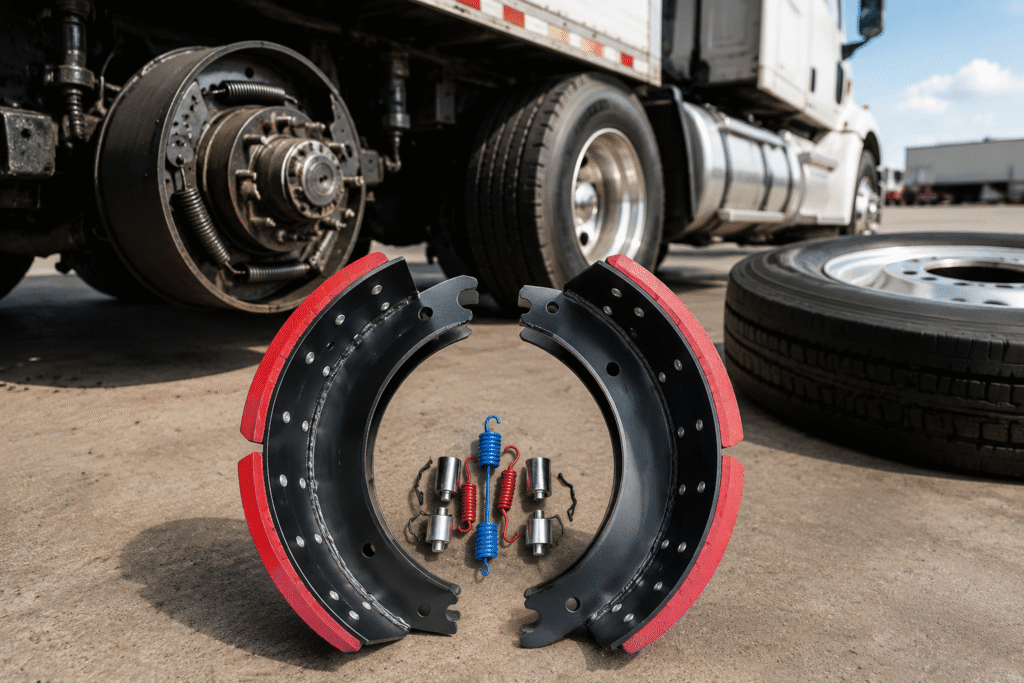
Compare New and Remanufactured Shoes by Total Cost
New versus remanufactured isn’t just a question of which costs less per unit. It also depends on how you handle inventory, used cores, shop time and downtime.
New shoes start with fresh steel and known geometry. There’s no past heat exposure, wear, corrosion or repair history to worry about, and no core charges or returns, which keeps purchasing simple for distributors with many customers or fleets without an organized core program.
Remanufactured shoes make good sense when the process is well controlled. A qualified remanufacturer should inspect the shoe table, webs, welds, rivet holes, anchor ends and roller ends; reject damaged cores; check or restore the shoe radius; apply corrosion protection; and verify the new lining attachment. Done consistently, reman extends the life of the steel core and cuts material waste.
The real difference often shows up after you buy. A low reman price can be eaten up by core charges, return freight, missing or rejected cores and the admin time spent tracking credits. Fleets also need to ask whether reused shoes with different histories will give consistent geometry and wear on the same axle.
A useful cost comparison includes:
- Purchase price and core charge
- Freight for returning used cores
- Time spent sorting, storing, and documenting cores
- Percentage of returned cores rejected for damage
- Expected lining life under the actual duty cycle
- Effect on brake drum wear
- Installation and workshop time
- Warranty and claim-handling costs
- Cost of bringing a vehicle back for early brake service
- Availability of replacement products when demand increases
For fleets with common platforms, predictable maintenance and an efficient core-return system, a well-run reman program can be good value. For distributors handling many applications, or operators who want simpler inventory and more consistent starting geometry, new shoes are often more practical.
So base the decision on total cost per service cycle, not just the price on the quote. A product that lowers purchase cost but adds core losses, shop admin or an extra brake job isn’t a real saving.
Verify Standards and Technical Claims
Certifications and test reports only help if you know what they actually cover. A familiar standard number on a quote doesn’t always mean the exact brake shoe you’re buying was tested for your vehicle and operating conditions.
North American buyers often use the Friction Materials Standards Institute numbering system to identify friction product shapes and applications. An FMSI reference helps confirm dimensions, cross-reference products and talk clearly with suppliers. It doesn’t define the friction formula, and it doesn’t guarantee that products with the same FMSI number will match on braking performance, wear life, noise or drum compatibility.
Treat quality-management certificates the same way. A certificate shows the factory follows a documented system, but it isn’t product-level evidence. Check that it belongs to the facility making the quoted product, is still valid and covers the relevant manufacturing steps. A certificate issued to a sales office or another plant tells you little about the actual line.
Supporting technical documents should relate as closely as possible to the product you’re buying. Depending on the application, useful evidence includes:
- Friction testing under normal and elevated temperatures
- Fade and recovery results
- Dimensional inspection records
- Shear or lining-attachment strength
- Brake shoe radius and geometry checks
- Wear and drum-compatibility data
- Corrosion or salt-spray testing
- Material and copper-content declarations
- Production-lot and raw-material traceability
- Warranty terms and claim procedures
Be careful with claims about FMVSS 121. Federal Motor Vehicle Safety Standard No. 121 sets braking performance requirements for vehicles with air-brake systems. It evaluates the vehicle and brake configuration, not every aftermarket brake shoe as a general certificate.
If a supplier cites FMVSS 121, ask which brake size, axle load, drum, friction material, chamber and vehicle configuration were tested, and whether the quoted product uses the same formula and construction. A report on a different lining, brake assembly or axle setup doesn’t say much about the part in front of you.
Dates and revision control matter too. Friction formulas, raw material suppliers and production sites change over time, so confirm the report reflects the current production spec, not an older version.
The goal isn’t the biggest folder of certificates. It’s a clear line from the supplier to the factory, the test evidence and the exact brake shoe you’re buying. Once that line is clear, technical claims become purchasing evidence instead of marketing language.
Evaluate Supply Capability, Not Just Production Capacity
A big annual output figure shows factory scale. It doesn’t show how well a supplier can support the specific references you need. For distributors, availability, steady lead times and order flexibility usually matter more than total output.
A supplier can have plenty of capacity and still need long runs, high minimums or long lead times on less common part numbers. Find out how it handles both fast movers and slow movers.
Useful questions:
- Which brake shoe references are normally kept in stock?
- What is the standard production and delivery lead time?
- How does lead time change during peak seasons?
- What is the minimum order quantity for each reference?
- Can slow-moving references be combined with higher-volume products?
- How does the supplier use customer forecasts?
- Is production capacity reserved for regular customers?
- What happens when actual demand exceeds the forecast?
- Is safety stock available for key applications?
- Does the supplier operate a US warehouse or work with a local stocking partner?
Look at forecasting too. A supplier that gets a rolling forecast can prepare raw materials, reserve production time and stock high-demand references. Confirm which part of the forecast counts as firm, how often it can change and how unexpected demand is handled.
The best supply partner isn’t always the one with the biggest factory or longest catalog. For a distributor, it’s usually the one that keeps the right references in stock, flags changes early and holds lead times steady as volumes grow.
US Local Supplier or Overseas OEM Manufacturer?
For urgent replacement orders, a US supplier with local stock usually wins. Parts arrive faster, returns are easier and fitment questions get answered in the same time zone. That’s especially valuable for fleets with unexpected repairs and distributors restocking fast movers without carrying too much safety stock.
For a distributor planning container orders or building a private-label range, the math is different. An overseas OEM brake shoe manufacturer may offer wider coverage, custom friction formulas, packaging support and better pricing at planned volumes. With reliable forecasts and enough lead time, that model can widen your range and protect your margins.
Neither model solves everything. A local warehouse doesn’t help if the part isn’t in stock, and a low overseas price is worth little if lead times are unpredictable or quality drifts from order to order. Compare real availability, landed cost, order flexibility and supply reliability, not just where the supplier is.
| Buying factor | US or North American supplier | Overseas OEM manufacturer |
| Urgent delivery | Usually stronger | Depends on local inventory |
| Small replacement orders | Generally easier | May be restricted by MOQ |
| High-volume pricing | May have a higher cost structure | Often more competitive |
| Custom friction formulation | Depends on the supplier | Common at specialized factories |
| Private-label packaging | Not always a core service | Frequently available |
| Domestic returns | Easier | Requires an agreed claim process |
| International vehicle coverage | May focus on US references | Often broader |
| Production audit | Easier to arrange locally | Requires overseas qualification |
| Inventory planning | Shorter replenishment cycle | Longer forecasting horizon |
As the comparison shows, you don’t have to pick just one channel. Each can cover a different part of your product and inventory plan.
The strongest programs often use both. Local stock covers urgent demand and fast movers, while planned overseas production covers private-label lines, high-volume orders and applications that domestic stock doesn’t carry. That keeps service levels up without relying on one supplier, warehouse or production site.
Compare on landed cost, not factory price. Landed cost includes freight, duties, inspection, packaging, inventory carrying cost, claims, returns and the financial impact of longer lead times. Add the cost of stockouts, emergency buys and extra safety stock as well.
Once you count all that, the lowest quote isn’t always the cheapest supply. The better model is the one that balances availability, consistent quality, workable margin and reliable supply.
What Drives US Commercial Vehicle Brake Shoe Replacement Demand?
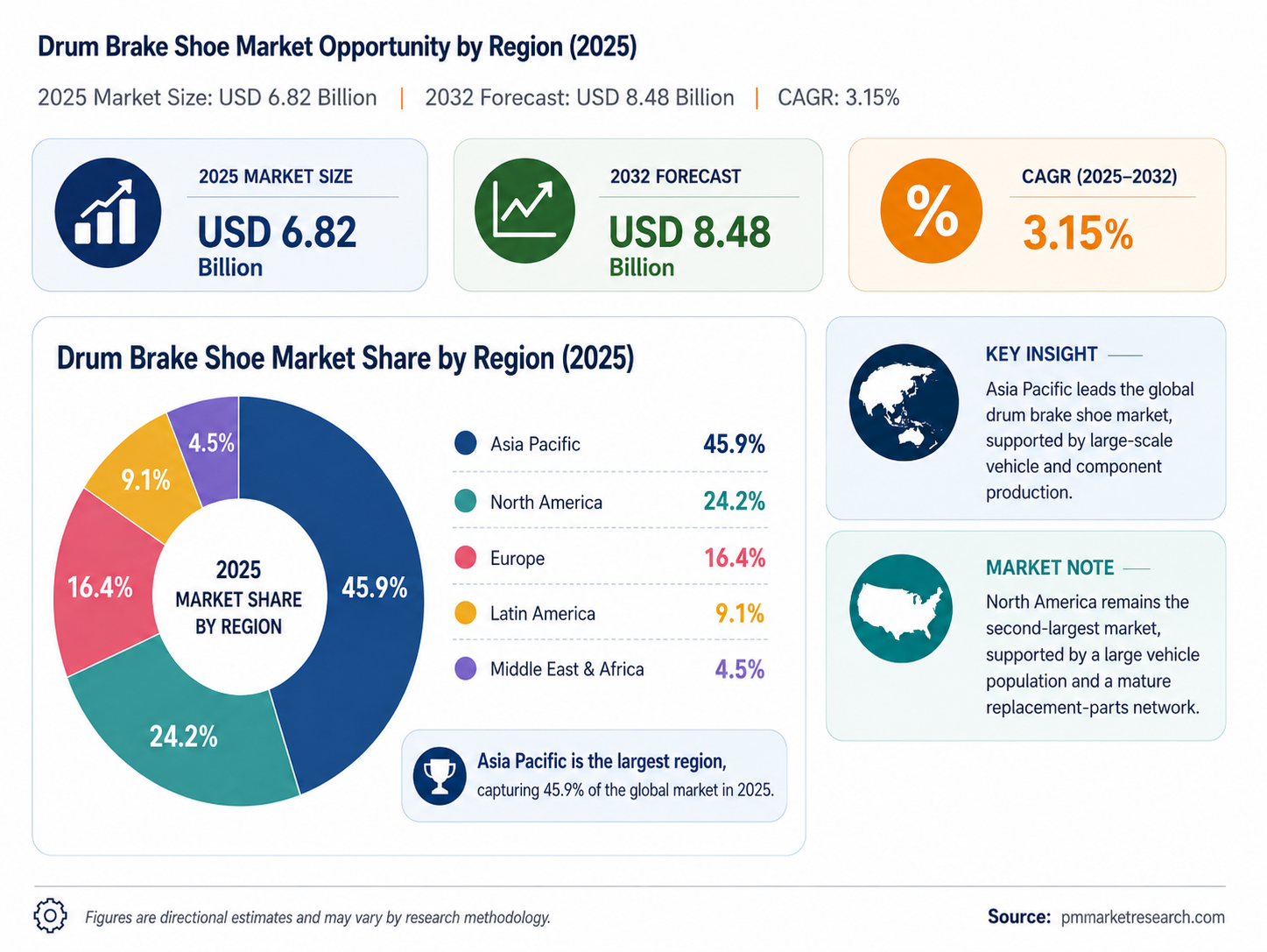
According to PW Consulting’s 2025 Drum Brake Shoe Market analysis, the global drum brake shoe market is supported by both original equipment and replacement demand across regions. Asia Pacific is the largest regional market, while North America remains significant thanks to a large installed vehicle base and a mature aftermarket. Research firms define brake shoes, linings and assembled products differently, so read these figures as a picture of market structure, not audited industry totals.
Global production helps explain the regional differences. Data from the International Organization of Motor Vehicle Manufacturers shows China, the United States, Japan, India, Mexico and several European countries remain major vehicle-production centers. Production volume alone doesn’t set brake component demand, though. In mature markets like North America, a large installed vehicle population creates constant replacement demand through fleet maintenance, repair networks and aftermarket channels.
Within North America, the United States is one of the most important replacement markets. According to MEMA’s US Aftermarket Vehicle Supplier Industry report, the country had approximately 291 million light vehicles and 10.9 million medium- and heavy-duty vehicles in operation as of early 2024. MEMA also valued the US medium- and heavy-duty aftermarket at approximately $125.4 billion.
The wider US replacement market keeps growing. A joint forecast from the Auto Care Association and MEMA Aftermarket Suppliers projected the US light-vehicle aftermarket to reach $435 billion in 2025 and exceed $500 billion by 2028.
These figures cover the whole automotive aftermarket, not just brake shoes, but they show the size of the vehicle population, service network and repeat replacement demand behind the US brake parts market. That environment supports many kinds of supplier: commercial vehicle brake system makers, aftermarket brake shoe suppliers, remanufacturers, friction specialists and industrial brake providers.
Against that background, the guide below compares ten brake shoe manufacturers and suppliers serving the United States: where each is strongest, which applications and buyers they suit, and what to check before choosing a long-term supplier.
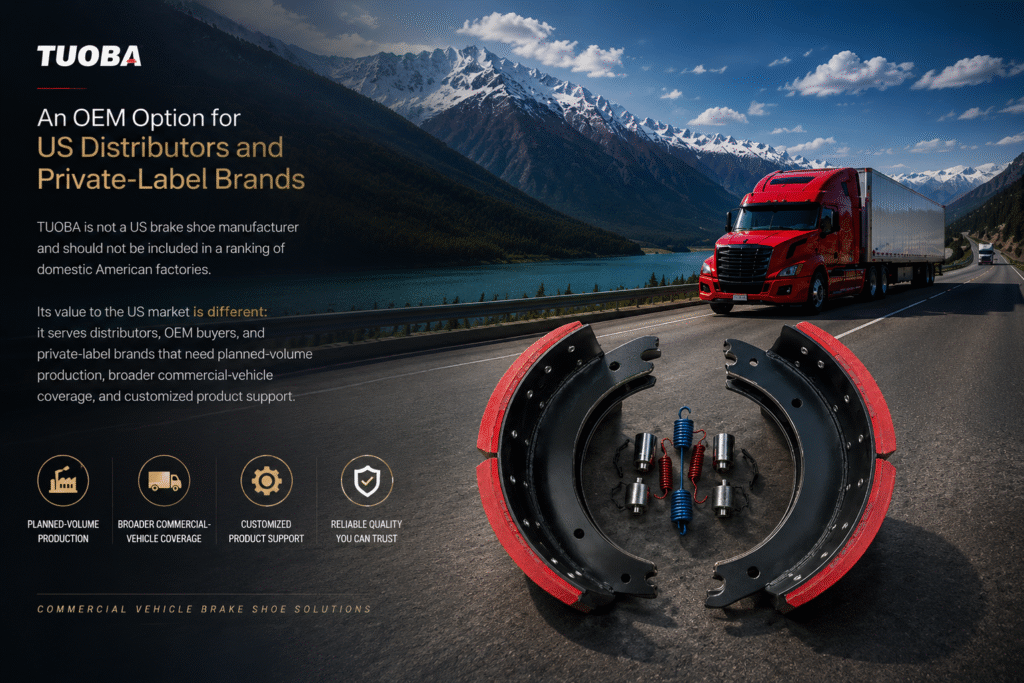
TUOBA: An OEM Option for US Distributors and Private-Label Brands
TUOBA isn’t a US brake shoe manufacturer and shouldn’t be ranked among domestic American factories. Its value to the US market is different: it serves distributors, OEM buyers and private-label brands that need planned-volume production, wider commercial vehicle coverage and customized product support.
For US distributors and private-label brands looking for another sourcing option, TUOBA is a heavy-duty brake shoe manufacturer with commercial vehicle brake shoe production capability, OEM manufacturing experience, flexible customization and long-term supply cooperation.
We make drum brake shoes for trucks, semi-trailers, buses, commercial vehicles and industrial applications, with semi-metallic, low-metallic and application-specific friction materials built around load, braking frequency, heat, wear, noise and target-market requirements.
For a private-label buyer, the project covers more than the shoe. Application cross-referencing, labeling, custom packaging, barcodes, pallet planning, technical documents and production traceability all decide whether a new range succeeds.
A productive first conversation starts with:
- OE, WVA, or FMSI reference
- Vehicle make and application
- Target country or market
- Expected annual volume
- Current product or supplier
- Required friction performance
- Packaging requirements
- Target delivery schedule
- Existing quality or field problem
With that, both sides can tell whether an existing product works, whether development is needed, and whether the project makes commercial sense.
If you’re a distributor, OEM buyer or private-label brand looking at new brake shoe suppliers, contact TUOBA with your part numbers, annual volumes and application details, and we’ll work out a suitable production solution.
Frequently Asked Questions
Who are the leading commercial vehicle brake shoe manufacturers in the USA?
Leading commercial vehicle brake shoe manufacturers and suppliers serving the USA include Bendix, Cummins-Meritor, Haldex, Marathon Brake Systems, Carlisle Brake & Friction and other specialized friction companies. The right one depends on the vehicle application, volume, friction requirements and service needs.
Are brake shoes still manufactured in the United States?
Yes. Some companies make new brake shoes or remanufacture them in US facilities, but many brands run global supply networks. Confirm the actual country of origin, production site, quality standards and availability for the specific part number rather than going by the headquarters address.
What is the difference between a brake shoe manufacturer and a reliner?
A brake shoe manufacturer produces new shoes with new steel and friction material, while a reliner rebuilds used cores by replacing worn lining. Remanufactured shoes need extra inspection, geometry checks and quality control to perform reliably.
What materials are used in commercial vehicle brake shoe linings?
Common commercial vehicle brake shoe lining materials include non-asbestos organic, semi-metallic, low-metallic, ceramic-enhanced and composite formulas. Performance depends on the complete formula: wear resistance, fade control, noise and drum compatibility.
Are new brake shoes better than remanufactured brake shoes?
New shoes give consistent geometry, no wear history and simpler inventory. Properly remanufactured shoes can also be good value when core inspection and restoration are well controlled. The right choice depends on the application, your maintenance strategy and total operating cost.
Which brake shoes are best for heavy-duty trucks?
There’s no single “best” brake shoe for every heavy-duty truck. It depends on axle load, application, braking frequency, operating temperature, drum compatibility and expected service life. Choose on real operating conditions, not price alone.
Can brake shoe manufacturers provide private-label products?
Yes, many manufacturers make private-label brake shoes for distributors and aftermarket brands, with custom packaging, product specs and production support. TUOBA offers commercial vehicle brake shoe production, OEM manufacturing experience and customization for planned-volume customers.
How should buyers choose a brake shoe manufacturer?
When choosing a brake shoe manufacturer, look at product coverage, friction options, manufacturing capability, test systems, OEM/private-label support and supply consistency. A good supplier delivers stable quality across repeat orders, not just a competitive price.
Can an overseas manufacturer supply brake shoes to US distributors?
Yes. Overseas manufacturers can supply US distributors and aftermarket brands. Before a long-term deal, check quality control, test documents, traceability, application accuracy, logistics, lead time and after-sales support.
Related reading
- 30 Commercial Vehicle Brake Shoe Manufacturers and Industry Suppliers
- 4515 vs 4707 vs 4709 Brake Shoes: Which One Fits Your Brake?
- Semi Trailer Brake Shoes & Drum Brake Pads: A Buyer’s Guide
Reviewed by: Robert, Chief Executive Officer, Tuoba Auto Parts
Technical basis: FMVSS No. 121 (49 CFR 571.121) · manufacturer information from each company’s official website (linked in each listing)
Need a Heavy-Duty Brake Shoe Supplier?
For distributors, OEM buyers and private-label brands looking for a reliable commercial vehicle brake shoe supplier, TUOBA offers OEM manufacturing experience, flexible customization and planned-volume production.
Send our team your OE number, FMSI reference, target volume and application details, and we’ll suggest a suitable brake shoe solution.