There is an important trend in the trucking industry that reveals more about brake system economics than any individual specification sheet.
On Class 8 tractors, air disc brakes have become increasingly common in the North American heavy-duty truck market. Industry sources, including insights from Meritor’s commercial vehicle brake technology, show that air disc brake adoption has continued to grow as fleets place greater emphasis on braking consistency, service efficiency, and total operating performance.
However, adoption on trailers remains lower compared with tractors. This difference is not simply because one technology is better than the other. Tractor and trailer applications operate under different conditions, maintenance strategies, replacement cycles, and cost considerations, which all influence brake system selection.
As a manufacturer producing both commercial vehicle brake pads and heavy-duty brake linings, we work with customers across different commercial vehicle applications. Through years of experience supporting fleets, distributors, and brake system partners, we have found that choosing between air disc brakes and drum brakes is not only a technical decision.
It is also a decision influenced by operating environment, maintenance practices, replacement frequency, inventory planning, and long-term ownership costs. For fleet operators, the right brake system choice depends on how the vehicle is used, where it operates, and how maintenance is managed. For distributors, understanding these differences is equally important when developing a reliable supply strategy for different markets and applications.
This guide examines the differences between air disc brakes and drum brakes from two perspectives: fleet operators selecting or maintaining trailers, and distributors managing commercial vehicle brake components supply for different customer requirements.
Air Disc vs Drum Brakes for Semi Trailers: Which Is Better?
Air disc brakes have gained popularity in many long-haul applications because they offer consistent braking performance and can simplify certain maintenance operations. However, drum brakes continue to play an important role in the trailer market, especially where durability, operating conditions, and cost control remain top priorities.
From our experience working with fleets and distributors, there is no single brake solution that fits every trailer application. The better choice depends on how the trailer operates, how long it stays in service, and how the maintenance system is managed. For high-mileage highway fleets, air disc brakes may provide advantages over the long term, while drum brakes remain a reliable option for demanding vocational environments where robustness and overall economics are critical.
The 30-Second Verdict by Application Type
- Long-haul dry van and reefer — Air disc, in most cases
- Tankers and bulk haulers — Air disc, strongly favored
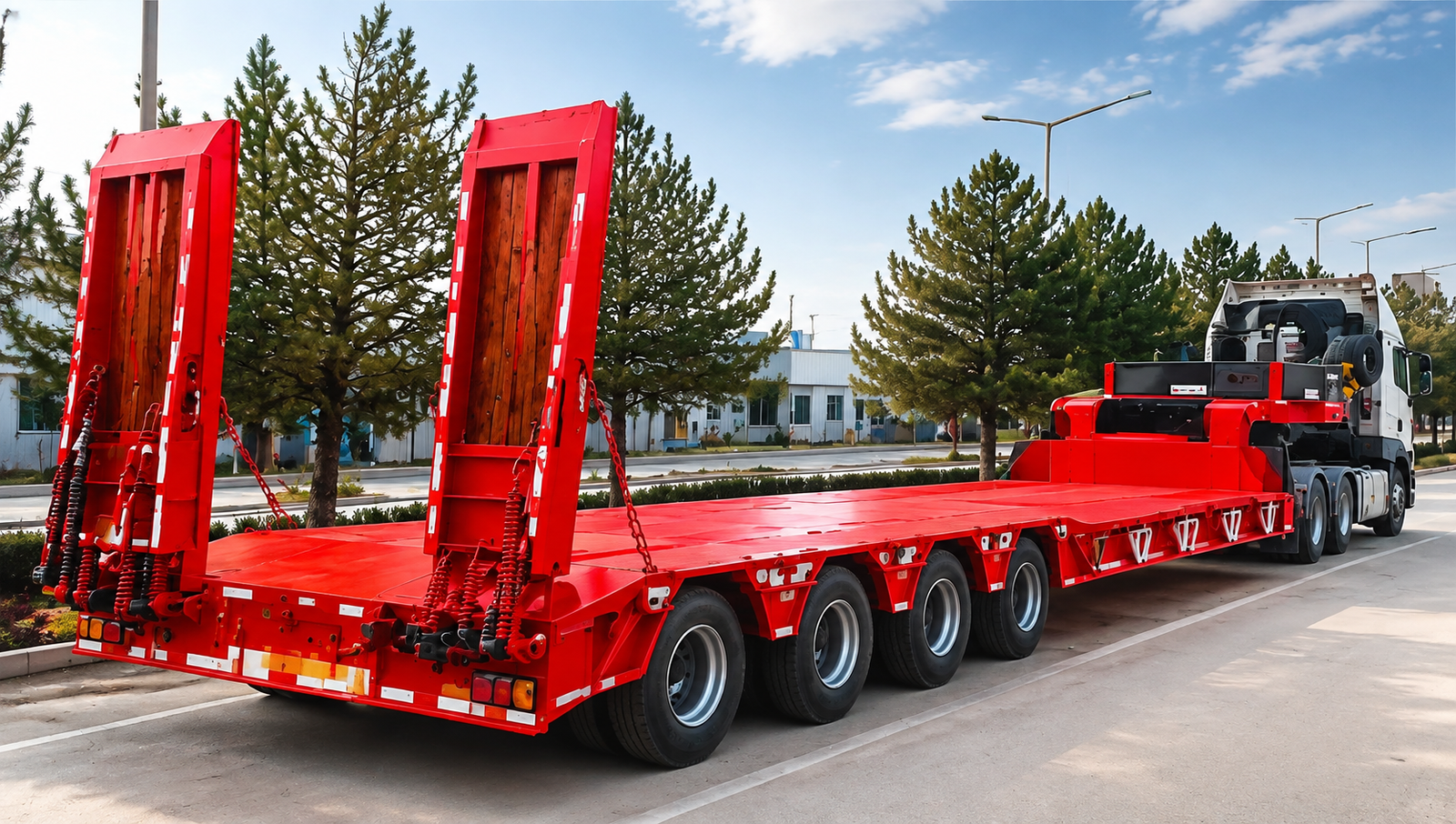
- Flatbed and heavy haul — Air disc, where budget allows
- Dump, logging, and vocational — Drum, in most cases
- Container chassis — Drum, in most cases
- Mountain grade and mixed regional — Air disc, favored
Side-by-Side Comparison Table
| Criterion | Air Disc Brakes | Drum Brakes |
| Stopping distance (6×4 combo, 60 mph) | ~200 ft (Bendix) | ~225 ft (Bendix) |
| Fade resistance under repeated braking | High — open, ventilated design | Lower — enclosed drum expands when hot |
| Wheel-end weight | Up to ~100 lbs lighter per trailer | Baseline |
| Upfront cost | Premium over drum | Lowest acquisition cost |
| Friction replacement labor | Pad change, no adjustment work | Reline can exceed an hour per wheel-end |
| Contamination tolerance | Exposed to grit, mud, and salt | Enclosed design shields components |
| Parking brake integration | Often needs additional provision | Native — spring brakes act through the shoes |
| Brake adjustment violations | Category effectively eliminated | Ongoing inspection exposure |
How Trailer Brake Systems Work
Before comparing them, it helps to be precise about what each system actually does at the wheel-end — because trailers introduce constraints that tractors do not.
S-Cam Drum Brakes: The Trailer Industry Default
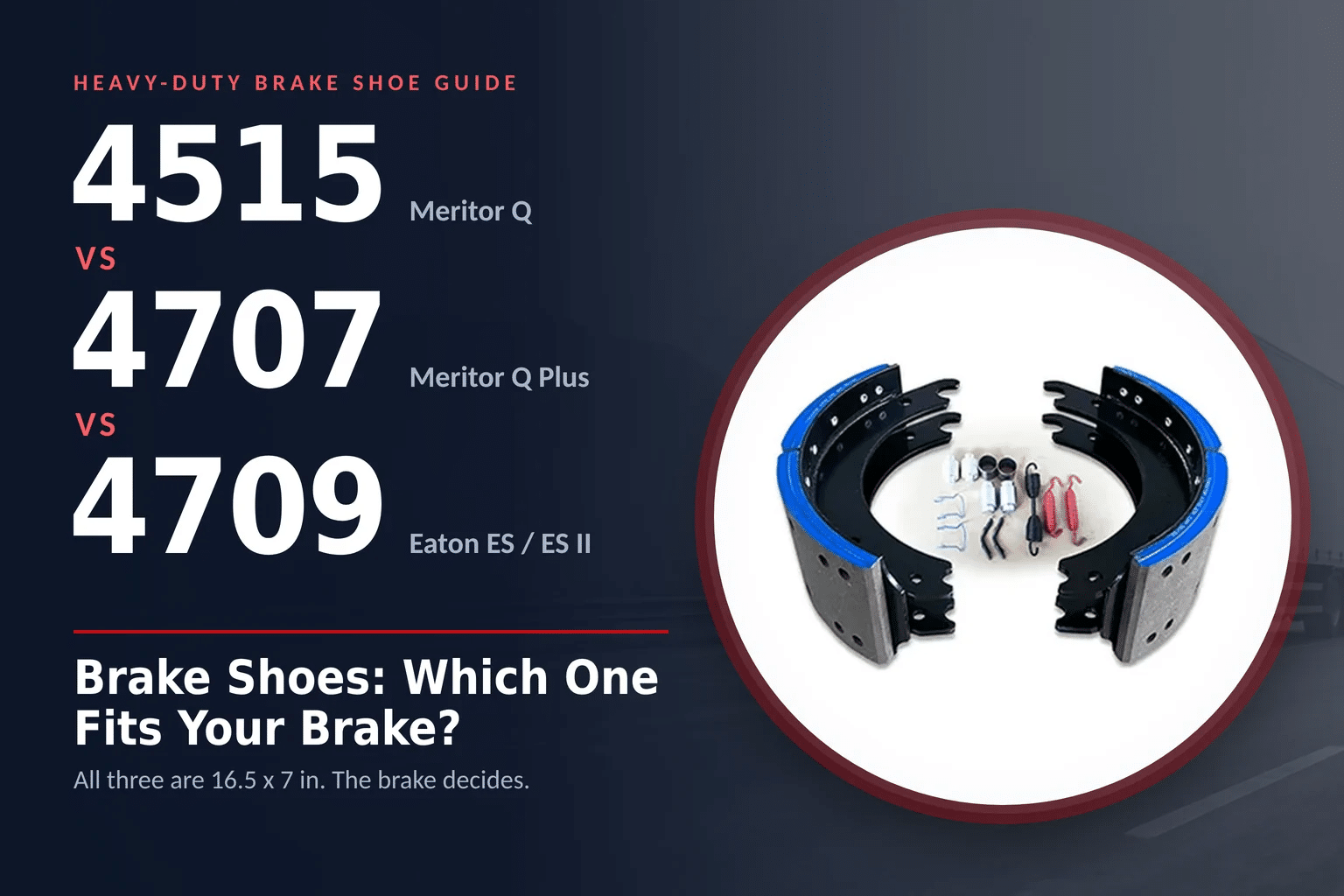
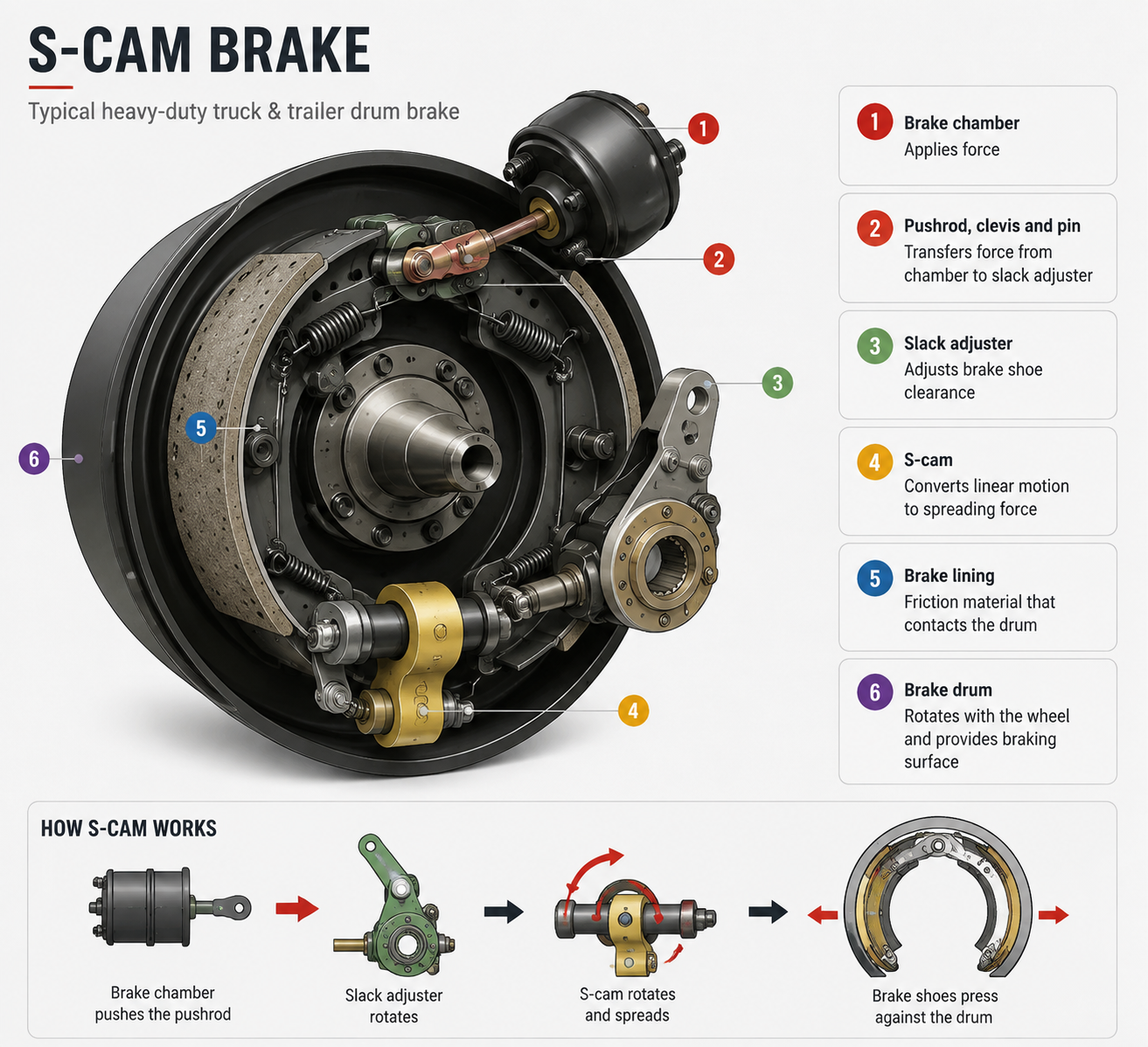
In an S-cam drum brake, air pressure moves a pushrod, the pushrod rotates a slack adjuster, and the slack adjuster turns an S-shaped cam. That cam forces two brake shoes outward against the inner surface of a rotating drum. The friction linings riveted or bonded to those shoes do the work of converting momentum into heat.
The design has been the trailer standard for decades, and one reason is rarely mentioned in disc-versus-drum comparisons: the parking brake comes for free. Spring brake chambers apply through the same shoes and the same drum. Because the shoes press outward against a surface that contracts slightly as it cools, holding force stays reliable. Disc-brake trailer axles typically require an additional provision to deliver equivalent parking capability — which adds cost and complexity to a system that already costs more.
Air Disc Brakes: Caliper, Rotor, and Pad Architecture
In our experience with commercial vehicle braking systems, air disc brakes use air pressure to activate a mechanical actuator inside the caliper, which applies clamping force through two brake pads onto both sides of the rotor. The working principle is similar to passenger vehicle disc brakes, but the structure has been significantly strengthened and optimized for heavy-duty truck and trailer applications.
This design has become increasingly common in modern heavy-duty vehicles as fleets look for more consistent braking performance, improved thermal management, and more efficient maintenance processes. Brake technology suppliers such as Bendix Commercial Vehicle Systems have continued to develop and improve air disc brake solutions to meet the evolving requirements of commercial vehicle applications.
Three consequences follow from that architecture:
- Heat escapes. The rotor is open to airflow and typically internally vented, allowing thermal energy to dissipate more efficiently compared with an enclosed drum structure.
- Geometry stays stable when hot. The relationship between the brake pads and rotor remains more consistent under high-temperature conditions, helping maintain predictable braking performance.
- Maintenance procedures are different. Compared with traditional S-cam drum brake systems, air disc brakes eliminate certain adjustment-related maintenance requirements, which can simplify inspection and service processes for some fleets.
Why Trailer Adoption Lags Tractor Adoption
The slower adoption of air disc brakes on trailers is not a technical verdict on one system over another. Based on our experience supporting fleets and distributors, the difference is mainly driven by economic considerations, operating requirements, and lifecycle expectations.
- Trailers typically outlive tractors. A trailer may remain in service for ten to fifteen years, which means the return on investment for a premium brake system needs to be evaluated over a longer ownership cycle.
- Purchasing and maintenance decisions are often separated. Trailers may be transferred between routes, locations, or fleets. The organization investing in the initial specification may not always be the same party benefiting from potential maintenance savings.
- System integration and cost considerations matter. Air disc brake systems can provide performance advantages, but they also involve different component requirements and higher initial investment compared with traditional drum brake configurations.
- Trailer brake conditions are harder to monitor. Unlike tractor brakes, trailer wheel-end issues may develop with less immediate feedback to the driver, making inspection practices and reliable commercial vehicle brake components increasingly important.
Industry trends show that air disc brake adoption in trailers is gradually increasing. Organizations such as Meritor have highlighted the continued development and adoption of advanced commercial vehicle braking technologies. However, the transition is expected to be gradual, meaning both air disc and drum brake systems will continue to serve different trailer applications for many years.
For fleets, distributors, and truck brake lining manufacturers, understanding this technology transition is essential. The market is not moving from one system to another overnight — instead, different braking technologies will continue to coexist based on application requirements, operating environments, and total ownership considerations.
Air Disc vs Drum Brake Performance: Stopping Distance and Fade
Stopping Distance — What the Published Numbers Say
Bendix has published figures showing a 6×4 tractor-trailer at 60 mph stopping in approximately 200 feet with air disc brakes versus approximately 225 feet with drums. An independent track test conducted by Pitt Ohio found their air disc-equipped units stopping about 15 feet shorter at 55 mph — and the fleet’s safety leadership noted the gap widens considerably at higher speeds, approaching 50 to 60 feet at 70 mph.
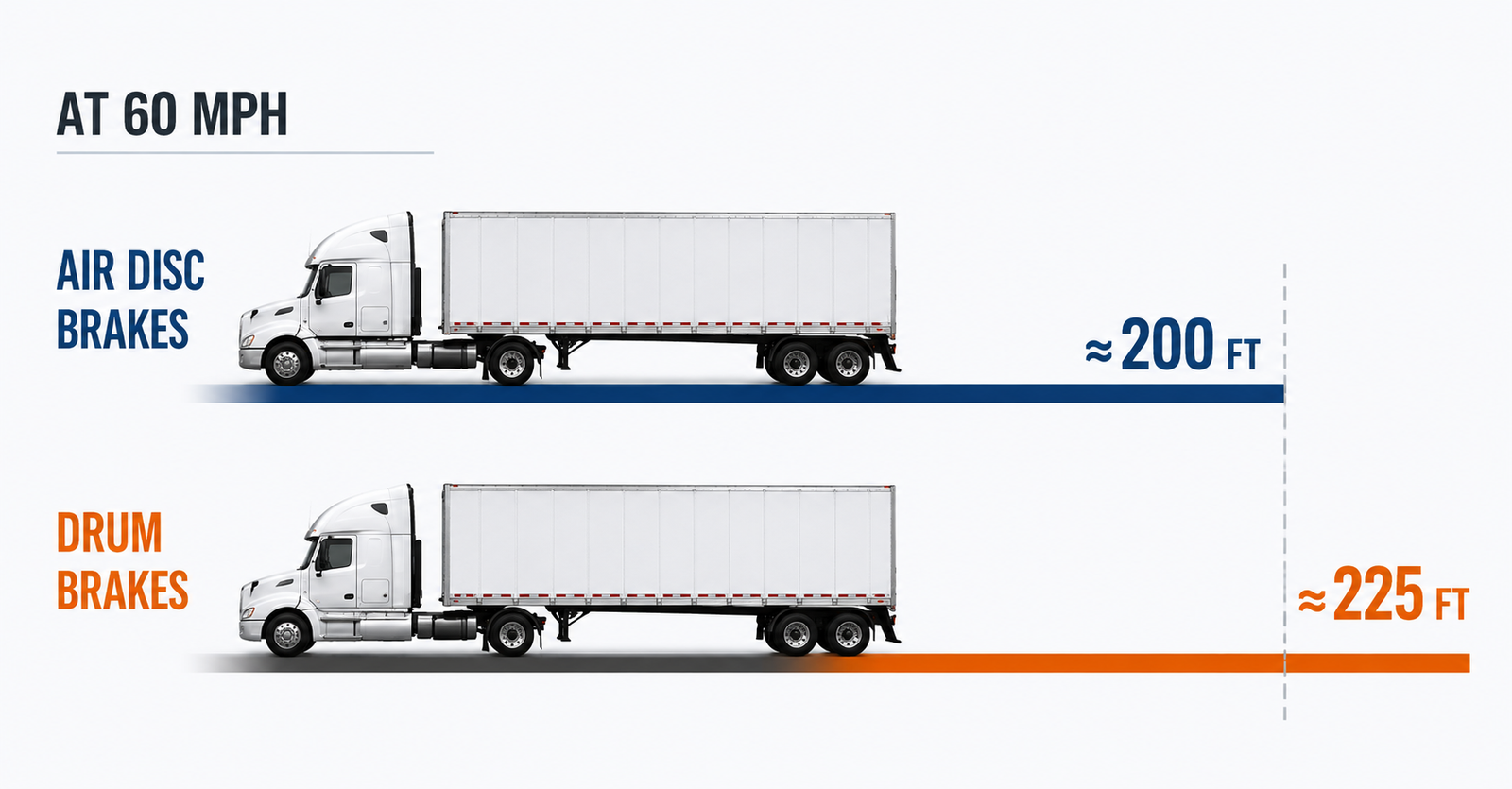
That widening is the important part. Braking energy scales with the square of speed, so any performance advantage compounds as speed increases. A 15-foot difference at 55 mph is a car length. At highway speed, it is the difference between a hard stop and a collision.
A study published by the Federal Motor Carrier Safety Administration (FMCSA) found that disc/disc configurations achieved shorter average stopping distances compared with drum/drum and disc/drum configurations under tested conditions.
However, brake system architecture is only one part of the equation. Consistent braking performance also depends on friction material development, manufacturing consistency, and validation through proper commercial vehicle brake pad testing.
Brake Fade: Why Enclosed Drums Lose Torque When Hot
Brake fade is where the two systems separate most clearly, and the mechanism is worth understanding rather than accepting as a slogan.
A drum brake is a closed system. Under sustained braking — a long descent, repeated stops in traffic, an emergency application from highway speed — heat accumulates faster than the enclosed assembly can shed it. As the drum heats, it expands outward, away from the shoes. The shoes must travel farther to make the same contact, and the effective braking torque drops even though the driver’s input has not changed.
Disc rotors expand too, but they expand in thickness rather than away from the pads. The clamping geometry stays intact. This is why fleets running mountain grades and heavily loaded tankers tend to move to disc first, regardless of the cost calculation.
How FMVSS 121 Reduced Stopping Distance Rules Changed the Game
From our perspective as a commercial vehicle brake manufacturer, the growth of air disc brakes in North America has been influenced not only by fleet preference, but also by changes in braking regulations and vehicle design requirements.
A major turning point came from the updated FMVSS No. 121 Air Brake Systems requirements introduced by the National Highway Traffic Safety Administration (NHTSA). These updated stopping distance requirements pushed manufacturers to improve braking performance across heavy-duty vehicle platforms.
During the initial phase of implementation, many vehicle manufacturers were able to meet the requirements through improvements to existing drum brake technologies, including larger brake components and optimized system designs. However, when the stricter requirements for heavier vehicles took effect in 2013, achieving additional braking performance margins became more challenging, and air disc brakes gained wider adoption, particularly on steer axle applications.
This regulatory change helps explain why air disc brake adoption increased faster on tractors compared with trailers. The requirements directly influenced tractor design, while trailer brake selection continued to be driven more by factors such as purchase cost, operating conditions, maintenance practices, and lifecycle economics.
For fleets and brake component suppliers, understanding this difference is important. The market transition is not simply a shift from one technology to another — it reflects how regulations, vehicle applications, and total ownership considerations work together to shape brake system decisions.
Why Disc Pads and Drum Linings Differ
This is where a manufacturer’s perspective adds value beyond a simple brake system comparison. The brake hardware determines the basic structure, but the friction material plays a critical role in how consistently that system performs in real-world operating conditions.
From our experience developing commercial vehicle friction materials, disc pads and drum linings are not simply the same material produced in different shapes. They are two different products developed around different braking structures, operating conditions, and performance requirements.
Different Brake Systems Require Different Friction Solutions
When comparing air disc brakes and drum brakes, one important factor that is often overlooked is how the friction material manages braking energy.
Compared with drum brake linings, disc brake pads typically operate with a smaller friction contact area while handling the same vehicle weight and braking requirements. This means the friction material needs to manage higher energy concentration, greater localized pressure, and more demanding thermal conditions.
For heavy-duty applications, this places higher requirements on friction formulation, heat resistance, wear stability, and overall material consistency. A well-designed disc brake pad needs to maintain stable friction performance throughout repeated braking cycles, especially in demanding operating environments.
For fleet operators, the practical takeaway is that friction material quality becomes even more important in air disc brake applications. The performance of the brake system depends not only on the hardware itself, but also on whether the friction material is properly engineered for the application.
Why Disc Pads and Drum Linings Are Not Interchangeable
Although both are friction components, disc pads and drum linings are designed for completely different working conditions.
A disc pad is bonded to a rigid steel backing plate and works under high clamping pressure against a rotor. The material design must consider heat management, mechanical stress, wear control, and stable friction output.
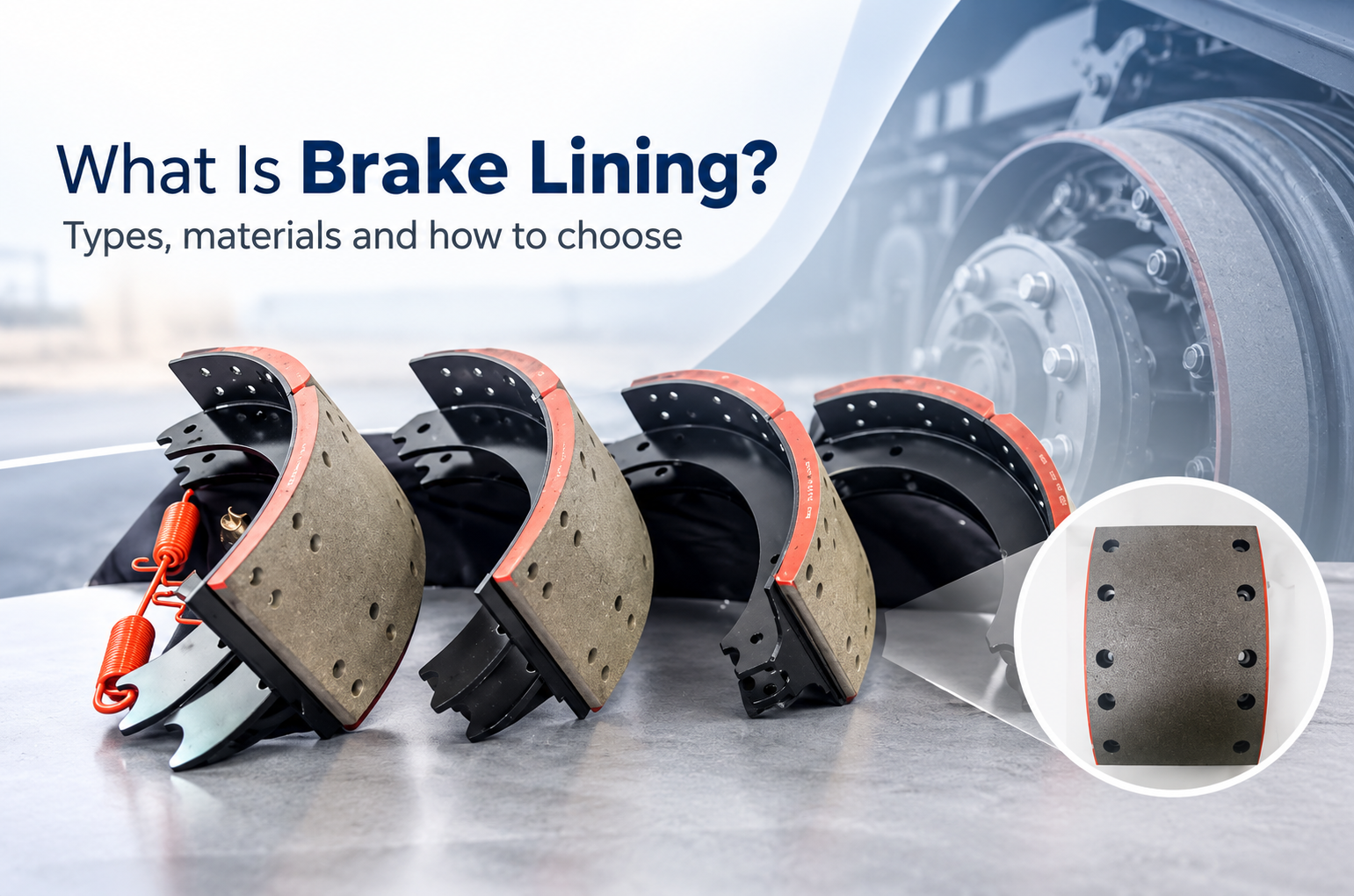
A drum lining, on the other hand, is attached to a curved brake shoe and operates inside a drum assembly. The friction material must adapt to different contact geometry, heat distribution, and repeated braking conditions.
Because of these differences, the development process is not the same. Disc pads and drum linings require different approaches in formulation design, pressing conditions, curing processes, surface finishing, and performance validation.Understanding the brake pad manufacturing process is also important because production consistency directly influences friction stability and service performance.
For example, disc pads may require features such as chamfers, slots, or additional layers to improve noise control, heat management, and initial braking performance. Drum linings require precise arc grinding to ensure proper contact with the drum surface.
This is why experience in one product category does not automatically translate into expertise in the other.
For fleets and distributors, this distinction is important when selecting a friction supplier for semi trailer brake pads and drum brake applications. When a trailer specification changes from drum brakes to air disc brakes, the supply chain is not simply changing a part number — it is relying on a supplier’s ability to understand different friction technologies, manufacturing processes, and application requirements.
Disc Tractors, Drum Trailers: What Fleets Should Know
Most real fleets do not run one system. They run disc-equipped tractors pulling drum-equipped trailers, because those two purchases were made years apart by different logic.
That combination works — it is legal, common, and safe when properly matched. But it introduces a genuine engineering problem that friction engineers at multiple manufacturers have discussed openly: the two systems produce different torque output profiles as temperature rises. Disc brakes maintain their output more consistently across a wide temperature range. Drums lose output as they heat.
When the profiles do not align, one end of the combination absorbs more than its share of the braking work. The consequences show up as uneven wear rates between tractor and trailer, shorter friction life on whichever end is working harder, and inconsistent feel for the driver.
Two practical rules follow, and they cost nothing to implement:
- Do not mix friction brands or quality grades across wheel positions.
Friction specialists consistently advise against it, and it is the single most common self-inflicted balance problem we see referenced in the field. - Treat friction selection as a combination-level decision, not a wheel-end decision.
If you are running mixed systems, ask your supplier directly what they recommend for the pairing — not just for the axle in front of you.
Total Cost of Ownership: Air Disc vs Drum Brakes
Upfront Cost: What the Premium Looks Like
The air disc premium is real, and it has historically been the single largest barrier to trailer adoption. Figures published by Bendix in the mid-2010s put the OEM-level premium anywhere from roughly $2,500 to $5,500 depending on manufacturer and application — with industry observers at the time suggesting adoption would accelerate sharply if that delta fell under roughly $800.
Those numbers are dated. Volume has increased substantially since, and the gap has narrowed. Treat the historical range as context for why the trailer market moved slowly, not as a current quote.
Friction Life and Reline Frequency
This is where disc recovers its premium, and the mechanism is labor rather than parts.
A drum reline is genuine work. Industry service estimates put it at an hour or more per wheel-end, and the job may pull in cam bushings and drums alongside the linings themselves. A disc pad change is a substantially shorter operation with fewer components involved.
Industry sources have argued that over a typical four- to five-year trade cycle, even a single friction replacement produces enough labor savings to offset the acquisition premium — and if the drum system would have required two relines in that period, the gap widens further.
The honest counter-argument: in dusty, gritty, or abrasive environments, rotor wear can accelerate sharply — and rotors are considerably more expensive to replace than drums. Fleets operating in gravel pits and similar conditions have tried air disc and returned to drums for exactly this reason. Anyone selling you air disc as universally cheaper is not describing the whole market.
The Long-Asset Argument — Why Trailers Change the Math
Trailers invert the usual TCO logic, and in a way that favors disc more than the tractor case does.
A tractor traded at four years might see one friction replacement. A trailer held twelve years will see several. Every one of those events carries labor cost, shop scheduling cost, and the opportunity cost of an asset sitting in a bay instead of under a load. Over a long-life asset, the accumulated service events — not the parts — drive the comparison.
Run your own version of this calculation rather than accepting anyone’s published figure:
(number of wheel-ends × expected friction replacements over asset life × labor hours per event × shop rate) + (downtime days × contribution per trailer-day)
Then compare against the acquisition premium. Fleets with long hold periods and high shop rates tend to find the answer obvious. Fleets cycling trailers in four years frequently find the opposite — the friction may outlast their ownership entirely, meaning they pay the premium and never collect the return.
Payload: Up to 100 Pounds Saved per Trailer
Air disc has been credited with weight savings of up to roughly 100 pounds per trailer versus a comparable drum installation.
Be honest about what that is worth. For a dry van fleet cubing out before it weighs out, it is close to irrelevant. For bulk haulers, tankers, and anyone regularly running against gross weight limits, 100 pounds is 100 pounds of revenue payload on every load for the life of the asset. Whether this belongs in your calculation depends entirely on whether weight is your binding constraint.
Compliance and Maintenance Considerations for Trailer Brake Systems
For most fleets, this is the category that quietly costs the most — and it is the one most often left out of the spec decision.
Brake Violations Remain the Number One Out-of-Service Category
The Commercial Vehicle Safety Alliance’s 2025 Brake Safety Week results are worth sitting with. Inspectors across North America conducted 15,175 commercial vehicle inspections and placed 2,296 vehicles out of service for brake-related violations — a 15.1% out-of-service rate, essentially unchanged from the prior year.
That is during a publicized enforcement week, when the industry knows inspections are coming.
Brake violations consistently make up the largest share of out-of-service vehicle violations in roadside enforcement generally, accounting for roughly a quarter of all vehicle out-of-service violations during CVSA’s International Roadcheck.
Why the 20% Rule Punishes Neglected Trailer Axles
The most-cited reason for an out-of-service order during Brake Safety Week 2025 was the 20% defective brakes criterion — inspectors identified 1,199 such violations.
Understand how that threshold is calculated, because it is where trailers become dangerous to your compliance record: the 20% applies to the total number of brakes required or equipped across the entire vehicle combination, including towed units.
Your tractor’s condition does not insulate you. On a standard five-axle combination, a small number of defective trailer wheel-ends can cross the threshold and place the whole combination out of service. A trailer that spends most of its life detached, pooled, or interchanged is exactly the asset most likely to accumulate unnoticed wheel-end problems — and exactly the asset that can strand a compliant tractor.
Drums and Rotors Are the 2026 Inspection Focus
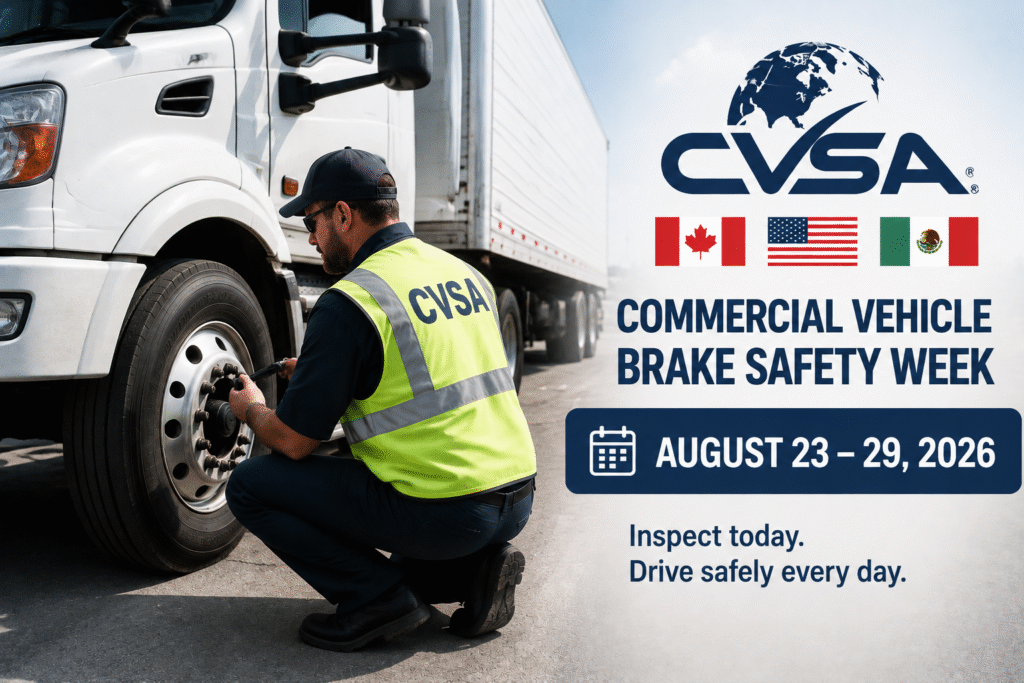
CVSA has scheduled Brake Safety Week 2026 for August 23–29, and inspectors will again focus specifically on brake drum and air disc rotor condition. In 2025, that focus produced 113 drum and rotor violations, 39 of which resulted in out-of-service orders.
If you are planning trailer PM schedules, that date is a free deadline. Rotor and drum condition — cracks, heat checking, thickness, and wear limits — is inspectable from outside the wheel-end on most configurations, which means it is also correctable before an inspector finds it.
Brake Adjustment: One Violation Category Air Disc Simply Removes
Out-of-adjustment brakes have been a persistent roadside violation category for as long as air brakes have existed, and adjustment-related citations feed directly into a carrier’s safety scoring.
Air disc brakes do not have a slack adjuster. There are no chamber strokes to measure and no caliper grease points, which simplifies DOT inspection and eliminates an entire violation category. For fleets whose safety scores are under pressure, this is sometimes the argument that carries the decision on its own — independent of stopping distance or service cost.
Choosing the Right Brake System by Application
General comparisons are less useful than application-specific ones. Here is how the decision tends to resolve by trailer type.
Dry Van and Refrigerated Long-Haul
Usually air disc. High annual mileage, long hold periods, mostly clean operating environments, and predictable duty cycles — every variable favors disc. Fade resistance matters less here than in vocational work, but service labor savings compound over a decade of ownership. Weight savings are typically irrelevant for van freight.
Tankers and Bulk Haulers
Air disc, strongly favored. Two independent reasons converge. First, liquid surge and high gross weights make consistent, fade-resistant braking a genuine safety requirement rather than a preference. Second, these operations are usually weight-constrained, so the payload savings convert directly into revenue.
Flatbed and Heavy Haul
Air disc where budget allows. Heavy, often irregular loads with high braking energy demands. The qualifier is environment: flatbed operations that regularly enter construction sites and unpaved yards face the same rotor abrasion risk as vocational fleets, which shifts the calculation.
Dump Trailers, Logging, and Vocational Work
Usually drum. This is where the enclosed design earns its place. Drum brakes shield friction components from mud, dust, road salt, and debris — the exact contaminants these operations live in. Add accelerated rotor wear in abrasive conditions, higher rotor replacement cost, and shorter effective asset life, and drums frequently remain the better economic answer.
Container Chassis and Drop-and-Hook Operations
Usually drum. Chassis are low-cost, high-turnover, frequently pooled assets where nobody clearly owns the maintenance savings. The party paying the premium is rarely the party collecting the return — which is a structural problem, not a technical one.
Regional Stop-and-Go vs. Mountain Grade Routes
Route profile can override trailer type. Frequent stop-and-go and sustained downgrade operation both generate repeated high-energy braking events, which is where drum fade appears. If your lanes include serious grades, evaluate air disc regardless of what your trailer category would otherwise suggest.
Drum to Air Disc Brake Conversion for Semi Trailers
Converting a semi trailer from drum brakes to air disc brakes is technically possible, but the economics are difficult to justify in many cases.
What a Conversion Actually Involves
A retrofit is not a wheel-end swap. Depending on the axle and the age of the trailer, it can reach into axle end configuration and spindle compatibility, hub and bearing changes, actuator and chamber replacement, parking brake provision, ABS sensor and tone ring compatibility, and validation that the converted trailer still balances properly against the tractors that will pull it.
Add the labor, and the cost frequently approaches a meaningful fraction of the trailer’s remaining value. Conversions make sense most often on high-value specialized equipment with long remaining service life — not on a mid-life dry van.
The Cheaper Alternative: Upgrading Friction Before Upgrading Hardware
Before evaluating a conversion, evaluate what is already installed. A well-maintained drum system running properly specified friction, correctly adjusted, with drums within wear limits, performs far better than a neglected one — and the gap between good and poor friction on the same hardware is larger than most fleets assume.
If your complaint about your drum trailers is fade, uneven wear, or short lining life, the honest first question is whether the friction is right for the duty cycle rather than whether the system is wrong. That diagnosis costs nothing and occasionally makes the conversion question disappear.
What Brake Parts Buyers Should Know About Disc Pads and Drum Linings
Everything above concerns the fleet’s decision. This section concerns yours — because a market shifting from drum toward disc changes how you quote, what you stock, and what you should be asking suppliers.
Get the Terminology Right Before You Send the RFQ
It sounds trivial. It is not, and it causes real quotation errors.
- Pads belong to disc brakes — friction material bonded to a steel backing plate.
- Linings belong to drum brakes — curved friction segments attached to brake shoes.
When a buyer requests pads and needs linings, or the reverse, the result is wasted quotation cycles, mismatched fitment discussion, and occasionally shipped product that cannot be installed. The risk rises when requirements cross languages, brands, or catalog systems.
Build the distinction into your RFQ template. Specify system type, axle position, and vehicle configuration before part numbers enter the conversation.
What Changes in Your Inventory When a Region Shifts Toward Disc
This is the practical consequence most distributors underestimate, and it is a structural difference rather than a volume one.
Drum lining SKUs are wide and shallow. Selection is driven substantially by geometry — drum diameter, lining width, thickness, and the specific shoe pattern. Manufacturers maintain lookup tools precisely because matching a lining to a shoe is a dimensional exercise across many variants. You carry many part numbers, each moving modest volume.
Disc pad SKUs are narrow and deep. As brake engineers have noted, disc friction selection is driven more by duty cycle than by geometry — the caliper platforms in service are comparatively few. You carry fewer part numbers, but each needs multiple grade options and deeper stock.
The implications for a distributor are direct:
- Inventory value concentrates into fewer lines, which raises the cost of a stocking error on any single one
- Grade differentiation becomes your primary selling conversation, since fitment questions largely disappear
- Technical selling ability matters more — with fewer fitment questions to answer, your value shifts toward advising on duty-cycle match
- The transition period is the expensive part, because you carry both structures simultaneously for years
What ECE R90 Certification Covers — and What It Does Not
Certification marks appear on nearly every supplier’s materials, which makes them close to useless as a differentiator unless you understand what each one actually verifies.
ECE R90 governs replacement brake linings and pads in Europe and the many markets that adopt UNECE regulations. Its core mechanism is performance equivalence: a replacement part must perform within a defined tolerance band of the original equipment part it replaces, verified on specified test procedures for the vehicle applications it claims.
That is genuinely meaningful. It is also narrower than most buyers assume:
- It certifies specific applications, not a manufacturer.
An R90 approval covers the part-to-vehicle combinations submitted and tested. A supplier holding R90 approvals is not therefore approved for everything in their catalogue. - It establishes equivalence, not superiority.
Passing means performing acceptably close to the OE part. It does not mean outperforming it. - It does not certify service life.
Wear rate and durability sit largely outside the scope. - It does not certify batch-to-batch consistency.
Approval tests a submitted sample. What arrives on your next container is governed by the manufacturer’s own quality system — which is why IATF 16949 and similar process certifications carry independent weight.
In North America, the regulatory structure is different. FMVSS requirements apply primarily at the vehicle and brake system level rather than mandating an equivalent approval regime for aftermarket heavy-duty friction. Buyers relying on a certification mark alone as a quality proxy in this market should be aware they may be relying on less than they think.
Five Questions to Ask Any Friction Supplier
Certifications establish a floor. These questions establish everything above it.
- Is your formulation range segmented by duty cycle?
A supplier offering one disc pad grade for line-haul, urban stop-and-go, and vocational work is offering a compromise for all three. - How is batch-to-batch consistency controlled, and what is verified per batch?
Ask what is actually tested on production output rather than on the approval sample. - Which specific vehicle applications does your certification cover?
Request the scope, not the certificate image. - What do you recommend for mixed disc-tractor and drum-trailer combinations?
A supplier who has not thought about torque profile matching across a combination is thinking at the wheel-end level only. - Can you provide third-party test results, and for which parts?
Independent verification of specific parts is worth more than a general claim of quality.
Premium vs. Economy — Where the Money Actually Goes
The friction market splits into premium and economy tiers, and the distinction is genuinely difficult for end users to evaluate, which is why the decision so often defaults to the distributor’s recommendation.
The argument for premium material is not primarily about stopping performance — it is about avoided service events. Industry specialists have made the case that spending more upfront on quality friction can eliminate at least one reline over the life of a vehicle, and the labor plus downtime avoided typically exceeds the parts premium several times over.
That argument is strongest exactly where the trailer market lives: long-life assets, high shop rates, and fleets that measure downtime cost. It is weakest on short-cycle equipment where the friction may outlast the ownership period regardless of grade.
How to Choose the Right Commercial Vehicle Brake Supplier
Choosing a brake supplier should go beyond checking whether a supplier can provide the correct part number. For commercial vehicle applications, the real difference often comes from whether the supplier understands the relationship between brake system design, friction material formulation, and operating conditions.
A capable supplier should have experience with both commercial vehicle brake pads and heavy-duty brake linings, because today’s market includes both air disc brake and drum brake applications. This knowledge allows suppliers to recommend suitable friction solutions based on vehicle type, duty cycle, and maintenance expectations.
For fleets and distributors, factors such as friction formulation capability, production consistency, testing support, and application experience are often more important than price alone. A reliable commercial vehicle brake manufacturer should help customers reduce uncertainty by providing stable quality, technical support, and solutions that match real operating requirements.
Conclusion
The lazy conclusion is that air disc brakes are better. The accurate conclusion is that air disc brakes are better at specific things, and whether those things matter depends on three variables you can assess without any supplier’s help:
How long will you hold the asset?
Long holds favor disc, because service labor savings accumulate. Short cycles favor drum, because you pay the premium and may never collect the return.
How severe is the operating environment?
Clean highway operation favors disc. Abrasive, contaminated, and off-road conditions favor drum, where the enclosed design protects components and rotor replacement cost becomes a real exposure.
What is your service capability?
Shops with high labor rates and constrained bay capacity benefit most from disc. Operations with experienced drum technicians, established tooling, and stocked parts lose less to drum servicing than the general figures suggest.
Answer those three honestly and the decision usually resolves itself — often differently for different parts of the same fleet, which is entirely reasonable.
One closing point, from the side of this industry we work in. The system choice sets a ceiling on performance. The friction material determines how close you get to it. A well-specified drum brake with properly matched linings will outperform an air disc brake running friction that was chosen on price alone — and the fleets that get the most from either system are the ones that treat the friction decision with the same seriousness they gave the hardware decision.
Need a Reliable Brake Supplier for Semi Trailer Applications?
Choosing the right friction solution depends on vehicle type, operating conditions, and expected service life.
TUOBA supplies commercial vehicle brake pads and truck brake linings for fleets, distributors, and OEM customers worldwide.
With experience in friction material development, testing, and customized solutions, we help customers select suitable products for different truck and trailer applications.