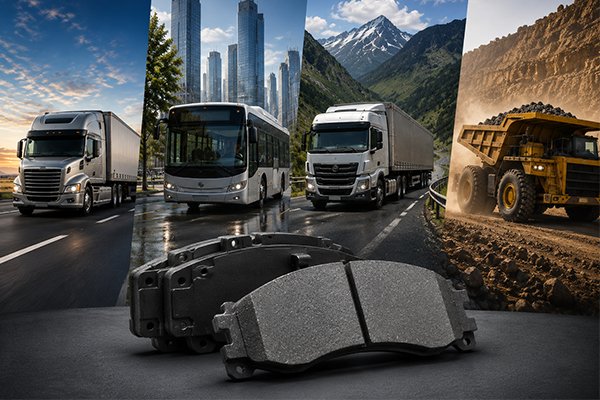
A long-haul truck running flat highway corridors, a transit bus working stop-and-go urban routes, a mining haul truck descending a loaded grade, and a delivery van operating in coastal humidity — these four vehicles can carry the same brake pad part number, and they will not experience the same brake pad.
That isn’t a manufacturing inconsistency. It’s physics. Brake pads fail differently under different operating environments. Thermal load, vehicle weight, braking frequency, ambient climate, and driver behavior interact with friction chemistry in ways that no single formulation can serve equally well across applications. Understanding this is what separates a procurement team that runs into recurring warranty claims from one that builds stable multi-year supply relationships.
This article explains why commercial vehicle brake engineering must be matched to real operating conditions — and why the right question to ask your supplier isn’t “which pad is best?” but rather “which pad is right for the way our fleet actually runs?”
Why One Brake Pad Cannot Fit Every Fleet Application
Brake Pads Are Thermodynamic Devices, Not Static Components
The brake pad is fundamentally a thermodynamic device. Every braking event converts the vehicle’s kinetic energy into heat, and that heat has to be absorbed, dissipated, and managed by the friction material. The amount of energy involved scales with vehicle weight and speed — and the rate at which the pad has to handle it scales with braking frequency.
A loaded 40-tonne tractor-trailer braking from 90 km/h on a 6% grade is asking its brake pads to dissipate roughly 50 times the energy of a passenger car decelerating from the same speed. A city bus that brakes 30 times per kilometer accumulates heat faster than it can radiate it away, regardless of stop severity. A mining truck running short, steep, cyclic descents at full payload creates thermal load profiles that no highway formulation was designed to handle.
Why Different Failure Modes Define Different Engineering Requirements
A semi-metallic formulation engineered for long-haul thermal cycling can glaze when forced into stop-and-go duty. A ceramic compound optimized for urban delivery noise behavior can fade dramatically under mountain descent loads. A pad that holds up beautifully in laboratory dynamometer testing can fail predictably in three months of mining operations.
These aren’t quality failures. They’re application mismatches — the formulation was engineered for one duty profile and deployed against another.
The Core Engineering Principle
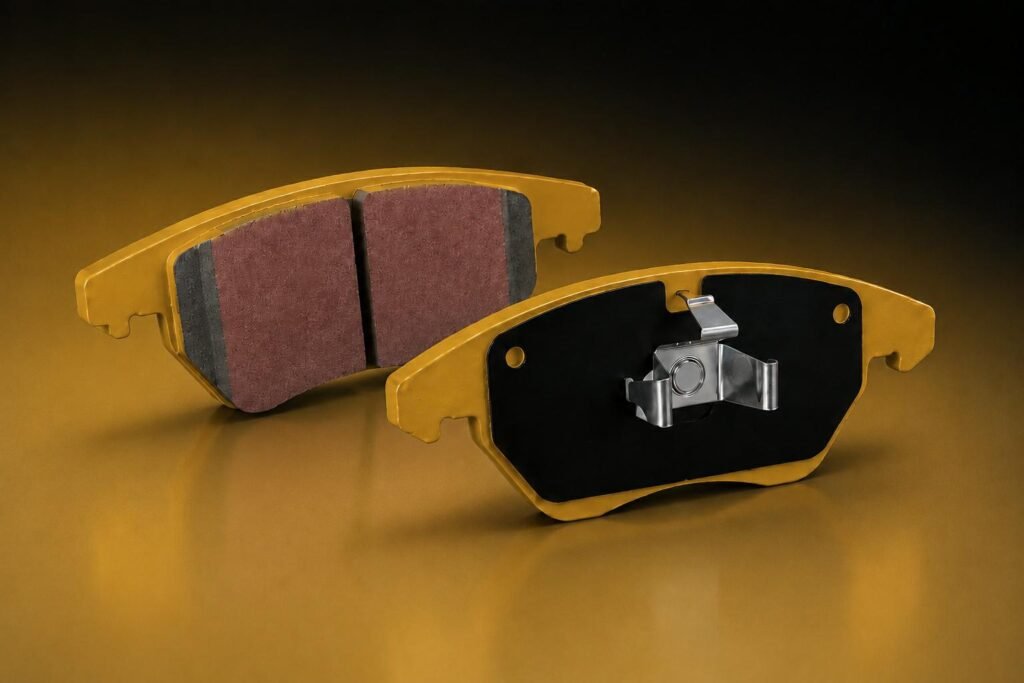
The same brake pad cannot perform equally well across all operations because the failure modes are different in each environment. Match formulation to application, or accept that some portion of your fleet will produce warranty events the rest won’t. This is the foundation of fleet brake pad performance as an engineering discipline rather than a procurement variable.
How Long-Haul Highway Fleets Create Different Brake Demands
What Highway Operations Look Like in Engineering Terms
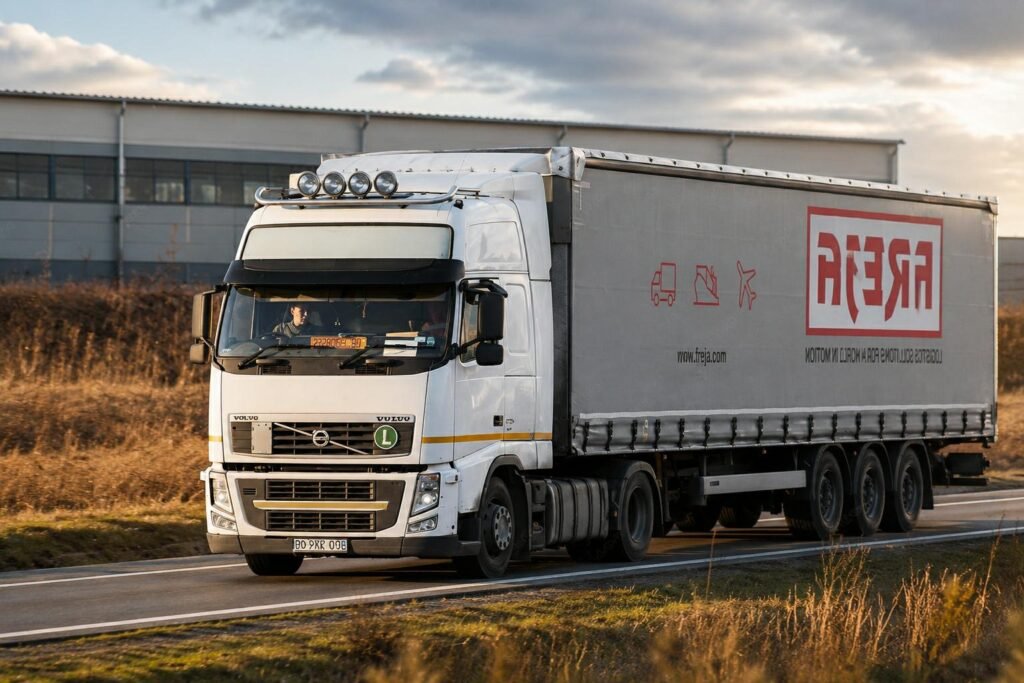
Long-haul highway operations look easy on the brake system — and that’s exactly what makes them deceptive. The brake events are infrequent, the thermal load per event is moderate, and the duty cycle looks gentle compared to mountain or mining work.
What highway fleets actually need is something more subtle: sustained braking stability across hundreds of thousands of kilometers of inconsistent driver behavior, predictable wear that aligns with scheduled maintenance intervals so brake replacement can be planned rather than reactive, and reduced maintenance frequency that minimizes scheduled downtime per truck per year.
Why Thermal Cycling Matters More Than Peak Heat
Long-haul pads have to handle thermal cycling differently than urban pads. A highway pad spends most of its life cool, then absorbs a major thermal event at the rare hard stop. That cyclic pattern — repeated thousands of times over a pad’s service life — slowly degrades the friction material’s binder system unless the brake pad formulation is specifically engineered to withstand long-haul thermal cycling conditions.
Pads that work fine on a dynamometer running back-to-back stops can crack or delaminate after two years of highway thermal cycling, simply because the test protocol didn’t replicate the actual stress pattern. Brake pad cracking in highway service almost always traces to thermal cycle fatigue, not peak temperature failure.
What Long-Haul Fleets Should Actually Specify
For long haul truck brake pad supplier relationships, the conversation worth having isn’t about peak friction torque. It’s about wear linearity over the maintenance interval, thermal cycle durability across multi-year service life, and brake pad batch consistency supported by digital traceability systems across thousands of pad sets — because what you want is the exact same pad twelve months from now.
Why Urban Delivery and Bus Fleets Require Different Brake Characteristics
The Stop-and-Go Heat Accumulation Problem
Urban transit and last-mile delivery sit at the opposite end of the duty spectrum. The braking events are frequent — dozens to hundreds per hour — and each one is relatively low-severity, but the heat accumulates faster than it dissipates.
Pads optimized for cold-start performance can glaze or polish their friction surface under sustained moderate heat, losing initial bite and pedal feel within months of service. Brake heat accumulation keeps the pad operating in a higher temperature window than its formulation may have been designed for, producing wear and friction behavior that didn’t appear in any single-stop test.
Why NVH Sensitivity Is Amplified in Urban Operations
Brake noise sensitivity is amplified in urban environments — bus passengers and delivery drivers notice every squeal, and unlike highway operators they have nowhere to escape the noise. Brake squeal complaints destroy fleet operator satisfaction faster than any other quality issue, even when stopping performance is technically acceptable.
The same pad that generates one complaint per month in a long-haul fleet can generate twenty complaints per month in an urban transit fleet — same SKU, same batch, completely different acoustic environment.
The Trade-Offs Urban Fleets Should Accept
The right formulation for urban duty looks very different from long-haul. It prioritizes thermal stability in the mid-temperature range (rather than peak temperature resistance), NVH control across the full temperature window, predictable behavior under repeated braking, and passenger comfort metrics that don’t appear on highway pad spec sheets.
For bus operators specifically, the trade-off favors slightly faster pad wear in exchange for dramatically lower noise — a trade-off long-haul fleets would reject but transit operators correctly prioritize.
Mountain Routes and Heavy Loads Create Extreme Thermal Stress

Why Mountain Braking Is Continuous Work, Not Discrete Events
Mountain operations are where brake engineering gets unforgiving. A loaded truck descending a sustained grade isn’t doing brake events — it’s doing brake work, continuously, for minutes at a time. Pad temperatures climb well past 600°C on extended descents, and once the friction material crosses its thermal threshold, brake fade sets in within seconds.
The Three Characteristic Failure Modes
The failure modes specific to mountain operations are severe and well-documented:
- Heat buildup that exceeds the binder system’s thermal limit, leading to outgassing and loss of friction coefficient — the classic fade condition.
- Cracking in the friction material from thermal shock when a hot pad encounters cooling air at the bottom of a descent.
- Delamination of the friction material from the backing plate when bonding strength has been compromised by sustained high temperature.
None of these are predictable from flat-route testing. All of them are predictable from sustained-grade duty cycle modeling.
What Mountain-Route Formulations Must Deliver
This is where high thermal stability becomes non-negotiable. Mountain-route fleets need friction formulations engineered specifically for sustained high-temperature operation — typically semi-metallic compounds with elevated copper or steel fiber content, paired with backing plate designs that maintain shear strength above ISO 6312’s minimum 400 N/cm² requirement even after sustained thermal exposure. The pad that works perfectly on flat Iowa runs may catastrophically underperform on a Colorado descent.
For mountain operations and heavy duty brake pads for towing, formulation must be matched to thermal duty cycle — not selected from a generic catalog.
Why Mining and Construction Vehicles Require Severe-Duty Brake Formulations
The Stress Factors That Compound on Each Other
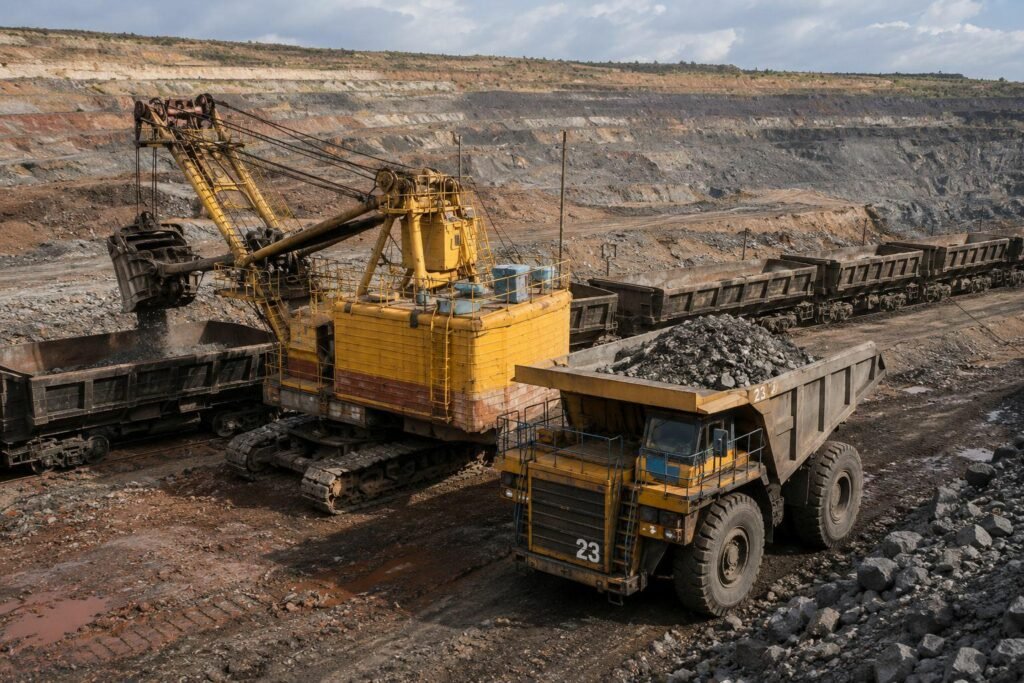
Mining and construction operations represent the harshest commercial brake environment that exists outside of motorsport. Severe duty brake pads for these applications have to survive conditions that would destroy a standard heavy-duty pad in weeks. Five stress factors compound on each other:
- Dust infiltrates the brake system continuously — limestone at quarries, iron ore at mining sites, silica at construction projects — accelerating wear of both pad and rotor.
- Mud and water exposure contaminate the friction surface and can cause flash glazing when the pad heats rapidly while still wet.
- Repeated heavy braking under full payload produces thermal cycling profiles that highway formulations were never engineered for.
- Harsh environments — temperature extremes, vibration, chemical exposure — degrade binder systems that hold up fine in cleaner operations.
- Extreme operating cycles mean a mining haul truck may complete 50 loaded descents per shift, each one a small mountain run in itself.
How Standard Heavy-Duty Pads Fail in Severe Environments
Standard heavy-duty formulations fail in these conditions through three predictable patterns: uneven brake wear as contamination creates non-uniform contact areas, premature brake pad cracking as thermal cycles compound with chemical degradation, and unpredictable friction coefficient drift as the friction surface gets repeatedly contaminated and re-bedded.
The warranty rate gap between a standard heavy-duty pad and a severe-duty pad in mining service is often 5–10×, even when both pads are nominally rated for commercial vehicle use.
Engineering Adaptations for Severe-Duty Applications
Severe-duty formulations address each failure mode specifically: hardened backing plates resistant to vibration fatigue, modified binder chemistry resistant to chemical contamination, friction surface designs that self-clean under load, and accelerated wear rates accepted as a deliberate trade-off for survival in the environment.
For mining and construction fleets, construction vehicle brake pads must be developed to the duty cycle — not adapted from on-highway designs.
How Climate and Road Conditions Influence Brake Pad Performance

High-Temperature and Cold-Weather Operating Extremes
Climate quietly changes everything. Two identical fleets running identical routes in different geographies will experience different brake pad lifespans, different failure modes, and different warranty rates.
High-temperature regions (Middle East, Australian outback, southwestern US, African mining belts) push pads toward their thermal limit before they even start braking. A pad sitting in 50°C ambient air on a black-painted brake rotor under direct sun is already at 80°C+ before the first stop. Compounds that test fine at 20°C ambient can fail in 50°C ambient through accelerated binder degradation.
Cold-weather fleets (Northern Europe, Canada, northern China) face the opposite problem: pads that need to deliver consistent initial bite from -30°C cold-start conditions. Friction coefficient at cold temperatures is a different engineering problem than friction coefficient at operating temperature, and many formulations that work well hot underperform cold.
Humidity, Salt, and Wet Braking Considerations
Three additional climate factors affect formulation selection:
- Humidity affects binder systems, particularly phenolic resin chemistry that’s sensitive to long-term moisture exposure — tropical and coastal fleets see binder degradation patterns that inland desert fleets don’t.
- Road salt in cold-climate winter operations attacks backing plate corrosion protection and shim bonding, particularly in regions where heavy salting is standard practice.
- Wet braking performance — the friction coefficient drop in the first stop after water exposure — varies dramatically between formulations and matters enormously for safety in wet climates.
Why Climate-Matched Formulation Doesn’t Appear on Spec Sheets
None of this appears in a standard spec sheet. All of it shows up in field warranty data eighteen months later. Climate-matched formulation is what separates fleet supplier relationships that hold across multiple years from those that drift toward unpredictability as geographic exposure widens.
Why Friction Materials Must Be Matched to Operating Conditions
The three primary friction material families — semi-metallic, ceramic, and low-metallic — each have engineering profiles that match specific operating windows. The wrong family in the wrong application produces predictable failure modes regardless of how good the specific formulation is within its family.
Semi-Metallic — Engineered for Thermal Capacity
Semi-metallic brake pads offer the best thermal capacity and the highest sustained-load durability. Their copper and steel fiber content gives them the heat resistance needed for mountain descents, heavy towing, and severe-duty operations.
The trade-off is higher noise potential, faster rotor wear, and more dust generation. For long-haul, mountain, mining, and heavy commercial applications, semi-metallic is the engineering default — and trying to substitute another family typically produces thermal failures.
Ceramic — Engineered for NVH and Rotor Friendliness
Ceramic brake pads offer the best NVH control, lowest dust generation, and most rotor-friendly behavior. The trade-off is reduced thermal capacity — ceramics handle moderate heat well but lose ground to semi-metallics at sustained extreme temperatures.
For urban transit, delivery fleets, and passenger-comfort-sensitive applications, ceramic is engineered for the duty cycle. OEM ceramic brake pads for passenger and light commercial applications represent one of the largest segments of the global market precisely because the duty cycle matches the material profile.
Low-Metallic and Hybrid — Engineered for Balanced Duty Profiles
Low metallic brake pads and hybrid brake formulations sit between the two extremes, offering balanced performance for fleets whose operating profile doesn’t sit cleanly at either end of the spectrum. Many European OEM commercial vehicle programs default to low-metallic precisely because their fleet operating envelope crosses multiple duty types.
The engineering question is never “which material is best?” — it’s “which material profile matches our fleet’s actual thermal load, noise tolerance, and wear economics?” Generic answers produce generic results.
How Brake Noise and Wear Patterns Change Across Different Fleet Applications
Why Brake Squeal Appears in Specific Operating Windows
Brake squeal appears predominantly in cold, light-load, low-frequency braking conditions where the friction surface has not yet reached its design operating temperature. Urban fleets see this constantly in morning startup conditions. Highway fleets see it on the first stop after a long highway cruise.
The shim package and chamfer geometry that suppress squeal have to be tuned to the duty cycle that actually generates the noise. A shim designed for highway pads can be acoustically wrong for urban duty even when the friction formulation is correct.
How Wear Patterns Differ Across Duty Cycles
Uneven brake wear patterns also differ predictably by application:
- Long-haul pads typically wear flat across the friction surface.
- Urban pads show characteristic tapered wear from the leading edge as repeated braking generates heat gradients.
- Mountain pads can show glazing on the friction surface as repeated high-temperature exposure polishes the contact area.
- Mining pads develop irregular wear patterns from dust and contamination cycles.
Vibration behavior changes by application as well — caliper interaction with vehicle suspension produces different resonance patterns at different vehicle weights and speed ranges. A pad with quiet behavior on a passenger truck can produce noticeable judder on a heavily loaded commercial chassis.
Reading Field Symptoms as Engineering Signals
When fleet operators report “the pads are noisy” or “the wear is irregular,” the right diagnostic question isn’t about the pad — it’s about the operating conditions producing the symptom. Manufacturers who don’t ask that question produce replacement pads with the same problems. Manufacturers who do ask that question solve the problem at the root.
Why Application-Specific Testing Matters More Than Laboratory Numbers
What Laboratory Protocols Can and Cannot Tell You
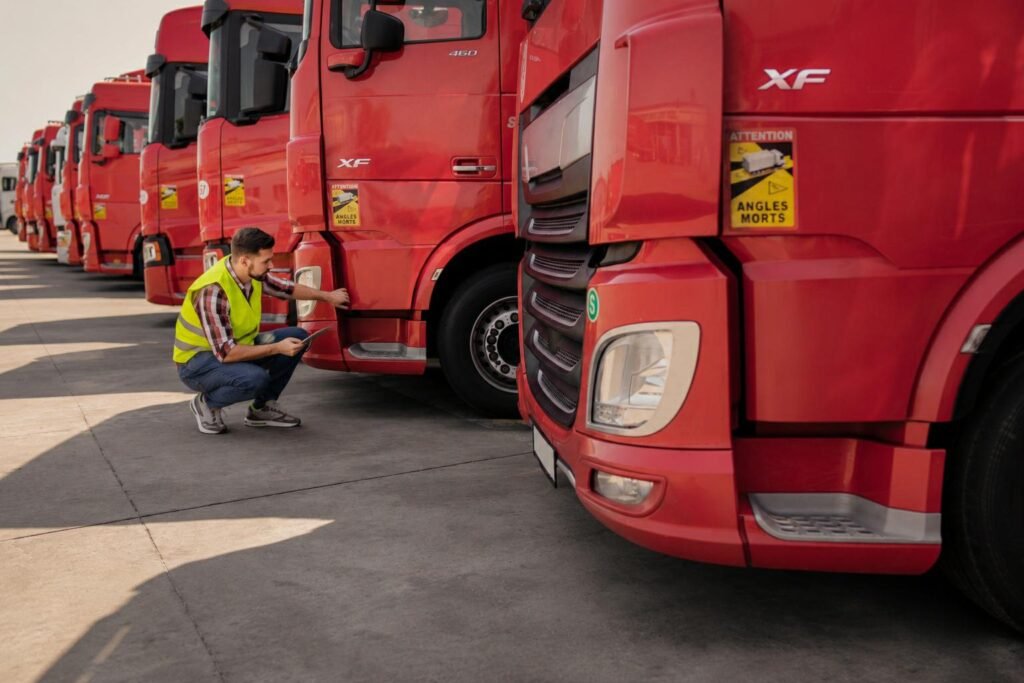
Laboratory brake pad dynamometer testing runs standardized protocols designed to characterize friction behavior under repeatable conditions. SAE J2522 AK Master friction performance testing provides a friction curve, while SAE J2521 brake noise and NVH testing evaluates squeal, vibration, and harshness characteristics. ECE R90 confirms aftermarket equivalence to OE within ±15%. All of these are necessary. None of them is sufficient.
A brake pad that performs well in laboratory testing may still fail under repeated heavy-load braking in specific operating conditions. The reason is structural: lab protocols are designed for repeatability, not for reproducing application-specific variability.
What Duty Cycle Validation Adds
What dynamometer protocols cannot replicate is the thermal cycle simulation of duty-cycle braking patterns, the cumulative effect of long-term contamination exposure, the interaction with specific vehicle suspension and brake system dynamics, and the installation variability introduced during routine maintenance procedures.
Fleet route simulation — designing test protocols around the actual duty cycle of a customer’s operation — is what separates suppliers who develop pads from suppliers who just produce them.
The Discipline That Separates Engineering from Production
Serious manufacturers run validation in real operating environments in parallel with laboratory testing:
- Pre-production fleet trials against representative duty cycles.
- Long-term field monitoring of warranty rates segmented by application type.
- Batch-level traceability that links failures back to specific production lots and root causes.
- Continuous formula refinement based on field data, not just lab data.
This is the discipline that produces pads which behave the same in the second year of service as they did during initial sample testing — and the discipline whose absence shows up as quality drift twelve to eighteen months into a supplier relationship.
Why Fleet Operators Prioritize Predictable Wear Over Peak Friction

What Fleet Operators Actually Fear
Ask a fleet manager what their ideal brake pad does, and the answer is almost never “highest possible friction coefficient.” The answer is “never surprises me.”
What fleet operators actually fear isn’t insufficient peak performance — it’s unpredictable maintenance, inconsistent batches, and fleet downtime. A pad that lasts exactly 100,000 km in every truck is more valuable than one that lasts 150,000 km on average with high variance. A pad whose friction behavior is identical batch after batch is more valuable than one with marginally higher peak friction but visible batch drift.
The Different Economics of Fleet vs Consumer Markets
This is the engineering philosophy that separates commercial fleet supply from consumer aftermarket supply:
- Consumer markets reward peak specifications because end customers compare specs on shelves
- Fleet markets reward consistency because fleet economics are built on schedule reliability
Predictable brake pad wear is the currency of the fleet supplier relationship. A pad that fits the maintenance schedule is worth more than a pad that exceeds it — because exceeding the schedule disrupts planning just as much as falling short of it.
The Right Question to Ask a Supplier
For fleet supplier evaluation, the question worth asking is not “what’s your peak friction coefficient?” but rather “what’s your batch-to-batch friction variance over the last twelve months, and can you show me the data?” The answer reveals whether the manufacturer is engineering for the right thing.
Choose a Brake Pad Manufacturer That Understands Fleet Operations
Selecting a commercial vehicle brake pad manufacturer for a multi-year program is fundamentally an engineering decision, not a procurement decision. The right partner isn’t the one with the lowest unit price or the most certifications — it’s the one whose engineering team can have a substantive conversation about your fleet’s actual operating conditions and match formulation to those conditions.
Tuoba’s Operating-Condition Engineering Capability
Tuoba develops commercial vehicle brake pads across the full range of operating environments:
- Long-haul highway compounds engineered for predictable wear and thermal cycle durability.
- Urban transit formulations optimized for NVH control and stop-and-go heat management.
- Mountain-route severe-duty pads with elevated thermal capacity for sustained-grade descents.
- Mining and construction compounds developed for contamination resistance and severe-duty cycling.
- Climate-specific formulations validated for high-temperature, cold-weather, humid, and corrosive operating environments.
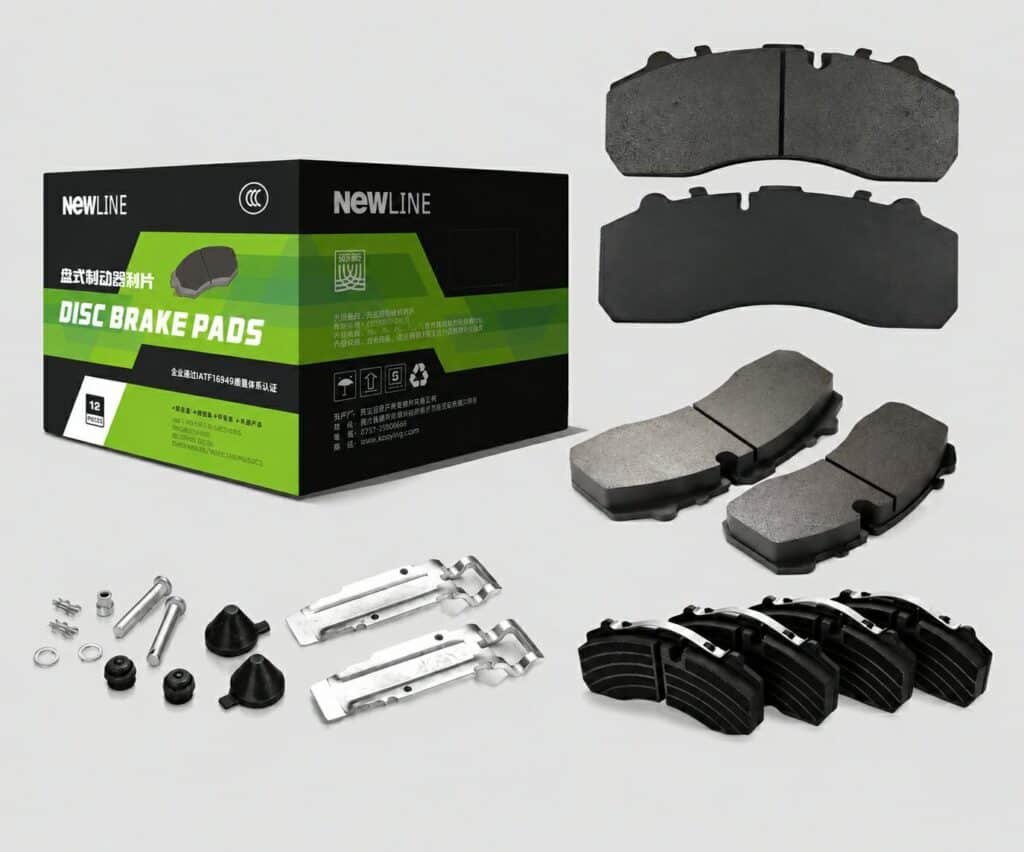
Our MTF formulation library — covering semi-metallic, low-metallic, ceramic, and hybrid systems — provides the engineering depth to match the duty cycle rather than force-fit a generic compound.
Quality System and Validation Infrastructure
Regulatory compliance and validation infrastructure include ECE R90, IATF 16949, ISO 14001/45001, AMECA, E-mark E11, and Leaf Mark copper-free certifications, supported by in-house NVH dynamometer with DTV testing, shear strength testing to ISO 6312, compressibility testing to ISO 6310, and SAE J2521/J2522 validation.
If you’re evaluating brake supply for fleet operations, OEM programs, or commercial brake solutions across mixed duty cycles, the conversation worth starting isn’t about price or catalog availability. It’s about how your fleet actually runs — vehicle weights, route profiles, climate exposure, driver behavior patterns, maintenance interval targets — and which formulation strategy matches.
Looking for a commercial vehicle brake pad supplier with proven validation capabilities and application-specific formulation expertise? Contact Tuoba to discuss your fleet, OEM, or private-label requirements.