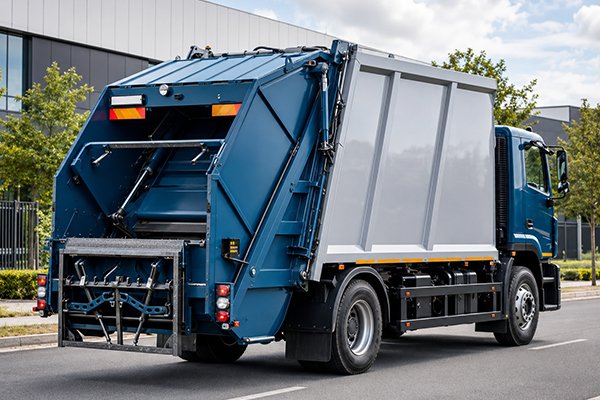
Refuse trucks operate under some of the most demanding braking conditions in the commercial vehicle industry. Unlike long-haul trucks that spend extended periods travelling at relatively stable speeds, refuse collection vehicles repeatedly accelerate, stop, collect waste and move to the next location. This operating cycle may continue throughout an entire shift, often with limited time for the brake system to cool between stops.
Every braking event converts vehicle energy into heat at the interface between the friction material and the brake drum or rotor. At the same time, the weight of the truck gradually increases as waste is collected, meaning the brake system must continue delivering predictable performance as axle loads and operating temperatures change. Road salt, mud, rain, dust and waste contamination can further affect the brake shoes, backing plates, rivets, hardware, calipers and other wheel-end components.
For fleet operators, distributors, OEM buyers and commercial vehicle parts companies, selecting the correct refuse truck brake lining or brake pad is therefore not simply a matter of finding a product with similar dimensions. The friction material must be matched to the brake system, axle rating, route profile, temperature range and expected service life. A product that appears suitable in a catalog may still wear prematurely, damage the drum or perform inconsistently if it was not designed for severe-duty, stop-and-go operation.
Why Refuse Trucks Need Severe-Duty Brake Components
Refuse trucks are normally classified as vocational or severe-duty vehicles because their operating conditions differ significantly from those of conventional highway trucks. On a residential collection route, a truck may move only a short distance before the driver applies the brakes again. Because the next acceleration begins almost immediately, the friction material and mating surface may not return to their normal temperature before the following stop.
This demanding operating profile is supported by real-world fleet research. A California Air Resources Board analysis incorporating National Renewable Energy Laboratory Fleet DNA data covered 387 operating days from 39 refuse trucks and examined stops per mile, daily operating distance, and average and maximum driving speeds. The data reinforces an important point for fleet buyers: refuse-truck brake demand cannot be evaluated by mileage alone. Stop density, payload, route speed and available cooling time can be equally important when selecting heavy-duty brake linings.
The changing vehicle load creates another challenge. A refuse truck may begin its route relatively light and return fully loaded. The friction material must therefore provide stable braking across different axle loads instead of performing well under only one operating condition. If the compound loses friction as temperature increases, the driver may experience reduced braking response or longer stopping distances. If the material is too aggressive, it may preserve lining thickness while causing excessive wear, scoring or heat checking on the drum or rotor.
These technical issues also have a direct commercial impact. A brake component with a low initial price may become expensive if it requires frequent replacement, increases workshop labor, damages the mating surface or causes unplanned vehicle downtime. For refuse fleets, the more useful purchasing measurement is total operating cost rather than unit price alone. Service life, maintenance frequency, drum or rotor replacement, consistency between production batches and fleet availability should all be considered when evaluating a brake product.
Brake Linings, Brake Shoes and Brake Pads
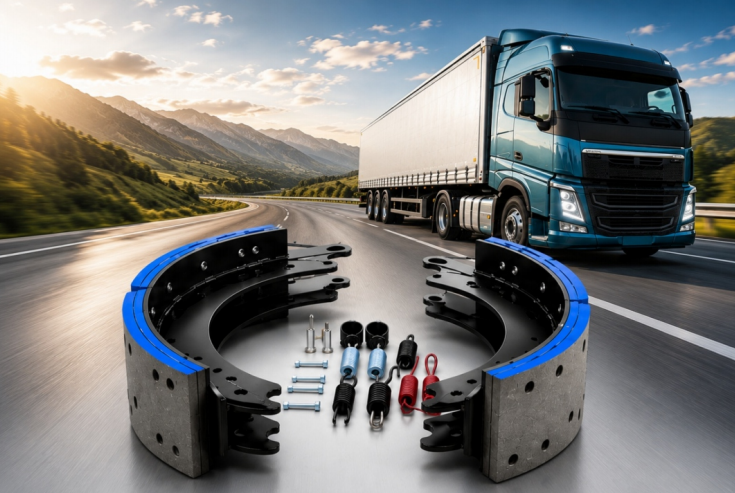
Although the terms are sometimes used interchangeably in online searches, brake linings and brake pads generally belong to different braking systems. A brake lining is a curved friction component used inside a drum brake. It may be supplied separately for riveting or bonding to a brake shoe, or it may be supplied as part of a complete lined brake shoe assembly. A brake pad is a flat friction component molded or bonded onto a steel backing plate and used in a disc brake system, including the air disc brakes found on many modern commercial vehicles.
| Component | Brake system | Typical construction | Common refuse-truck application |
| Brake lining | Drum brake | Curved friction segments installed on a brake shoe | Heavy-duty S-cam brakes |
| Lined brake shoe | Drum brake | Steel or cast shoe with installed lining | Complete replacement shoe kits |
| Brake pad | Disc brake | Friction material molded onto a steel backing plate | Air disc brake systems |
| Brake block | Specialized brake | Large friction block produced for a specific assembly | Selected vocational or industrial applications |
When buyers request a large brake lining for refuse trucks, they are normally referring to a wide or large-format drum brake lining installed on a heavy-duty brake shoe. However, the terms “large brake lining,” “small brake lining” and “size brake lining for refuse trucks” are not complete technical specifications. The buyer still needs to confirm the drum diameter, brake width, lining thickness, rivet pattern, shoe geometry, axle position and brake configuration.The dimensional guide below shows the key information buyers should provide so that the supplier can accurately identify the application, recommend the appropriate friction material and prepare a reliable quotation.
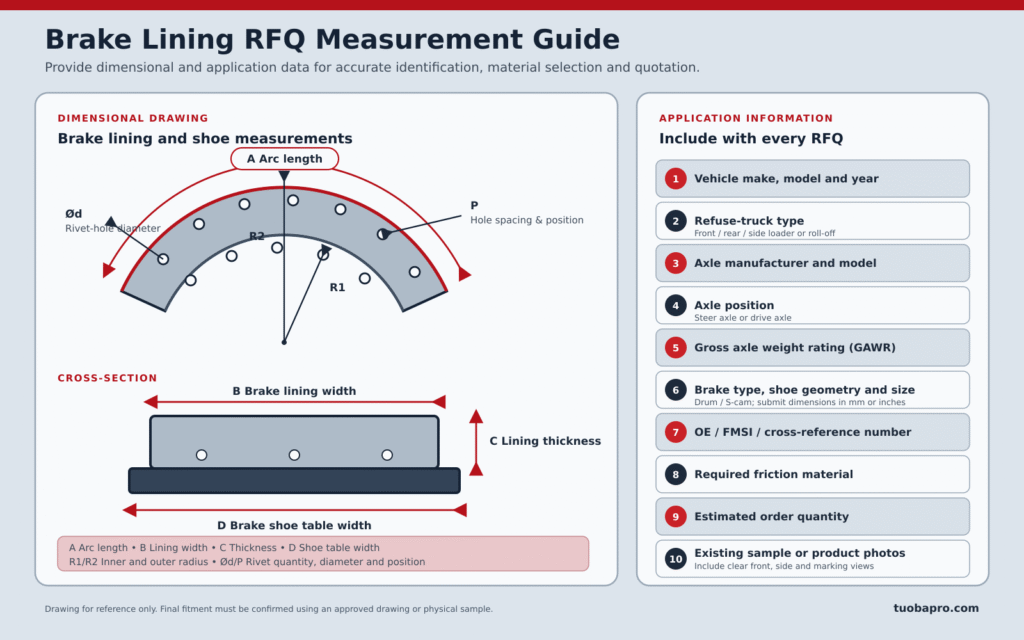
For disc brake applications, the more accurate product description is normally “heavy-duty air disc brake pads for refuse trucks.” The caliper model, backing plate geometry, pad thickness, retention system, wear sensor and fitting hardware must all be confirmed before a product can be treated as interchangeable. Two pads may look almost identical while using different attachment features or friction thicknesses.
Large Brake Linings and Brake-System Matching
A larger brake lining can provide a greater friction contact area, but size alone does not determine braking performance. A drum brake operates as a complete system in which the lining dimensions, drum diameter, shoe design, S-cam geometry, actuation force, axle rating and friction coefficient work together.
A large lining made from an unsuitable friction compound can still wear quickly or lose braking effectiveness as temperature rises. It may also generate excessive heat or increase drum wear. Conversely, a properly developed severe-duty formulation can provide stable friction and controlled wear without unnecessarily increasing maintenance costs.
Controlled NHTSA testing illustrates why brake-system configuration and application matching matter. In a 2013 NHTSA braking improvement study involving a Class 8 straight truck configured to emulate a refuse hauler at GVWR, the original hybrid S-cam configuration stopped from 60 mph in 298 feet. The big S-cam configuration stopped in 248 feet, the hybrid-disc configuration in 245 feet and the all-disc configuration in 228 feet.
The all-disc configuration shortened the tested stopping distance by approximately 70 feet, or 24%, compared with the original configuration. However, these results apply to the specific vehicle, load, surface and test conditions. They do not establish that one braking system is universally superior. Instead, they demonstrate that brake output, component dimensions and system configuration can materially affect performance. The complete results are available in the NHTSA Class 8 refuse-hauler braking study.
S-cam drum brakes continue to be widely used on refuse trucks because of their durability, established maintenance network and suitability for demanding vocational applications. Depending on the chassis and axle specification, buyers may require separate linings or complete heavy-duty drum brake shoes.
Air disc brakes can provide consistent brake response, relatively convenient inspection and good fade resistance when they are correctly specified and maintained. Nevertheless, refuse-truck air disc brake pads still operate under severe thermal and mechanical loads. Their friction stability, shear strength, backing plate attachment, edge-cracking resistance and rotor compatibility must be evaluated under repeated braking conditions.
Selecting the Right Friction Material
There is no single friction formulation that is best for every refuse truck. The appropriate material depends on the brake system, axle load, route conditions, temperature range and expected balance between friction-material life and drum or rotor wear.
Non-asbestos organic materials are widely used in drum brake applications. A properly developed severe-duty NAO formulation can provide balanced friction, controlled noise and suitable drum compatibility. Heat-resistant and reinforcing fibers may be incorporated to improve mechanical strength and wear performance during frequent braking.
Semi-metallic formulations contain a higher proportion of metallic fibers or particles and can provide strong braking response, heat transfer and wear resistance in selected linings and brake pads. However, increasing metallic content does not automatically produce a better product. If the formulation is not balanced correctly, it may increase noise or create more aggressive wear on the drum or rotor.
Ceramic fibers, aramid fibers, fiberglass and other advanced reinforcing materials may also be used to improve thermal stability, impact resistance or dimensional strength. Buyers should not select a product solely because the supplier describes it as ceramic, semi-metallic or premium. The complete formulation, laboratory results, brake-system compatibility and field performance are more important than a single material label. Buyers comparing ceramic or semi-metallic brake pads for trucks should therefore begin with the operating requirements rather than the material name.
For refuse-truck applications, friction stability deserves particular attention. A material may provide acceptable braking when cold but lose effectiveness after repeated stops. Fade-and-recovery testing helps determine how the friction coefficient changes as temperature rises and whether the material returns to the expected level after cooling. More information about formulations, friction behavior and testing methods is available in Tuoba’s overview of brake pad technology.
Wear performance must also be evaluated together with the mating surface. The longest-lasting lining is not automatically the most economical product if it shortens drum life. A balanced friction material should provide acceptable lining or pad life without causing excessive scoring, cracking, heat checking or wear on the brake drum or rotor.
Mechanical integrity is equally important. Brake linings and pads must withstand vibration, compression, shear force and repeated thermal expansion. The quality of the molding, curing, riveting, bonding and backing plate can affect whether the friction material remains structurally stable throughout its service life. A severe-duty formulation cannot compensate for poor manufacturing control or weak attachment to the shoe or backing plate.
Brake Condition, Inspection and Fleet Downtime
Brake condition has a direct effect on whether a commercial vehicle can remain in operation. During CVSA’s 2025 Brake Safety Week, inspectors examined 15,175 commercial motor vehicles across North America and placed 2,296 vehicles out of service for brake-related violations. This represented a brake-related out-of-service rate of 15.1%.
The most frequently cited reason was that 20% or more of a vehicle’s service brakes had an out-of-service condition, accounting for 1,199 cases. Inspectors also recorded 113 brake drum and rotor violations, with 39 vehicles placed out of service specifically for drum or rotor conditions. These figures cover commercial vehicles generally rather than refuse trucks alone, but they demonstrate the operational consequences of inadequate brake condition across heavy-duty fleets. The full results are published in the CVSA 2025 Brake Safety Week report.
The issue remains current. CVSA selected brake drum and rotor condition as the focus area for its 2026 Brake Safety Week, scheduled for August 23–29, 2026. This emphasis reinforces why fleets should evaluate friction-material wear together with drum or rotor compatibility instead of treating lining or pad life as an isolated measurement. Details are available from the CVSA 2026 Brake Safety Week focus area.To quickly review the key inspection items for the August 2026 Brake Safety Week, click here to view the PDF.
For fleet managers, a brake problem involves more than the replacement part. An out-of-service vehicle may interrupt a collection route, require another truck to be dispatched and increase labor and workshop costs. A structured fleet brake pad strategy should therefore consider inspection frequency, wear data, route severity, product consistency and total cost per vehicle rather than relying only on the lowest quotation.
Testing, Documentation and FMVSS 121
Professional B2B buyers should request evidence that the proposed brake lining or pad has been tested under relevant conditions. Depending on the product and target market, this may include friction coefficient, wear, fade, recovery, shear strength, compressibility, hardness, density, corrosion and dynamometer testing.
Test data must correspond to the product being supplied. A general laboratory report covering another brake size, axle rating or formulation does not necessarily demonstrate the performance of the quoted product. Buyers should check the tested brake configuration, friction material, load, procedure and laboratory information instead of accepting a certificate based only on its title.
The attachment between the friction material and its supporting component is particularly important for disc brake pads. Insufficient brake pad shear strength may contribute to cracking, separation or structural failure under high thermal and mechanical loads. For this reason, shear testing should be considered together with friction and wear performance rather than treated as an isolated laboratory result.
FMVSS No. 121 establishes braking-system performance and equipment requirements for trucks, buses and trailers equipped with air brakes in the United States. However, a replacement brake lining should not automatically be described as “FMVSS 121 certified” without supporting documentation for the applicable brake configuration. Buyers should request the corresponding report and verify the tested axle rating, brake size, friction material and operating conditions.
It is also important not to confuse FMVSS 121 with FMVSS 135. FMVSS 135 primarily addresses light-vehicle hydraulic brake systems, while FMVSS 121 applies to relevant heavy air-braked vehicles. Similarly, ECE R90 applies to replacement brake components in markets where the regulation is required. Because the scope varies between standards, buyers should understand which brake pad certifications apply to the intended vehicle and destination market rather than treating all certificates as interchangeable.
Comprehensive commercial vehicle brake pad testing should ultimately demonstrate that the product provides an appropriate balance of friction, fade resistance, recovery, wear and structural integrity for the target application.
Matching the Product to the Refuse-Truck Application
Front loaders, rear loaders, automated side loaders and roll-off trucks do not necessarily require the same brake specification. Even vehicles in the same category can operate under significantly different route and load conditions.
Front-loader refuse trucks are commonly used for commercial waste collection and may carry high payloads through repeated collection and compaction cycles. Rear loaders are widely used on residential and mixed collection routes, where frequent stops and changing loads create repeated temperature fluctuations. Automated side loaders may travel only a short distance between containers and complete a high number of braking events during every shift. Roll-off trucks may spend more time travelling between collection sites, but heavy container loads and mixed urban and highway operation can still place considerable demands on the brake system.
The body configuration helps describe the way the vehicle is used, but it should not be the only basis for selecting a brake lining or pad. The chassis, axle, brake dimensions, gross axle weight rating and actual route profile are more important. Two rear-loader trucks may require different friction materials if one operates on flat suburban roads and the other works fully loaded on steep urban streets.
To provide an accurate recommendation, the manufacturer should understand the vehicle manufacturer, model, production year, axle model, brake system, dimensions and OE or FMSI reference. Information about the route is also valuable, including the approximate number of stops, terrain, climate, current service life and any existing problem such as brake fade, noise, cracking, rapid wear or drum damage.
If a buyer only provides a photograph and describes the product as a large brake lining for a refuse truck, a responsible supplier should request additional information before confirming the application. Providing a quotation without verifying the necessary specifications may save time initially, but it creates a much higher risk of incorrect fitment or unsuitable performance.
Common FMSI and Brand Cross-References
Common 16.5-inch Q-type S-cam references used across refuse trucks and other heavy-duty vocational vehicles include FMSI 4707, 4711, 4715 and 4720. Complete references may also appear as 4707Q, 4711Q or Q Plus brake shoe kits. These numbers can help identify the product family, but they should not be treated as final confirmation of fitment.
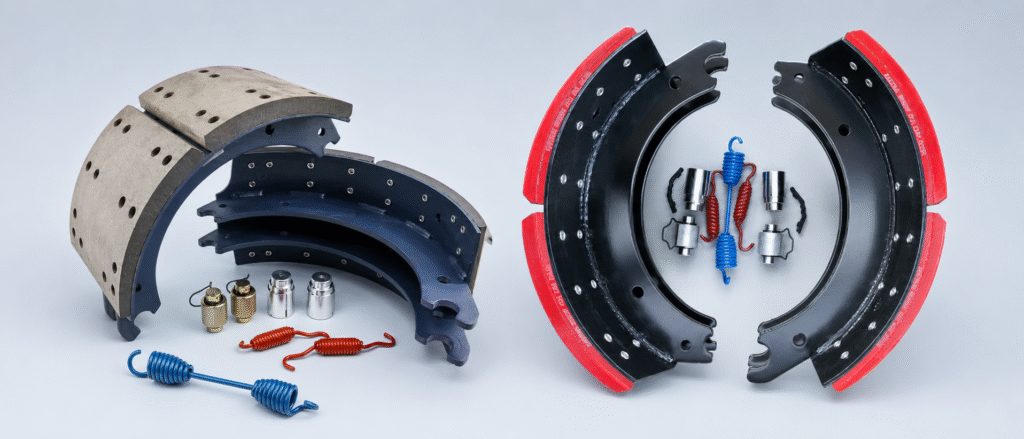
Before approving an order, the supplier should verify the brake diameter and width, lining thickness, rivet-hole quantity and position, shoe table design, axle position and gross axle weight rating. A technical drawing, physical sample or reliable application record should be used whenever possible.
Brand charts can also provide an initial reference, but they should not replace dimensional verification. Buyers searching for Abex brake shoes, an Abex brake lining chart or an Abex 685 brake lining should confirm the actual technical data before selecting an alternative. Products associated with similar brand references may still differ in friction grade, intended axle load or operating conditions.
This cross-reference process is particularly important for distributors building a broad aftermarket catalog. A reliable supplier should not simply match a competitor number in a database; it should verify whether the dimensions, construction and performance requirements correspond to the customer’s application.
Evaluating a Refuse-Truck Brake Lining Manufacturer
A professional brake lining or brake pad manufacturer should contribute more than a product catalog and a unit price. The supplier should be capable of reviewing drawings, samples, OE numbers, FMSI references, brake dimensions and operating conditions before recommending a product. Buyers following a structured process for sourcing truck brake pads should evaluate technical support, testing capability, production consistency and traceability alongside commercial terms.
Formulation capability is particularly important for severe-duty applications. Different refuse fleets may need different balances of friction, wear, temperature resistance, noise and drum compatibility. A manufacturer with friction-material development experience can determine whether an existing compound is suitable or whether an application-specific adjustment is necessary. Reformulating a product without adequate evidence can introduce new wear, noise or braking problems, so any change should be supported by testing and controlled field validation.
Production consistency is just as important as initial sample performance. The brake pad manufacturing process includes raw-material control, weighing, mixing, molding, curing, grinding, scorching, bonding and final inspection. Variations in these processes can change friction behavior, compressibility, wear or structural strength even when the external dimensions remain unchanged.
The manufacturer should maintain batch records and retained samples so that any future field issue can be investigated using evidence. A professional brake pad failure analysis should compare the field sample with production records, retained samples, vehicle conditions and maintenance history before concluding that the formula must be changed.
Distributors developing their own brands often require support beyond the friction component itself. Custom packaging, private-label printing, product markings, barcode labels, electronic catalogs, product photography, cross-reference data, batch tracking and market-specific documentation all influence how efficiently a new product line can enter the market. These requirements should be reviewed at the beginning of an OEM or private-label brake pad project because they may affect tooling, minimum order quantities, production lead time and the final quotation.
Supply continuity should also be evaluated. Refuse fleets cannot afford extended downtime because an important replacement reference is unavailable. Distributors should understand the manufacturer’s normal production lead time, raw-material controls and ability to support repeat orders. The supplier should also communicate before making any material or process change that could affect product performance.
Sample Testing Before Bulk Purchasing
Sample testing provides a practical bridge between laboratory data and actual fleet operation. Before bulk production, the buyer and manufacturer should confirm the drawing, reference number, friction material and product dimensions. The samples can then be inspected for installation fit and evaluated through laboratory, dynamometer or controlled field testing as required.
For field validation, the samples should be installed on selected vehicles with the axle position, route, mileage and operating conditions recorded. The buyer can monitor wear, braking response, noise and changes in drum or rotor condition. After an agreed test period, the results should be compared with the existing product under similar operating conditions.
This comparison is important because results from different routes may not be directly comparable. A brake lining tested on a lightly loaded suburban route may appear to last longer than one operating on a fully loaded truck in dense urban traffic. The difference may reflect the duty cycle rather than product quality. A useful field test therefore controls as many variables as possible and records enough information to explain the result.
Once fitment, friction performance, wear and drum or rotor compatibility have been verified, the final specification can be approved for bulk production. The approved sample, drawing, formulation reference and quality requirements should then become part of the manufacturer’s production control records.
What Determines Refuse-Truck Brake Lining Price?
The price of a refuse-truck brake lining depends on more than its physical size. The friction formulation, lining thickness, brake shoe construction, riveting or bonding method, hardware, order quantity and packaging requirements all influence cost. Custom markings, private-label packaging, testing, tooling and market-specific documentation may also affect the quotation.
Buyers comparing brake linings for sale should make sure each supplier is quoting the same technical and commercial scope. A professional quotation should identify the product reference, friction material, supply unit, packaging, minimum order quantity, lead time, trade terms and supporting documentation.
An apparently lower brake liner price may not represent a genuine saving if the product uses a different friction grade, excludes hardware, has a shorter service life or causes more aggressive drum wear. The more meaningful comparison is the product’s total cost throughout its service life, including installation labor, inspection frequency, mating-surface replacement and fleet downtime.
Frequently Asked Questions
What is the best brake lining for refuse trucks?
The best brake lining is the one that matches the vehicle’s brake system, axle load and operating conditions while providing stable friction, controlled fade, acceptable wear and suitable drum compatibility. No single formulation is best for every refuse fleet.
Are large brake linings always better?
No. A larger lining may provide more contact area, but braking performance also depends on the friction compound, brake geometry, drum condition and actuation system. Correct application matching is more important than selecting a product only because it is larger.
How often should refuse-truck brake linings be replaced?
There is no universal replacement interval. Service life depends on route conditions, vehicle load, number of stops, driver behavior, brake adjustment, friction material and maintenance quality. Fleets should establish inspection and replacement limits using manufacturer guidance and their own operating data.
Should refuse trucks use drum brakes or air disc brakes?
Both systems can be suitable. Drum brakes are durable and widely supported, while air disc brakes may provide consistent response and convenient inspection. The correct choice depends on the vehicle design, axle rating, maintenance capability and operating environment.
Can refuse-truck brake linings and pads be customized?
Yes. Manufacturers can support custom dimensions, friction formulations, product markings and private-label packaging. Customization normally requires complete technical information, sample validation and an agreed minimum order quantity.
What information is required for an accurate quotation?
The buyer should provide the OE or FMSI reference, brake dimensions, vehicle application, expected quantity and delivery destination. A technical drawing, sample or clear product photographs are also helpful. For an application-specific recommendation, axle rating, route conditions and current performance problems should be included.
Conclusion
Refuse trucks place unusually high demands on brake linings and brake pads because they combine frequent stopping, changing payloads, repeated thermal cycling and limited cooling time. Choosing a product only by price, brand or approximate size can result in premature wear, drum or rotor damage and unnecessary fleet downtime.
A reliable purchasing decision begins with accurate application identification and continues through friction-material selection, documentation review, sample validation and production control. Fleet operators and distributors should evaluate how the product performs as part of the complete brake system and whether the manufacturer can maintain the same quality across repeat orders.
Tuoba supports commercial vehicle customers with heavy-duty brake linings, lined brake shoes and brake pads for demanding fleet applications. Buyers can provide an OE or FMSI reference, technical drawing, sample or vehicle information for product identification and technical review. For OEM, aftermarket and private-label projects, samples can be evaluated before bulk production so that fitment, braking performance, wear and drum or rotor compatibility are confirmed under the intended operating conditions.
To discuss a refuse-truck brake lining, brake shoe or air disc brake pad project, please contact Tuoba with the available vehicle, axle and product information. Our technical team will review your application, identify the appropriate product reference and friction material, and provide a suitable sample-validation plan and quotation to support your project from initial testing through stable bulk supply.