Sourcing brake friction for a semi trailer is not as simple as matching a tractor model, and that is where a surprising number of orders go wrong. Semi-trailers may run either air disc brake pads or drum brake shoes and linings, and the correct replacement product is determined by the trailer axle, the caliper system, the brake dimensions, and the operating conditions — not by the truck pulling it. Get that identification wrong and you order a part that will not fit, or one that fits but is wrong for the duty. Get it right and you protect both safety and margin.
The commercial reason to get it right has rarely been stronger. According to Frost & Sullivan, fleets are holding onto trucks and trailers longer — higher vehicle prices, tighter financing, and freight-market volatility are pushing operators to extend equipment life, which sustains steady demand for replacement parts across the medium- and heavy-duty aftermarket. With a global medium- and heavy-duty vehicle parc measured in the tens of millions of units, every trailer retained rather than replaced becomes a recurring source of friction-component demand. That structural shift toward fleet retention and higher utilization is exactly why brake friction is a resilient, growing category — and why buying it well matters to a distributor’s or fleet’s bottom line.
Think of this guide as a walk through the whole decision. We will look at what semi trailer brake pads actually are, how to identify the correct part with confidence, the specifications that separate a good pad from a poor one, and how distributors and fleets should evaluate a supplier — so your next order fits, performs, and holds up.
What Are Semi Trailer Brake Pads?
A semi trailer brake pad is a replaceable friction component used in an air disc brake (ADB) system. It works together with the brake caliper and rotor to slow or stop the trailer, gradually wearing down as it absorbs friction and heat. Understanding how this component works—and how it differs from drum brake parts—is the first step in sourcing the correct replacement product.
When the driver applies the brakes, compressed air activates the brake chamber and caliper mechanism. The caliper then presses the inner and outer brake pads against both sides of the rotating disc, or rotor. This contact converts the trailer’s kinetic energy into heat, reducing wheel speed and bringing the vehicle to a controlled stop. Because semi trailers often operate under heavy loads, repeated braking and long-distance conditions, their brake pads must provide stable friction, effective heat dissipation and consistent performance throughout their service life.
A typical semi trailer brake pad consists of a steel backing plate, a friction material layer and, depending on the design, a noise-reducing or heat-insulating component. The friction material may be semi-metallic, low-metallic, ceramic-based or specially formulated for heavy-duty commercial applications. The correct formulation depends on factors such as axle load, road conditions, operating temperature, braking frequency and the required balance between stopping performance, wear life, noise and rotor protection.
How Air Disc Brake Pads Work on a Trailer
In a commercial vehicle air brake system, pressing the brake pedal directs compressed air from the reservoir to the service brake chamber. On an air disc brake, this force actuates the caliper mechanism, which presses a pair of brake pads against the rotor mounted on the wheel hub.
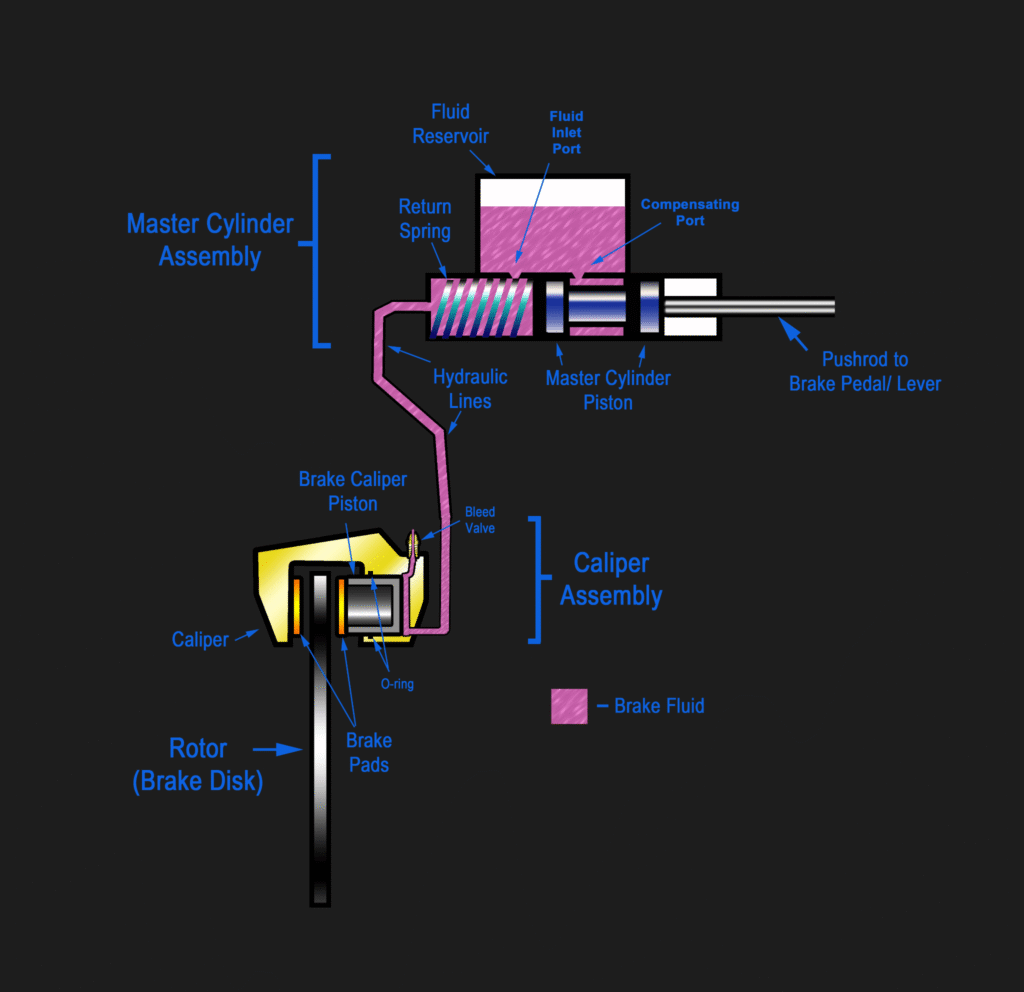
As explained in the operating principle of a disc brake, the caliper squeezes the pads against both sides of the rotating disc to create friction. This friction converts the trailer’s kinetic energy into heat, reducing wheel speed and bringing the vehicle to a controlled stop. Because brake pads repeatedly absorb friction and heat during braking, their friction material gradually wears down and requires regular inspection and replacement.
Compared with drum brakes, disc brakes can dissipate heat more quickly, helping reduce the risk of overheating during repeated braking. Their construction also makes pad and rotor condition easier to observe during routine maintenance. Air disc brakes are becoming more common in heavy commercial vehicles, increasing the replacement demand for application-specific semi trailer brake pads.
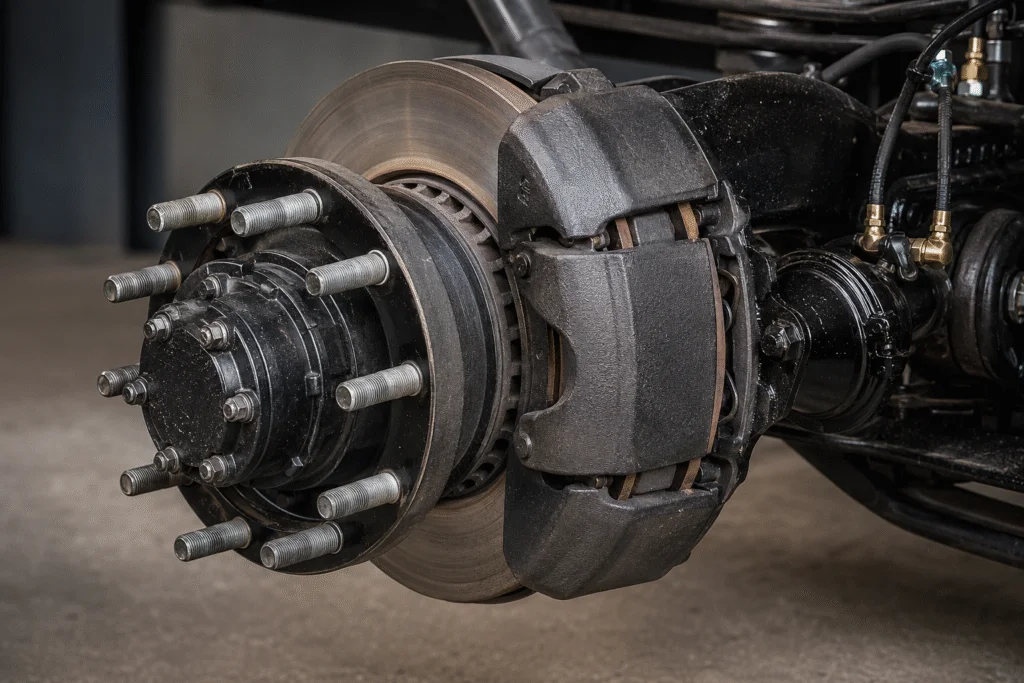
The two images below provide a visual explanation of this braking process. The first diagram uses a hydraulic system to show how pressure causes the caliper to clamp the brake pads against the rotor. Although trailer air disc brakes use compressed air instead of brake fluid, the pad-to-rotor friction principle is similar. The second image shows the actual arrangement of the rotor, caliper, brake chamber and brake pads in a heavy-duty air disc brake assembly
Brake Pads vs. Brake Shoes and Brake Linings
Brake pads, brake shoes, and brake linings all create the friction required to slow a vehicle, but they belong to different braking systems and cannot be used interchangeably.
Brake pads are used in disc brake systems. They are mounted inside the caliper and pressed against a flat rotor to slow or stop the wheel. A brake shoe, by comparison, carries the friction lining used in a drum brake system. When the brake is applied, the shoe moves outward and presses the lining against the inside of the brake drum.
On many heavy-duty drum brake systems, an S-cam rotates to push two curved brake shoes outward against the drum. The friction generated between the linings and the inner surface of the drum produces the braking force and converts the vehicle’s motion into heat.
Although both systems perform the same basic function, their structures, dimensions, installation methods, and replacement components are entirely different. A semi trailer brake pad is therefore not another name for a semi trailer brake shoe. Using the wrong terminology when requesting a quotation can lead to incorrect product selection, wasted freight, excess inventory, and unnecessary trailer downtime.
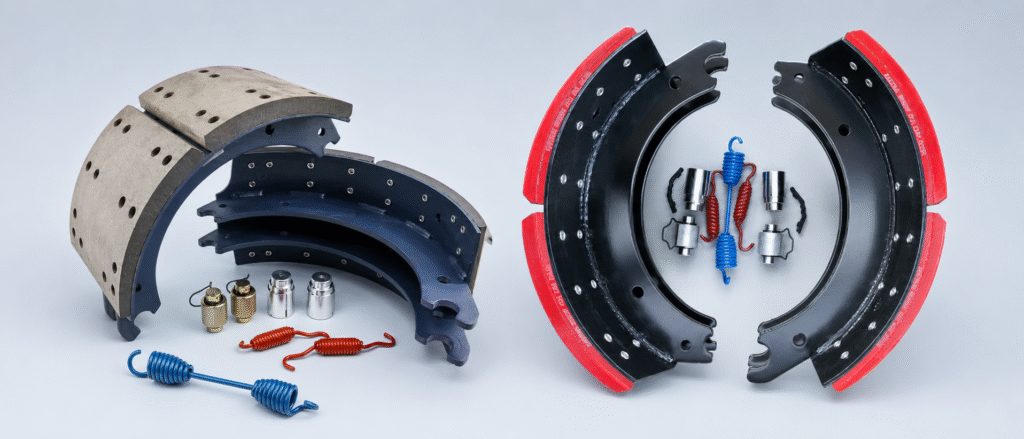
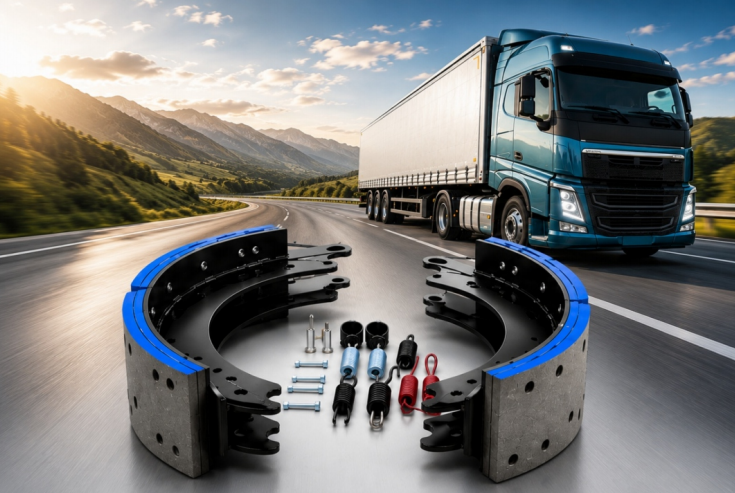
Semi-trailer drum brake shoes, friction linings, and associated installation hardware.
Why the Brake System Must Be Confirmed Before Sourcing
Before requesting a quotation, first confirm whether the trailer axle is equipped with an air disc brake or an S-cam drum brake. This initial check determines which replacement component is required and what application information must be provided to the supplier.
For an air disc brake, the most useful identification details include the caliper brand and model, OE or cross-reference number, brake pad dimensions, axle application, operating conditions, and required quantity. When the part number is unavailable, clear photos of the existing pad, caliper, and rotor assembly can help the supplier verify the application.
A drum-braked trailer requires different information, such as the brake drum diameter, shoe width, lining thickness, hole pattern, axle specification, and FMSI or WVA reference number. These measurements should be confirmed rather than estimated because similar-looking brake shoes may have different dimensions or installation requirements.
Ordering brake pads for a drum-braked axle—or brake shoes for a disc-braked axle—results in parts that cannot be installed. Confirming the brake type before sourcing helps distributors, repair shops, and fleet operators avoid application errors, control inventory costs, and reduce delays caused by incorrect replacement components.
The rest of this guide focuses primarily on semi trailer air disc brake pads while explaining where drum brake shoes and linings apply, helping buyers identify the correct system and source suitable replacement parts.
Air Disc Brake Pads vs. Drum Brake Shoes: Which Does Your Trailer Use?
Before matching a specific part, identify the system at the wheel-end. The two systems differ in friction component, actuation, and — crucially — how you identify the correct replacement.
| Attribute | Air Disc Brake Pads | Drum Brake Shoes / Linings |
|---|---|---|
| Friction component | Pads (pair per wheel-end) | Shoes with bonded or riveted lining |
| Typical system | ADB caliper on a rotor | S-cam air drum brake |
| Common strengths | Fast inspection and pad swaps, stable braking, strong fade resistance | Broad vehicle coverage, generally lower component cost |
| How you identify the part | Caliper brand and model, pad shape and dimensions, rotor diameter, OE cross-reference | FMSI number, drum diameter, shoe width, bolt/rivet pattern |
| Example reference | Bendix ADB22X, WABCO PAN 22 | FMSI 4707 (16.5″ x 7″ S-cam shoe) |
Spotting the system at the wheel-end
Most modern trailers make the system easy to identify at the wheel-end: a disc system shows a caliper straddling a visible rotor, while a drum system presents a solid drum with no external rotor. It is worth checking each axle rather than assuming, because a single tractor-trailer combination can mix systems — disc on some axles, drum on others. A quick visual confirmation here saves the far more expensive mistake of ordering the wrong family of part.
Why you’ll source both systems for years to come
The industry trend is clear: air disc adoption keeps rising on new trailers, but the enormous installed base of S-cam drum brakes means both systems will be sourced in volume for a long time. The FMSI 4707 16.5″ x 7″ shoe remains one of the most common heavy-duty references, rated to roughly 23,000 lb axle loads and FMVSS 121 certified, and is a useful reminder that “the market” is really two systems running side by side. A distributor or fleet that wants to cover its customers or its equipment needs a plan for both.
How to Identify the Correct Semi Trailer Brake Pad
Correct identification is the most valuable step in the entire process — it is what turns a vague request into an accurate quote and a part that actually fits. The good news is that a handful of details, supplied up front, will almost always pin down the exact pad.
Start with the caliper, then the OE cross-reference
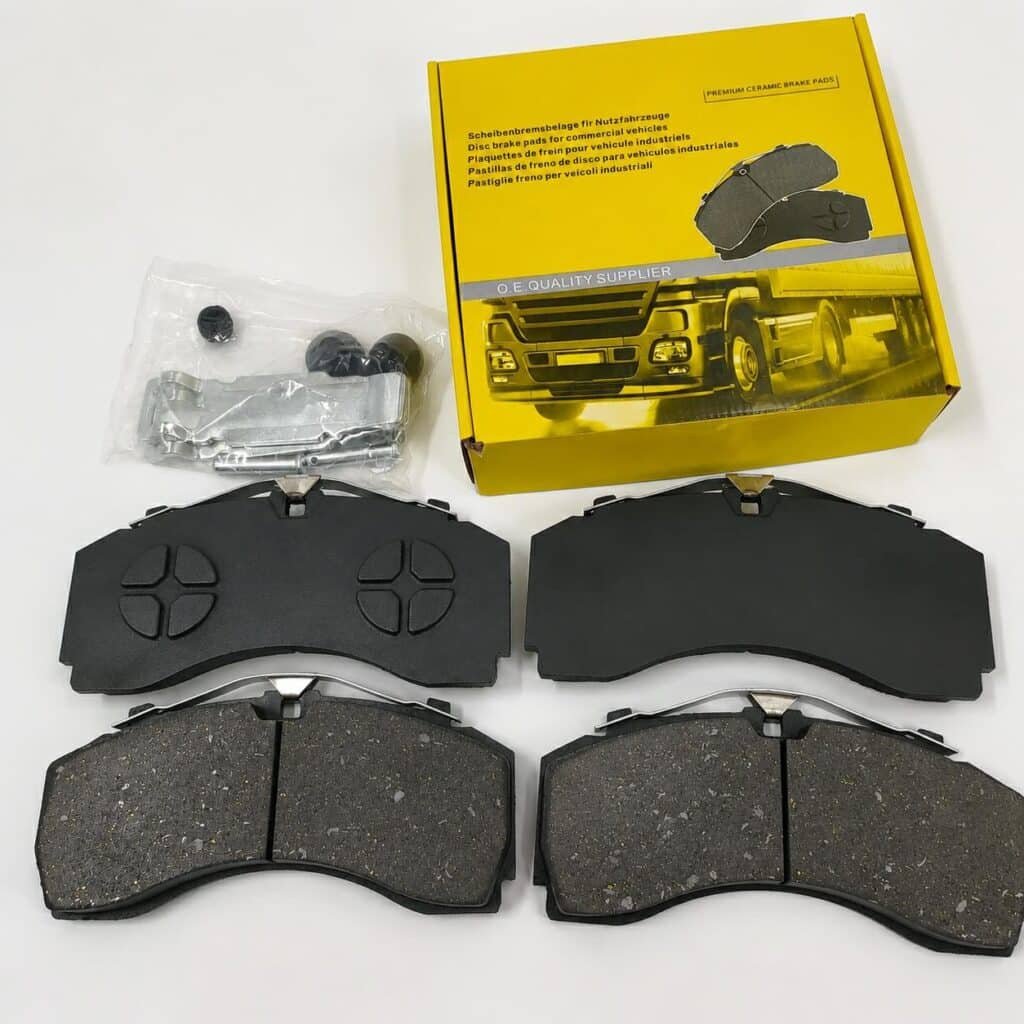
The caliper is the anchor for everything else, so begin there. The caliper brand and model — for example a Bendix ADB22X, a WABCO PAN 22, or a Meritor EX+ — is the primary determinant of pad shape, and pairing it with the trailer axle or suspension model narrows the compatible wheel-end considerably. From there, the fastest and most reliable path is an OE number or cross-reference number, which points straight to the exact pad without guesswork. When those numbers have worn off or were never recorded, a clear pad photo together with a dimensional drawing does much the same job: the pad’s length, height, and total thickness define the fit, while the rotor diameter and wheel size confirm you are in the right wheel-end family.
Confirm sensors, hardware, and the commercial context
On the commercial side, the context shapes the offer as much as the part does: telling a supplier the trailer application and duty cycle—long-haul, urban stop-and-go, heavy-haul, or refrigerated—helps them match the right friction material to the operating conditions. Sharing your annual purchasing volume informs pricing, packaging, and stocking, while identifying the target market and its applicable regulations—such as ECE R90 in Europe or FMVSS No. 121 (49 CFR § 571.121) for air-braked trucks, buses, and trailers in the United States—helps suppliers determine the appropriate product configuration, testing and compliance documentation. The more information you provide, the faster and more accurately a supplier can quote, reducing the risk of a costly mismatch.
Common Semi Trailer Air Disc Brake Systems
Across the North American commercial brake pad market and the European trailer aftermarket, the ADB landscape is dominated by a handful of major caliper platforms. In fact, a small number of calipers cover the large majority of the Class 8 truck and trailer market—one leading aftermarket pad line advertises coverage of roughly 70% of that market across just four caliper families. Knowing the platform is the starting point for every disc-pad order.
| Caliper system | Manufacturer | What to confirm when sourcing |
|---|---|---|
| ADB22X / ADB22X-LT | Bendix (Knorr-Bremse) | Left/right hand, pad shape, rotor diameter, wear-sensor version, retainer/tappet kit |
| MAXX22T | Hendrickson | Caliper generation, pad set part number, hardware kit, sensor requirement |
| PAN 22 / PAN 19 / PAN 17 / MAXXUS | WABCO (ZF) | Which PAN size (17/19/22), OE cross-reference, retainer bar kit |
| EX+ / EX225 (single- and twin-piston) | Meritor (Cummins) | Exact EX variant, piston configuration, pad kit and hardware |
| DBT / ModulT series | Haldex | Caliper model and generation, rotor size, sensor and hardware kit |
| P89 / SK7 | SAF-Holland | Integral axle/caliper match, pad kit part number, wear-sensor version |
| SB6 / SB7 / SN7 | Knorr-Bremse (Europe) | Caliper model, ECE R90 compliance, OE cross-reference |
Making sense of the caliper numbering
A word on the numbering is useful here. Designations like ADB22X, MAXX22T, and PAN 22 broadly indicate the caliper’s size class, with 17 and 19 variants serving lighter axles. Because each platform comes in left- and right-hand versions, multiple pad shapes, and sensor and non-sensor options, the caliper name alone is a starting point rather than a complete specification — always pair it with an OE cross-reference or a dimensional confirmation before you order.
Key Semi Trailer Brake Pad Specifications
Once the platform is identified, the specification determines whether the pad performs. A professional buyer is really evaluating a short list of properties, and a serious semi trailer brake pad manufacturer should be able to document each one.
Fit, material, and thickness limits
Sourcing begins with fit and material. The pad dimensions — length, height, and total thickness — must match the caliper exactly, and the friction material, whether semi-metallic, low-metallic, or ceramic, should be chosen for the duty rather than assumed. Thickness deserves particular attention because two different numbers are in play. The initial (new) friction thickness varies by caliper platform, so confirm it against the OE specification for your system; the replacement limit, by contrast, is fixed by regulation. Under FMCSA rules (49 CFR § 393.47), a non-steering (trailer) axle air disc pad must be replaced before it wears below 3.2 mm (1/8 inch), and a drum brake lining before it reaches 6.4 mm (1/4 inch) at the shoe center — or at its wear indicator if the lining is marked. Sound fleet practice is to replace comfortably before those limits, not at them.
How the pad performs and holds together
Beyond fit, a pad is judged on how it behaves under load. Friction stability — a consistent coefficient across speed and temperature — is what makes braking feel predictable, while high-temperature fade and recovery describes whether the pad holds its stopping power when hot and recovers as it cools, which is decisive for loaded trailers on long descents. Wear rate governs how often the pad is replaced and therefore its cost per mile, and rotor compatibility matters just as much: a good formulation protects rotor life rather than trading it away for a slightly longer-lasting pad. Underneath these performance traits sit the structural properties that keep a pad safe and consistent — shear strength holds the friction material to the backing plate, backing plate strength resists distortion under high clamp loads, controlled compressibility gives correct pedal feel and even wear, and corrosion-resistant coatings keep everything sound on trailers that face road salt and sit for long stretches. The integration details finish the picture: wear-indicator compatibility, whether mechanical or electronic, and the correct hardware kit configuration supplied with the set.
Consistency, traceability, and documented testing
Easily overlooked, but arguably most important, is what stands behind the product — batch consistency and lot-level traceability, so performance remains reliable from one order to the next rather than only in a single sample. A manufacturer that can explain its material choices and provide supporting test data is therefore worth shortlisting.
Semi trailer brake pads are commonly available in semi-metallic, low-metallic, non-asbestos organic (NAO), aramid-fiber, and ceramic or low-copper ceramic formulations. Semi-metallic materials are generally preferred for heavy loads and high-temperature braking, while low-metallic and NAO formulations offer a balance between braking performance, noise, pad life, and rotor protection. Ceramic and low-copper ceramic materials can provide lower dust and quieter operation, but the formulation must be designed and tested specifically for heavy-duty commercial applications.
Tuoba develops commercial-vehicle friction products across multiple material categories and benchmarks our products under repeatable dynamometer conditions against recognized brands such as Meritor, Bendix, Fras-le, and TMD Friction.
Our supporting documentation includes independent LINK Engineering reports for 20,000-lb and 23,000-lb air-brake configurations tested under the applicable FMVSS No. 121 procedure, as well as SAE J661 documentation confirming an FF friction rating. Combined with controlled production processes and lot-level traceability, these documented test results give our customers greater confidence in product quality and consistency.
Need help selecting the right semi trailer brake pad material? Contact Tuoba on WhatsApp and send us your caliper model, OE or cross-reference number, operating conditions, target market, and required quantity. Our team can confirm compatibility, recommend a suitable friction formulation, provide supporting test documents, and prepare samples or a detailed quotation for your application.
Choosing Brake Pads by Trailer Application
There is no single “best” semi trailer brake pad. The best pad depends on axle load, route, braking frequency, temperature, rotor type, and maintenance strategy — and matching the friction formulation to the actual duty is where sourcing expertise pays off.
Highway, distribution, and heavy-haul duty
Long-haul and dry-van work, with its steady highway rhythm, rewards a balanced formulation that keeps wear rate low and friction stable for a predictable cost per mile. Refrigerated trailers add the weight of the reefer unit and the frequent stops of regional distribution, which calls for durable friction with good fade recovery. Tanker and heavy-haul duty is more demanding still: high axle loads and long descents make high-temperature stability and fade resistance the priorities, and robust semi-metallic compounds usually earn their place here. Flatbed and container-chassis operations swing between empty and fully loaded, so consistency across a wide load range matters more than peak performance at any single weight.
Urban, mountain, and harsh-climate duty
Some duty cycles are defined less by load than by conditions. Urban and stop-and-go operation generates heat and noise through sheer braking frequency, favouring formulations tuned for thermal management and quiet operation, while mountainous routes make sustained downhill fade resistance the single decisive property. In cold, salty, corrosive environments, the coatings and hardware that resist rust protect performance on trailers that would otherwise degrade through the winter. Tuoba’s heavy-duty commercial linings and pads are engineered around exactly these variables — its heavy-duty truck lining, built on metal fibres, graphite, and resin, targets high friction stability, wear resistance, and high-temperature resistance for trucks, trailers, and buses, while its low-copper ceramic range addresses quieter, cleaner duty. The point is not that one product wins everywhere, but that the formulation should be chosen for the route and load the trailer actually runs.
How Long Do Semi Trailer Brake Pads Last?
There is no universal mileage figure for semi trailer brake pad life, and any single number is misleading — two identical pads can wear at very different rates depending on how and where the trailer runs.
What determines brake pad life
Several forces pull on service life at once. Trailer load and how fully it is loaded on each run set the baseline demand, and route gradient adds to it through the amount of sustained downhill braking a pad has to absorb. Stop frequency matters just as much, since urban and regional duty wears pads far faster than steady long-haul, and driver behaviour — smooth anticipation versus hard, late braking — can swing wear meaningfully in either direction. The pad’s own formulation and its inherent wear rate are part of the equation too, but so is the condition of the parts around it: a scored or warped rotor accelerates pad wear, a sticking caliper causes uneven, premature wear, and a noticeable difference between inner and outer pad wear is often the first sign of a caliper or slide-pin problem. Threaded through all of this is the quality of inspection and maintenance, because regular attention catches small issues before they compound into expensive ones.
Manage replacement by inspection, not mileage
For fleets, the practical takeaway is to manage brake pads by inspection cadence rather than by a fixed mileage. Regular wheel-end inspection — checking pad thickness against the wear indicator and the regulatory minimum, and looking for uneven wear — is the reliable way to plan replacement, avoid roadside violations, and prevent the rotor damage that turns a routine pad swap into a far more expensive repair.
Brake Pad Price vs. Total Cost of Ownership
Unit price is the easiest number to compare and the least useful in isolation. For a fleet or distributor, the metric that matters is total cost of ownership, because a cheaper pad frequently costs more once the full picture is counted.
What total cost of ownership includes
The purchase price is only the visible layer. Beneath it, pad life determines how far that cost is spread — a longer-lasting pad quietly lowers the cost of every mile — and rotor life often matters even more, since a rotor-friendly formulation avoids the larger expense of premature rotor replacement. Every service event also carries replacement labour and, more painfully, vehicle downtime, because a trailer out of service is a trailer that is not earning. Predictable wear reduces inspection surprises, consolidating around consistent, well-referenced products cuts inventory complexity, and all of these threads ultimately tie together in a single figure worth managing to: cost per mile. Viewed through this lens, the cheapest pad is very often the most expensive choice.
Why used brake pads are a false economy
This is also the right place to be blunt about used semi trailer brake pads. Reusing worn friction on a safety-critical, heavy-duty braking system is a false economy and a serious safety risk — worn pads have unknown remaining life, compromised friction, and potential heat damage, and they belong in no professional fleet’s cost calculation. The durable saving comes from a properly specified new pad with a low cost per mile, not from the lowest number on a quote.
How Distributors and Fleets Should Evaluate a Supplier
For a distributor building a private label range or a fleet standardizing its wheel-ends, the supplier is as important as the product, because a strong supplier is what protects you from the mismatches, quality drift, and supply gaps that quietly derail brake programs. A good evaluation looks at capability across several dimensions rather than at price alone.
Product coverage and cross-reference data
Coverage and data come first, since together they determine whether a supplier can even serve you well. What matters is how many caliper platforms and references the supplier can supply from a single source, and how robust its OE and cross-reference database is — that cross-reference is what makes accurate, fast quoting possible in the first place. Tuoba, for context, maintains more than 2,000 brake pad and brake lining references spanning European, American, Japanese, Chinese, and Korean models, which is the kind of breadth that lets one partner cover most of what a distributor needs to stock.
Testing, quality, and batch consistency
Next, look at how the product is proven and produced. Genuine material and performance testing — dynamometer validation and benchmarking against recognized brands, rather than visual inspection alone — tells you the performance claims are measured rather than hoped for, and batch consistency tells you that performance will hold from the first order through every repeat order. A credible quality management system such as IATF 16949 signals real automotive process discipline behind the scenes, and a supplier’s willingness to provide samples and test data before a large commitment is a good measure of its confidence in its own work.
Commercial flexibility, capacity, and support
Finally, the practical commercial factors decide whether a supplier is easy to work with over the long term. Look for reasonable minimum order quantities with the ability to consolidate several references in one mixed shipment, private-label packaging for distributor programs, and dependable lead times backed by the capacity to restock. On that last point, scale speaks for itself — Tuoba produces around 600,000 brake shoe assemblies and over 3.6 million brake pad sets annually across two manufacturing bases, in China and Cambodia, which is the headroom a growing program needs. Just as valuable is the support that surrounds the product: an engineering contact who can resolve identification and performance questions, and the catalogue, images, and dimensional drawings that make the range easy to sell from. A supplier that scores well across all of this — documented quality, with Tuoba’s certifications including IATF 16949, ISO 9001, ECE R90, and E-mark alongside its FMVSS 121 reference for air-brake duty; broad referenced coverage; real testing; batch traceability; and private-label support — is one a distributor or fleet can build a multi-year relationship around, rather than a single order.
Information to Include in a Semi Trailer Brake Pad Quote Request
To get an accurate quote on the very first exchange, give the supplier the essentials in your RFQ:
Please provide the caliper model, OE number, pad dimensions or product photos, trailer application, annual demand, destination country, and packaging requirements.
Supplying these up front lets a manufacturer confirm the exact part, match the right friction formulation to your duty cycle, quote realistic pricing at your volume, and confirm the certifications your destination market requires — turning a rough enquiry into a precise, actionable offer. To discuss a semi trailer brake pad program, whether standard references or a private label range, you can reach Tuoba’s engineering team.
Conclusion
Semi trailer brake pads reward buyers who identify before they order. Confirm whether the axle runs disc or drum, pin down the caliper platform and OE reference, match the friction formulation to the trailer’s real duty, and judge the product by total cost of ownership rather than unit price. Do that with a supplier that offers documented quality, broad referenced coverage, and genuine engineering support, and brake sourcing stops being a source of risk and becomes a source of reliability — for your fleet’s uptime or your distribution brand’s reputation.
Frequently Asked Questions
1. What is the normal thickness of a semi trailer brake pad?
Initial (new) friction thickness varies by caliper platform, so confirm it to the OE specification for your system. What is fixed is the replacement limit rather than the starting thickness.
2. What is the minimum brake pad thickness?
Under FMCSA rules (49 CFR § 393.47), a non-steering axle air disc pad must be replaced before it wears below 3.2 mm (1/8 inch); a drum brake lining before it reaches 6.4 mm (1/4 inch) at the shoe center, or its wear indicator if marked. Replace well before these limits as good practice.
3. How can I identify the correct trailer brake pad?
Start with the caliper brand and model, then confirm with an OE or cross-reference number, pad dimensions or photos, rotor diameter, and whether a wear sensor is required. The caliper platform plus an OE cross-reference is the most reliable combination.
4. How often should fleet trailer brake pads be inspected?
Manage by inspection cadence rather than a fixed mileage, since wear depends on load, route, and duty. Regular wheel-end inspections that check pad thickness against the wear indicator and regulatory minimum are the reliable way to plan replacement and avoid violations.
5. Should brake pads and rotors be replaced together?
Not always, but inspect the rotor whenever pads are replaced. A scored, cracked, or excessively worn rotor should be replaced or serviced with the pads — installing new pads on a damaged rotor shortens pad life and compromises braking.
6. Can used semi trailer brake pads be reused?
No. Reusing worn friction material on a safety-critical heavy-duty braking system is a false economy and a safety risk — worn pads have unknown remaining life and possible heat damage. Use properly specified new pads.
7. Do trailer brake pad kits include wear sensors and hardware?
It depends on the kit and the caliper system. Some pad kits include hardware (retainer bars, springs, clips) and wear sensors; others do not. Confirm the hardware and sensor requirements when you request a quote.
8. Can semi trailer brake pads be privately labeled?
Yes. A capable manufacturer can supply semi trailer brake pads under a distributor’s private label with custom packaging and branding. Confirm the supplier’s private-label capability, minimum order quantities, and packaging options upfront.