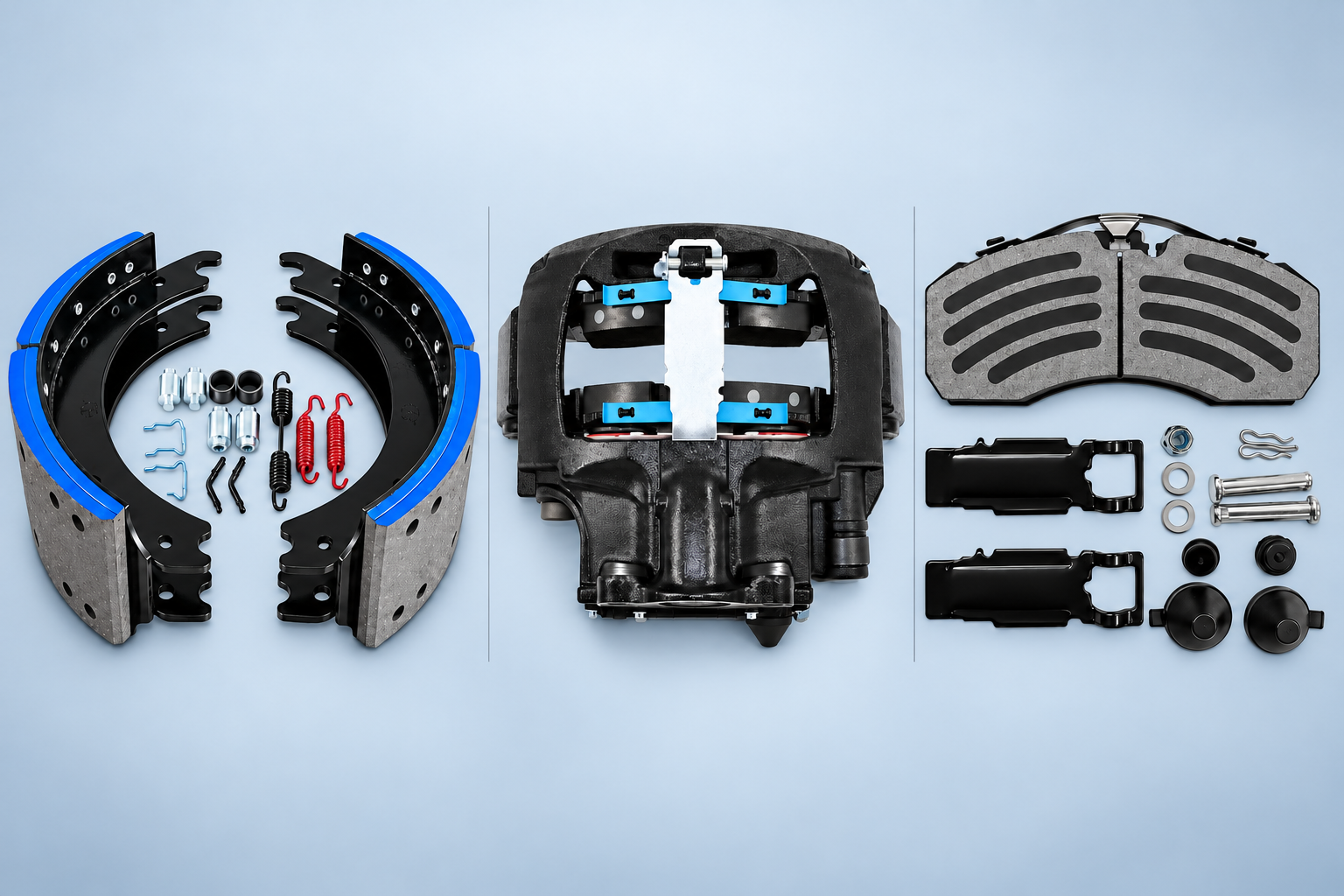

Finding a brake lining manufacturer isn’t difficult. The difficult part is working out which one can actually support your business after the first quotation and sample.
For a commercial vehicle parts distributor, an RFQ might contain dozens or even hundreds of references covering trucks, trailers and buses. Some are WVA numbers, some are OE or FMSI references, and others may come from an old catalog or a physical sample. The applications can be just as varied. A lining used on a long-haul truck doesn’t necessarily face the same conditions as one fitted to a city bus, refuse truck or heavy trailer. So when we talk with buyers about a new brake lining program, price is usually only one part of the conversation. Market compliance, friction performance, material choice, application matching, production consistency and supply capability all matter if the relationship is expected to last.
Check Brake Lining Compliance
Before getting into friction formulas or comparing prices, make sure the product fits the market where you plan to sell it. This sounds obvious, but certification claims can be surprisingly easy to misunderstand. For European replacement brake friction products, UNECE Regulation No. 90 requirements for replacement brake linings are an important reference. If a supplier says its brake linings are ECE R90 approved, don’t stop there. Ask which references are covered and whether the documentation can be matched to the actual products in your RFQ. A factory may produce hundreds of references while an approval applies only to particular products or applications.
The same logic applies in other markets. For OEM-oriented sourcing, IATF 16949 customer-specific requirements are useful when evaluating how a manufacturer handles process control, traceability and corrective action. North America works differently: FMVSS No. 121 establishes braking-system performance requirements for air-braked trucks, buses and trailers; it shouldn’t be presented as a stand-alone brake lining certificate. If you’re sorting through different standards, our guides to brake pad certifications and ECE R90 requirements go into this in more detail. The practical rule is simple: don’t just ask a supplier, “What certificates do you have?” Ask, “What applies to my market and which of my references are actually covered?”
Look at Friction Performance When the Brakes Get Hot
A friction coefficient on a specification sheet doesn’t tell the whole story. Commercial vehicle brakes work across changing loads and temperatures. A highway tractor may spend a long time cruising and then face sustained braking on a descent, while a city bus or refuse truck can go through repeated braking cycles all day. What matters is not simply whether the material has “high friction,” but whether braking remains predictable as the system gets hot.
That’s why repeated braking matters in performance evaluation. The NHTSA FMVSS 121 brake dynamometer procedure, for example, includes repeated brake applications and heating before subsequent performance checks. When you’re comparing suppliers, ask how the material behaves through a test cycle: Does friction change significantly as temperature rises? How does it recover after heating? What wear occurs during the test? A supplier quoting one friction number without explaining the test conditions isn’t giving you much to compare.
We support brake friction development with in-house commercial vehicle brake testing equipment. Having the equipment is useful, but that’s not really the point. What matters is being able to connect application → formulation → prototype → testing → production without sending every technical question somewhere else. If a test result looks unusual, the engineering team can bring that information back into the formulation or production discussion. Our article on brake testing for heavy commercial vehicles explains more about that process.
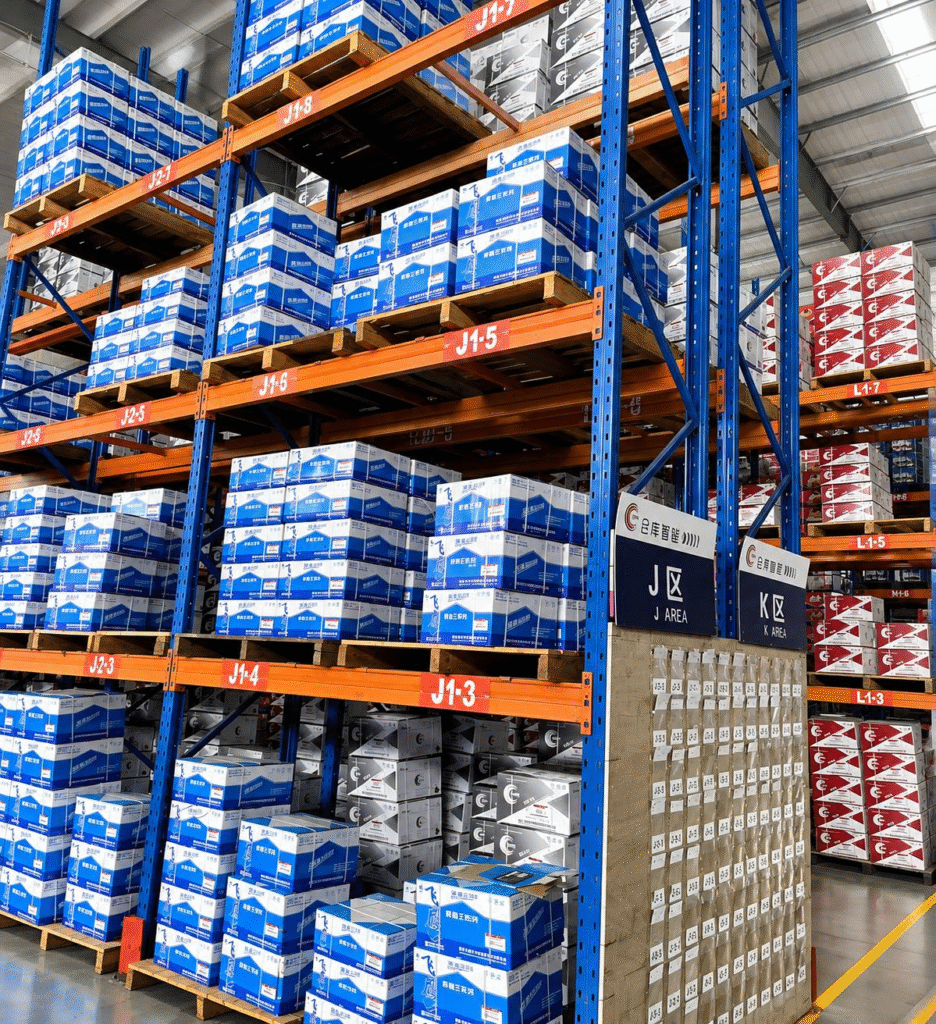
Caption: Finished commercial vehicle brake products stored by reference before order consolidation and shipment.
So instead of asking a manufacturer, “Which is your best brake lining?”, try asking:
“Which formulation would you recommend for this vehicle and duty cycle, and what testing supports that choice?”
You’ll usually learn much more from the answer.
Don’t Look at Brake Lining Wear Alone
“Long life” sounds good in a catalog, but a brake lining doesn’t work by itself. It works against the brake drum, and the wear of both components matters.
A lining can be extremely wear-resistant and still be a poor commercial choice if it is too aggressive against the drum. Friction materials use different combinations of fibers, abrasives, lubricants, fillers and binders, and changing those ingredients affects more than lining life. It can also change heat behavior, friction stability and mating-surface wear. For fleets, the more useful way to think about the cost is lining life + drum life + replacement labor + vehicle downtime. A slightly more expensive lining can make sense if it gives predictable maintenance intervals and doesn’t create unnecessary wear elsewhere in the brake system.
Duty cycle changes the answer as well. The braking pattern of a long-haul truck is very different from a refuse vehicle working through constant stop-and-go cycles. We discussed this in more detail in our guide to heavy-duty brake linings and brake pads for refuse trucks. This is why we’re careful with claims such as “this lining lasts X kilometers.” Without knowing the load, route, brake condition and operating pattern, that number can be misleading. A better question for the supplier is what kind of duty cycle the formulation was developed for and how lining wear and drum wear are evaluated together.
Check What the Brake Lining Is Made For
Material names are useful, but they can also create a false sense of certainty. Two suppliers may both describe a lining as semi-metallic while using very different formulations. The label tells you the general material family; it doesn’t tell you exactly how the product will behave under heat, how quickly it will wear or whether it suits your particular application.
This is where the conversation should move from “What material do you have?” to “What was this formulation designed to do?” A heavy truck running long routes may need a different balance from a bus operating in frequent-stop urban service. The same principle applies across friction products, which is why our comparison of semi-metallic and ceramic friction materials focuses on operating characteristics rather than declaring one material universally better.
For international buyers, asbestos also needs to be treated as a compliance issue rather than just another material claim. The U.S. EPA publishes guidance covering asbestos and automotive brakes and linings. If you’re sourcing non-asbestos brake linings, ask what material declarations, test information or other supporting documentation can be provided for your destination market. “Asbestos free” printed in a catalog is a starting point, not the whole verification process.
Check Brake Lining Production After Sample Approval
Samples usually get plenty of attention. The harder part is keeping the same product when an order moves from a few samples to hundreds or thousands of sets.
Brake lining production connects raw-material control, mixing, forming, curing, grinding, drilling and final inspection. A variation early in that process may not be obvious when you first look at the finished product, but it can show up later as a friction, wear, dimensional or durability issue. From our own manufacturing experience, dimensional accuracy alone isn’t enough. The formulation and key processing conditions also have to remain controlled when the product moves into volume production.
When you visit or audit a factory, don’t spend all your time looking at how many machines it has. Ask how incoming materials are controlled, how production parameters are recorded, what happens when something falls outside specification and whether a finished shipment can be traced back to its production batch. Our overview of the commercial vehicle brake pad manufacturing process shows how these stages connect in friction-product manufacturing. In the end, the goal is pretty straightforward: the product coming off the line six months later should still behave like the sample you approved today.
Check WVA, FMSI and OE Matching Before You Order
This is where a supplier’s actual aftermarket experience becomes easy to see. A typical commercial vehicle RFQ may contain WVA numbers, FMSI references, OE numbers, competitor numbers and sometimes just vehicle information or dimensions. A large cross-reference database helps, but it doesn’t solve every matching problem.
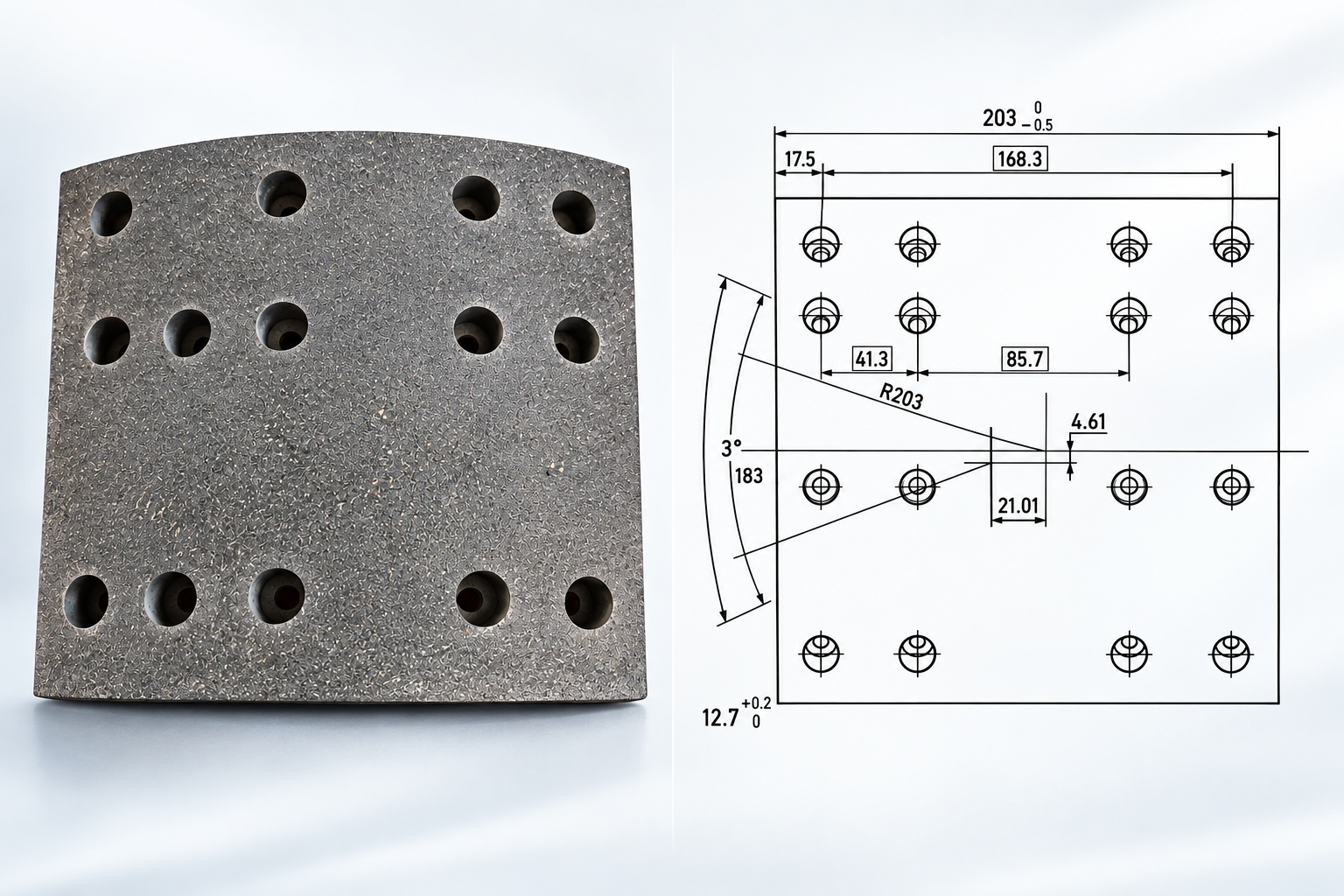
When a reference isn’t certain, we’d rather check it than guess. Dimensions, lining profile, drilling pattern, vehicle or axle application and available OE information can all help confirm the product. For less common applications, a drawing or physical sample may be the safest option before tooling or production begins.
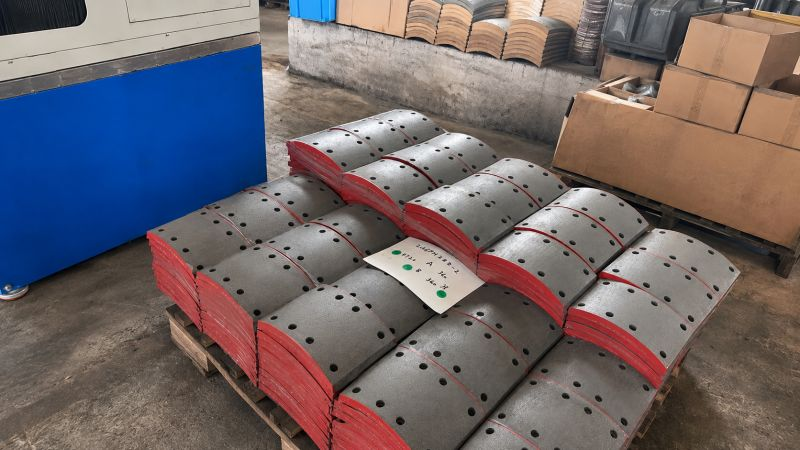
Caption: Commercial vehicle brake linings prepared for production inspection and application matching.
A practical matching path looks something like this:
WVA / FMSI / OE → Dimensions → Vehicle or Axle → Brake System → Drawing or Sample if Needed
For distributors carrying European trucks, Asian commercial vehicles and trailer applications, this becomes especially important. Mercedes-Benz, Volvo, Scania, MAN, BPW, FUWA, HOWO, Hino or Isuzu references may all appear in the same inquiry. What buyers really need isn’t a supplier that says “yes” to every number. They need one that can tell them which matches are confirmed, which need more information and which should be checked against a sample before production.
That can save a lot of trouble compared with discovering a matching error after a container arrives.
Product Range Matters When One RFQ Has 100 References
A distributor rarely buys one brake lining model at a time. One order may contain fast-moving European truck applications, BPW or FUWA trailer linings, Chinese heavy-duty truck references and several slower-moving Japanese models. If every group comes from a different supplier, you’re also managing different MOQs, lead times, packaging rules, quality systems and shipping schedules.
This is where a broader product range can genuinely make purchasing easier. But there is an important difference between catalog coverage and supply capability. A catalog may contain thousands of numbers; that doesn’t mean every reference is already tooled, regularly produced or ready to ship. Ask which models are in regular production, which require a new production run and which still need application confirmation.
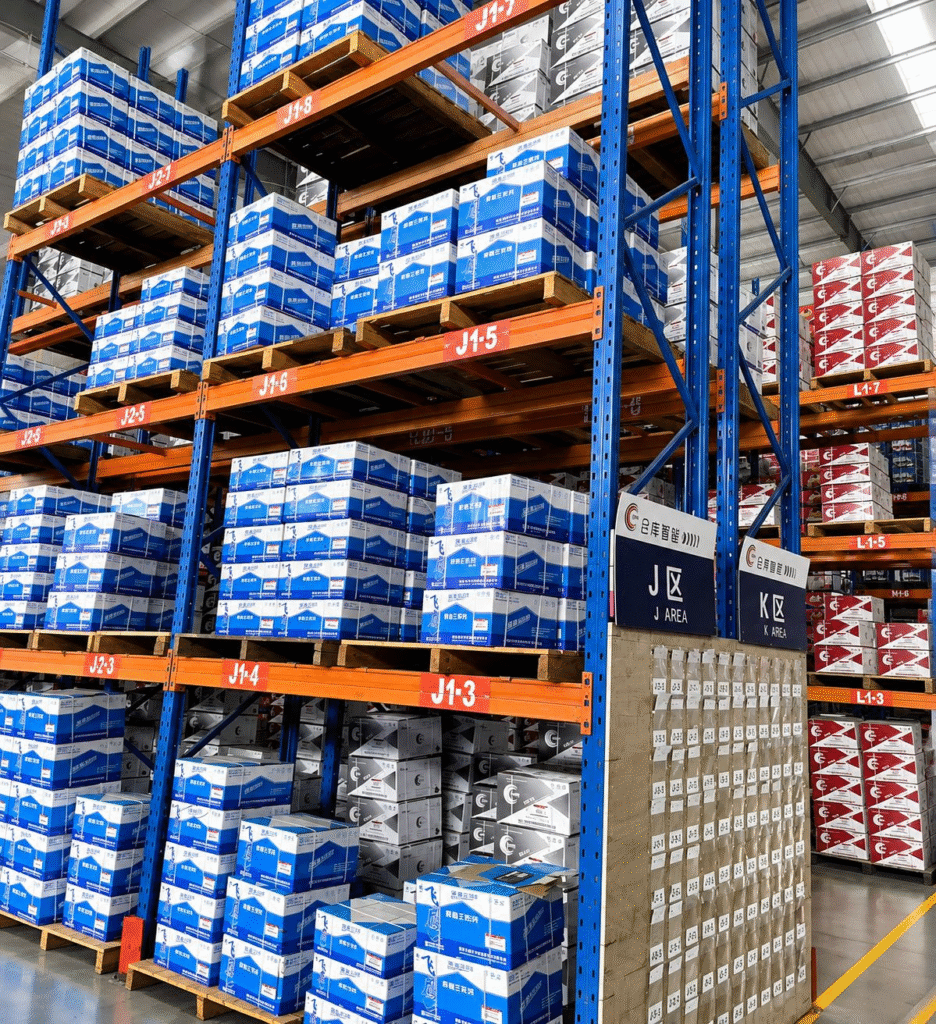
Caption: Finished commercial vehicle brake products organized by reference for order preparation, consolidation and shipment.
This is also where the warehouse tells you something the catalog cannot. Once an order moves from an Excel sheet into actual production and shipment, different references have to be identified, stored, picked and consolidated correctly. For distributors handling a broad application range, that affects order accuracy and replenishment just as much as the number of SKUs shown online. Buyers who are already building a sourcing list can compare it against our current range of commercial vehicle brake linings.
Manufacturer or Trading Company? It Depends on the Order
Buying directly from a factory isn’t automatically better in every situation. If you need a very small quantity immediately or want to combine unrelated brands from different manufacturers, a local distributor or trading company may actually be more convenient.
Direct manufacturer cooperation starts to matter more when you’re dealing with repeat orders, OEM or private-label products, formulation requirements, sample validation or a technical issue that needs investigation. In those situations, being able to speak with the people responsible for engineering and production saves a lot of back-and-forth. Rather than asking only, “Are you a factory?”, ask how a formulation is selected, how an approved sample becomes a production specification, whether batches can be traced and who reviews an abnormal test result. Those questions usually tell you much more. Buyers considering an OEM program can also read our comparison of OEM vs aftermarket brake products for the differences in sourcing requirements.
Watch for Brake Lining Supplier Red Flags
A supplier saying “we need more information” isn’t necessarily a bad sign. Sometimes it’s exactly the answer you want to hear. Commercial vehicle applications are too varied for every part number or performance question to have an instant answer.
I’d be more cautious with a supplier that recommends the same friction formulation for nearly every application, makes certification claims that can’t be tied to actual references, promises an exact service life without knowing the duty cycle, or produces a perfect sample but can’t explain how the same specification will be maintained during mass production. Price works the same way. A low price isn’t the problem; a low price that nobody can explain is. Raw materials, formulation, production control, testing and commercial terms all affect the final cost.
It’s also worth asking about complaints before you have one. How would the supplier investigate a field problem? Can the production batch be identified? Who reviews the application and returned sample? A reliable supplier isn’t one that promises you’ll never have a problem. It’s one that has a sensible way to find out what happened when you do.
MOQ and Lead Time Need to Fit the Whole Product Range
MOQ looks simple on a quotation, but it becomes more complicated when you’re buying 50 or 100 different references. The lowest MOQ for one SKU doesn’t help much if every slow-moving model has to meet the same quantity. For distributors, mixed-model ordering, replenishment planning and packaging flexibility can be just as important as the number printed next to “MOQ.”
The same goes for lead time. A realistic production schedule that is consistently met is more useful than an aggressive promise that keeps slipping. Private-label packaging, neutral cartons and shipment consolidation also need to be discussed early because they affect production planning and inventory. When we look at a long-term brake lining program, the useful calculation isn’t simply the lowest FOB price. It’s closer to product cost + inventory + freight + downtime + quality risk + after-sales support.
Brake Lining Manufacturer Evaluation Checklist
If you’re comparing several suppliers, using the same questions for each one makes the differences much easier to see.
| What to Check | What to Ask | What Should Make You Look Closer |
| Market compliance | Which of my references are covered by the required approval? | Only generic certificates are provided |
| Application matching | Can WVA/FMSI/OE be checked against dimensions and vehicle data? | The match is based on one number only |
| Friction performance | What test data supports this formulation? | Only one friction number is quoted |
| Heat stability | How does the material behave after repeated heating? | “High temperature” with no test context |
| Wear | How are lining wear and drum wear evaluated together? | Only lining lifespan is discussed |
| Material | Why is this formulation recommended for my duty cycle? | The same material is recommended for everything |
| Production | How are mixing, curing and dimensions controlled? | The process can’t be clearly explained |
| Traceability | Can my shipment be traced to a production batch? | There is no clear batch identification |
| Supply | Can different references be consolidated? | MOQ becomes impractical across many SKUs |
| After-sales | How would you investigate a field complaint? | There is no technical review process |
You don’t need a supplier to have a polished sales answer for every row. In fact, I’d rather hear a specific “we need to check this” than a vague “no problem.” What matters is whether the manufacturer can give technically sensible answers and knows when more information or testing is needed.
FAQs for Brake Lining Buyers
What should I send to a brake lining manufacturer for a quote?
If you already have WVA, FMSI or OE numbers, start there and include the quantity and destination market. Vehicle model, axle information, dimensions, drawings and photos are useful when the reference isn’t clear. For uncommon applications, a physical sample can sometimes save more time than exchanging several rounds of catalog information.
What certifications should a brake lining manufacturer have?
There isn’t one certificate that applies to every brake lining in every country. It depends on the product, application and destination market. European replacement products may involve ECE R90, while IATF 16949 can be relevant when you’re evaluating the manufacturer’s automotive quality-management system. The important thing is to connect the requirement to the product you’re actually buying rather than collecting certificate logos.
How do I verify a WVA brake lining number?
Start with the WVA reference, but don’t stop there if anything looks uncertain. Check dimensions, lining profile, drilling pattern, vehicle or axle application and available OE or FMSI information. If those don’t line up clearly, use a drawing or sample before confirming production.
What is a typical MOQ for wholesale brake linings?
It depends on the model, tooling status, formulation, packaging and supplier. If you’re buying many references, ask whether different models can be combined into one practical order. For a distributor, that can be much more useful than getting a very low MOQ on one fast-moving SKU.
How do I compare two heavy-duty brake lining suppliers?
Put the quotations aside for a moment and compare application matching, friction performance, heat behavior, drum wear, compliance documentation, production consistency, product coverage, MOQ, lead time, traceability and after-sales support. Then bring price back into the discussion. The cheapest part isn’t always the lowest-cost sourcing decision.
Choose a Brake Lining Manufacturer That Makes Sourcing Easier
After working through all of this, the decision doesn’t need to be complicated. A good brake lining manufacturer should gradually reduce the amount of work on your side. You should spend less time correcting references, chasing production schedules and trying to work out why one batch behaves differently from another. The supplier should know when a WVA, FMSI or OE match is certain, when more application information is needed, and when a drawing or sample is safer than guessing.
Related reading
- What Should Buyers Look for in a Truck Brake Lining Supplier?
- OEM vs Aftermarket Brake Linings for Commercial Vehicle Distributors
- What Is Brake Lining? Types, Materials and How to Choose
Reviewed by: Robert, Chief Executive Officer, Tuoba Auto Parts
Technical basis: UN ECE Regulation No. 90 · IATF 16949 · FMVSS No. 121 (49 CFR 571.121)
If you’re already comparing suppliers, you probably have a product list sitting in Excel, PDF or your existing catalog. You don’t need to rebuild it for us. Send us the WVA, OE or FMSI list you already use. We’ll first check what can be matched, flag anything that needs more information and let you know where dimensions, a drawing or a physical sample would be safer before quotation.