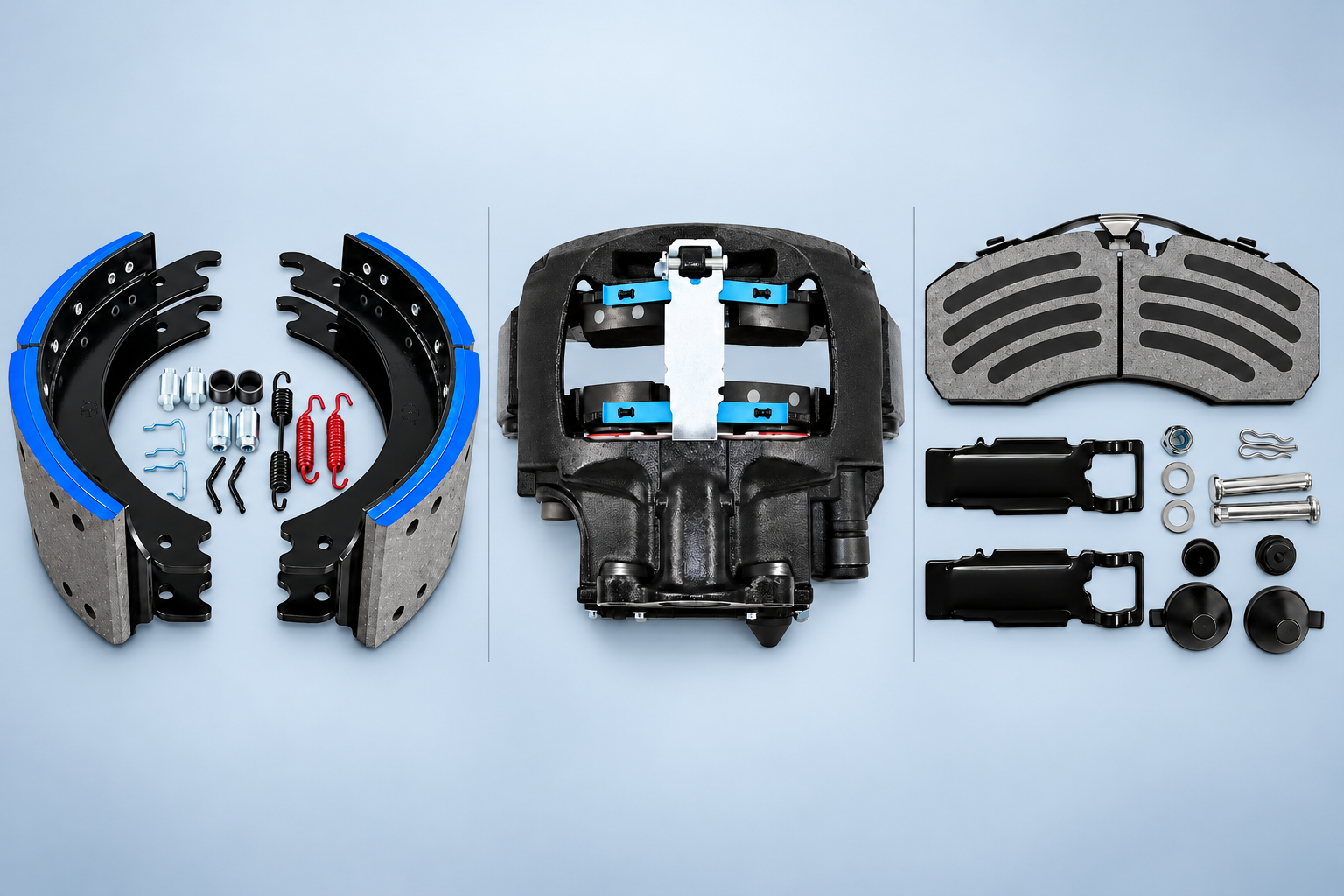
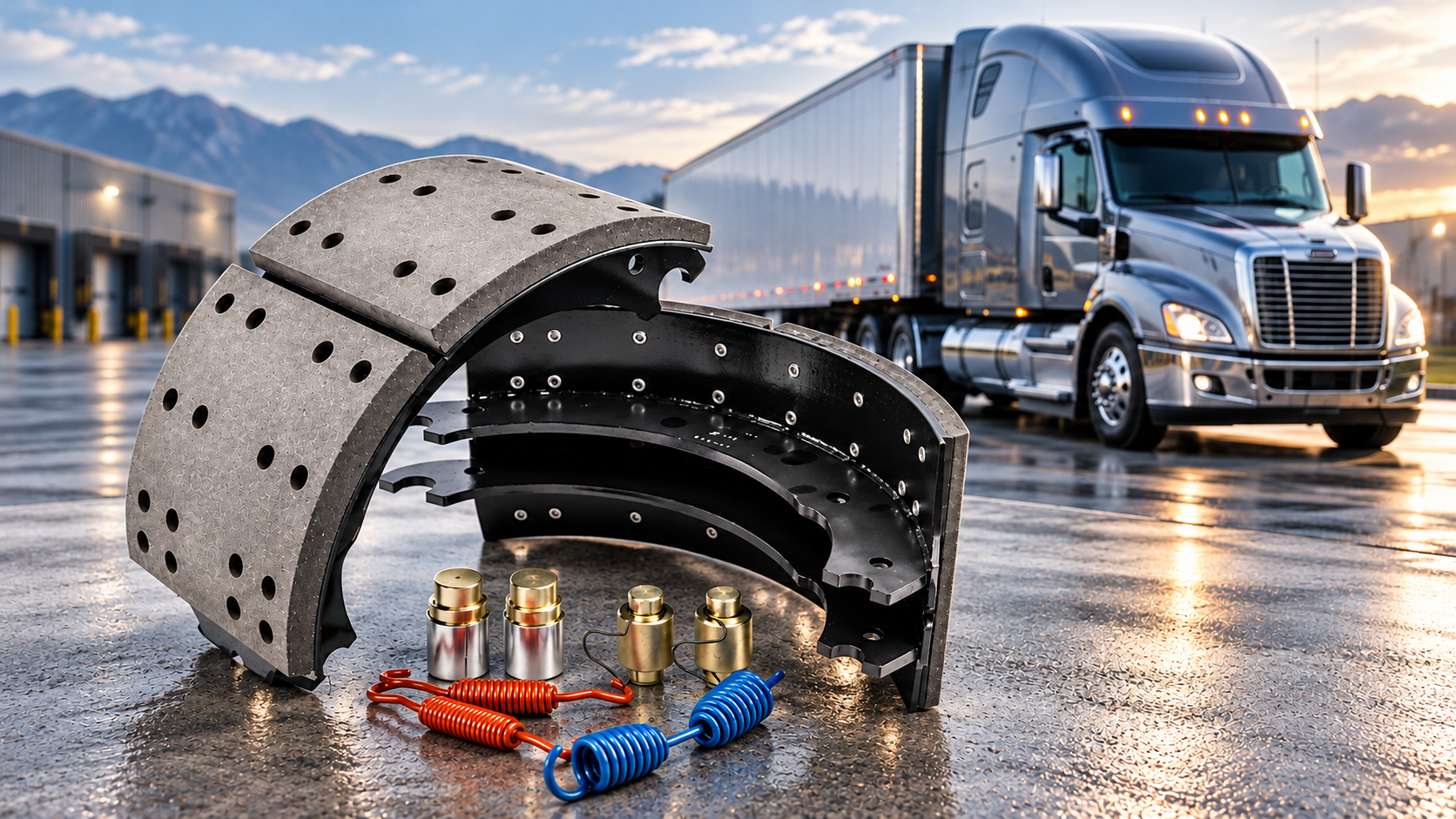
I’m Robert, founder and CEO of TUOBA. When someone asks us for trailer brake shoes or drum brake pads, the first thing I want to know is what they actually need: the friction lining, a complete brake shoe, or a shoe kit with hardware.
These parts are closely related, but they’re not the same. On a heavy-duty trailer with air drum brakes, the friction lining is attached to a curved steel shoe. When the brakes are applied, the shoe pushes the lining against the inside of the drum.
Getting that detail right makes a difference. It helps us check the correct part, avoid misunderstandings in quotations, and make sure the buyer receives what they ordered.
In this guide, I’ll explain the common terms, the difference between new and relined shoes, what friction codes mean, and which specifications to check before buying.
We’re focusing on heavy-duty air-braked trailers here, not the smaller electric drum brakes commonly found on light-duty, boat or RV trailers. For lining and pad options on these trailers, see our semi trailer brake pads page.
Key Takeaways
- Treat “brake pad,” “lining,” “block” and “brake shoe” as separate terms, and write down which one you mean.
- Relined and new shoes are different products. Ask what steel and what lining each quotation includes.
- A friction code labels tested friction. It does not predict braking distance or wear life.
- Specify drum size, lining width, lining material, attachment method and whether hardware is included, not just a part number.
- Ask for test documentation that names the exact lining and the conditions used.
Are Trailer Brake Shoes, Linings, Blocks and Drum Brake Pads the Same Thing?
No. A brake shoe is the curved steel carrier that pushes outward against the inside of a drum, while a brake pad is the friction part of a disc brake that clamps inward on a rotor. “Drum brake pad” is a loose term that usually means either the lining or the complete lined shoe, so I always recommend checking what a quotation actually includes.
I use “bare brake shoe” for the unlined steel carrier and “lining” or “block” for the friction material. Disc brakes use pads on a backing plate, which is why the word travels into drum-brake conversations. In a drum brake, the friction material sits on a curved shoe and presses outward against the drum. The federal thickness rule reflects the split by using the heading “Linings and pads” in 49 CFR 393.47(d). That paragraph sets minimum thickness only; it does not define part names for purchasing.
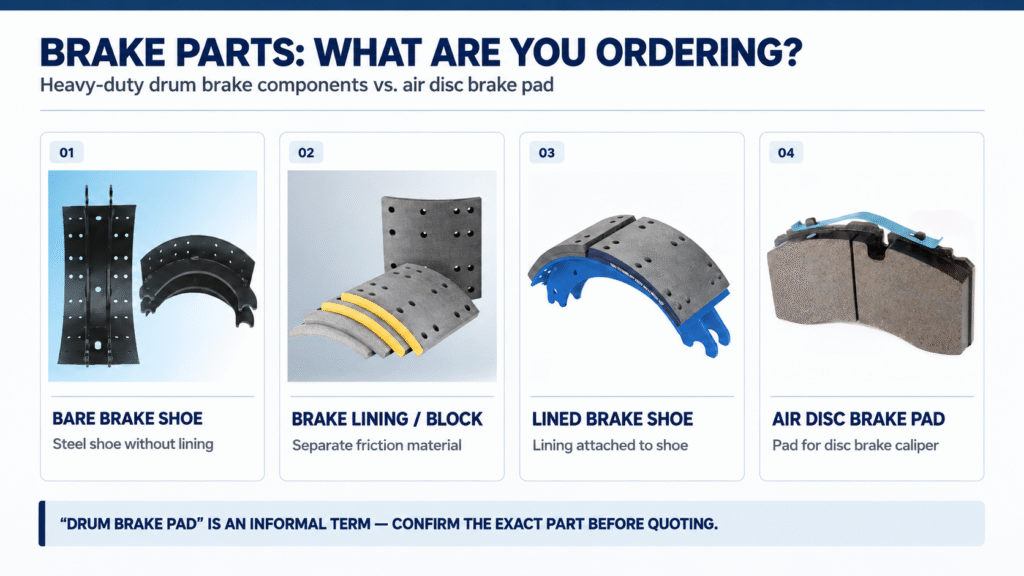
Here’s what these terms mean when you’re ordering:
- Bare brake shoe: The unlined steel shoe frame (the carrier), including the table and web that carry the lining and ride on the anchor and cam.
- Brake lining or lining block: The drum-brake friction material, supplied as a segment or a pair of blocks per shoe.
- Lined brake shoe: A brake shoe with the lining attached, ready to install.
- Brake shoe kit: Parts supplied together, which may include fitting hardware. Confirm the exact contents on the quotation or packing list.
- Drum brake pad: An informal buying term. Clarify exactly which item is meant.
Before placing an order, ask the supplier to confirm whether the quoted price covers the steel shoe, the loose lining, the complete lined shoe, or a kit with hardware.
What Separates a Relined Trailer Brake Shoe from a New One?
The difference is in the steel shoe. A relined shoe pairs a previously used steel shoe with new friction lining; a new shoe starts with new steel. At TUOBA, we sell new brake shoes only, but the distinction matters when you compare quotations.
New doesn’t automatically mean better, and relined doesn’t automatically mean poor quality. The lining formulation, steel condition, manufacturing quality and operating conditions all matter. If you’re comparing a relined product from another source with a new one, ask for the inspection criteria and supporting documents.
Table 1. Relined versus new shoes: what to confirm
| Item | Relined shoe | New shoe |
|---|---|---|
| Steel shoe | Reused; ask how it was inspected and sorted | New; ask for material and finish details |
| Lining | New lining fitted to the used shoe | New lining fitted to new steel |
| What to request | Inspection criteria and any rejection rules | Specification sheet for the shoe and lining |
| Shared requirement | Lining documentation that names the exact part | Lining documentation that names the exact part |
For relined shoes, ask how the reused steel is inspected and when it is rejected, whether the steel and lining materials and dimensions match the original specification, how the lining is installed, and what traceability documents are available. For new shoes, confirm the design, dimensions and lining specification against your existing part or drawing.
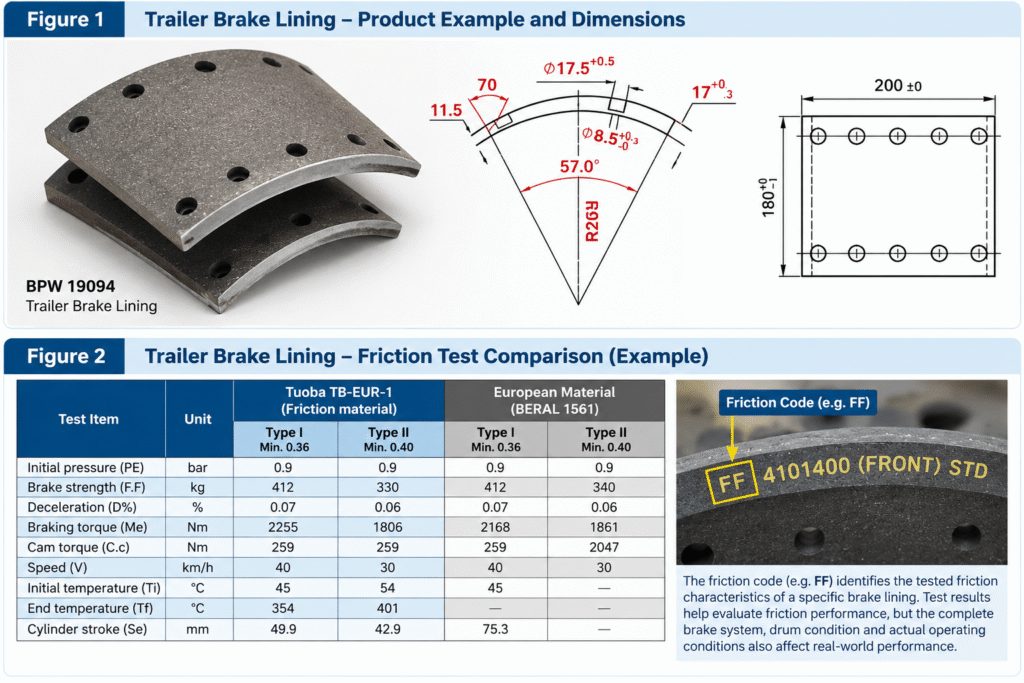
How Should You Read a Friction Code on a Trailer Brake Lining?
A friction code can tell us something about a lining, but it doesn’t tell the whole story. Test results help identify friction characteristics, but the complete brake system, drum condition and real operating conditions still matter.
SAE J866 is a recommended practice for identifying brake-lining friction characteristics and certain environmental information. Its scope refers to friction data from SAE J661 and elemental measurements from SAE J2975. The standard is listed as “Stabilized.” A J866 friction code does not set minimum braking-performance requirements, and it does not reliably predict performance in a complete brake system.
For example, an “FF” marking uses two letters to describe friction-coefficient classifications measured under the applicable test procedure. In the commonly published J866 code table, “F” corresponds to a tested average friction-coefficient band above 0.35 and up to 0.45. The code does not tell you how long a lining will last, how a complete brake system will stop, or whether a material is suitable for your specific axle. Ask your supplier for the report and the matching lining reference.
When you see a friction code on a quotation, look at four things:
- The code itself: It labels tested friction, not wear life or stopping distance.
- The test behind it: Ask which procedure and conditions produced the label.
- The lining it names: The code belongs to a specific lining, not to every product from that supplier.
- The brake it will run on: Drum size and duty cycle still have to match.
Ask for the relevant test report, and check that the material identification and test conditions match the product being quoted. A report for a different formulation should not be presented as proof for your part.
What Should a Semi Trailer Brake Shoe Specification Include?
When someone sends only a part number, I confirm the drum diameter, lining width, shoe design, friction material, attachment method and kit contents before quoting. A part number helps, but similar numbers can hide design differences, so a drawing or clear photos can prevent an expensive mismatch.
Common heavy-duty trailer shoe designations include 4515, 4707 and 4709. They look alike on a parts list but are not interchangeable by name alone, so confirm dimensions and the shoe design before ordering. For the differences, see our comparison of 4515, 4707 and 4709 brake shoes.
FMVSS No. 121 sets performance and equipment requirements for covered air-braked vehicles. It does not serve as an individual approval certificate for a replacement brake lining. Ask which brake configuration was tested and whether the available evidence applies to the exact part you’re buying.
Table 2. Specification checklist for trailer brake shoes
| Item | Why it matters | What to send or ask |
|---|---|---|
| Drum diameter and lining width | Wrong size will not fit the brake | Measurements from the existing shoe or drum |
| Shoe design or part number | Similar shoes can differ in key features | Part number and a photo of the old shoe |
| Lining material | Duty cycle drives the choice | Supplier’s intended-use statement |
| Attachment method | Riveted and bonded linings are built differently | Method stated on the quote |
| Kit contents | A quote for shoes only cannot be compared with a kit that includes hardware | Whether springs, rollers or other hardware are included, listed item by item |
| Shoe condition | Relined and new shoes are not the same product | “Relined” or “new” written on the quote |
| Test documentation | Evidence has to match the exact part | Report naming lining, method and conditions |
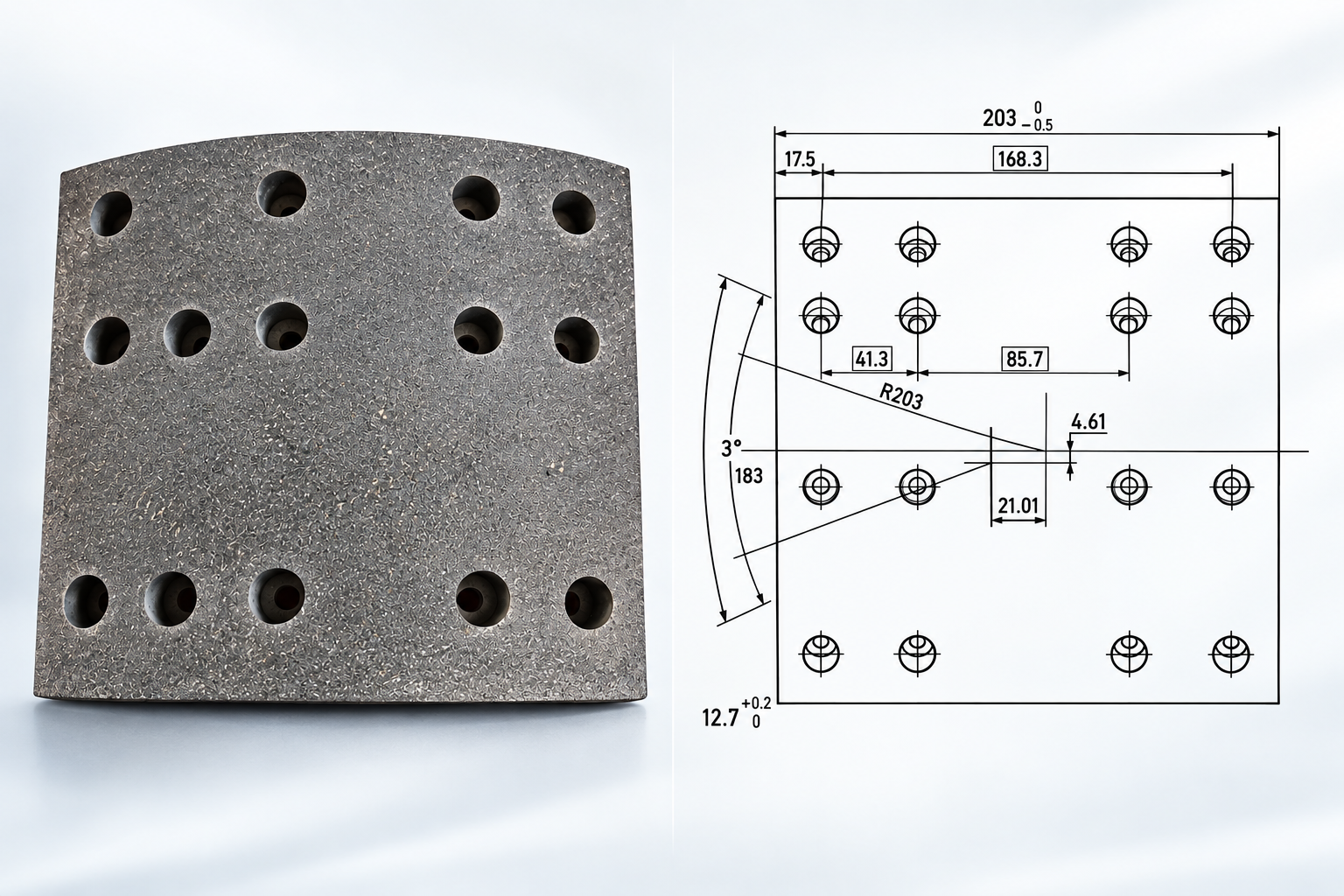
Friction lining dimensions are another important reference when verifying replacement brake components. The example below shows dimensional differences between three WVA lining references.
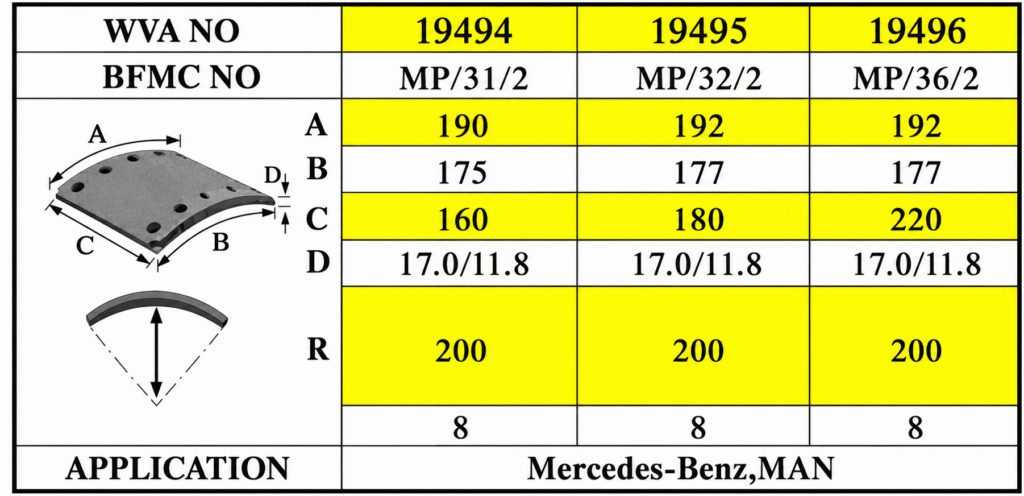
For example, you can send us: “Heavy-duty air-braked semi trailer; drum diameter: [confirmed size]; lining width: [confirmed width]; shoe reference: [part number]; attachment method: [riveted/bonded]; kit contents: [shoes only / with hardware]; condition: new. Please confirm compatibility and the available technical documentation.”
Our reference images include different shoe designs, such as 4551 FUWA 16T, 4515 FUWA 13T, BPW220 and 4311 E-1. Those pictures help identify the design, but check dimensions and reference numbers before confirming a match. You can also browse our heavy-duty drum brake shoes category.
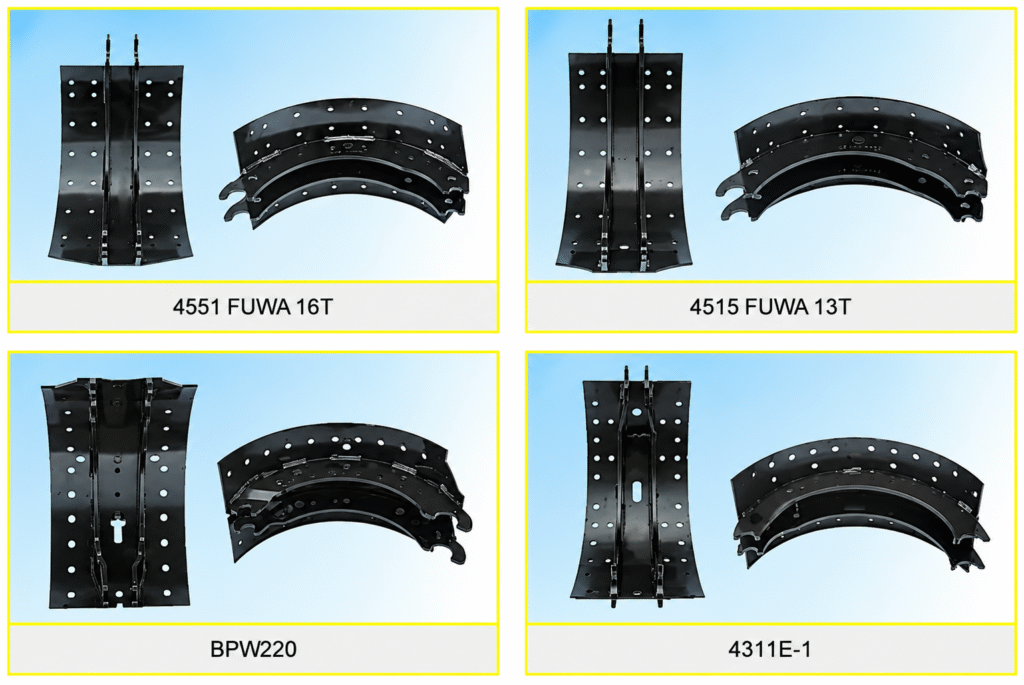
Figure 3. Examples of brake shoe designs: 4551 FUWA 16T, 4515 FUWA 13T, BPW220 and 4311 E-1. Confirm exact fitment and dimensions before ordering.
The more details you share upfront, the easier it is to find the right match. Tell us whether you need a lining, a complete shoe or a kit with hardware, share your drum size, lining width, part reference and attachment method, and send photos or a drawing when possible. We’ll review the product match and tell you which supporting documents are available. A friction code can be useful, but it should never replace checking the actual brake application.
FAQ
Are drum brake pads and brake shoes the same part?
Not exactly. The shoe is the steel carrier, and the lining is the friction material attached to it. “Drum brake pad” is a loose term, so ask the supplier to name the exact part.
When should heavy-duty trailer brake shoes be replaced?
For a typical non-steering, air-braked semi-trailer axle with drum brakes, 49 CFR 393.47(d)(2) sets a minimum lining thickness of 6.4 mm (1/4 in), measured at the shoe center, or the applicable wear-indicator threshold where provided. This is an operating minimum, not a recommended replacement point. Follow the brake manufacturer’s service instructions and arrange replacement before components reach an unsafe condition. I also wouldn’t keep a lining that is cracked or coming away from the steel, whatever its thickness. Drum wear has its own limit, set by the drum manufacturer.
Is a relined trailer brake shoe lower quality than a new one?
Not necessarily. I would ask how the reused steel was inspected and which lining was fitted. Compare the supporting evidence, not just the label.
Does a friction code tell me how long a lining will last?
No. A friction code labels tested friction, not wear life or stopping distance. System design and operating conditions also affect results, so use the code only to compare like with like.
Can I order trailer brake shoes by part number alone?
I wouldn’t recommend it. Similar part numbers can still hide design differences. Please send us the drum diameter, lining width, attachment details, kit contents, and a photo or drawing so we can check the new shoe against your reference.
Does mentioning FMVSS 121 mean a lining is approved?
Not by itself. FMVSS No. 121 is a vehicle-level performance standard. Ask for documentation that names the exact lining, the test method and the conditions it was tested under.
How do I measure a trailer brake shoe?
Record the brake drum’s specified nominal diameter, the lining width, and the shoe reference or design. If you are measuring an in-service drum, remember that its actual internal diameter may differ from the nominal size because of wear. Send clear photos and part markings so the supplier can confirm compatibility.
Related reading
- 4515 vs 4707 vs 4709 Brake Shoes: Which One Fits Your Brake?
- Heavy-Duty Drum Brake Shoes
- Semi Trailer Brake Pads: Types, Specifications, and B2B Sourcing Guide
- OEM vs Private Label Brake Pads: Which Option Fits Your Business?
Reviewed by: Robert, Chief Executive Officer, Tuoba Auto Parts
Technical basis: 49 CFR 393.47, eCFR · SAE J866, SAE Mobilus · 49 CFR 571.121 (FMVSS No. 121), Cornell LII
Need New Trailer Brake Shoes for Your Application?
Send us your brake shoe reference, drum diameter, lining width, attachment method, required quantity and any available drawings or photos.
At TUOBA, we supply new brake shoes for heavy-duty applications. Our team can help review your specifications, check available product options and provide the relevant documentation for your inquiry.