When buyers search for the top brake pad manufacturers, they often find the same familiar global brands. But for a distributor, fleet operator, private-label brand owner, or OEM buyer, brand recognition is only one part of the sourcing decision. Production capability, friction technology, testing, compliance, supply stability, and long-term consistency matter just as much.
This guide compares well-known brake pad manufacturers and brands from a professional buyer’s perspective. Rather than ranking them by popularity, we look at where different manufacturers are positioned and, more importantly, what buyers should check before selecting a long-term brake pad supplier. We’ll first look at ten established names commonly seen in the global aftermarket, then move beyond the brand name to compare manufacturing capability, friction material development, testing, certification, application support, and OEM or private-label capability. These are the areas that usually matter most when a sourcing discussion turns into a long-term supply program.
“The best brake pad manufacturer is not always the most famous brand — but the supplier that delivers stable performance and predictable supply.”
This isn’t a popularity contest. It’s a sourcing decision — and the wrong call shows up later as warranty claims, fleet downtime, and lost customers.
Why Choosing the Right Brake Pad Manufacturer Matters
The global brake aftermarket has changed. Buyers are no longer evaluating suppliers on brand recognition and price alone. Product consistency, application coverage, compliance, lead time, technical support, and the ability to respond when a quality issue occurs can have a much greater effect on the long-term cost of a sourcing program.
For distributors and aftermarket buyers, the pressure now comes from several directions at once. Customers expect better braking performance and fewer noise or wear complaints, while regulatory and documentation requirements continue to develop across major markets. At the same time, buyers are under constant pressure to control purchasing cost without creating additional warranty or return costs later. Third, the cost gap between a “premium-branded” pad and an equally well-engineered private-label pad has widened to the point where many buyers can no longer justify the premium without a measurable performance reason.
When you choose the wrong brake pad brand for a given market, the consequences arrive quickly:
- Noise complaints — the single most common reason customers reject a pad, even when stopping performance is acceptable.
- Thermal fade — pads that work fine in flat city driving but lose effectiveness on grades or under repeated heavy braking, which is why proper brake pad testing for heavy commercial vehicles matters.
- Premature wear — short pad life that erodes your customers’ trust faster than any marketing claim can rebuild it.
- Higher return rates — which destroy margin on platforms like Amazon, eBay, and regional B2B marketplaces.
- Fleet maintenance overruns — when inconsistent pads force unscheduled service, the total cost of ownership balloons regardless of the unit price.
This is why which brake pads are best isn’t really the right question. The right question is: which brake pad is best for your specific market, vehicle parc, and duty cycle? Some popular brake pad brands are excellent for daily-driver sedans but unsuitable for heavy-duty commercial vehicles. Others excel in cold climates but disappoint in mountain or desert conditions.
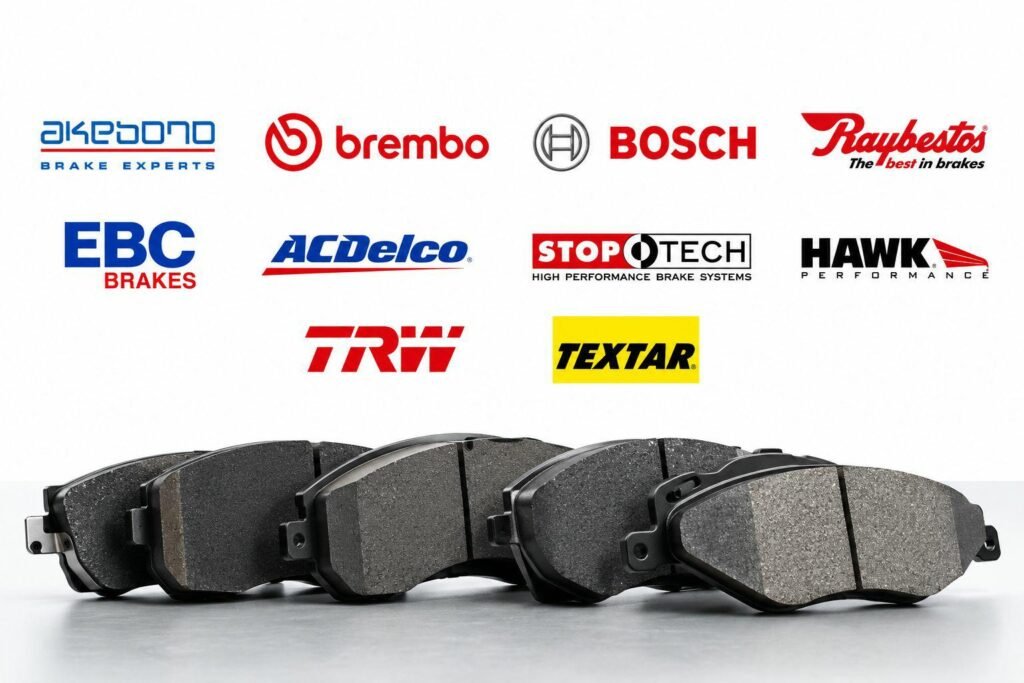
Top 10 Brake Pad Brands Commonly Recognized in the Global Aftermarket
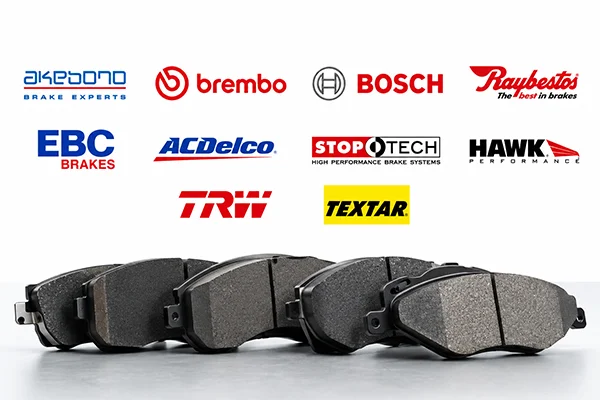
The following companies are established names in the global brake market and provide useful benchmarks for buyers comparing brake pad manufacturers. Rather than treating this as a simple ranking, it is more useful to look at each company’s market position, product focus, application strengths, and relevance to different sourcing requirements.
1. Akebono
Akebono is the reference point for OE-grade ceramic technology. The Japanese manufacturer supplies original equipment to Toyota, Honda, GM, Nissan, and several other major OEMs, and its aftermarket ProACT and Performance lines inherit that engineering DNA.
- Strengths: very low dust, low noise, consistent friction coefficient in city and highway use, exceptional rotor friendliness.
- Best fit: Japanese and American passenger vehicles, premium daily-driver replacement.
- Watch-outs: premium pricing; not the strongest choice for sustained mountain descents or heavy towing.
2. Brembo
If you’re sourcing for performance or premium segments, Brembo is the brand customers ask for by name. The Italian system supplier covers everything from OE supply to professional motorsport, and its high-temperature compounds are engineered for sustained thermal load.
- Strengths: excellent fade resistance, precise pedal modulation, strong NVH control across performance ranges.
- Best fit: sport sedans, European luxury vehicles, performance street applications.
- Watch-outs: premium pricing across the line; rotor-pad matching and proper bedding are essential to realize the performance.
3. Bosch
Bosch is the broad-line workhorse of the global aftermarket. Its QuietCast and Blue Disc lines emphasize NVH, and its global distribution depth is among the strongest in the industry.
- Strengths: wide vehicle coverage, stable quality across regions, mature NVH engineering.
- Best fit: general aftermarket distributors needing breadth and reliability across mixed car parks.
- Watch-outs: regional product lines differ — confirm country of origin and friction compound before stocking.
4. Raybestos
A century-old American brand operating under First Brands Group, Raybestos covers everything from replacement-grade pads to its Element3 hybrid compound and specialty Truck & Tow lines.
- Strengths: broad fitment depth, clear good-better-best tiering, strong North American technical documentation.
- Best fit: North American aftermarket and light truck/towing applications.
- Watch-outs: product line tiering can be confusing for new buyers — make sure your channel is selling the tier you priced.
5. EBC Brakes
EBC’s tiered color-coded ranges (Green, Red, Yellow, Blue) give enthusiasts and tuners a clear upgrade path. The British manufacturer is well known for strong initial bite and elevated thermal headroom.
- Strengths: identifiable performance tiering, strong heat capacity, recognizable enthusiast brand.
- Best fit: enthusiast upgrades, light track use, motorcycle and performance segments.
- Watch-outs: some series produce more cold dust and noise; positioning is mid-to-high price.
6. ACDelco
ACDelco is the GM-affiliated aftermarket brand and remains the default replacement choice for many GM vehicle owners. Its Gold and Silver ceramic lines target balanced OE-equivalent performance.
- Strengths: trusted by GM service channels, broad GM application coverage, predictable replacement-grade performance.
- Best fit: North American service workshops and GM-heavy markets.
- Watch-outs: primarily oriented to a specific vehicle parc — narrower fit for European or Japanese-heavy markets.
7. StopTech
StopTech (part of the Centric Parts group) focuses on performance street and entry-level track use. Its Sport line is widely respected for street-driven upgrade builds.
- Strengths: strong cold bite, controlled heat behavior, accessible performance positioning.
- Best fit: performance street, autocross, light track use.
- Watch-outs: not engineered for sustained endurance racing; pair with the right rotor.
8. Hawk Performance
Hawk is an enthusiast-favorite specifically because it offers a clearly defined compound ladder — from street HPS to motorsport DTC series — letting buyers match a pad to a specific duty cycle.
- Strengths: clearly differentiated compounds, strong reputation in autocross and club racing.
- Best fit: track-day buyers, performance specialty shops, vehicles built for spirited driving.
- Watch-outs: higher-grade compounds produce significant cold noise and dust — not suitable as a daily-driver pad.
9. TRW
TRW (now part of ZF Aftermarket) carries deep European OE heritage and is one of the broadest replacement-pad ranges across European passenger and light commercial vehicles.
- Strengths: strong European fitment depth, stable quality control, balanced value positioning.
- Best fit: European aftermarket distributors and workshops.
- Watch-outs: confirm regional line differences and batch origins, especially when sourcing for non-EU markets.
10. Textar
Textar (under TMD Friction) is one of the oldest European brake pad names and supplies extensively to OE programs in Germany and across Europe.
- Strengths: mature compound engineering, refined NVH behavior, strong OE-equivalent positioning.
- Best fit: European premium vehicles where customers expect OE-level refinement.
- Watch-outs: priced above economy lines; choose the correct program for each model.
These companies provide useful reference points, but they do not represent every sourcing option available to professional buyers. Depending on the market, a distributor may work with an established global brand, a regional specialist, or a direct brake pad manufacturer supporting OEM and private-label production. The important question is not simply how well known the name is, but whether the supplier can meet the required product, quality, cost, and supply targets consistently.
Why More Buyers Are Sourcing Directly from Brake Pad Manufacturers
More distributors, fleet operators, and aftermarket brands are now evaluating brake pad manufacturers directly, particularly when they need better cost control, private-label support, broader application coverage, or formulations developed for specific operating conditions. For these buyers, the sourcing decision is moving from “Which brand should we stock?” toward “Which manufacturer can support the product program we want to build?”
As a result, search behavior across the industry has changed as well. Buyers are increasingly searching for terms such as:
- brake pad factory
- china brake pad manufacturer
- OEM brake pad suppliers
- custom brake pads manufacturer
This shift isn’t about lowering standards. It’s driven by commercial reality.
Cost Pressure Is Structural
Price pressure is no longer limited to low-cost segments. Online price transparency, regional distributors, cross-border sourcing, and increasingly direct access to manufacturers have made it much easier for buyers to compare similar brake pad references across different supply channels. At the same time, distributors still have to absorb freight, warehousing, sales commissions, warranty costs, and increasingly expensive local operations. The margin available between factory cost and market price is being squeezed from both sides.
That changes the sourcing calculation. Buyers are looking more closely at what they are actually paying for: the product, the brand, the distribution structure, or a combination of all three. An established brand can justify a premium through market recognition, application coverage, technical support, and customer confidence. But where the buyer already owns the sales channel and customer relationship, sourcing directly from a capable manufacturer can give them more room to control both product specification and margin.
Brand Premiums Do Not Always Reflect the Same Performance Gap
A higher-priced brake pad may offer genuine advantages, but price alone does not tell a buyer how large the performance difference actually is. Friction stability, fade and recovery, wear, noise, rotor interaction, and temperature behavior need to be evaluated against the intended application rather than inferred from the name printed on the box.
This is where controlled testing becomes useful. For replacement products covered by ECE R90, performance is evaluated against the corresponding original replacement assembly under defined test requirements; it is not simply a matter of claiming that two pads use a similar friction coefficient. For distributors developing private-label products, dynamometer testing and benchmark comparison provide a much stronger basis for deciding whether a formulation is suitable for the intended market.
Customization Needs Have Multiplied
The same brake pad reference may be sold into very different operating conditions. A passenger vehicle in Northern Europe, a taxi working continuously in a hot Middle Eastern city, and a commercial vehicle operating under repeated heavy loads do not place exactly the same demands on friction material. Noise expectations, dust, wear rate, temperature resistance, braking feel, and cost priorities can also vary between markets.
That is why more buyers are moving beyond catalog-based sourcing. They may need a different friction formulation, shim configuration, backing plate specification, product marking, packaging, or performance target for a particular market. A manufacturer that can discuss these requirements with the buyer and validate the resulting sample offers something fundamentally different from a supplier simply selling an existing reference.
Private-Label Programs Are Becoming More Strategic
For distributors with an established customer base, private label creates an opportunity to build value around their own name rather than competing only on someone else’s brand and pricing structure. It also gives them more control over product positioning: one range may target price-sensitive aftermarket customers, while another may focus on lower noise, longer wear, commercial applications, or a specific regional vehicle parc.
But owning the box also means owning the customer experience. If friction performance changes between batches, part numbers are inconsistent, packaging information is wrong, or repeat orders do not match the approved sample, the distributor’s brand takes the complaint. This is why buyers evaluating OEM vs private-label brake pads increasingly need to look beyond unit price and ask how the manufacturer controls formulation, testing, traceability, packaging, and repeat production.
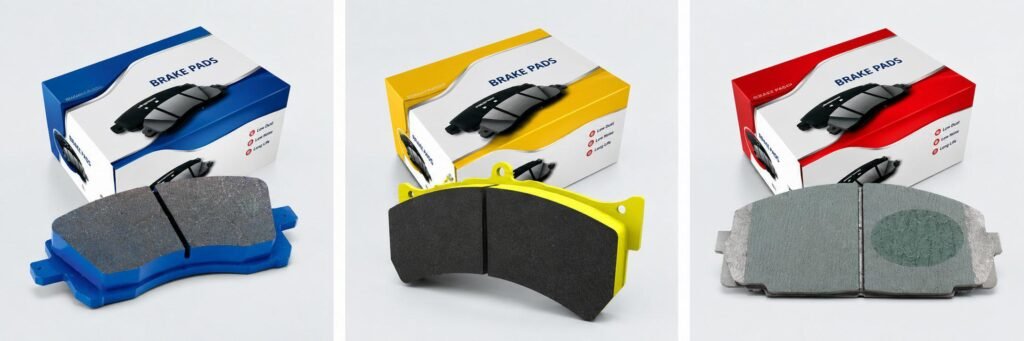
E-commerce Demands Platform-Ready Supply
Selling brake pads online creates a different set of requirements from supplying a traditional parts counter. Accurate OE/FMSI/WVA references and fitment data matter because a wrong application can quickly turn into a return. Barcodes, labels, product images, packaging information, and stable SKU management also need to remain consistent as the catalog grows. When hundreds of references are involved, these details become part of the supply chain rather than simply a marketing task.
Replenishment speed matters as well. Online sales can make demand less predictable, and a fast-moving reference that stays out of stock for several weeks can lose ranking, sales, and repeat customers. For distributors building their own online channels, the manufacturer therefore needs to support more than the brake pad itself. Reliable product data, consistent packaging, manageable MOQs, stable production, and repeat-order availability all affect how successfully the range can be sold and expanded.
More Choice Means Buyers Need to Evaluate the Factory Behind the Product
None of this reduces the value of established brake manufacturers. Global brands still bring strong application coverage, technical experience, distribution networks, and market recognition. What has changed is that buyers now have more credible sourcing models available to them. A distributor can carry an established brand, develop a private-label range with a direct manufacturer, or use both for different parts of the market.
That makes supplier evaluation more important. Once buyers move beyond the brand label, they need to understand who develops the friction material, how samples are tested, how specifications are controlled in mass production, whether batches can be traced, and what happens when a product or application problem appears after delivery.
The question is no longer simply which brake pad brand is better, but which manufacturing model gives the buyer the right balance of product performance, cost, control, and long-term supply.
How Professional Buyers Evaluate a Brake Pad Manufacturer
Once brand recognition is taken out of the equation, buyers need a practical way to judge whether a brake pad manufacturer can support the business behind the product. Four areas usually reveal much more than a catalog or quotation: production stability, friction material capability, compliance and testing, and application-based validation.
Production Capacity and Supply Stability
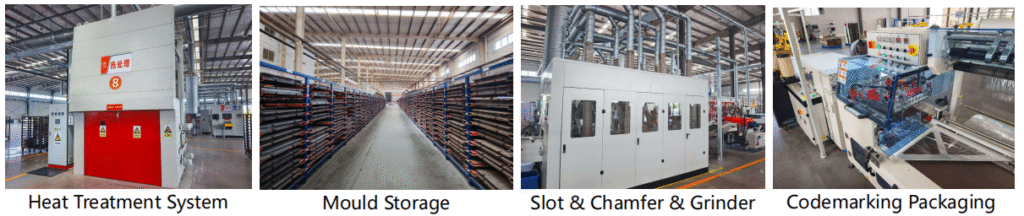
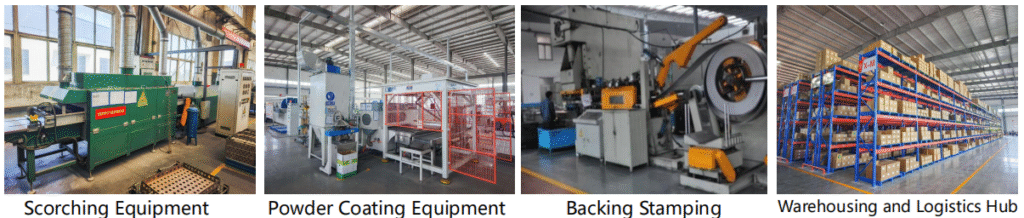
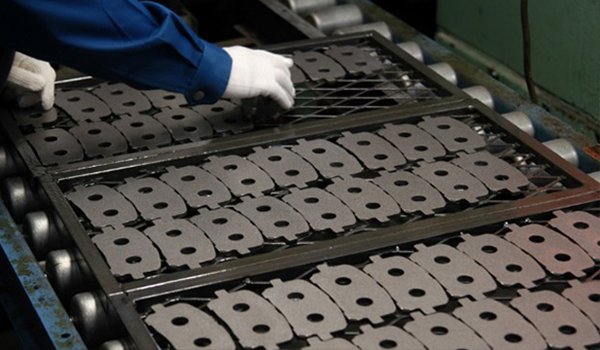
When you commit to a supplier for a multi-year program, capacity matters as much as quality. A factory that can produce excellent samples but can’t scale to your peak season volumes will hurt you more than a slightly less impressive factory that delivers every month.
Look for:
- Automation level — automated weighing, mixing, and pressing produce far more consistent batches than manual lines.
- Multi-formulation capability — whether the factory can run ceramic, semi-metallic, and low-metallic compounds without cross-contamination.
- Batch-to-batch consistency — ideally backed by SPC (Statistical Process Control) records you can review.
- Peak-season lead times — what the supplier delivers in March is interesting; what they deliver in October during peak global ordering is far more telling.
Production capacity becomes especially important when a program moves from samples to repeat orders across multiple references. Buyers should therefore look beyond the factory’s stated annual capacity and ask about actual output, available production lines, peak-season lead times, and whether the approved specification can be maintained as order volume increases.
Friction Material R&D and Formulation Capability
A real brake pad manufacturer is, fundamentally, a friction material company. “Pressing and packaging are commodity steps; formulation is where real brake pad technology and engineering value live.”
When you evaluate this capability, ask whether the supplier has in-house development across:
- Ceramic compounds — quiet operation, low dust, premium daily-driver and Japanese/American passenger applications.
- Semi-metallic compounds — strong heat capacity, durability under load, common across European and commercial vehicles.
- Low-metallic compounds — a balanced middle ground favored in many European OE programs.
- Fleet-specific formulations — engineered for predictable wear, lower maintenance cycles, and reduced downtime.
- Towing and heavy-load applications — formulations that maintain friction stability under sustained thermal load.
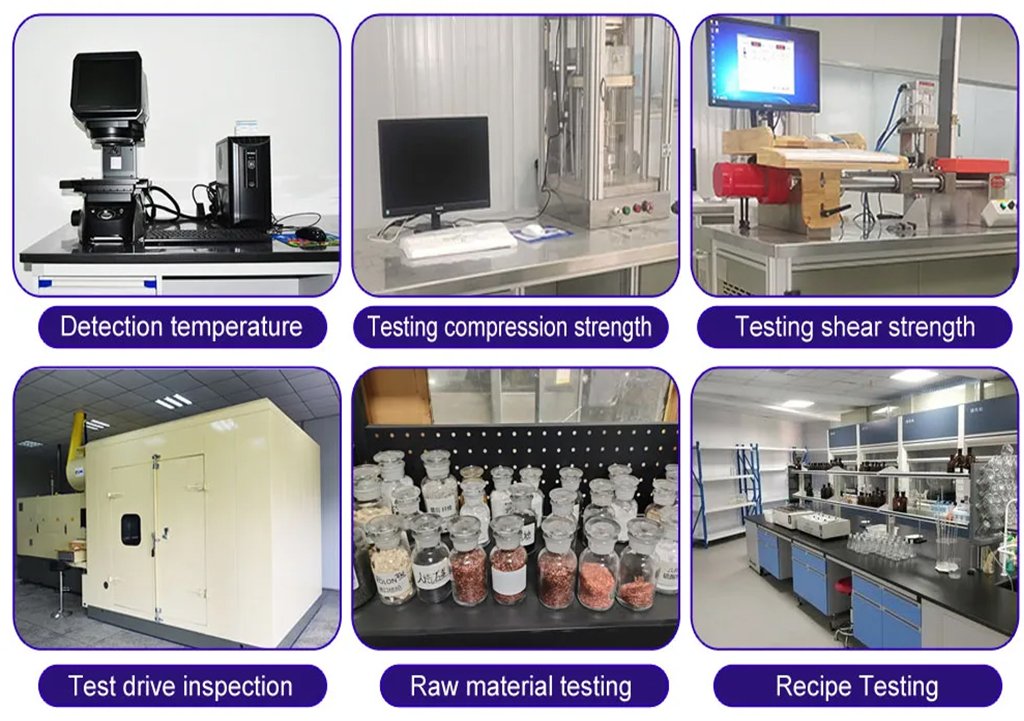
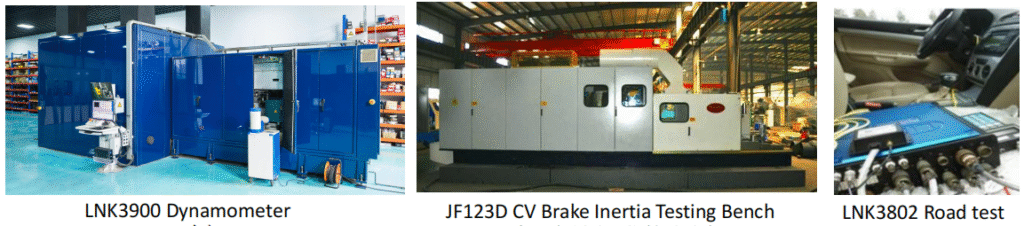
A supplier who can only quote you “one ceramic and one semi-metallic” off the shelf isn’t a development partner. They’re a reseller. Look for manufacturers running their own R&D team — typically with formulation specialists, friction physicists, and dedicated tribology testing. Below are some of the brake pad formulation testing and validation equipment used in the Tuoba brake pad production workshop and R&D process, including dynamometer testing, inertia brake testing, and real-road validation systems.
Certification and Compliance
Certifications matter, but you have to read them correctly. Certifications confirm that at the moment of testing, a product met a standard. They do not, on their own, prove that every batch over the next three years will meet that same standard. Combine certifications with traceability requirements (see below).
The four certifications most relevant for global buyers:
- ECE R90 — the European homologation that requires aftermarket pads to perform within ±15% of OE friction behavior. Required across the EU and adopted in many other markets including Egypt, Malaysia, UAE, Colombia, South Africa, and New Zealand.
- FMVSS 135 — the U.S. vehicle-level brake performance standard. Note: U.S. regulation works differently from Europe — there’s no mandatory replacement-part certificate equivalent to R90, so buyers must look for evidence of OEM-compatibility testing.
- SAE J2521 — noise testing protocol (NVH dynamometer testing).
- SAE J2522 (AK Master) — the friction characterization test most widely used to compare brake pads across manufacturers.
Beyond product-level certifications, also check system-level certifications — IATF 16949 for automotive quality management is the baseline expectation for any serious supplier, and AMECA registration adds North American credibility.
The right question to ask isn’t “do you have ECE R90?” — most credible manufacturers do. The better question is: “Can I see the dynamometer test report for the specific part number I’m buying, dated within the last 12 months?” That’s the answer that separates real compliance from a certificate on a wall.
Because in practice, long-term brake pad consistency is not determined by certification alone. It depends on whether the manufacturer maintains a complete validation system behind the product — including ongoing testing, formulation verification, process control, and traceable quality management throughout production.
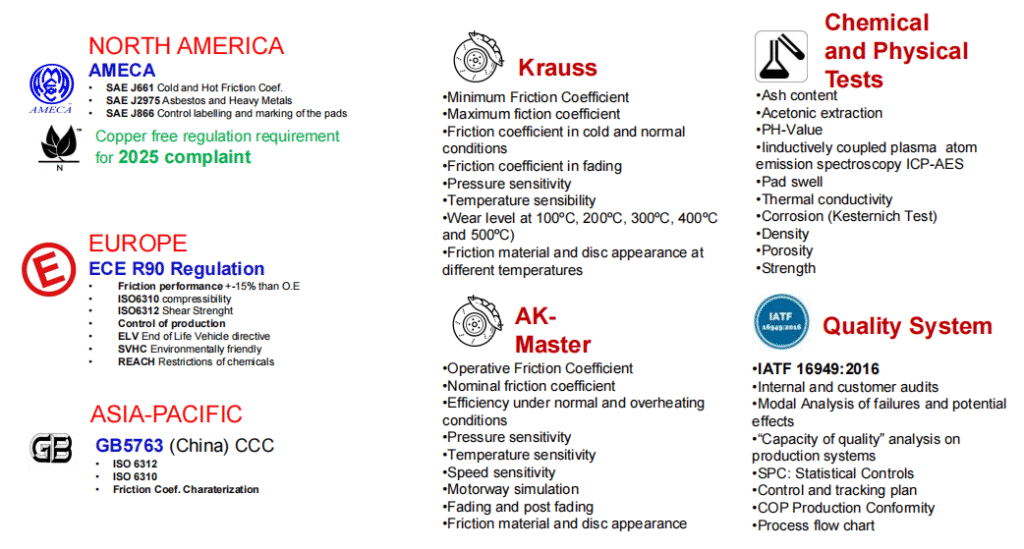
At Tuoba, certification and validation are integrated into both product development and production control. Beyond meeting regional regulatory requirements, our brake pad programs are supported by dynamometer testing, friction characterization, chemical and physical analysis, and automotive quality management systems used for global aftermarket and commercial vehicle applications. Below are some of the standards, testing methods, and quality systems referenced throughout the Tuoba brake pad validation process.
Application-Based Validation
Even a well-certified pad can fail in the wrong application. Application matching is where many sourcing decisions silently go wrong, because the certification looks fine on paper but the real-world conditions don’t match the test profile.
Evaluate whether the manufacturer has documented validation for:
- Mountain driving — sustained downhill braking, where thermal fade and pad-rotor compatibility under cyclic high temperatures become critical.
- High-temperature environments — Middle Eastern, Australian, or African operating climates where ambient temperatures alone push pads near their working limit.
- Heavy-load and towing applications — commercial fleets, recreational towing, and pickup truck duty cycles.
- Fleet operations — where predictable wear is more valuable than maximum braking torque, because predictability is what fleet maintenance schedules are built on.
The right question here: “Has this specific compound been validated on a vehicle and duty cycle that resembles mine?” If the supplier has only validated on flat-road passenger driving but you’re selling to mountain-region fleet operators, you have a mismatch — regardless of how clean the dynamometer report looks.
China Brake Pad Manufacturers: What Global Buyers Should Know
China is now an important part of the global brake pad supply chain, covering everything from raw materials and backing plates to friction material development, finished brake pads, packaging, and export support. For international buyers, however, the useful question is no longer simply whether a product is made in China. It is what type of manufacturer is behind it.
A factory producing standard aftermarket references for price-sensitive markets may operate very differently from a manufacturer supporting OEM, fleet, or private-label programs. Buyers should therefore compare formulation capability, testing, traceability, application support, and repeat-order consistency rather than treating all China brake pad manufacturers as the same type of supplier.
The Chinese manufacturing base has matured in several measurable ways:
- Complete supply chain integration — raw materials, backing plates, friction compounds, shims, and packaging are available within concentrated manufacturing clusters, helping shorten lead times and simplify supply-chain coordination.
- Raw material access — China has an established friction-material supply base, giving brake pad manufacturers access to a broad range of materials and supporting more flexible formulation development.
- Cost and supply-chain efficiency — concentrated manufacturing clusters can reduce sourcing, transportation, tooling, and coordination costs, allowing established manufacturers to compete on both price and production efficiency.
- Tooling and mold development — fast new-part introduction is increasingly important as vehicle applications continue to expand, particularly for EVs and new-energy commercial vehicles. Local tooling capability can shorten the development cycle for new references.
- OEM experience — established manufacturers with OEM experience generally work under tighter requirements for process control, testing, documentation, and product consistency, capabilities that can also support aftermarket and private-label programs.
- Export-ready operations — experienced export manufacturers are more familiar with certification requirements, product documentation, packaging, labeling, and the practical requirements of supplying overseas distributors.
The bigger difference today is often found within the Chinese supplier base itself. A small workshop relying heavily on outsourced friction materials operates very differently from an established China brake pad manufacturer with in-house R&D, controlled production, testing capability, and batch traceability. For buyers, understanding that difference is far more useful than judging a supplier by country of origin alone.
Common Mistakes When Comparing Brake Pad Manufacturers
Even experienced buyers can make the wrong comparison when several suppliers appear similar on paper. The problem is usually not a lack of information, but giving too much weight to the easiest things to compare—price, certificates, brand recognition—and too little attention to what happens after the product enters the market.
Comparing on Price Alone
A lower unit price can look attractive during quotation comparison, but the real cost of a brake pad shows up after installation. Wear rate, noise complaints, returns, warranty handling, rotor interaction, and replacement frequency can quickly outweigh a small saving at purchase.
For distributors and fleet buyers, a better comparison is cost per usable service life, not simply cost per set. If two products are priced differently, ask what is behind that difference: friction material, accessories, testing, process control, packaging, or simply supplier margin. The cheapest quotation is useful only if the product can still meet the performance and service expectations of the target market.
Treating Certifications as a Finish Line
Certificates are useful because they show that a manufacturer or product has met a defined requirement, but they should not replace supplier evaluation. A certificate does not tell you whether the next production batch will match the sample you approved, whether raw-material changes are controlled, or how a quality issue will be investigated six months later.
Professional buyers should therefore look beyond whether a certificate exists and ask how it is supported in daily production. Batch records, traceability, incoming-material control, process inspection, testing capability, and change-management procedures usually tell you much more about long-term consistency.
Sourcing by Brand Alone
Brand recognition still has value. Established brake brands can bring market trust, broad application coverage, technical support, and easier sell-through. But a familiar name does not automatically make it the best sourcing model for every distributor, fleet, or private-label program.
The more useful comparison is what sits behind the product. Who controls the formulation? Who manufactures it? How is quality checked? Can the supplier support different market requirements or future references? Buyers with strong local channels may find that a direct manufacturer gives them more control over specification, branding, and margin, while branded products may still make sense in other parts of the range.
Ignoring Real-World Application Matching
A brake pad can perform well in one operating environment and disappoint in another. Vehicle load, road gradient, ambient temperature, traffic conditions, braking frequency, and customer expectations all influence how a product is experienced in service.
This is especially important for buyers selling across several regions. A formulation chosen mainly for low noise in urban passenger-car use may not be the best choice for heavily loaded commercial vehicles or repeated downhill braking. Sample evaluation should therefore reflect the actual vehicles and duty cycles the product will serve, rather than relying only on a general material label or catalog specification.
Overlooking After-Sales Support
Supplier capability becomes much easier to judge when something goes wrong. A noise complaint, abnormal wear issue, packaging problem, or application mismatch needs more than a quick replacement—it needs someone who can help identify the cause and stop the same problem from repeating.
Before placing volume orders, buyers should understand how complaints are handled, what information the manufacturer will request, whether the affected batch can be traced, how technical feedback is provided, and what corrective action looks like. A supplier that can investigate a problem and improve the process is much more valuable than one that only responds when the next order is being discussed.
These mistakes all come back to the same point: supplier evaluation should focus on the system behind the product, not only the product in front of you. Price, brand, certificates, and samples are useful filters, but long-term sourcing quality is determined by consistency, application fit, traceability, problem-solving, and the supplier’s ability to keep supporting the program as it grows.
How to Choose the Right Brake Pad Manufacturer for Your Business
Different buyer types prioritize different things. Use this as a quick orientation:
- Distributors need breadth of fitment, predictable margin, MAP discipline, and a credible warranty story. The right supplier here is one with a broad part number range, stable pricing, and platform-ready packaging.
- Fleet operators prioritize predictability over peak performance. The right pad is the one that wears at a known rate, lasts through a known maintenance window, and never produces an off-cycle failure. This is why many commercial vehicle operators place greater emphasis on long-term consistency when selecting fleet brake pads. Friction torque consistency matters more than friction torque peak.
- E-commerce sellers live and die by return rates, review scores, and fitment accuracy. Their right supplier provides complete vehicle fitment data, marketing-ready assets, and a return rate measurably below the platform average.
- Private-label brand owners need a manufacturer who supports formula tuning, branded packaging, scalable MOQ, and a long enough relationship to grow brand equity without re-tooling every two years.
- OEM and tier-one buyers need engineering capability, full traceability, PPAP-grade documentation, IATF 16949 quality discipline, and the ability to support new-vehicle programs from sample through serial production.
Across all five buyer types, the same three priorities keep recurring: matching market demand, balancing cost and performance, and ensuring batch-to-batch consistency. The brand on the box is far less important than whether the supplier behind it delivers on those three priorities, month after month, year after year.
Conclusion
Choosing a brake pad manufacturer is ultimately a supply-chain decision, not a popularity contest. Established global brands remain important benchmarks, but professional buyers also need to look behind the label at the manufacturer’s production capability, formulation eChoosing a brake pad manufacturer is ultimately a supply-chain decision, not a popularity contest. Established global brands remain useful benchmarks, but professional buyers also need to look behind the label at production capability, formulation experience, testing, traceability, application support, and the ability to maintain the same standard across repeat orders.
For distributors, fleets, private-label brands, and OEM buyers, four areas deserve particular attention:
- Consistency — can the approved specification be maintained from samples through repeat production?
- Traceability — can a quality issue be traced back to a specific production batch?
- Application matching — is the friction material suited to the vehicle, operating conditions, and target market?
- Supply reliability — can the manufacturer support growing volumes and additional references without disrupting delivery?
These factors have a direct impact on warranty claims, customer complaints, inventory planning, and repeat business. A familiar brand name may help sell the product, but it does not replace the need to understand how the product is manufactured and controlled.
China has also become an important part of the global brake pad supply chain, giving buyers more options beyond traditional branded suppliers. For sourcing teams, the more useful question is therefore not simply “Which brand should we buy?” but “Which brake pad manufacturer can support the product, quality, volume, and market requirements of our business over the long term?”
Looking for a Brake Pad Manufacturer for OEM or Private Label Production?
Tuoba supports distributors, fleet programs, aftermarket brands, and OEM customers with brake pad manufacturing, formulation development, testing, and private-label production for passenger and commercial vehicle applications.
If you are evaluating a new brake pad supplier, share your OE/FMSI/WVA references, target market, application, and expected volume with our team. We can discuss the product specification before moving to samples and quotation.