Bus Types, Brake Systems and Brand Applications
Before selecting bus brake pads, buyers must identify the bus type and braking system. City buses operate under frequent stop-and-go conditions, so their pads must manage repeated thermal cycles while maintaining stable friction, controlled noise and acceptable wear. Coaches operate at higher speeds and can experience sustained braking on mountain descents, making high-temperature stability and fade resistance particularly important. School buses require predictable cold response, wet recovery and balanced braking, while minibuses such as Toyota Coaster, Nissan Civilian and Mitsubishi Rosa may use hydraulic systems that differ significantly from the air brakes found on full-size buses.
Many full-size buses use air disc or air drum brakes. In an air disc system, compressed air activates the brake chamber and caliper, which clamps the pads against the rotor. In an air drum system, the brake shoes and linings are forced against the inner surface of the drum. Smaller buses may use hydraulic disc or drum brakes. A buyer searching for “brakes for a bus” may therefore need disc brake pads, drum brake linings, complete brake shoes, hardware kits, rotors or drums.
For a more focused technical comparison, see the guide to the differences between bus and truck brake pads.
| Application keyword | Information that must be confirmed |
|---|---|
| Yutong bus brake pads | Model, year, axle, OE number, caliper and operating route |
| Volvo bus brake pads | Chassis, axle designation, caliper and pad reference |
| Prevost bus brake pads | Coach model, axle, brake system and route |
| Toyota Coaster bus brake pads | Vehicle generation, market, axle and OE number |
| Nissan Civilian bus brake pads | Model code, year, axle and hydraulic brake configuration |
| Mitsubishi Rosa bus brake pads | Model generation, axle and OE or cross-reference number |
| VW bus brake pads | Exact Volkswagen vehicle or TRATON application |
| Bendix bus brake pads | Bendix caliper or friction reference |
| Bosch brake pads | Bosch reference and compatible vehicle application |
Bosch and Bendix are brake product or system brands rather than bus manufacturers. Their references can help with cross-matching, but the buyer should still confirm the exact vehicle and axle. The phrase “VW bus brake pads” is also ambiguous because it may refer to a Volkswagen Transporter, mi
Global bus demand is entering a new growth cycle. Public transport authorities are replacing aging fleets, emerging economies are expanding urban and intercity transportation networks, and electric buses are becoming increasingly common in China, Europe, India and Latin America. This development is also reshaping demand for bus brake pads, brake linings, brake shoes and other maintenance parts. Every new bus added to a fleet creates a long-term requirement for replacement friction products, while older diesel, CNG and hybrid buses will continue to need maintenance during the transition to electric transportation.
Sourcing the correct bus brake pad is becoming more complex at the same time. A brake pad designed for a Yutong electric city bus may not be suitable for a Volvo coach, Prevost motorcoach, Toyota Coaster, Nissan Civilian, Mitsubishi Rosa or North American school bus. Vehicle brand alone is not enough to identify the correct product. Buyers must also consider the model year, front or rear axle, caliper, pad geometry, vehicle load, route, climate and certification requirements.
This guide examines the 2026 bus market, regional demand, bus brake pad materials, certifications, service life, common purchasing problems and the criteria buyers should use when evaluating an OEM bus brake pad manufacturer.
Bus Brake Pad Materials by Duty Cycle and Region
Bus brake pad material should be selected according to required performance rather than marketing labels alone. A ceramic, semi-metallic or low-metallic description does not guarantee suitability for a specific bus. Two pads within the same material family can have very different friction stability, wear, compressibility, noise and rotor impact.
Low-metallic and low-metallic NAO formulations can provide strong friction response, heat dissipation and controlled NVH, making them suitable for many transit applications. Semi-metallic formulations generally offer strong thermal conductivity and fade resistance, although noise and rotor wear must be controlled. NAO and organic formulations can provide quieter operation and lower rotor aggressiveness, but their suitability depends on temperature, axle load and duty cycle. Ceramic and low-copper formulations can reduce dust and certain regulated substances, but a passenger-car ceramic formula should never be assumed to meet commercial bus requirements.
For a detailed explanation of how formulation affects braking behavior, see Tuoba’s guide to brake pad technology and testing.
| Application or region | Main operating challenge | Required performance direction |
|---|---|---|
| Urban transit buses | Frequent braking and passenger comfort | Cycle consistency, controlled NVH and balanced wear |
| Electric city buses | Intermittent friction-brake use | Cold response, corrosion control and emergency braking |
| Coaches and mountain routes | Sustained high-temperature braking | Fade resistance and stable hot friction |
| School buses | Cold starts, wet roads and predictable response | Cold bite, wet recovery and balanced braking |
| Middle East and Africa | Heat, dust and heavy loads | Thermal stability, bonding strength and durability |
| Northern Europe and Canada | Cold, moisture and road salt | Low-temperature friction and backing-plate corrosion protection |
| Southeast Asia | Heat, humidity and congestion | Wet recovery, heat-cycle stability and corrosion resistance |
| Latin American mountain routes | Heavy loads, grades and changing climates | High-temperature stability and consistent recovery |
| Coaster, Civilian and Rosa minibuses | Different hydraulic systems and axle loads | OE-matched formulation and geometry |
Material performance also depends on backing-plate quality, adhesive application, pressing, curing and the mating rotor. Tuoba’s brake pad manufacturing process explains how these elements are controlled during production.
Bus Brake Pad Certifications and Compliance
Quality systems, product approvals, vehicle regulations and laboratory test reports are not the same. Buyers should understand what each document proves and confirm that its scope matches the actual product.
| Requirement | Type | Main relevance |
|---|---|---|
| ECE R90 / E-mark | Replacement component type approval | Europe and markets adopting UN regulations |
| FMVSS 121 | Vehicle and air-brake system regulation | Air-braked buses in the United States |
| SAE J661 | Friction material test and classification | North American friction edge codes |
| SAE J2975 | Material content test | Copper and regulated substance reporting |
| GB 5763-2018 | Brake lining product standard | Chinese market |
| ADR 35/07 | Commercial vehicle braking regulation | Australian large passenger and commercial vehicles |
| IATF 16949 | Automotive quality management system | OEM process and supply-chain control |
| ISO 9001/14001/45001 | Management systems | Quality, environmental and workplace controls |
UN Regulation No. 90 covers applicable replacement brake lining assemblies, drum brake linings, discs and drums. Buyers should confirm the actual product family covered by the approval. An E-mark displayed on an unrelated passenger-car pad does not prove approval for a commercial bus application.
In the United States, FMVSS No. 121 establishes vehicle and air-brake system requirements. It is not a standalone certificate independently awarded to every aftermarket pad. Buyers may also request SAE J661 friction data, edge-code information and SAE J2975 material reports. The AMECA laboratory listing identifies laboratories that conduct relevant friction and material testing.
Some US states also regulate copper and other substances in friction materials. Washington’s Better Brakes requirements require applicable pads and shoes manufactured after January 1, 2025, to contain less than 0.5% copper by weight.
China applies GB 5763-2018, Brake Linings for Automobiles, while Australia uses ADR 35 commercial vehicle brake requirements for applicable commercial and large passenger vehicles. As with FMVSS 121, ADR 35 is principally a vehicle-level braking requirement rather than a simple standalone pad certificate.
A more detailed comparison is available in Tuoba’s guide to brake pad certifications and market requirements.
Bus Brake Pad Service Life and Replacement
There is no universal mileage for bus brake pads. Service life depends on vehicle mass, passenger load, axle balance, daily braking frequency, city or mountain operation, driving behavior, regenerative braking strategy, caliper condition, rotor condition, formulation and maintenance.
A city bus completing hundreds of daily stops may wear pads faster than a coach travelling mainly on flat highways. A mountain coach, however, can expose its pads to more severe high-temperature events even if it brakes less frequently. Electric buses may achieve longer pad intervals where regenerative braking is used extensively, but corrosion, uneven wear and caliper drag can still require replacement before the friction material reaches its theoretical wear limit.
Fleet operators should measure actual thickness and wear rate rather than rely only on generic mileage:
Estimated remaining distance = Remaining usable friction thickness ÷ Average wear per kilometre
The original thickness, required replacement limit and measurements at consistent maintenance intervals should be recorded. Comparing wear per 10,000 km across vehicles, routes and axles makes it easier to detect abnormal wear before it becomes a failure.
In the United States, 49 CFR §393.47 specifies that air disc brake pads must not be below 3.2 mm, while hydraulic disc and drum linings must not be below 1.6 mm. Air drum brake lining limits vary according to axle and lining configuration. If the vehicle or brake-system manufacturer specifies an earlier replacement point, the more conservative limit should be followed.
Common Purchasing Problems and Correct Product Selection
The most common purchasing problem is incorrect identification. A model name may cover several axles, calipers and production years, so ordering only by “Volvo bus brake pads” or “Yutong bus brake pads” can result in the wrong geometry or thickness. Certificates can also be misleading when the document covers a different model or formulation from the supplied product.
Other common problems include inconsistent friction between batches, premature wear, excessive noise, rotor damage, incomplete repair kits and long lead times. Some buyers focus only on bus brake pads price, but the lowest unit price may result in higher labor cost, rotor replacement, downtime and customer complaints. Cost per kilometre and total maintenance cost are more useful than purchase price alone.
For an accurate quotation, buyers should provide:
- Bus manufacturer and exact model
- Production year
- Front or rear axle
- OE, WVA or FMSI reference
- Caliper manufacturer and model
- Pad dimensions and clear photographs
- Vehicle load and route conditions
- Destination market and certification requirements
- Annual purchase quantity
- Packaging and private-label requirements
If the part number is unavailable, a dimensional drawing or physical sample can normally help confirm the application. Buyers should then evaluate fitment, route suitability, regulatory documentation, testing evidence and the supplier’s ability to maintain the same formulation over long-term production.
How to Choose a Bus Brake Pad Manufacturer
A reliable manufacturer should provide more than a catalogue and quotation. It should be able to identify applications from OE references, caliper information, drawings or samples and explain how the selected friction formulation fits the intended vehicle load, operating route and climate.
Buyers should also examine friction-material development, in-house testing, raw-material control, batch traceability and production change management. For OEM projects, the supplier should support processes such as APQP, PPAP, drawing control, sample approval, packaging development and corrective action. At Tuoba, we support OEM and private-label bus brake pad production, including custom logos on backing plates, shims, labels and packaging. The factory video below shows our team printing a customer’s logo on newly manufactured disc brake pads.
Custom logo printing on newly manufactured disc brake pads during the Tuoba OEM production process.
Certificates and test reports must be connected to the supplied part number, friction formulation and product configuration. A folder containing unrelated documents does not demonstrate that the product being purchased complies with the required standard. Buyers should therefore confirm the applicable part number, test standard, friction grade and report configuration before approving an order.
Long-term production capacity, delivery planning and technical response are equally important. Fleet operators, distributors and private-label brands cannot tolerate unannounced formulation changes, inconsistent batches or prolonged stock shortages. A qualified manufacturer should maintain controlled production records, lot-level traceability and a clear process for handling technical feedback and corrective actions.
For additional factory-audit questions, read Tuoba’s guide to evaluating a brake pad production line, developed for OEM, fleet and distributor buyers.
Tuoba’s Yutong Bus Brake Pad Experience
Tuoba has manufactured brake pads for Yutong bus applications, giving our team practical experience with the matching and production requirements associated with one of the world’s largest bus manufacturers. The most important lesson from this work is that “Yutong bus brake pads” do not represent one universal part.
Different Yutong city buses, coaches and electric buses can use different axles, calipers, pad geometries and friction requirements. Before recommending a product, our team confirms the vehicle model, operating market, OE or cross-reference number, axle, caliper, dimensions, route and climate rather than relying only on the Yutong brand name.
For a typical Yutong bus brake pad project, the process includes application confirmation, dimensional comparison, friction formulation selection, sample preparation, performance validation, packaging confirmation and controlled batch production. City bus applications usually place particular importance on repeated-braking consistency, heat recovery, noise and balanced wear. Electric Yutong buses also require consideration of regenerative braking because lower routine friction use can affect corrosion, cold response and pad surface condition.
This experience strengthens Tuoba’s ability to support international distributors sourcing replacement parts for Chinese buses. It also demonstrates why a responsible manufacturer should request technical details before giving a formal quotation. A supplier offering one generic pad for every Yutong bus is ignoring important differences between models and brake systems.
Global Bus Market Outlook for 2026–2030
According to the Global Buses industry study published by Freedonia, global bus demand exceeded 582,000 units in 2025 and is forecast to reach approximately 724,000 units by 2030, representing average annual growth of nearly 4.5%. Market expansion will be supported by public and private transport operators replacing aging fleets, governments investing in urban and intercity transportation, increasing tourism activity, growing private employee and airport transportation services, and the continued development of electric buses and charging infrastructure.
Asia Pacific, led by China and India, is expected to account for nearly two-thirds of new global bus demand between 2025 and 2030. The region combines large urban populations, growing public transport use, strong domestic manufacturing capacity and government fleet-renewal programs. Electric bus sales in Asia Pacific are projected to increase by nearly 11% per year from an already high 2025 base, supported by subsidies, public procurement and investment in charging infrastructure across China, India, Japan and other Asian countries.
Global electric bus sales are expected to increase by nearly 12% per year through 2030. Transit buses should record stronger growth than motorcoaches because they operate on predictable routes, return to centralized depots and are frequently purchased through public tenders. City governments can therefore accelerate adoption through procurement targets, subsidies and charging investments more easily than private long-distance operators.
Electric buses still depend on friction brakes. Regenerative braking can reduce brake pad use during normal deceleration, but conventional brake pads must remain capable of reliable braking during emergencies, low-adhesion conditions, low battery states and situations in which regenerative braking is unavailable. Reduced friction-brake use can also introduce other maintenance concerns, including disc corrosion, uneven pad contact and surface glazing. Electric bus brake pads therefore need to balance wear, cold response, corrosion resistance and emergency braking performance rather than focusing only on longer service life.
The growth of the transit segment also affects material selection. A city bus may complete hundreds of braking events during a shift, generating repeated heating and cooling cycles. A long-distance coach may brake less frequently but experience sustained high temperatures on mountain descents. For this reason, the best bus brake pads are not defined by one universal material; they are defined by how well the formulation matches the vehicle and its actual operating conditions.
European Bus Sales Increased 22.7% in H1 2026
According to the European Automobile Manufacturers’ Association’s H1 2026 report, new EU bus registrations increased by 22.7% to 22,590 units. Bus registrations grew faster than both vans and trucks during the period. Italy recorded growth of 51.6%, Germany and France both increased by 21.6%, and Poland grew by 78%, becoming the EU’s fourth-largest bus market. Spain was the only major market to contract, falling by 8.5%.
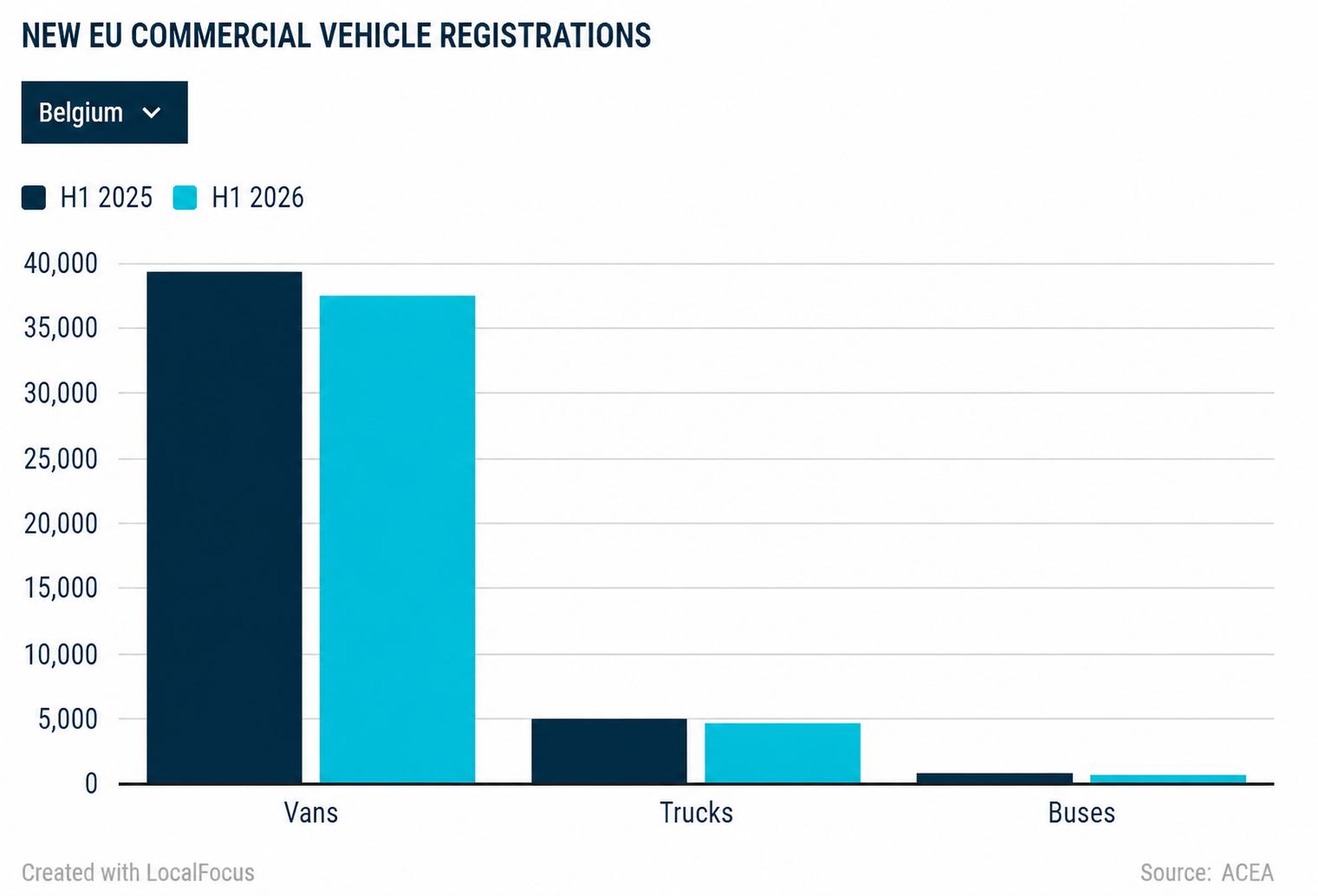
Figure 1. New commercial vehicle registrations in Belgium by vehicle type, H1 2025 vs. H1 2026. Source: ACEA; chart created with LocalFocus.
Electrically chargeable bus registrations increased by 56.8% in the first half of 2026, raising their market share from 21.6% to 27.7%. Nevertheless, Europe continues to operate a mixed fleet. Diesel bus registrations increased by 11% and still represented 58.2% of the market, while hybrid-electric buses increased by 10.7% and accounted for 6.1%.
These figures demonstrate why a bus brake pad supplier should not focus exclusively on electric models. Diesel, hybrid and electric buses will continue operating together for many years, creating demand for a broad range of commercial vehicle brake pads. European buyers must also consider low-temperature response, wet recovery, noise, backing-plate corrosion and regulatory approval. For replacement products within its scope, UN Regulation No. 90 is a central part of the European compliance framework.
Electric Bus Demand by Region
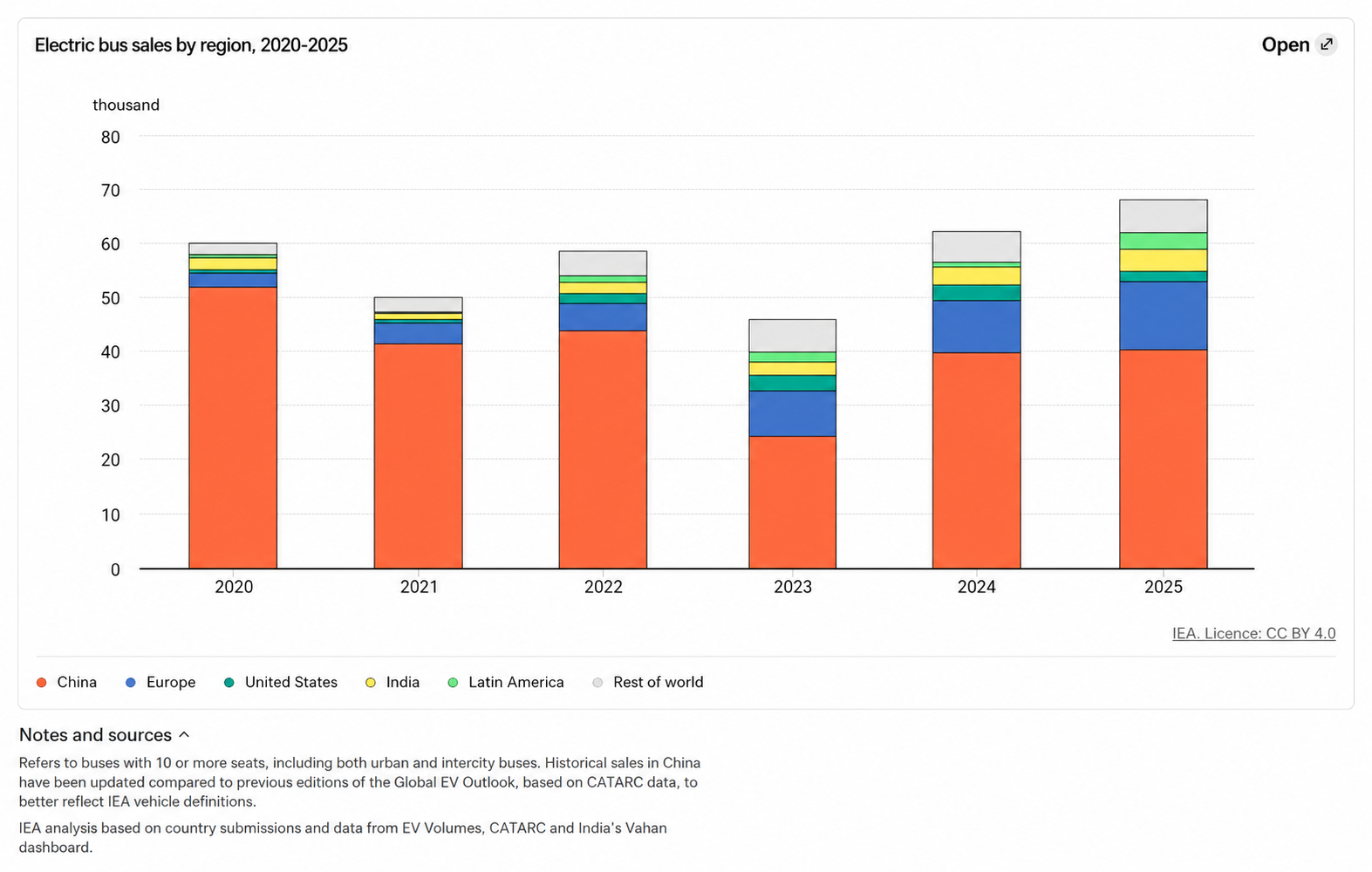
The IEA Global EV Outlook 2026 reports that global electric bus sales reached almost 70,000 units in 2025, an increase of 12% from 2024. Battery-electric powertrains represented approximately 98% of electric bus sales, supported by public procurement, subsidies, lower battery costs and the expansion of depot charging infrastructure.
| Region | 2025 market development | Relevance to bus brake pad demand |
|---|---|---|
| China | Around 60% of global electric bus sales; electric buses exceeded 60% of national bus sales | Growing demand from both new vehicles and first-generation electric bus replacement cycles |
| Europe | More than 12,000 electric buses sold, up 28% | Stronger demand for approved, low-noise and corrosion-resistant replacement pads |
| India | Electric bus sales exceeded 4,000 for the first time | Large public tenders require stable supply and consistent batch quality |
| Latin America | Sales exceeded 3,000 and more than tripled year on year | Chinese bus growth creates opportunities for imported replacement parts |
| Chile | Nearly 2,000 electric buses sold | Expansion of city fleets increases long-term maintenance demand |
| Brazil | Around 850 electric buses sold | Local assembly and imported component supply will operate together |
| United States | Electric bus sales fell around 40% | Diesel, CNG, hybrid and school bus fleets remain important aftermarket segments |
China remains the largest electric bus market, although its share of global sales declined from almost 100% in 2018 to around 60% in 2025 as other regions expanded. Electric buses represented more than 60% of total Chinese bus sales, while new city bus sales were almost entirely electric. The intercity coach segment is transitioning more slowly because longer routes require more range and more complex charging arrangements. Zero-emission vehicles represented only around 10% of Chinese coach sales in 2025.
Europe is the second-largest electric bus market. More than 12,000 electric buses were sold in 2025, approximately 28% more than in 2024. Battery-electric city buses accounted for over 55% of new EU city bus sales, compared with around 45% one year earlier. Electric buses represented more than 60% of new bus sales in Norway, around 30% in the United Kingdom and more than 25% in Germany. However, delays in charging infrastructure and vehicle delivery in markets such as Ireland and the Netherlands demonstrate that electric fleet expansion does not always progress smoothly.
India remained the third-largest electric bus market in 2025. Its PM E-DRIVE program aims to deploy up to 14,000 electric buses between 2024 and 2026, while PM-eBus SEWA supports the deployment of more than 38,000 electric buses through a payment-security mechanism. High ambient temperatures, passenger loads, congestion and dust make formulation selection especially important for the Indian market.
Latin American electric bus sales exceeded 3,000 units in 2025, more than three times the previous year. Chile recorded nearly 2,000 electric bus sales, representing more than one-fifth of national bus sales, while Brazil recorded approximately 850 units. Argentina plans to require newly procured buses to use electric or CNG power beginning in 2027, and Colombia is expanding electric bus assembly through partnerships with manufacturers including BYD and Hino. As Chinese buses become more common in the region, local distributors will need reliable access to corresponding bus brake pads, brake linings and brake shoes.
The United States followed a different path, with electric bus sales declining by approximately 40% in 2025. However, the American bus brake market remains significant because of the large installed population of school buses, transit buses, motorcoaches and CNG vehicles. North American distributors therefore need to cover school bus brake pads, air disc brake pads, hydraulic bus brake pads, bus brake linings and complete brake shoes rather than concentrating on only one powertrain.
Major Bus Manufacturers and Model Availability
The global bus manufacturing industry is relatively concentrated. Freedonia estimates that the 12 largest suppliers accounted for approximately half of worldwide bus product sales in 2025. Major manufacturers include Ashok Leyland, Daimler, King Long, Tata Motors, Volkswagen through TRATON Group and Yutong.
| Manufacturer or group | 2025 bus sales or deliveries | Source |
|---|---|---|
| Yutong Bus | 49,518 vehicles, +5.54% | Yutong 2025 business update |
| TRATON Group bus operations | 34,359 units, +21% | TRATON 2025 key figures |
| Daimler Buses | 26,991 units | Daimler Truck 2025 unit sales |
| Volvo Buses | 6,005 deliveries, including 511 fully electric buses | Volvo Group full-year 2025 report |
Model-level sales for Toyota Coaster, Nissan Civilian and Mitsubishi Rosa are not normally disclosed separately in global financial reports. These vehicles are better covered through model applications and part-matching information rather than unsupported sales estimates.
The IEA counted approximately 800 battery-electric heavy-duty vehicle models worldwide in 2025, an increase of only six models from the previous year. More than 130 models were discontinued during 2024 and 2025 as manufacturers consolidated platforms and several smaller companies exited the market. China offered almost 450 battery-electric heavy-duty models, approximately half of which were buses. Europe had close to 150 models, while North American model availability remained above 130 but had declined from its 2022 peak.
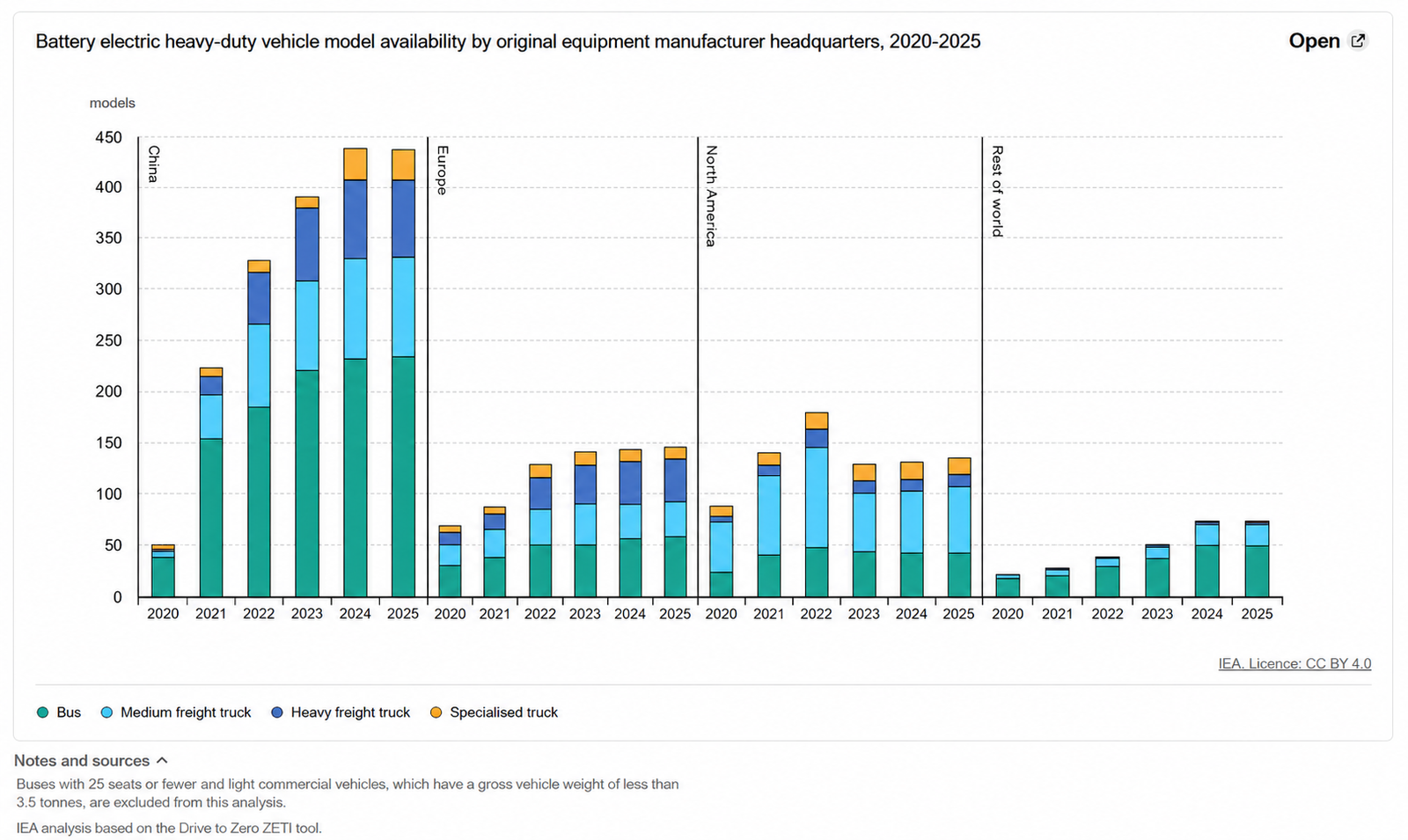
Figure 3 . Battery-electric heavy-duty vehicle model availability by OEM headquarters, 2020–2025. China offered nearly 450 models in 2025, approximately half of which were buses. Europe had close to 150 models, while North America and the rest of the world had fewer available models. Source: IEA, Global EV Outlook 2026, based on the Drive to Zero ZETI tool, licensed under CC BY 4.0.
A larger number of vehicle platforms does not make replacement-part sourcing easier. Different production years, axles and calipers may use different brake pad geometries under the same bus brand or model. Discontinued buses may also remain in service for many years after production ends, creating continuing demand for older part numbers. Accurate cross-referencing, sample matching and long-term aftermarket support are therefore increasingly valuable.
Why Choose Tuoba for Bus Brake Pads?
Tuoba supports OEM, private-label and aftermarket projects for commercial vehicle friction products. Our capabilities include experience producing Yutong bus brake pads, application matching through OE/WVA/FMSI references and samples, multiple friction material formulations, self-owned dynamometer testing equipment, batch traceability, customized packaging and technical support for different climates and routes.
Tuoba has focused on brake components since 2006 and works with customers across OEM and international aftermarket channels. Our objective is not to offer one generic formulation for every market, but to match pad geometry, friction material and documentation to the vehicle’s actual operating requirements.
Buyers can learn more through our custom OEM brake pad solutions and comparison of OEM and private-label brake pad programs.
From Production to Export Shipment
Selecting the correct brake pad is only the beginning of a successful sourcing project. Reliable order execution also depends on controlled production, final quality inspection, accurate packaging and organized shipment preparation. For OEM and private-label orders, the packaging must follow the customer’s requirements for branding, labels, quantities and export protection.
After completing production and quality inspection, Tuoba packs each batch according to the confirmed order specifications and prepares it for delivery. The following video shows a real batch of finished disc brake pads being packed at the Tuoba warehouse and prepared for customer shipment.
Finished disc brake pads being packed according to customer requirements and prepared for shipment at the Tuoba warehouse.
Frequently Asked Questions
What kind of brakes do buses use?
Buses may use air disc, air drum, hydraulic disc or hydraulic drum brakes. Full-size transit buses and coaches frequently use air systems, while minibuses often use hydraulic brakes.
Do buses have air brakes?
Many large buses use air brakes because compressed-air systems are suitable for heavy vehicles and can support service, emergency and parking-brake functions. Smaller buses may use hydraulic systems.
How do bus brakes work?
A bus brake system converts vehicle motion into heat through friction. Disc brakes use calipers to clamp pads against rotors, while drum brakes push shoes and linings against the inside of the drum. Electric buses may also recover energy through regenerative braking.
How long do bus brakes last?
There is no fixed mileage. Service life depends on vehicle load, route, braking frequency, driver behavior, friction material, caliper condition and maintenance. Regular thickness measurement is more reliable than a general mileage estimate.
What are the best bus brake pads?
The best product is the one correctly matched to the vehicle, axle, braking system, operating route and destination-market requirements. No single formulation is best for every bus.
Are bus and truck brake pads the same?
Not necessarily. Some buses and trucks may share an axle or caliper platform, but their duty cycles and NVH requirements can differ. See our complete comparison of bus versus truck brake pads.
Are electric bus brake pads different?
They can be. Regenerative braking changes how frequently friction brakes operate, which can affect wear, corrosion and glazing. Exact selection still depends on the axle, caliper, load and manufacturer specification.
How do I identify the correct replacement bus brake pads?
Provide the bus brand, exact model, production year, axle, OE/WVA/FMSI number, caliper information, dimensions and photographs. Vehicle brand alone is insufficient.
Can Tuoba manufacture pads for Yutong, Volvo and Prevost buses?
Tuoba has experience producing brake pads for Yutong bus applications and can evaluate Yutong, Volvo, Prevost, Toyota Coaster, Nissan Civilian, Mitsubishi Rosa and other applications. Final availability must be confirmed using the exact vehicle and braking information.
What affects bus brake pads price?
Price depends on pad size, material formulation, accessories, testing, certification, quantity, packaging and shipping terms. B2B buyers should compare total operating cost and batch consistency rather than unit price alone.
Conclusion
From market growth and changing powertrains to application matching, material selection and final delivery, sourcing bus brake pads requires more than comparing product prices. Global bus demand is forecast to grow through 2030, led by the Asia-Pacific region, public fleet renewal and the expansion of electric transit buses. Europe is rapidly increasing electric bus registrations, India is expanding government procurement, and Latin America is becoming an important market for Chinese and international bus manufacturers. Meanwhile, diesel, hybrid, CNG and electric buses will continue operating together, creating demand for a wide range of bus brake pads, brake linings and brake shoes.
Successful sourcing begins with accurate application identification. Buyers should confirm the bus model, production year, axle, caliper, OE reference, operating route and destination-market requirements before comparing quotations. The selected product should then be connected to its friction formulation, test evidence, certification scope, production batch and quality-control records. Reliable packaging, order management and export preparation are equally important for ensuring that the correct products arrive safely and on schedule.
For a bus brake pad application review, please send Tuoba the bus brand and model, production year, OE/WVA/FMSI number, caliper information, dimensions or photographs, operating conditions, destination market, annual quantity and packaging requirements.
Contact Tuoba for a bus brake pad application review and OEM quotation, or click here to contact us via WhatsApp.